Daily Current Affairs & News Analysis
Our daily news analysis consists of two integral parts — Daily News Analysis and Important Editorials curated rigorously from The Hindu, The Indian Express, LiveMint, PIB, and Sansad TV debates. Content is mapped directly to UPSC CSE and State PCS syllabi.
India's Rice Economy: MSP, Food Security & UPSC
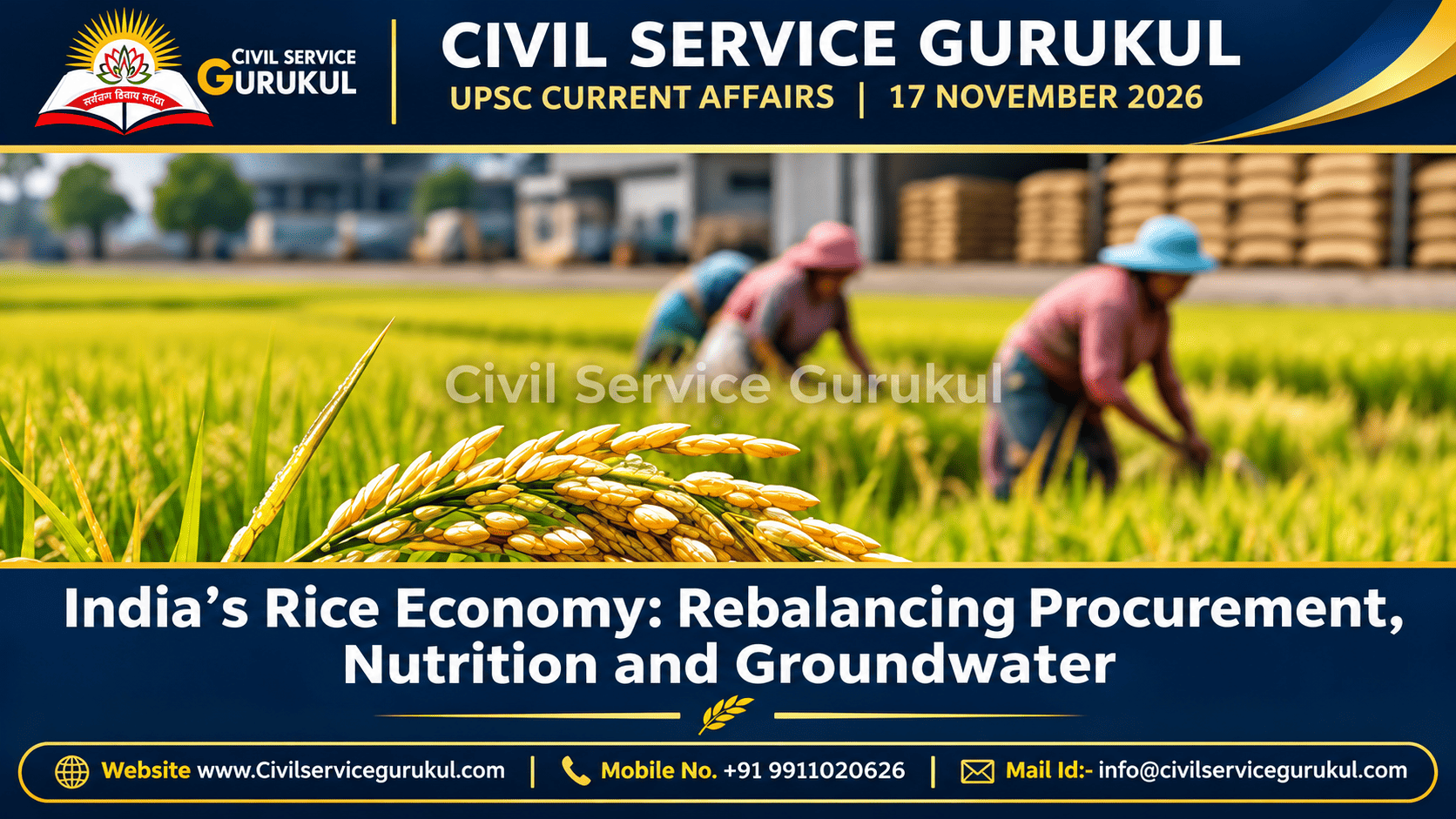
India's rice economy supports food security, farm incomes and the Public Distribution System, but it also presents significant challenges for groundwater sustainability and agricultural diversification. Minimum Support Price signals, assured procurement and state-level electricity subsidies influence farmers' cropping decisions. Meanwhile, rice cultivation's water footprint varies across agro-climatic regions, irrigation methods and crop varieties. This Civil Service Gurukul analysis examines the role of the Food Corporation of India, paddy procurement, nutritional security, groundwater stress and policy reforms needed to balance farmer welfare, environmental sustainability and diversified food systems.
Environmental Clearance & Ecological Baselines — UPSC
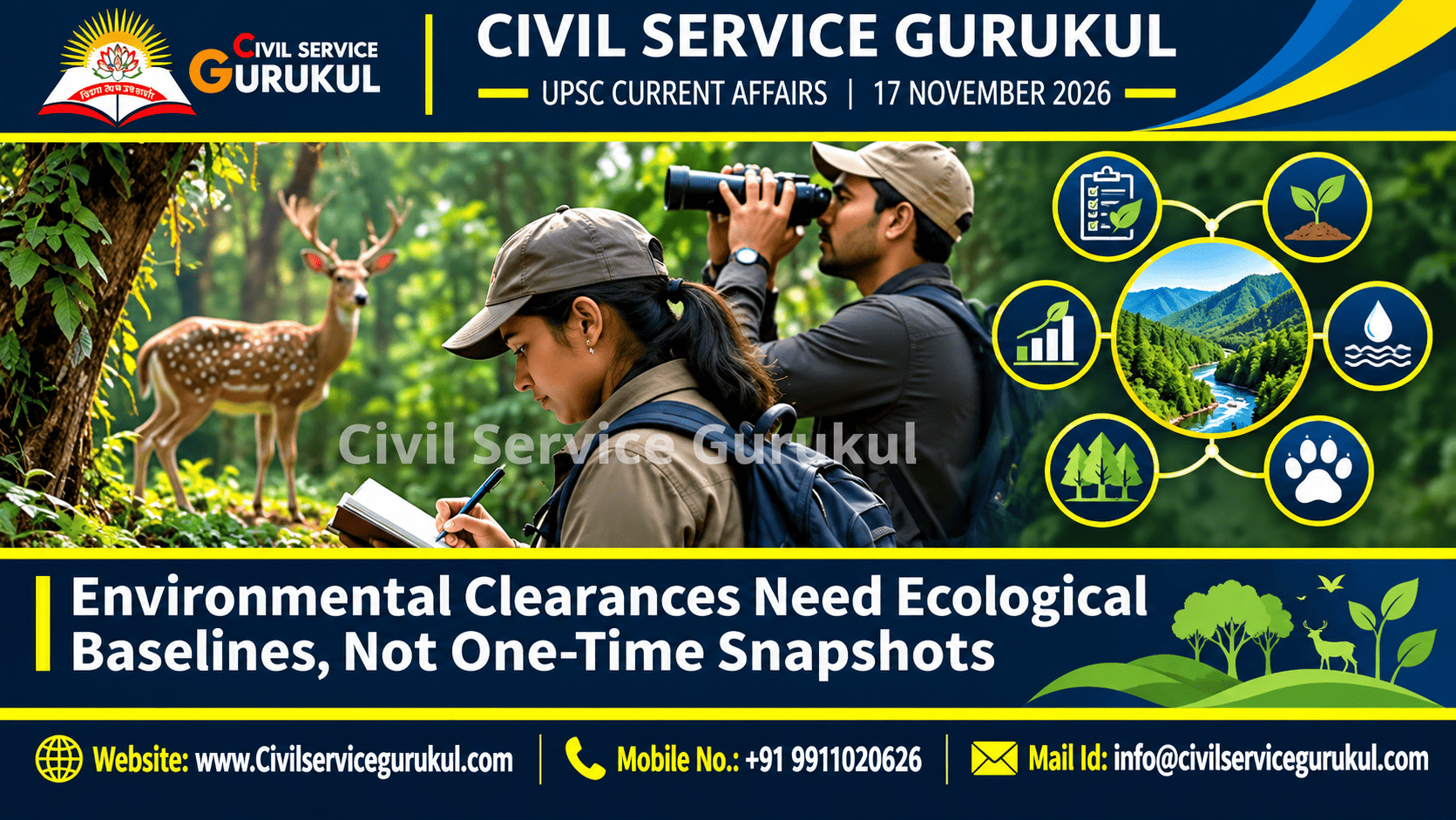
Environmental clearances are essential for balancing infrastructure development with ecological protection. However, environmental impact assessments based on short-duration or one-time surveys may fail to capture seasonal biodiversity, monsoon hydrology, groundwater stress and cumulative environmental impacts. The quality of baseline environmental data is therefore central to credible project appraisal. This Civil Service Gurukul analysis examines ecological baselines, environmental impact assessment, institutional accountability, independent scientific review, public participation and post-clearance monitoring, along with reforms needed to make environmental governance transparent, evidence-based and effective.
Census Religion Coding in India: UPSC 2026 Analysis
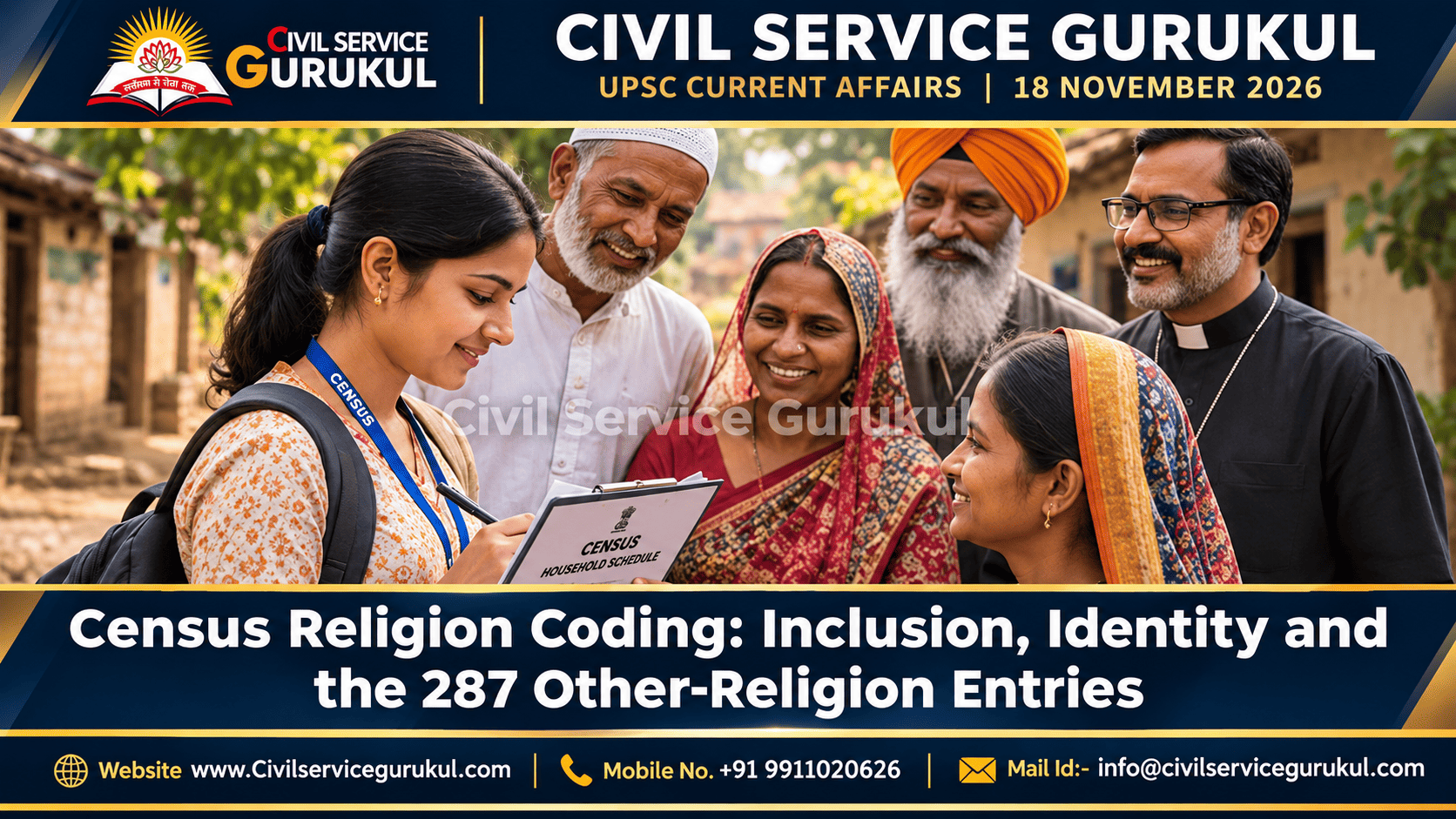
A November 2026 report concerning 287 “other” religion entries briefly appearing on a Census portal has renewed discussion about religious identity, statistical classification and the representation of smaller communities in India. The development raises important questions about self-identification, administrative coding, data reliability, minority visibility and the difference between provisional portal information and officially validated Census statistics. For UPSC aspirants, the issue connects directly with Indian Society, constitutional values, governance, ethics and social justice. This Civil Service Gurukul analysis examines the institutional context, opportunities and risks of religious enumeration, policy recommendations, Prelims practice questions and a structured GS Mains answer.
Onboard Satellite Computing: AI in Space UPSC 2026
Onboard satellite computing is emerging as an important approach to managing the enormous volume of data collected by Earth-observation satellites. Instead of transmitting every image and measurement to Earth for analysis, satellites equipped with suitable processors can filter, prioritise and analyse selected information directly in orbit. This can reduce unnecessary data transmission and improve the timeliness of applications such as disaster monitoring, environmental observation and maritime surveillance. However, onboard computing faces constraints involving power consumption, radiation, heat dissipation, processing capacity and algorithm reliability. This Civil Service Gurukul article explains satellite edge computing, its advantages over ground-based processing, relevance to India's space programme, technological challenges, ethical considerations and UPSC Prelims–Mains preparation.
WPI vs CPI Inflation October 2026: UPSC Analysis
India's October 2026 inflation data highlights an important divergence between wholesale and retail prices. According to the figures cited in the source article, Wholesale Price Index inflation reached 12.29%, compared with 11.39% in September, while Consumer Price Index inflation stood at 6.09%. The difference reflects the distinct coverage, weights and price transmission mechanisms of the two indices. Fuel and power, primary articles and manufactured products contributed to wholesale price pressures, raising questions about production costs, business margins, household purchasing power and monetary policy. This Civil Service Gurukul analysis explains WPI and CPI, the reasons for their divergence, implications for India's economy, inflation management strategies and important UPSC Prelims and Mains questions.

Foreign Portfolio Investment in India: UPSC 2026
A reported revival in foreign portfolio investment in November 2026, accompanied by selling by domestic market participants, highlights the complex relationship between capital flows, stock market performance and financial stability. Foreign portfolio investors can provide liquidity and support market development, but their investments are often more readily reversible than greenfield foreign direct investment. Global interest rates, exchange-rate expectations, valuations and risk sentiment can influence these flows. A temporary market rebound therefore does not necessarily indicate durable investor confidence or stronger domestic productive capacity. This Civil Service Gurukul analysis examines FPI versus FDI, the role of domestic institutional investors, capital-flow volatility, regulatory institutions, macroeconomic risks and important UPSC Prelims–Mains questions.
COP31 Climate Negotiations 2026: UPSC Analysis
The COP31 climate negotiations in Türkiye have brought renewed attention to disagreements over climate finance, equity, emissions mitigation and the meaning of consensus in international environmental governance. A draft negotiating text discussed in November 2026 reportedly reflects divergent positions among participating countries, but a draft should not be confused with a formally adopted decision. For developing countries such as India, climate negotiations involve balancing development priorities, energy transition, adaptation needs and predictable international financial support. This Civil Service Gurukul analysis explains the UNFCCC framework, the Paris Agreement, common but differentiated responsibilities and respective capabilities (CBDR-RC), climate finance, loss and damage, negotiating procedures and India's strategic interests, along with UPSC Prelims questions and Mains answer-writing guidance.
Indian Students in US Universities 2026: UPSC Analysis
A November 2026 report indicating a decline in the number of Indian students at American universities has renewed debate about international education, student mobility and India's human-capital development. However, a fall in new admissions, total enrolment or student visa issuances represents different statistical developments and should not be interpreted interchangeably. Overseas education can provide access to advanced research, global networks and professional opportunities, but high costs, immigration uncertainty and unequal access may create challenges. The debate also extends beyond traditional brain drain to brain circulation, where knowledge, skills, investment and research networks move across borders. This Civil Service Gurukul analysis examines India–US education relations, the drivers of international student mobility, implications for Indian universities and research, policy options, UPSC Prelims MCQs and a Mains model answer.
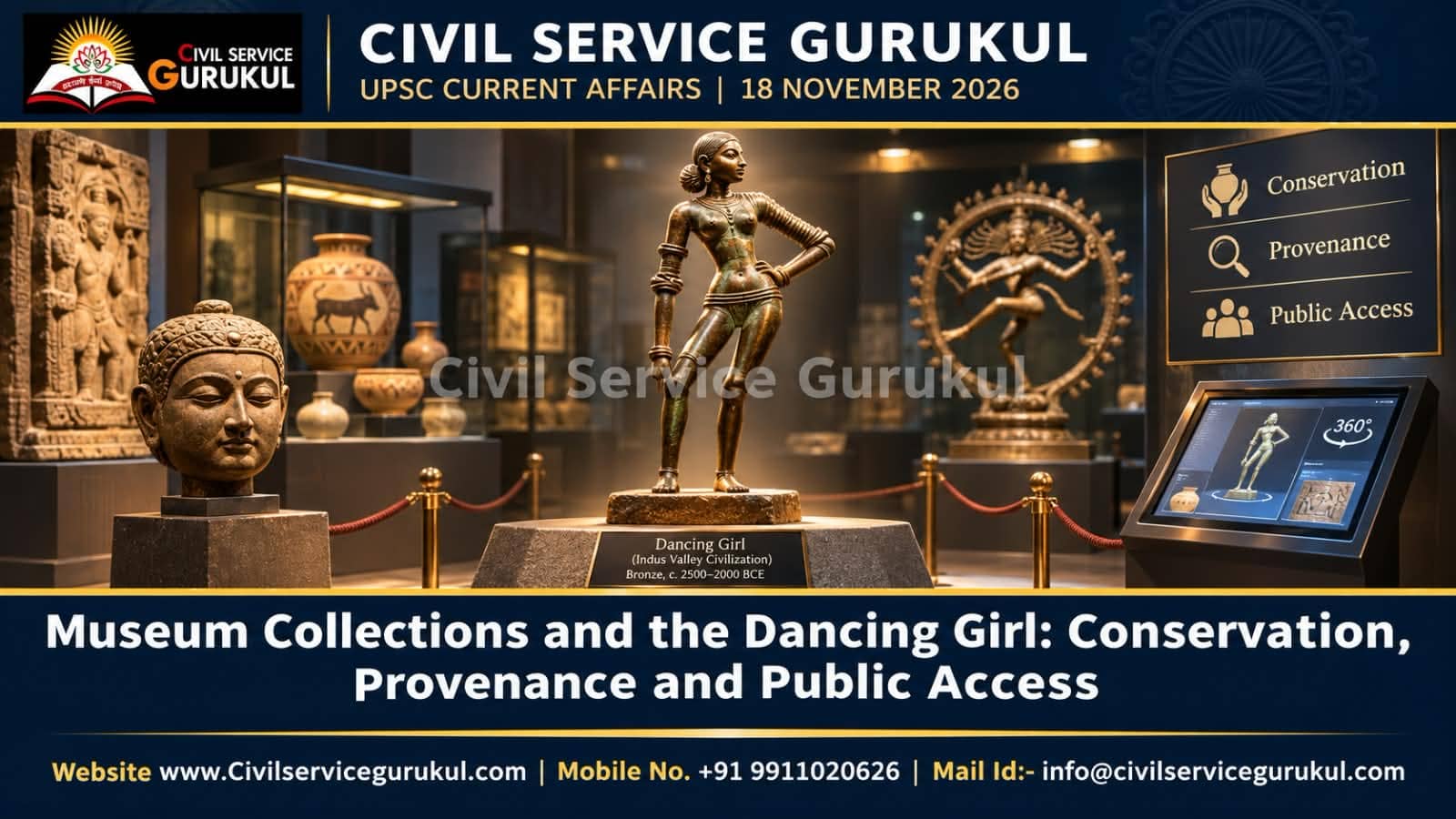
Dancing Girl of Mohenjo-daro: UPSC Heritage Analysis 2026
The reported plan to relocate the iconic Dancing Girl bronze sculpture of Mohenjo-daro and the Nizam's jewels to the Yuge Yugeen Bharat Museum has renewed discussions about India's cultural heritage management. Beyond the display of historically significant artefacts, museum administration involves conservation science, provenance documentation, secure transportation, public accessibility and ethical stewardship. The Dancing Girl is among the most celebrated examples of bronze craftsmanship from the Indus Valley Civilisation. This Civil Service Gurukul analysis explores the historical significance of the sculpture, the challenges of relocating museum collections, the difference between provenance and ownership, the responsibilities of public museums and the relevance of heritage governance for UPSC Prelims and Mains.

Aadhaar Biometric Exclusion: Rights & UPSC 2027
A November 2026 news report highlighting Supreme Court concerns about Aadhaar accessibility has renewed debate over the relationship between digital identity, welfare delivery and constitutional rights. Although Aadhaar-based verification can improve administrative efficiency, biometric mismatches, connectivity problems and inaccessible interfaces may prevent eligible individuals from accessing essential services. Older persons, persons with disabilities, manual workers and residents of areas with weak digital infrastructure can face particular difficulties. Importantly, authentication failure does not establish that an individual is ineligible for welfare benefits. This Civil Service Gurukul analysis examines Aadhaar's role in digital governance, biometric exclusion, accessibility, alternative authentication, grievance redressal, privacy, dignity and public-service accountability, along with original UPSC Prelims MCQs and a Mains model answer.
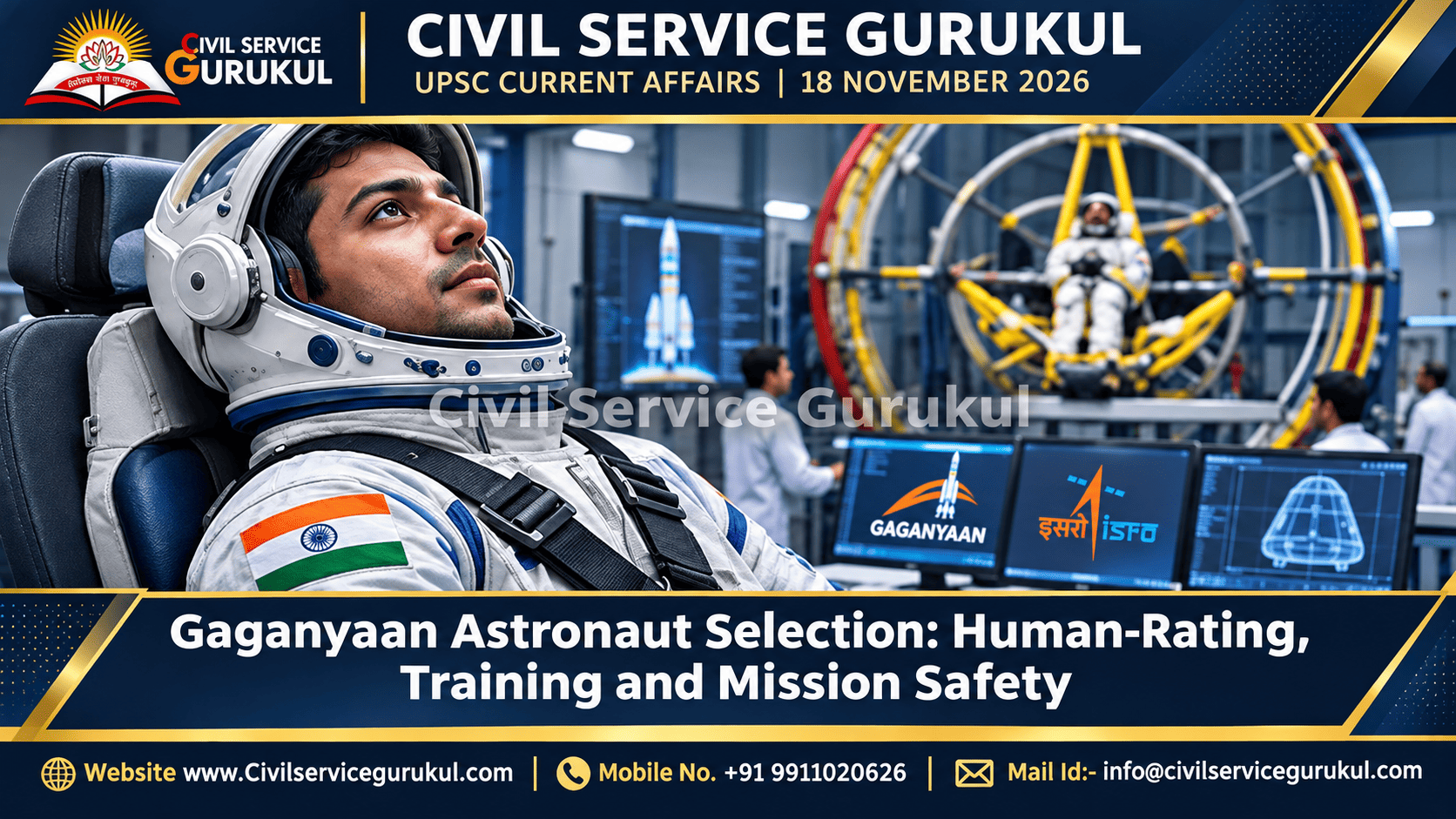
Gaganyaan Mission: Astronaut Training & Safety UPSC 2027
India's Gaganyaan human spaceflight programme represents a major technological challenge that extends far beyond launching astronauts into space. A November 2026 current affairs discussion of astronaut selection and training highlights the importance of human-rated launch systems, emergency preparedness, medical fitness, spacecraft environmental controls, reliable communications and safe crew recovery. Unlike uncrewed missions, human spaceflight requires rigorous safety engineering, repeated testing and close coordination between astronauts, mission controllers and engineering teams. This Civil Service Gurukul analysis examines the scientific and organisational foundations of Gaganyaan, the astronaut selection and training process, human-rating, life-support systems, crew escape technology and the importance of safety culture, along with original UPSC Prelims questions and a Mains model answer.
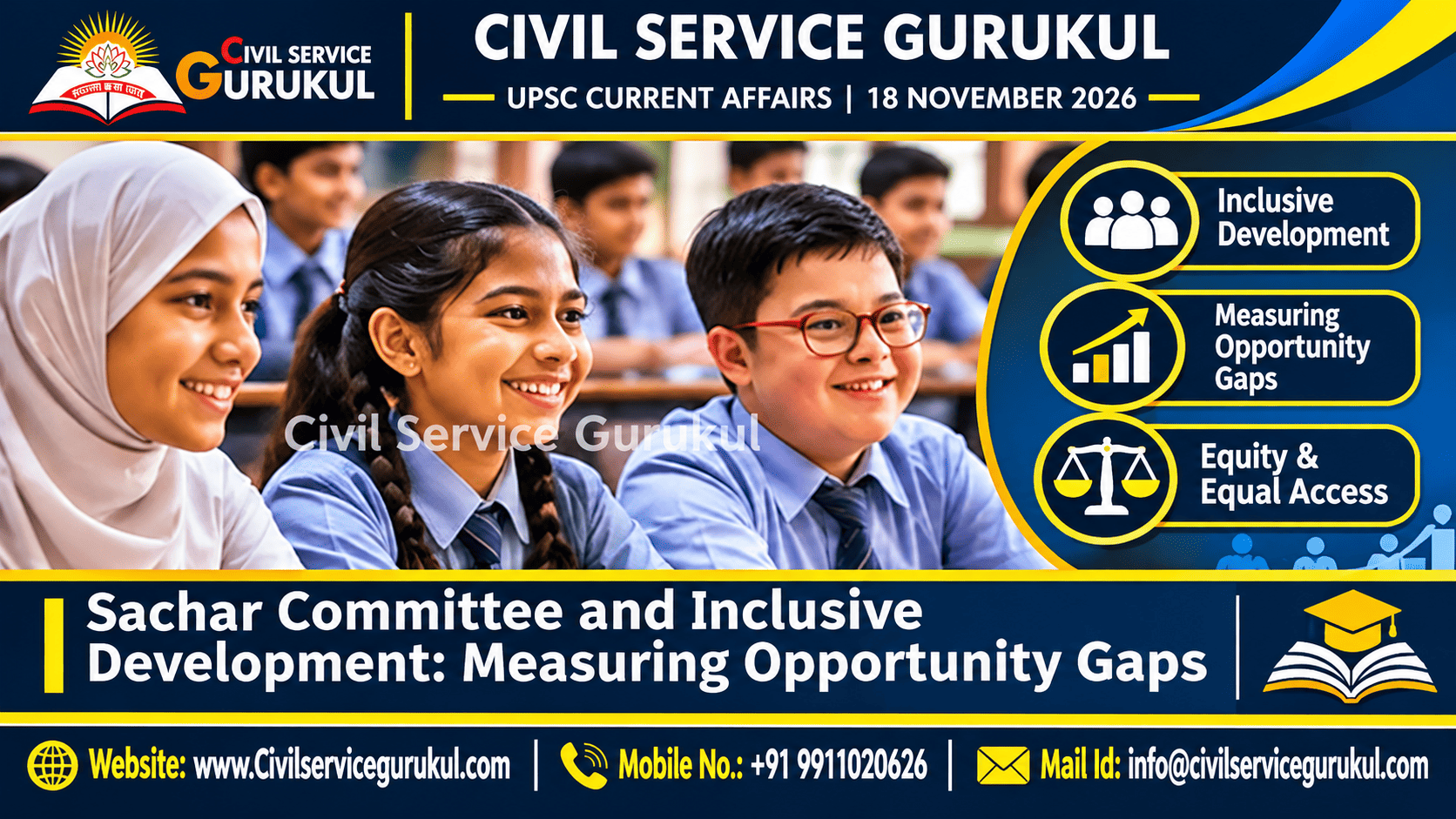
Sachar Committee Report: Social Justice & UPSC 2027
Nearly two decades after the Sachar Committee submitted its report in 2006, questions about equal opportunity, social inclusion and evidence-based public policy remain relevant to India's development journey. The committee examined the social, economic and educational status of India's Muslim community, highlighting the importance of measuring access to education, employment, credit and institutional representation. A November 2026 opinion discussion has renewed attention to the need for updated, comparable and disaggregated indicators rather than relying exclusively on historical findings or broad national averages. This Civil Service Gurukul analysis explores the Sachar Committee's significance, the constitutional framework for equality, the distinction between formal and substantive equality, the role of data in identifying opportunity gaps, policy design challenges and practical approaches to inclusive development, with original UPSC Prelims questions and a Mains model answer.
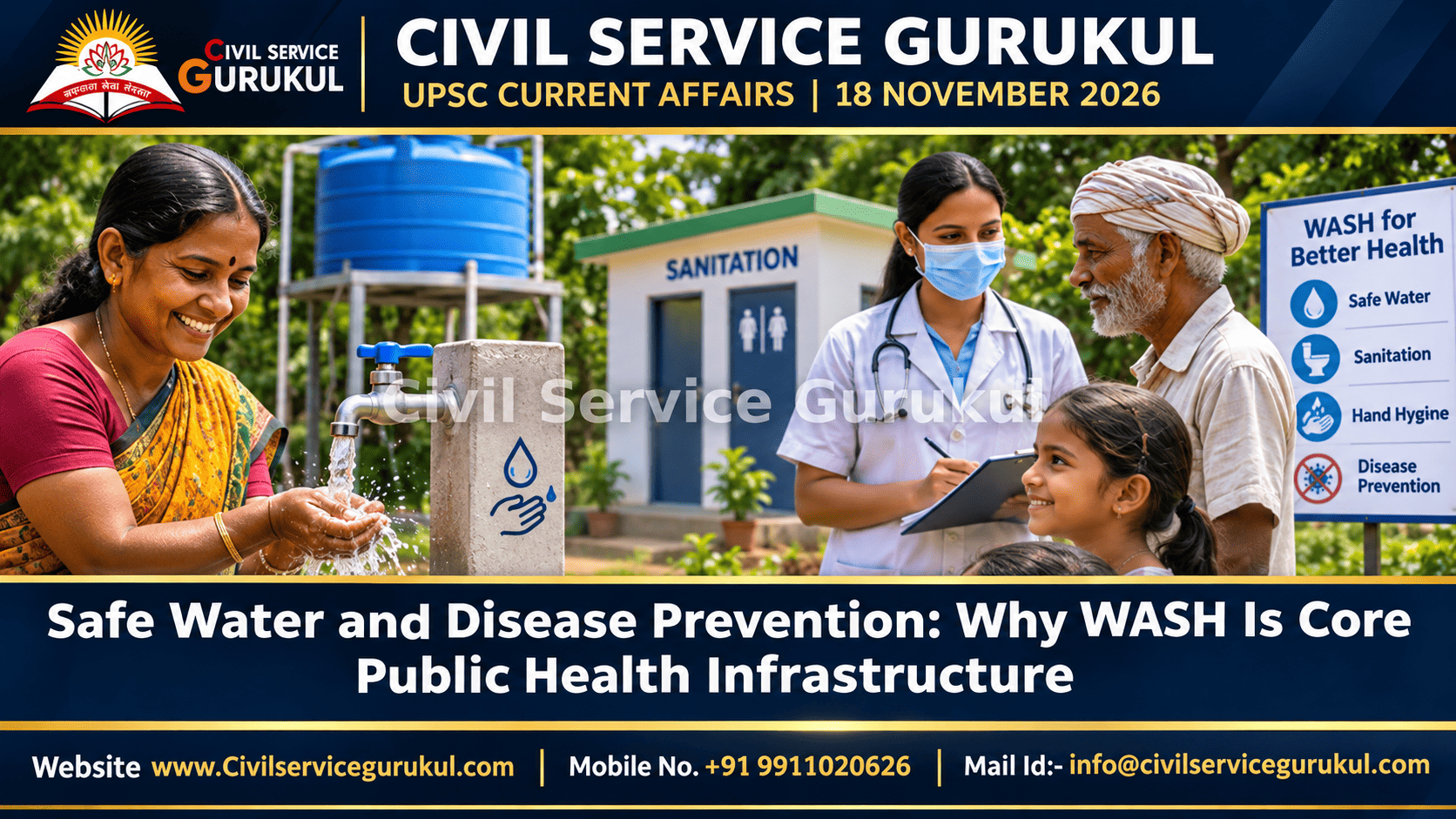
Safe Drinking Water & WASH in India: UPSC 2027
Access to safe drinking water, adequate sanitation and proper hygiene is essential for preventing infectious diseases, protecting human dignity and strengthening public health systems. A November 2026 editorial discussion has renewed attention to Water, Sanitation and Hygiene (WASH) as a fundamental component of disease prevention rather than merely a matter of infrastructure construction. Although household tap connections improve physical access, they do not automatically guarantee microbiologically safe water, reliable supply or effective wastewater disposal. This Civil Service Gurukul analysis examines the relationship between contaminated water and disease transmission, the role of sanitation and handwashing, drinking-water quality monitoring, Jal Jeevan Mission, Swachh Bharat Mission, SDG 6, climate resilience and inclusive water governance. It also includes original UPSC Prelims questions and a Mains model answer.

JAIMEX 2026: India–Japan Maritime Cooperation for UPSC
India–Japan maritime cooperation has emerged as an important pillar of the evolving Indo-Pacific security architecture. A November 2026 current affairs report highlights the reported participation of INS Sahyadri in the Japan–India Maritime Exercise (JAIMEX 2026), alongside renewed attention to high-level defence engagement between the two countries. Naval exercises strengthen interoperability, maritime communication, operational coordination and shared awareness of regional security challenges. However, participation in joint military exercises does not automatically create a binding mutual-defence alliance. This Civil Service Gurukul analysis examines JAIMEX, India–Japan strategic relations, the Quad, maritime trade routes, sea lines of communication, ASEAN centrality, strategic autonomy and the opportunities and challenges associated with Indo-Pacific cooperation, along with original UPSC Prelims MCQs and a Mains model answer.
AI Chip Export Controls & Digital Sovereignty: UPSC 2027
Advanced artificial intelligence depends increasingly on high-performance computing infrastructure, including specialised AI chips, cloud data centres and secure network access. A November 2026 current affairs report has raised questions about possible US restrictions on remote access to advanced AI computing resources. Such restrictions could affect international users even when no physical semiconductor crosses a national border. The issue highlights the growing intersection of technology policy, national security, international trade and digital sovereignty. This Civil Service Gurukul analysis explains remote AI computing, semiconductor export controls, cloud access, extraterritorial regulatory challenges, India's dependence on global computing infrastructure, the importance of domestic AI capacity and the need to balance technological security with innovation and equitable access.

Electoral Roll Revision in India: SSR, Voter Rights & UPSC 2027
Electoral rolls are the foundation of democratic participation because they determine which eligible citizens are registered to vote in an election. A November 2026 current affairs report has highlighted substantial additions to draft electoral rolls during a revision exercise, renewing attention to voter inclusion, accuracy, transparency and the right to correct electoral records. Draft publication is not the final determination of the electorate; it provides an important opportunity for eligible citizens to inspect entries, seek inclusion, request corrections and raise objections through prescribed procedures. This Civil Service Gurukul analysis explains the constitutional and statutory framework governing electoral rolls, the role of the Election Commission of India, Special Summary Revision, claims and objections, the distinction between draft and final rolls, digital and offline accessibility, risks of wrongful exclusion and the importance of procedural fairness in electoral governance.
Voyager 1 One-Light-Day Milestone: UPSC 2027
Voyager 1, launched by NASA in 1977, continues its historic journey through interstellar space, far beyond the region dominated by the Sun's solar wind. A November 2026 science report has highlighted the spacecraft's approach toward a distance of one light-day from Earth, raising important questions about communication delays, spacecraft autonomy and the engineering challenges of extremely long-duration space missions. One light-day represents approximately 25.9 billion kilometres—the distance travelled by light in a vacuum over 24 hours. At such a distance, a radio command would require about one day to reach the spacecraft, while a response would take another day to return. This Civil Service Gurukul analysis explains Voyager 1, the heliopause, the heliosphere, the Oort Cloud, NASA's Deep Space Network, signal propagation, declining spacecraft power, autonomous fault management and the scientific importance of interstellar exploration.

Rooppur Nuclear Power Plant: Bangladesh & UPSC 2027
Bangladesh's Rooppur Nuclear Power Plant represents a major step in the country's efforts to diversify its electricity generation system and strengthen long-term energy security. A November 2026 current-affairs report has highlighted a trial phase at the project, drawing attention to the difference between reactor testing, first criticality, grid synchronisation and commercial operation. Nuclear power offers the potential for reliable, low-carbon electricity generation, but also requires strong regulatory oversight, emergency preparedness, cooling-water management, radioactive waste handling and financial sustainability. For India and South Asia, the project raises important questions about regional energy cooperation, nuclear safety, technology partnerships and cross-border emergency communication. This Civil Service Gurukul analysis explains the Rooppur project, nuclear fission, energy-transition opportunities, safety challenges, regulatory responsibilities and their relevance to UPSC Prelims and Mains 2027.
3D Digital Twins of Indian Cities: IN-SPACe & UPSC 2027
Three-dimensional digital twins are emerging as important tools for modern urban governance by combining geospatial models with relevant real-world observations and administrative information. A November 2026 current-affairs report has highlighted the reported selection of three firms by IN-SPACe for urban 3D reconstruction, bringing attention to the role of India's expanding private space ecosystem in city planning. Technologies such as satellite imagery, photogrammetry, Geographic Information Systems and sensor-based monitoring can help municipalities visualise infrastructure, assess flood risks, improve drainage planning and strengthen disaster preparedness. However, a static 3D city model does not automatically become a continuously updated digital twin. Successful implementation requires reliable data, interoperability, municipal capacity, cybersecurity, privacy safeguards and transparent procurement. This Civil Service Gurukul analysis explains the technology, the institutional role of IN-SPACe, practical applications, governance challenges and its relevance to UPSC Prelims and Mains 2027.
India–China–Russia Relations 2026: UPSC GS-II
The November 2026 United States–Russia–China summit has renewed attention to great-power diplomacy, multipolarity and India's strategic autonomy. While the Shenzhen summit involved the leaders of the United States, Russia and China, the separate Russia–India–China (RIC) format remains important for understanding India's engagement with Eurasian powers. India must manage its longstanding strategic partnership with Russia, complex border and economic relations with China, and expanding cooperation with the United States without becoming dependent on any single geopolitical bloc. This Civil Service Gurukul analysis examines the history of RIC diplomacy, the distinctions between RIC, BRICS and the Shanghai Cooperation Organisation, competing interests in the Indo-Pacific, energy security, emerging technology and India's role in shaping a multipolar world order. Includes UPSC Prelims revision, statement-based MCQs and GS Paper II Mains answer-writing practice.