
Safe Drinking Water & WASH in India: UPSC 2027
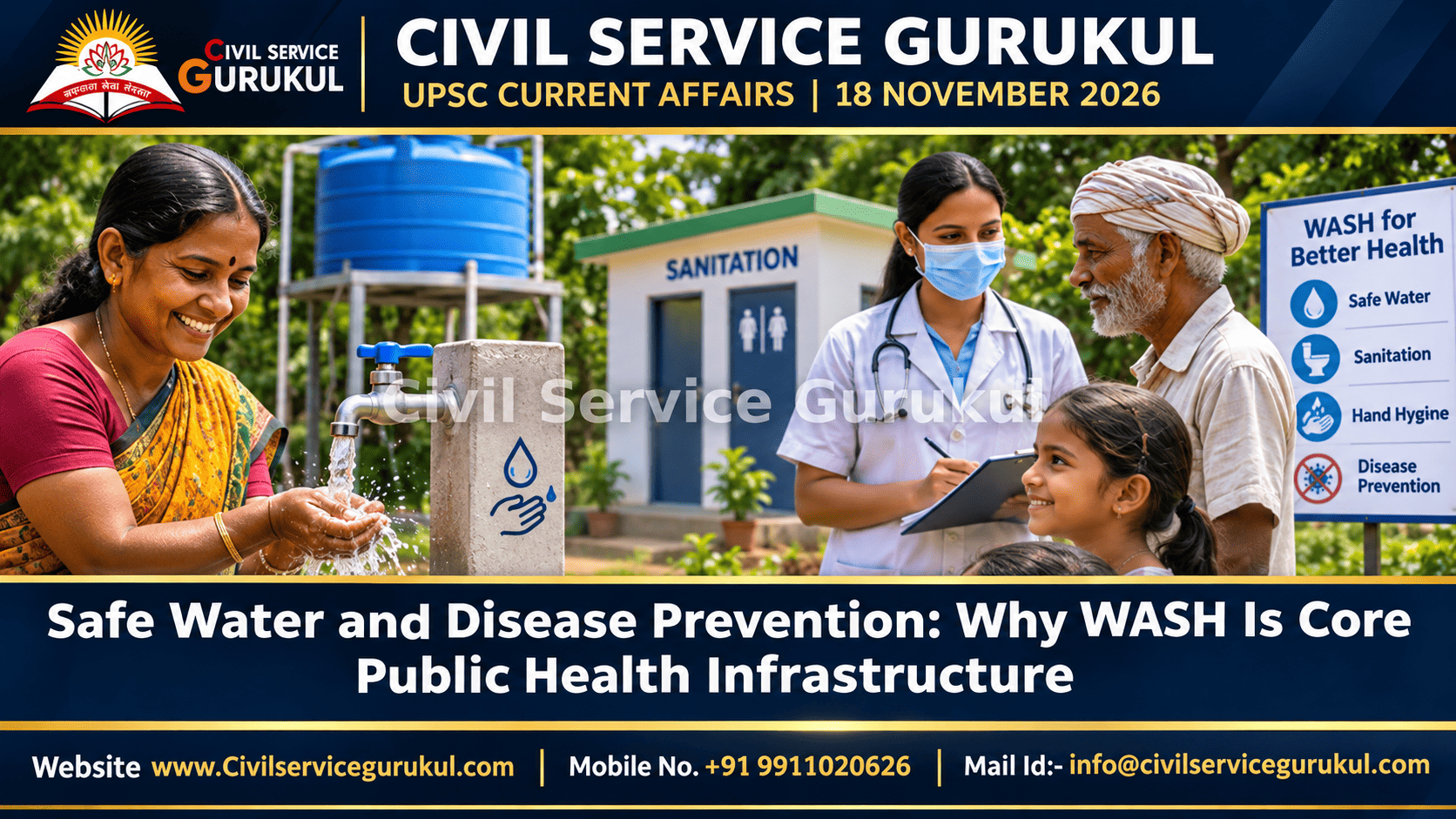
Safe Drinking Water and WASH: Why India's Disease Prevention Strategy Must Begin with Public Health Infrastructure
A comprehensive UPSC analysis of waterborne diseases, sanitation, hygiene, drinking-water quality, Jal Jeevan Mission, SDG 6, climate resilience and preventive healthcare.
1. Why Is Safe Drinking Water in the News?
A November 2026 editorial discussion has highlighted the central role of safe water in preventing infectious diseases and improving public health.
The issue draws attention to the difference between constructing water infrastructure and ensuring reliable delivery of safe water.
It also emphasises that drinking-water supply must be supported by sanitation, handwashing, wastewater management and effective public-health systems.
2. What Is WASH?
WASH stands for Water, Sanitation and Hygiene.
It is an integrated public-health approach aimed at reducing exposure to disease-causing organisms and improving human well-being.
Three Pillars of WASH
Reliable access to water that is safe for its intended use.
Safe management of human excreta and associated sanitation systems.
Practices such as handwashing that help reduce disease transmission.
3. Why Is WASH Public Health Infrastructure?
Public-health infrastructure includes systems that prevent disease and protect communities before illness occurs.
WASH contributes to this objective by reducing environmental exposure to pathogens and supporting healthier living conditions.
Major Public Benefits
- Reduced exposure to waterborne pathogens.
- Improved hygiene conditions.
- Lower preventable disease burden.
- Greater dignity and safety.
- Potential reduction in avoidable healthcare costs.
- Improved conditions for education and productivity.
These benefits depend on service quality, behavioural adoption and effective operation over time.
4. How Does Contaminated Water Spread Disease?
Contaminated drinking water may transmit pathogens that cause gastrointestinal and other infectious diseases.
One important pathway is faecal-oral transmission, in which pathogens from faecal contamination enter the body through ingestion.
Examples of Waterborne Diseases
| Disease | Causative Agent | Relevant Transmission Route |
|---|---|---|
| Cholera | Vibrio cholerae bacterium | Consumption of contaminated water or food. |
| Typhoid Fever | Salmonella Typhi bacterium | Faecal-oral transmission, including contaminated water or food. |
| Hepatitis A | Hepatitis A virus | Faecal-oral transmission, including contaminated food or water. |
| Giardiasis | Giardia parasite | Ingestion of infectious cysts, including through contaminated water. |
5. Waterborne vs Water-Related Diseases
Not every water-related disease is transmitted by drinking contaminated water.
Some diseases are associated with water because their vectors breed in aquatic environments.
| Category | Meaning | Example |
|---|---|---|
| Waterborne | Transmission through ingestion of contaminated water. | Cholera |
| Water-Related Vector-Borne | Transmission by vectors associated with aquatic breeding habitats. | Malaria |
| Water-Washed | Infections associated with inadequate water for personal hygiene. | Some skin and eye infections |
6. Household Tap Coverage vs Safe Water Quality
A household tap connection improves physical access to water infrastructure.
However, a connection alone does not establish that water is consistently safe for consumption.
Water quality can be affected by contamination at the source, treatment failure, distribution leakage or unsafe storage.
Important Water-Service Indicators
Proportion of households with access to the relevant water service.
Whether water meets applicable safety standards.
Reliability and frequency of supply.
Whether households can reasonably access the service without excessive burden.
Continued operation and repair of infrastructure.
Monitoring, complaint handling and corrective action.
7. Why Is Microbial Water Testing Important?
Microbial testing helps identify possible contamination by disease-causing organisms or indicator microorganisms.
Water systems require appropriate monitoring at relevant points in the supply chain.
Monitoring results should inform timely corrective action, rather than remain isolated administrative records.
8. Why Sanitation and Hygiene Matter
Sanitation helps reduce the release and spread of pathogens in the environment.
Hygiene practices such as handwashing with soap can interrupt important transmission pathways.
Key Sanitation Components
- Access to appropriate sanitation facilities.
- Safe containment and management of human waste.
- Wastewater treatment and disposal.
- Maintenance of sanitation infrastructure.
- Public awareness and sustained hygiene practices.
9. Source Protection and Wastewater Management
Protecting drinking-water sources reduces the risk of contamination before water enters the supply system.
Wastewater management helps prevent untreated waste from entering water bodies and surrounding environments.
Both are important for protecting human health and maintaining environmental quality.
10. Indian Policy Framework for WASH
Jal Jeevan Mission
Jal Jeevan Mission is an important Government of India initiative associated with providing functional household tap connections in rural areas.
Its relevance to public health extends beyond physical connections to reliable water-service delivery and quality considerations.
Swachh Bharat Mission
Swachh Bharat Mission focuses on sanitation and cleanliness through its relevant programme components.
Sustained sanitation outcomes require infrastructure, behavioural adoption and effective waste management.
National Health Mission
Public-health systems support disease surveillance, prevention, health awareness and responses to outbreaks.
Coordination between health authorities and water-service institutions is important for early detection and response.
11. Sustainable Development Goal 6
SDG 6 concerns the availability and sustainable management of water and sanitation for all.
It includes important objectives related to drinking water, sanitation, hygiene, water quality and sustainable water management.
12. Climate Change and Water Security
Climate-related hazards can affect water availability, infrastructure reliability and water quality.
Flooding may increase contamination risks, while drought conditions can place pressure on available supplies.
Important Resilience Measures
- Protection of water sources.
- Climate-resilient infrastructure planning.
- Reliable water-quality surveillance.
- Preparedness for flood-related contamination.
- Contingency planning for water scarcity.
- Coordination between local governments and health agencies.
13. WASH and Social Equity
Unequal access to safe water and sanitation can create disproportionate burdens for vulnerable communities.
Distance, affordability, service reliability and accessibility may affect how households experience water infrastructure.
Effective policy should therefore evaluate distributional outcomes rather than rely only on national averages.
14. Constitutional and Governance Dimensions
Article 21
Article 21 protects life and personal liberty.
Indian constitutional jurisprudence has recognised the importance of environmental quality and conditions necessary for a dignified life.
Public Accountability
Water-service institutions should maintain transparent monitoring systems, responsive complaint procedures and clear responsibility for corrective action.
Local Governance
Local institutions have important roles in service monitoring, community participation and coordination with relevant public authorities.
15. Ethical Dimensions for GS Paper IV
- Equity: Address disparities in safe-water access.
- Accountability: Monitor quality and resolve service failures.
- Transparency: Communicate relevant water-quality information.
- Responsiveness: Act promptly on contamination concerns.
- Public Welfare: Prioritise disease prevention and dignity.
16. Way Forward: Strengthening WASH as Public Health Infrastructure
- Monitor water quality: Conduct appropriate microbial and other relevant testing.
- Improve continuity: Focus on reliable water supply, not merely connection counts.
- Strengthen sanitation: Improve waste containment, treatment and disposal.
- Promote hygiene: Support sustained handwashing and other protective practices.
- Protect water sources: Reduce contamination risks at source.
- Integrate surveillance: Coordinate public-health monitoring with local water governance.
- Build climate resilience: Prepare for flooding, drought and infrastructure disruption.
- Improve accountability: Publish relevant performance indicators and enable corrective action.
17. UPSC Prelims 2027: Quick Revision
- WASH stands for Water, Sanitation and Hygiene.
- Waterborne diseases may spread through contaminated drinking water.
- Cholera is caused by Vibrio cholerae.
- Typhoid fever is caused by Salmonella Typhi.
- Malaria is mosquito-borne, not ordinarily waterborne through ingestion.
- A tap connection does not automatically guarantee microbiologically safe water.
- Water-quality testing and distribution maintenance are essential.
- SDG 6 concerns clean water and sanitation.
- SDG 3 concerns good health and well-being.
- Sanitation and hygiene complement drinking-water supply.
18. Original UPSC Prelims MCQs
Question 1
Consider the following statements:
- A household tap connection automatically guarantees microbiologically safe water.
- Water-quality testing is relevant to safe drinking-water delivery.
- Distribution-system integrity can affect water safety.
Which statements are correct?
(A) 1 only
(B) 2 and 3 only
(C) 1 and 2 only
(D) 1, 2 and 3
Statement 1 is incorrect. Physical connection alone does not establish water safety. Statements 2 and 3 are correct.
Question 2
Which of the following diseases can be transmitted through ingestion of contaminated water?
- Cholera
- Typhoid fever
- Malaria
(A) 1 only
(B) 1 and 2 only
(C) 2 and 3 only
(D) 1, 2 and 3
Cholera and typhoid fever can spread through contaminated water or food. Malaria is transmitted through infected Anopheles mosquitoes.
Question 3
Which Sustainable Development Goal is primarily associated with clean water and sanitation?
(A) SDG 2
(B) SDG 3
(C) SDG 6
(D) SDG 13
SDG 6 addresses water and sanitation.
Question 4
Consider the following statements:
- Handwashing can help interrupt disease transmission.
- Wastewater management is unrelated to water quality.
- Source protection can reduce contamination risks.
Which statements are correct?
(A) 1 and 3 only
(B) 1 and 2 only
(C) 2 and 3 only
(D) 1, 2 and 3
Handwashing and source protection are important preventive measures. Wastewater management is also relevant to environmental and water quality.
Question 5
Which approach best evaluates the performance of a public drinking-water programme?
(A) Count only newly installed connections.
(B) Measure only the length of pipelines.
(C) Assess coverage, quality, continuity, affordability and maintenance.
(D) Assume all connected households receive safe water.
Water-service outcomes require multiple indicators, including safe quality and reliable supply.
19. UPSC Mains Practice Question
"Water, Sanitation and Hygiene should be treated as core preventive public-health infrastructure rather than merely as a collection of construction projects." Critically examine.
Word Limit: 250 words
20. Model UPSC Mains Answer
Introduction
Water, Sanitation and Hygiene (WASH) constitute essential preventive public-health infrastructure by reducing exposure to infectious pathogens and supporting human dignity.
Public-Health Importance
- Disease Prevention: Safe water reduces exposure to waterborne pathogens.
- Sanitation: Proper waste management reduces environmental contamination.
- Hygiene: Handwashing helps interrupt transmission pathways.
- Social Equity: Reliable services reduce unequal health burdens.
Major Challenges
- Tap coverage does not automatically guarantee safe water quality.
- Inadequate maintenance can reduce infrastructure effectiveness.
- Weak wastewater management can contaminate water sources.
- Climate-related hazards may disrupt water services.
Way Forward
India should monitor microbial water quality, improve continuity and affordability, protect sources, strengthen sanitation and integrate health surveillance with local water governance.
Climate resilience, transparent performance indicators and community participation should support long-term implementation.
Conclusion
WASH should be assessed through sustained health and service outcomes, not merely the construction of physical infrastructure.
21. Frequently Asked Questions
What does WASH stand for?
WASH stands for Water, Sanitation and Hygiene.
Why is WASH important for public health?
It helps reduce exposure to pathogens, supports hygiene and improves living conditions.
Does a household tap connection guarantee safe water?
No. Water safety also depends on quality monitoring, treatment, distribution integrity and maintenance.
Which SDG is associated with water and sanitation?
Sustainable Development Goal 6.
How is WASH relevant for UPSC?
It connects public health, governance, environment, social equity, sustainable development and ethics.
22. Conclusion: Safe Water Is Preventive Healthcare
The November 2026 editorial discussion reinforces the importance of safe water as a foundation of public health and human well-being.
However, infrastructure coverage alone cannot establish successful disease prevention.
Reliable water quality, sanitation, hygiene, wastewater management and responsive institutions are essential.
For UPSC aspirants, the central lesson is that WASH should be understood as a continuous public-health service requiring monitoring, maintenance and accountability.
Master Public Health, Environment & Governance for UPSC 2027
Prepare with Civil Service Gurukul through concept-based current affairs, Prelims MCQs, Mains answer writing and structured mentoring.
CIVIL SERVICE GURUKUL
UPSC | IAS | State PCS | Prelims & Mains
Visit Our Website Call +91 9911020626 Email for Enquirywww.civilservicegurukul.com
Editorial Disclaimer: This original educational article expands upon a November 2026 editorial topic concerning safe water and disease prevention. It does not claim that waterborne diseases have been eliminated or that a new government policy was adopted on the date of the editorial. Additional technical explanations and UPSC practice material are provided for educational purposes.
Prepare with Mentors Who Cleared the Exam
Get personalized study plans, evaluated answer models, and test series access.