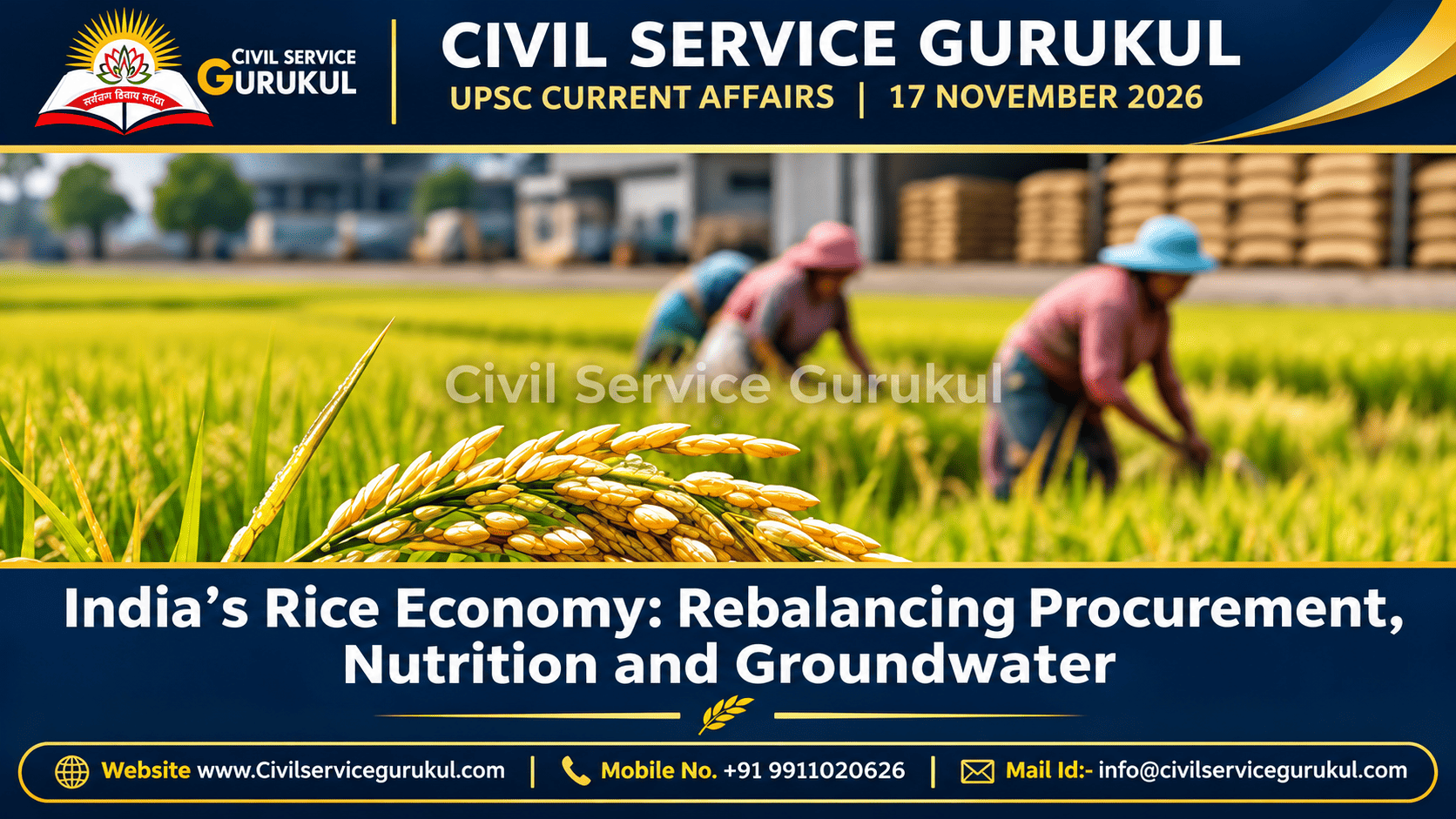
Why Is India's Rice Economy in the News?
A current-affairs explainer featured in the 16 November 2026 topic index examined the need to rebalance India's rice economy.
The discussion focuses on the interaction between procurement policies, minimum support prices, food distribution, agricultural incentives and groundwater sustainability.
The issue is not simply whether rice production should increase or decrease.
The central policy challenge is how India can maintain food security and farmer welfare while reducing environmental pressures and encouraging appropriate crop diversification.
The supplied editorial analyses structural policy incentives in India's rice economy.
It does not establish that a new procurement policy or government decision was announced on 16 November 2026.
UPSC Syllabus Relevance
| UPSC Paper | Relevant Topics |
|---|---|
| GS Paper I | Agricultural geography, cropping patterns, irrigation and regional agricultural systems |
| GS Paper II | Food security, public distribution, welfare delivery and government interventions |
| GS Paper III | MSP, procurement, agricultural economics, subsidies, groundwater, crop diversification and sustainable agriculture |
| Prelims | FCI, MSP, paddy versus rice, buffer stocks, PDS and agricultural sustainability |
Understanding India's Rice Economy
India's rice economy includes cultivation, procurement, milling, storage, distribution and consumption.
Public policies influence this system through price signals, procurement arrangements, food distribution and agricultural subsidies.
Major Components
- Rice cultivation and farm production.
- Minimum Support Price signals.
- Government procurement operations.
- Paddy milling and rice conversion.
- Food grain storage and buffer management.
- Public distribution to eligible households.
- Domestic consumption and nutritional needs.
- Water and environmental sustainability.
What Is Minimum Support Price?
Minimum Support Price, or MSP, is an administered price announced by the Government of India for specified agricultural commodities.
It is intended to provide a price-support signal to farmers.
However, the announcement of MSP must be distinguished from actual procurement operations.
MSP announcement does not mean that every farmer's entire production is automatically purchased by the government.
Role of the Food Corporation of India
The Food Corporation of India, or FCI, is an important institution in India's food grain management system.
FCI and state agencies procure eligible food grains for central-pool operations.
Important Functions
- Food grain procurement and associated operations.
- Storage and stock management.
- Movement of food grains.
- Supporting distribution arrangements.
- Contributing to food security operations.
The precise division of responsibilities varies across procurement and distribution arrangements.
Paddy vs Rice: An Important UPSC Concept
Paddy is the harvested crop before milling, while rice is the milled grain obtained after processing.
Milling removes the husk and changes the weight of the material.
Therefore, paddy procurement quantities and milled rice stock quantities should not be treated as identical.
| Paddy | Rice |
|---|---|
| Harvested grain with husk | Grain after milling and husk removal |
| Associated with crop procurement | Associated with milled grain and consumption |
| Weight includes husk and other components | Weight changes after processing |
How Procurement Incentives Influence Crop Choices
Farmers make cropping decisions based on expected prices, market access, production costs, water availability and perceived risk.
Where procurement is relatively predictable, it can reduce uncertainty for eligible producers.
However, strong procurement incentives for particular crops may reduce the attractiveness of alternative crops.
Assured procurement can protect farm incomes while narrowing incentives for crop diversification.
Rice Cultivation and Groundwater Stress
Rice cultivation can involve significant irrigation water requirements under certain production systems.
However, the water footprint of rice varies across agro-climatic regions, irrigation methods and crop varieties.
It would therefore be misleading to assume that all rice cultivation creates the same groundwater pressure.
Important Factors
- Rainfall availability and timing.
- Soil characteristics.
- Groundwater depth and recharge.
- Irrigation technology.
- Crop variety and growing duration.
- Local agricultural practices.
Electricity Subsidies and Groundwater Extraction
State-level electricity subsidies may influence the cost of pumping groundwater for irrigation.
Where pumping costs are low, farmers may have weaker financial incentives to reduce groundwater use.
However, the overall effect depends on local water conditions, electricity supply, crop choices and other agricultural factors.
Policy reform must therefore be region-specific rather than based on uniform assumptions.
Food Security vs Nutritional Security
Food security and nutritional security are closely connected but not identical concepts.
Food security concerns reliable access to sufficient food.
Nutritional security also requires adequate dietary quality and essential nutrients.
| Food Security | Nutritional Security |
|---|---|
| Emphasises adequate food access | Emphasises dietary quality and nutritional adequacy |
| Food grains can play a major role | Requires attention to diverse food groups |
| Addresses food availability and access | Addresses nutritional needs and diet quality |
A food distribution system can support food security, but broader nutrition policy may require dietary diversification.
Public Distribution System and Nutrition Policy
The Public Distribution System plays an important role in distributing subsidised or entitled food grains under applicable programmes.
Its primary delivery objectives should be distinguished from the wider objectives of nutrition policy.
Nutrition policy must consider dietary diversity, health needs and access to appropriate food groups.
PDS and nutrition policy have related but different objectives.
Food grain distribution alone does not automatically ensure a nutritionally balanced diet.
Why Crop Diversification Matters
Crop diversification involves shifting or expanding the mix of crops grown in a farming system.
It may support better resource use, risk management and market opportunities when supported by appropriate conditions.
Potential Benefits
- Reduced dependence on a single crop.
- Improved adaptation to local water conditions.
- Opportunities for alternative farm income.
- Support for more diverse food systems.
- Potential reduction in pressure on stressed aquifers.
However, diversification must be supported by viable markets and suitable agricultural services.
Why Replacing Rice Is Not a Simple Solution
A sudden shift away from rice may expose farmers to new market and production risks.
Alternative crops require appropriate agronomic conditions, market demand, storage facilities and consumer acceptance.
Important Constraints
- Uncertain prices for alternative crops.
- Limited procurement or market access.
- Inadequate agricultural extension services.
- Crop-specific storage and processing needs.
- Consumer demand and acceptance.
- Farmer familiarity with existing practices.
Replacing rice without viable markets, agricultural extension and consumer acceptance may shift risk from the environment to farmers.
Procurement Diversification and Pulse Markets
A more balanced procurement system may consider region-specific opportunities for alternative crops, including pulses.
However, procurement diversification should be designed with reference to agro-climatic suitability, market infrastructure and farmer incentives.
Important Policy Measures
- Develop viable markets for suitable alternative crops.
- Improve processing and storage infrastructure.
- Strengthen agricultural extension services.
- Support transparent price information.
- Reduce avoidable marketing risks.
- Align diversification with local water conditions.
Water-Saving Agricultural Practices
Improving water efficiency is an important component of sustainable rice production.
Appropriate water-saving agronomic practices may reduce irrigation requirements under suitable conditions.
However, the effectiveness of particular methods depends on soil, climate, crop variety and local management practices.
Possible Approaches
- Improved irrigation scheduling.
- Region-appropriate water management practices.
- Better soil and field management.
- Selection of suitable crop varieties.
- Groundwater monitoring.
- Farmer training and extension support.
MSP, Procurement, Buffer Stocks and Open-Market Sales
These four concepts are related to food grain management but should not be confused.
| Concept | Meaning |
|---|---|
| MSP | Administered price announced for specified agricultural commodities |
| Procurement | Actual purchase of eligible agricultural produce under applicable arrangements |
| Buffer Stocks | Food grain stocks maintained for food security and operational purposes |
| Open-Market Sales | Sale of food grains from government stocks under specified arrangements |
An MSP announcement is not identical to procurement.
Procurement is not the same as buffer stock maintenance, and open-market sales are a separate operation.
Regional Differences in Rice Production
India's rice production systems vary across regions.
Some areas depend substantially on rainfall, while others use irrigation systems that may place pressure on groundwater resources.
Therefore, the environmental effects of rice cultivation cannot be assessed using one national assumption for all farming regions.
Region-specific analysis is essential for effective agricultural policy.
How Should Rice Economy Reforms Be Evaluated?
A successful reform should not be judged solely by changes in procurement volumes or crop area.
Policy evaluation should also consider farmer income, nutritional outcomes and groundwater conditions.
| Evaluation Area | Possible Indicator |
|---|---|
| Farmer welfare | Changes in farm income and income stability |
| Food security | Reliability of food grain access and distribution |
| Nutrition | Dietary diversity and nutritional outcomes |
| Groundwater | Groundwater levels and recharge trends |
| Diversification | Adoption of suitable alternative crops |
| Market performance | Price realisation and access to buyers |
| Public expenditure | Procurement and related fiscal costs |
Ethical Dimensions of Agricultural Reform
1. Equity
Policy reforms should consider their effects on farmers with different resources and market access.
2. Sustainability
Agricultural systems should protect natural resources for future generations.
3. Transparency
Procurement and subsidy decisions should be communicated clearly.
4. Prudence
Reforms should be designed with attention to uncertainty and unintended consequences.
5. Accountability
Government institutions should evaluate whether policy objectives are actually being achieved.
Way Forward: Building a Sustainable Rice Economy
- Promote region-specific diversification: Support suitable alternative crops where environmental and market conditions permit.
- Strengthen pulse markets: Improve market access, processing and price information.
- Support water-saving agronomy: Promote appropriate irrigation and crop management practices.
- Monitor groundwater: Improve transparency and assessment of aquifer conditions.
- Protect farmer incomes: Avoid reforms that transfer unmanageable risks to producers.
- Improve agricultural extension: Provide training and technical support for crop transitions.
- Strengthen nutrition outcomes: Evaluate food security and dietary diversity together.
- Measure environmental results: Track groundwater recovery alongside production and income indicators.
- Improve policy coordination: Align procurement, subsidy, agricultural and environmental objectives.
India should evaluate agricultural reforms through three connected outcomes: farmer incomes, nutritional security and environmental sustainability.
UPSC Prelims Quick Revision
- FCI and state agencies procure eligible food grains for central-pool operations.
- MSP announcement and actual procurement are different.
- Paddy is the crop; rice is the milled grain.
- Paddy and rice quantities should not be treated as identical.
- Buffer stocks and open-market sales are distinct operations.
- PDS supports food security, while nutrition policy has broader objectives.
- Rice cultivation's water footprint varies across regions.
- Electricity subsidies can influence irrigation incentives.
- Crop diversification requires viable markets and extension support.
- Groundwater sustainability is an important agricultural policy concern.
Original UPSC Prelims Practice MCQs
Question 1: Paddy and Rice
Consider the following statements:
1. Paddy is
the harvested
crop before
milling.
2. Rice is
obtained after
milling paddy.
3. Paddy and
rice always
have identical
weights in
government statistics.
Which statements are correct?
(a) 1 and 2 only
(b) 2 and 3 only
(c) 1 and 3 only
(d) 1, 2 and 3
View Answer and Explanation
Correct Answer: (a) 1 and 2 only.
Milling removes the husk and changes the weight of the grain.
Question 2: MSP and Procurement
Consider the following statements:
1. MSP is
an administered
price announced
for specified
agricultural commodities.
2. Announcement
of MSP
automatically guarantees
government purchase
of every
farmer's entire
production.
3. Procurement
refers to
actual purchase
under applicable
arrangements.
Which statements are correct?
(a) 1 and 2 only
(b) 1 and 3 only
(c) 2 and 3 only
(d) 1, 2 and 3
View Answer and Explanation
Correct Answer: (b) 1 and 3 only.
MSP announcement and procurement operations are different policy concepts.
Question 3: Rice and Groundwater
Consider the following statements:
1. The water
footprint of
rice cultivation
may vary
by agro-climatic
region.
2. Irrigation
methods can
influence water
use in
rice cultivation.
3. Every rice
field in
India necessarily
creates identical
groundwater pressure.
Which statements are correct?
(a) 1 and 2 only
(b) 2 and 3 only
(c) 1 and 3 only
(d) 1, 2 and 3
View Answer and Explanation
Correct Answer: (a) 1 and 2 only.
Rice cultivation's water footprint varies with climate, irrigation methods and crop variety.
Question 4: Food and Nutrition Security
Consider the following statements:
1. Food security
and nutritional
security are
related but
different concepts.
2. Food grain
distribution alone
automatically ensures
a nutritionally
balanced diet.
3. Nutrition
policy may
require attention
to dietary
diversity.
Which statements are correct?
(a) 1 and 2 only
(b) 1 and 3 only
(c) 2 and 3 only
(d) 1, 2 and 3
View Answer and Explanation
Correct Answer: (b) 1 and 3 only.
Food access is important, but nutritional security also depends on dietary quality.
Question 5: Crop Diversification
Which of the following best represents a sustainable approach to crop diversification?
(a) Replace rice everywhere without assessing local conditions.
(b) Ignore farmer incomes and market access.
(c) Support region-specific alternatives, viable markets, agricultural extension and water monitoring.
(d) Assume all crops have identical water requirements.
View Answer and Explanation
Correct Answer: (c).
Sustainable diversification requires attention to local conditions, farmer incentives and market infrastructure.
UPSC Mains Practice Question
"India's rice economy illustrates the tension between food security, farmer income protection and environmental sustainability." Critically examine the role of MSP, procurement incentives and groundwater management in addressing this challenge.
Suggested Answer-Writing Framework
Introduction: Explain the role of rice in India's food security and agricultural economy.
Institutional Dimension: Discuss MSP, FCI procurement, PDS and buffer stocks.
Environmental Dimension: Examine groundwater stress, regional water use and irrigation incentives.
Economic Dimension: Discuss farm income protection and diversification constraints.
Way Forward: Recommend region-specific diversification, pulse markets, water-saving agronomy and monitoring.
Conclusion: Balance farmer welfare, nutrition security and aquifer sustainability.
Key Takeaways for UPSC Aspirants
- Rice supports food security and farm incomes in India.
- MSP, procurement and electricity subsidies influence cropping decisions.
- FCI and state agencies support central-pool procurement operations.
- Paddy and rice are not identical statistical quantities.
- Rice cultivation's water footprint varies across regions and methods.
- Food security and nutrition security should be evaluated separately.
- Crop diversification needs viable markets and extension services.
- Groundwater monitoring is essential for sustainable agricultural planning.
- Policy success should be assessed through farmer incomes, nutrition and aquifer recovery.
Frequently Asked Questions
1. What is India's rice economy?
It includes rice cultivation, procurement, milling, storage, distribution and consumption.
2. What is the role of FCI?
FCI plays an important role in food grain procurement, storage, movement and food security operations.
3. Are paddy and rice the same?
No. Paddy is the crop before milling, while rice is the milled grain.
4. Does MSP guarantee procurement?
No. MSP announcement and actual procurement are separate policy concepts.
5. Why is groundwater important in rice cultivation?
Irrigation water requirements can create pressure on groundwater resources in some agricultural regions.
6. Why is crop diversification difficult?
Alternative crops require viable markets, suitable growing conditions, extension support and acceptable economic returns.
Conclusion: Rebalancing Food Security, Farmer Welfare and Groundwater
India's rice economy performs an important role in supporting food security and agricultural livelihoods.
However, procurement incentives, irrigation costs and regional water stress create long-term policy challenges.
A sustainable approach should not rely on abrupt crop replacement or uniform national assumptions.
Instead, India should promote region-specific diversification, improved water management, viable alternative markets and transparent groundwater monitoring.
The objective should be to strengthen farmer incomes, improve nutritional outcomes and protect aquifer sustainability.
Prepare for UPSC Prelims & Mains with Civil Service Gurukul
Master Indian Economy, Agriculture, Food Security, Environment and Current Affairs through conceptual learning, original MCQs and structured Mains answer-writing practice.
Visit Civil Service Gurukul Contact Our TeamEditorial Note
This original educational article is based on the topic and context supplied in the uploaded editorial.
The 16 November 2026 topic index discusses structural incentives in India's rice economy.
It should not be interpreted as confirmation of a newly announced government procurement decision.