
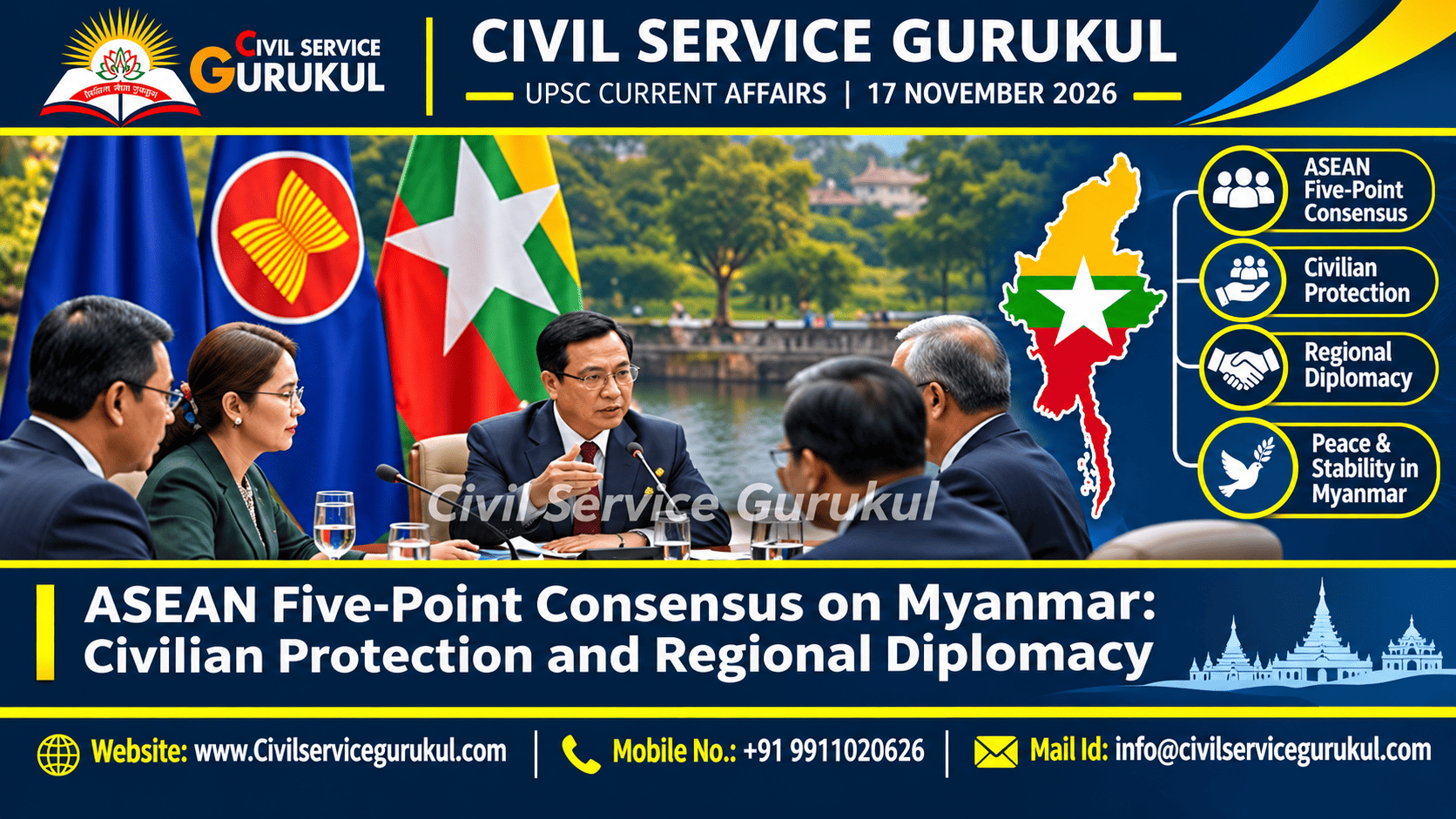
Why Is ASEAN's Myanmar Response in the News?
The supplied current-affairs editorial reports that a 16 November 2026 news index highlighted ASEAN's condemnation of attacks on civilians amid Myanmar's continuing political and humanitarian crisis.
According to the uploaded material, ASEAN leaders adopted a review dated 15 November 2026 reaffirming the Five-Point Consensus as a central reference for regional engagement with Myanmar.
The reported statement condemned violence against civilians and civilian infrastructure and called for improved humanitarian access.
These developments raise important questions about the effectiveness of ASEAN diplomacy, the protection of vulnerable populations and the implications of instability for India.
The November 2026 statement and review are described in the supplied editorial. The original ASEAN document has not been independently verified for this publication draft. The established 2021 Five-Point Consensus is discussed separately below.
UPSC Syllabus Relevance
| UPSC Paper | Relevant Areas |
|---|---|
| GS Paper II | India and its neighbourhood, regional groupings, international relations, diplomacy and humanitarian issues |
| GS Paper IV | Humanitarian ethics, neutrality, empathy, responsibility and accountability |
| Prelims | ASEAN, Five-Point Consensus, Myanmar geography and AHA Centre |
| Essay | Peace, sovereignty, regional cooperation and human dignity |
Understanding Myanmar's Political and Humanitarian Crisis
Myanmar's political crisis intensified following the military takeover in February 2021.
The resulting political instability and armed conflict have created significant humanitarian concerns, including displacement, threats to civilian safety and difficulties in delivering essential assistance.
The crisis also affects neighbouring countries through border insecurity, population movements and disruption of economic activity.
Major Dimensions
- Political instability and competing claims to authority.
- Armed conflict and civilian insecurity.
- Internal displacement and humanitarian needs.
- Challenges in delivering relief assistance.
- Regional security and cross-border implications.
- Diplomatic difficulties in promoting inclusive dialogue.
What Is ASEAN?
The Association of Southeast Asian Nations, or ASEAN, is a regional intergovernmental organisation established in 1967.
It promotes regional cooperation, peace, stability and economic integration among Southeast Asian countries.
ASEAN diplomacy has traditionally emphasised consultation, consensus and respect for national sovereignty.
Important Institutional Features
- Regional cooperation among member states.
- Consensus-oriented decision-making.
- Respect for sovereignty and territorial integrity.
- Peaceful settlement of disputes.
- Economic and socio-cultural cooperation.
ASEAN is a regional organisation. It is not an international court, and its Five-Point Consensus on Myanmar is not a criminal judgment.
What Is ASEAN's Five-Point Consensus?
The ASEAN Five-Point Consensus was agreed at the ASEAN Leaders' Meeting in April 2021 as a political framework to address the situation in Myanmar.
The Five Core Elements
- Immediate cessation of violence: Violence in Myanmar should cease, and all parties should exercise restraint.
- Constructive dialogue: Dialogue among all parties concerned should begin to seek a peaceful solution in the interests of the people.
- ASEAN Special Envoy: A special envoy of the ASEAN Chair should facilitate mediation of the dialogue process, with assistance from the ASEAN Secretary-General.
- Humanitarian assistance: ASEAN should provide humanitarian assistance through the AHA Centre.
- Engagement with all parties: The special envoy and delegation should visit Myanmar to meet all parties concerned.
The Five-Point Consensus is a regional political and diplomatic framework. It is not a binding judgment issued by an international criminal court.
ASEAN Five-Point Consensus: Objectives and Challenges
| Element | Intended Objective | Implementation Challenge |
|---|---|---|
| End violence | Reduce civilian suffering | Continued conflict and limited compliance |
| Inclusive dialogue | Encourage a political solution | Difficulty securing participation of relevant parties |
| Special envoy | Facilitate mediation | Access and diplomatic constraints |
| Humanitarian assistance | Reach affected populations | Access, security and delivery difficulties |
| Engagement with parties | Build confidence and communication | Political disagreements and restricted engagement |
What Is the AHA Centre?
The ASEAN Coordinating Centre for Humanitarian Assistance on disaster management, commonly known as the AHA Centre, is an ASEAN institution supporting coordination of humanitarian assistance and disaster management.
The Five-Point Consensus identifies the AHA Centre as a channel for ASEAN humanitarian assistance concerning Myanmar.
Important Distinction
| Five-Point Consensus | AHA Centre |
|---|---|
| Regional political framework | Institutional humanitarian coordination mechanism |
| Addresses violence, dialogue, mediation and assistance | Supports humanitarian and disaster-related coordination |
| Agreed by ASEAN leaders in 2021 | Established as an ASEAN humanitarian coordination institution |
The two are related in ASEAN's Myanmar response, but they are not the same institution or instrument.
Why Is Civilian Protection Central to the Myanmar Crisis?
Civilian protection concerns the safety and dignity of people who are not participating in hostilities.
Armed conflict can disrupt access to food, healthcare, shelter, education and essential infrastructure.
Important Humanitarian Concerns
- Threats to civilians and civilian infrastructure.
- Internal displacement and loss of shelter.
- Disruption of healthcare and essential services.
- Restrictions on humanitarian access.
- Risks affecting children and other vulnerable groups.
- Challenges in ensuring safe delivery of relief.
Humanitarian responses should be guided by needs and protection considerations rather than political support for any armed actor.
Humanitarian Neutrality and Impartiality
Humanitarian action is commonly associated with principles including humanity, neutrality, impartiality and operational independence.
Humanity
Human suffering should be addressed, and human dignity should be protected.
Neutrality
Humanitarian actors should not take sides in hostilities or engage in political, racial, religious or ideological controversies.
Impartiality
Assistance should be provided on the basis of need without adverse discrimination.
Operational Independence
Humanitarian objectives should remain independent of political, economic or military objectives.
Humanitarian neutrality does not mean approval or endorsement of an armed actor. It concerns the principled delivery of assistance to people in need.
ASEAN's Non-Interference Principle: Strength or Limitation?
ASEAN's emphasis on sovereignty and non-interference has helped shape its approach to regional cooperation and diplomatic engagement.
However, a prolonged internal crisis with regional humanitarian effects can expose tensions between non-interference and collective action.
| Potential Strength | Potential Limitation |
|---|---|
| Encourages dialogue and regional ownership | May limit stronger collective responses |
| Respects sovereignty | Can complicate responses to severe civilian harm |
| Supports diplomatic engagement | Consensus may delay decisions |
| Reduces perceptions of external imposition | Implementation may depend heavily on cooperation |
The challenge is to preserve regional legitimacy while improving the practical effectiveness of humanitarian and diplomatic initiatives.
Why Has Implementation Been Difficult?
1. Continued Violence
Persistent hostilities undermine confidence-building and peaceful dialogue.
2. Limited Cooperation
Diplomatic initiatives depend on meaningful participation by relevant parties.
3. Restricted Humanitarian Access
Security conditions and access constraints can prevent assistance from reaching affected populations.
4. Consensus-Based Decision-Making
Different national preferences may complicate collective action.
5. Difficulty Measuring Progress
Public declarations do not by themselves demonstrate reductions in violence or improvements in humanitarian conditions.
Why Does the Myanmar Crisis Matter to India?
Myanmar is strategically important for India because the two countries share a land border and have long-standing geographical, social and economic connections.
Myanmar also plays an important role in India's engagement with Southeast Asia and its Act East Policy.
Major Implications for India
- Security and stability in India's northeastern border areas.
- Cross-border displacement and humanitarian needs.
- Risks of trafficking and illicit activities.
- Regional connectivity and trade.
- Diplomatic engagement with ASEAN.
- Long-term stability in the wider neighbourhood.
India–Myanmar Border: Important UPSC Geography
India and Myanmar share a land border involving four Indian states.
- Arunachal Pradesh
- Nagaland
- Manipur
- Mizoram
For UPSC, connect the geographical location of Myanmar with India's Northeast, border management, connectivity and regional diplomacy.
India's Act East Policy and Myanmar
India's Act East Policy seeks to strengthen engagement with Southeast Asia across diplomatic, economic, strategic and connectivity dimensions.
Myanmar is an important geographical link between India's northeastern region and mainland Southeast Asia.
Instability in Myanmar can create difficulties for connectivity, trade and cross-border cooperation.
India's policy challenge involves balancing security interests, regional diplomacy and humanitarian considerations.
Displacement, Trafficking and Regional Security
The supplied editorial identifies cross-border displacement and trafficking as important implications of Myanmar's instability for India's northeastern region.
Population movements can create humanitarian and administrative challenges for border communities.
At the same time, conflict-related insecurity may increase risks of exploitation and illicit activity.
Public policy must distinguish people seeking safety from those engaged in criminal conduct.
Effective border management should integrate security coordination, humanitarian sensitivity and respect for applicable legal obligations.
Regional Diplomacy vs Humanitarian Urgency
ASEAN's diplomatic approach seeks regional ownership and engagement.
However, humanitarian needs may require urgent operational action even when political negotiations remain difficult.
This creates a policy challenge: how can regional institutions facilitate assistance without allowing political disagreements to prevent relief?
Possible Responses
- Needs-based humanitarian coordination.
- Continued engagement with relevant stakeholders.
- Transparent assessment of civilian needs.
- Regional dialogue and confidence-building.
- Monitoring of access and delivery outcomes.
How Should Progress Be Measured?
The success of regional diplomacy should not be assessed solely by the number of meetings or statements issued.
| Policy Objective | Possible Indicator |
|---|---|
| Reduction in violence | Credible evidence of declining attacks on civilians |
| Humanitarian access | Ability to deliver needs-based assistance to affected communities |
| Inclusive dialogue | Meaningful engagement among relevant parties |
| Regional coordination | Consistency and effectiveness of diplomatic initiatives |
| Accountability | Transparent reporting and independent review |
Way Forward: Making ASEAN Diplomacy More Effective
- Prioritise civilian protection: Place the safety and dignity of affected people at the centre of regional diplomacy.
- Support humanitarian access: Facilitate needs-based assistance to internally displaced persons and other vulnerable groups.
- Encourage inclusive dialogue: Promote meaningful engagement among relevant stakeholders.
- Strengthen regional coordination: Improve communication among ASEAN members and partners.
- Measure implementation: Track actual changes in violence, humanitarian access and dialogue.
- Protect humanitarian neutrality: Avoid confusing relief assistance with endorsement of any armed actor.
- Address cross-border risks: Improve coordination on displacement, trafficking and border security.
- Support accountable diplomacy: Encourage transparent review of regional initiatives.
ASEAN's Five-Point Consensus remains a significant diplomatic reference, but its effectiveness ultimately depends on measurable progress towards peace, civilian protection and humanitarian access.
UPSC Prelims Quick Revision
- ASEAN was established in 1967.
- Myanmar is a Southeast Asian country.
- The Five-Point Consensus was agreed in April 2021.
- It is a political framework, not a judicial verdict.
- The framework calls for cessation of violence and constructive dialogue.
- It envisages a special envoy of the ASEAN Chair.
- It identifies the AHA Centre as a humanitarian assistance channel.
- Humanitarian neutrality does not mean endorsement of an armed actor.
- India shares a land border with Myanmar through four states.
- Myanmar is strategically relevant to India's Act East Policy.
Original UPSC Prelims Practice MCQs
Question 1: ASEAN Five-Point Consensus
Consider the following statements:
1. The Five-Point Consensus calls for
an immediate cessation of violence.
2. It envisages constructive dialogue
among parties concerned.
3. It is a binding judgment of
an international criminal court.
Which statements are correct?
(a) 1 and 2 only
(b) 2 and 3 only
(c) 1 and 3 only
(d) 1, 2 and 3
View Answer and Explanation
Correct Answer: (a) 1 and 2 only.
The Consensus is a regional political framework promoting cessation of violence, dialogue and humanitarian assistance. It is not a judicial judgment.
Question 2: AHA Centre
Consider the following statements:
1. The AHA Centre is associated with
ASEAN humanitarian assistance coordination.
2. The Five-Point Consensus refers to
humanitarian assistance through the AHA Centre.
3. The AHA Centre is an international
criminal court.
Which statements are correct?
(a) 1 only
(b) 1 and 2 only
(c) 2 and 3 only
(d) 1, 2 and 3
View Answer and Explanation
Correct Answer: (b) 1 and 2 only.
The AHA Centre supports humanitarian and disaster-related coordination. It is not a criminal court.
Question 3: India–Myanmar Geography
Which of the following Indian states share a land border with Myanmar?
1. Arunachal Pradesh
2. Nagaland
3. Manipur
4. Mizoram
(a) 1 and 2 only
(b) 2, 3 and 4 only
(c) 1, 3 and 4 only
(d) 1, 2, 3 and 4
View Answer and Explanation
Correct Answer: (d) 1, 2, 3 and 4.
All four listed states share India's land border with Myanmar.
Question 4: Humanitarian Principles
Which of the following best describes humanitarian neutrality?
(a) Supporting one party to a conflict
(b) Providing assistance only to politically aligned groups
(c) Not taking sides in hostilities while pursuing humanitarian objectives
(d) Treating civilian protection as unnecessary
View Answer and Explanation
Correct Answer: (c).
Neutrality is a recognised humanitarian principle and does not mean approval of any armed actor.
Question 5: ASEAN Diplomacy
Consider the following statements:
1. ASEAN diplomacy has traditionally
emphasised consensus.
2. Consensus-based decision-making
can create implementation difficulties
when members disagree.
3. Regional political agreements
automatically guarantee compliance
by all conflict parties.
Which statements are correct?
(a) 1 and 2 only
(b) 1 and 3 only
(c) 2 and 3 only
(d) 1, 2 and 3
View Answer and Explanation
Correct Answer: (a) 1 and 2 only.
Consensus can support regional ownership, but implementation may remain difficult. Political agreements do not automatically guarantee compliance.
UPSC Mains Practice Question
"ASEAN's Five-Point Consensus reflects both the possibilities and limitations of consensus-based regional diplomacy." Critically examine with reference to Myanmar's humanitarian crisis and implications for India.
Suggested Answer-Writing Framework
Introduction: Briefly explain Myanmar's crisis and ASEAN's Five-Point Consensus.
Positive Aspects: Regional ownership, dialogue, mediation and humanitarian assistance.
Limitations: Continued violence, access constraints, limited cooperation and consensus-based implementation difficulties.
India's Interests: Northeastern security, displacement, regional connectivity and Act East Policy.
Way Forward: Needs-based humanitarian assistance, inclusive dialogue, measurable progress and regional coordination.
Conclusion: Emphasise peace, civilian protection and accountable diplomacy.
GS Paper IV: Ethics Case Study
You are an administrator in a border district facing an increase in people seeking safety because of conflict in a neighbouring country.
Local communities express concerns about limited public resources, while humanitarian groups request immediate assistance.
How would you balance security, human dignity, resource constraints and administrative accountability?
Suggested Ethical Approach
- Identify vulnerable persons and urgent humanitarian needs.
- Act within applicable legal and administrative procedures.
- Coordinate with relevant security and civil authorities.
- Ensure fair, transparent and non-discriminatory service delivery.
- Protect personal information and dignity.
- Communicate clearly with affected communities.
Frequently Asked Questions
1. What is ASEAN's Five-Point Consensus?
It is a regional political framework agreed in April 2021 to address the situation in Myanmar through cessation of violence, dialogue, mediation and humanitarian assistance.
2. What is the AHA Centre?
It is the ASEAN Coordinating Centre for Humanitarian Assistance on disaster management.
3. Is the Five-Point Consensus legally the same as a court judgment?
No. It is a diplomatic and political framework, not an international criminal court judgment.
4. Why does Myanmar matter to India?
Myanmar is important for India's Northeast, border security, regional connectivity and engagement with Southeast Asia.
5. Which Indian states border Myanmar?
Arunachal Pradesh, Nagaland, Manipur and Mizoram.
6. Why is ASEAN diplomacy difficult in Myanmar?
Continued violence, limited cooperation, humanitarian access constraints and consensus-based decision-making create significant challenges.
Conclusion: Regional Diplomacy Must Deliver Civilian Protection
ASEAN's Five-Point Consensus provides a regional framework for responding to Myanmar's political and humanitarian crisis.
Its emphasis on cessation of violence, dialogue, mediation and humanitarian assistance remains important.
However, diplomatic statements alone cannot establish effective implementation. Progress must be evaluated through actual changes in civilian safety, humanitarian access and meaningful dialogue.
For India, Myanmar's stability is linked to northeastern security, humanitarian concerns and regional connectivity.
A responsible approach should combine constructive diplomacy, needs-based assistance, border coordination and respect for human dignity.
Prepare for UPSC Prelims & Mains with Civil Service Gurukul
Master International Relations, India's Neighbourhood, ASEAN, Current Affairs and Ethics through conceptual learning, original MCQs and structured Mains answer-writing practice.
Visit Civil Service Gurukul Contact Our TeamEditorial Note
This original educational article is developed from the subject and contextual information provided in the uploaded editorial dated 17 November 2026.
The reported 15 November 2026 ASEAN review has not been independently checked against its original document for this draft. The discussion of the 2021 Five-Point Consensus and the broader institutional framework is presented as background analysis.