Aadhaar Biometric Exclusion: Rights & UPSC 2027
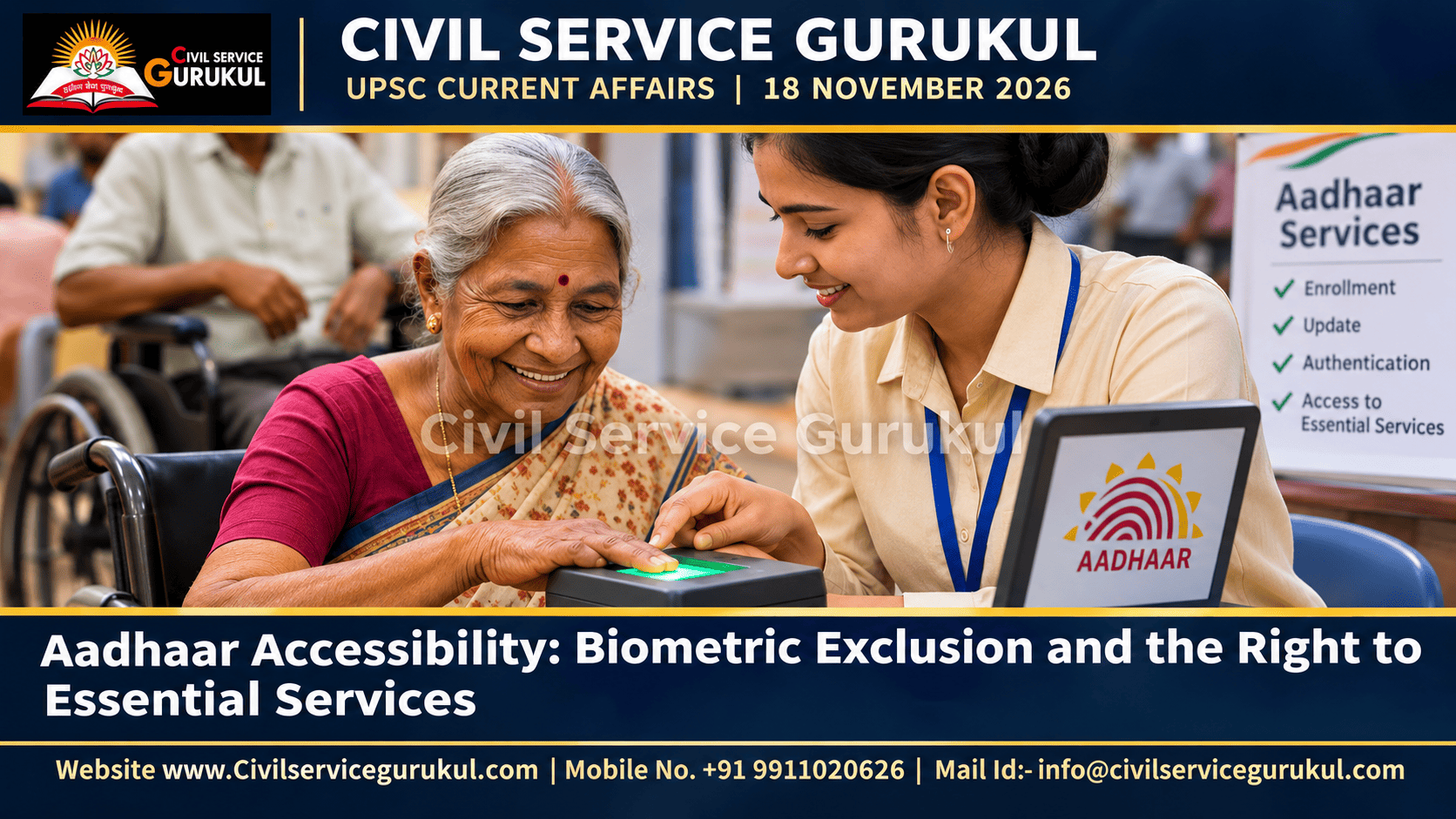
Aadhaar Biometric Exclusion in India: Can Digital Identity Deny Access to Essential Services?
A comprehensive UPSC analysis of Aadhaar accessibility, biometric authentication failures, welfare exclusion, constitutional rights, grievance redressal and inclusive digital governance.
1. Why Is Aadhaar Accessibility in the News?
A November 2026 news topic reports concerns raised in the Supreme Court regarding the accessibility of Aadhaar-related systems.
The development brings attention to the practical challenges faced by individuals who cannot complete biometric authentication reliably.
Digital identity can simplify verification, but service delivery must also account for technological failures and unequal access to digital infrastructure.
2. What Is Aadhaar?
Aadhaar is a unique identity number issued under India's Aadhaar framework to eligible residents following the prescribed process.
It is associated with demographic and biometric identity information.
Aadhaar is designed to support identity verification in permitted contexts.
3. Aadhaar and Digital Governance
Digital identity systems may help reduce duplication, support verification and improve administrative processes.
However, successful digital governance depends on reliability, accessibility, accountability and appropriate legal safeguards.
Potential Benefits
- Standardised identity verification.
- Reduced duplication in appropriate administrative processes.
- Support for digital service delivery.
- Potential improvement in transaction efficiency.
- Greater administrative traceability where properly designed.
These potential benefits must be evaluated against actual service outcomes and the risk of excluding eligible beneficiaries.
4. What Is Biometric Authentication?
Biometric authentication uses measurable biological characteristics to verify identity against a relevant reference record.
In the Aadhaar context, biometric authentication can involve permitted biometric modalities under the applicable technical framework.
Authentication vs Identification
| Concept | Meaning |
|---|---|
| Identification | Determining or establishing who a person is. |
| Authentication | Verifying a claimed identity through an accepted mechanism. |
| Eligibility | Whether a person meets the substantive conditions for a service or benefit. |
| Authorisation | Whether access to a particular service or transaction is permitted. |
A person may be eligible for a service even when a particular authentication attempt does not succeed.
5. Why Can Biometric Authentication Fail?
A biometric sample may not match the stored reference reliably.
Weak network access may interrupt authentication.
Equipment or software problems can prevent successful verification.
Interfaces may be difficult for persons with disabilities to use.
Some older users may face difficulties with particular biometric methods.
Manual work may affect fingerprint quality in some circumstances.
6. What Is Biometric Exclusion?
Biometric exclusion occurs when individuals are unable to access a service because a biometric verification requirement cannot be completed successfully.
The exclusion risk becomes particularly serious when authentication is treated as the only available route to an essential service.
Groups That May Face Greater Difficulties
- Older persons.
- Persons with disabilities.
- Manual workers with worn fingerprints.
- People living in areas with weak connectivity.
- Individuals requiring assisted digital access.
- People facing language or interface barriers.
7. Digital Divide and Social Inequality
The digital divide refers to differences in access to, ability to use and benefit from digital technologies.
It may involve infrastructure, affordability, digital literacy, disability access and institutional support.
Digital public services may produce unequal outcomes if these differences are not addressed.
8. Aadhaar Accessibility and Constitutional Values
Digital governance should be examined through the principles of equality, dignity, privacy and procedural fairness.
Article 14: Equality
Article 14 provides for equality before the law and equal protection of the laws.
A governance system should avoid unjustified or arbitrary distinctions in access to public services.
Article 21: Life and Personal Liberty
Article 21 protects life and personal liberty and forms an important basis for constitutional jurisprudence on dignity and privacy.
Exclusion from essential services may raise serious constitutional concerns depending on the legal and factual context.
Privacy and Data Protection
Identity systems involve sensitive personal information.
Responsible governance requires appropriate safeguards for lawful processing, security, purpose limitation and accountability under applicable law.
9. Aadhaar and Access to Essential Services
Identity verification may be used in the administration of welfare programmes and other public services, subject to applicable legal requirements.
However, technical verification mechanisms must not be confused with the underlying substantive conditions for entitlement.
Potential Areas of Concern
- Food security and public distribution services.
- Social assistance and pension delivery.
- Other eligible welfare benefits.
- Public-service access requiring identity verification.
- Grievance resolution when authentication fails.
The specific authentication requirements and fallback procedures may differ across schemes and jurisdictions.
10. Authentication Failure vs Welfare Ineligibility
| Parameter | Authentication Failure | Ineligibility |
|---|---|---|
| Meaning | A verification attempt does not succeed. | Substantive eligibility conditions are not satisfied. |
| Possible Cause | Biometric, technical or accessibility problem. | Failure to meet applicable scheme requirements. |
| Appropriate Response | Investigate failure and use lawful alternatives where available. | Apply the relevant eligibility and review procedures. |
| Key Distinction | Does not automatically prove ineligibility. | Requires assessment under the governing rules. |
11. Alternative Authentication and Inclusive Service Design
A resilient identity system should anticipate technical failure and provide appropriate recovery mechanisms.
Depending on the applicable legal and technical framework, alternatives may include assisted, offline or non-biometric verification routes.
Important Design Principles
Provide legally permitted alternatives when a primary method fails.
Support people who require help using digital systems.
Design systems for diverse physical and cognitive needs.
Provide clear complaint and correction procedures.
Allow appropriate human review of unresolved technical failures.
Record failures, resolution times and service outcomes.
12. Why Grievance Redressal Is Essential
An effective grievance mechanism allows individuals to report failures, seek correction and challenge improper service denial.
It should be accessible, time-bound, transparent and supported by clear institutional responsibility.
Without meaningful remedies, digital efficiency may come at the cost of procedural fairness and public trust.
13. Digital Governance: Efficiency vs Inclusion
| Policy Objective | Potential Benefit | Associated Risk |
|---|---|---|
| Digital Verification | Faster administrative processing. | Technical failures may block access. |
| Standardisation | More consistent verification procedures. | Uniform systems may overlook individual needs. |
| Automation | Reduced manual processing. | Limited human review may delay correction. |
| Data Integration | Potentially improved administrative coordination. | Privacy and security concerns. |
14. Ethical Dimensions for GS Paper IV
Dignity
Public-service systems should treat individuals with respect, particularly when they face technical difficulties.
Justice
Administrative efficiency should not impose disproportionate burdens on vulnerable groups.
Accountability
Authorities should identify failures, provide remedies and explain relevant decisions.
Compassion
Frontline service delivery should recognise the practical difficulties faced by individuals with limited digital access.
15. Way Forward: Making Aadhaar-Linked Services Inclusive
- Provide lawful alternatives: Use assisted, offline and non-biometric routes where permitted.
- Improve accessibility: Test interfaces against applicable disability-access standards.
- Strengthen grievance redressal: Establish clear and time-bound correction processes.
- Train frontline personnel: Improve understanding of authentication failures and available remedies.
- Monitor exclusion: Publish appropriate failure and resolution indicators.
- Protect privacy: Maintain safeguards for personal information.
- Improve connectivity: Address infrastructure barriers in underserved areas.
- Ensure human oversight: Provide review channels for unresolved cases.
16. UPSC Prelims 2027: Quick Revision
- Aadhaar is not, by itself, proof of citizenship.
- Authentication and eligibility are different concepts.
- Biometric mismatch may arise from technical or accessibility problems.
- Connectivity failure can disrupt digital verification.
- Persons with disabilities and older users may require accessible alternatives.
- Article 14 concerns equality before the law.
- Article 21 protects life and personal liberty.
- Grievance redressal is important for accountable public administration.
- Alternative verification must follow the applicable legal framework.
17. Original UPSC Prelims MCQs
Question 1
Consider the following statements:
- Aadhaar is, by itself, conclusive proof of Indian citizenship.
- Biometric authentication failure may occur because of technical problems.
- Authentication failure necessarily proves that a person is ineligible for welfare.
Which statement is correct?
(A) 1 only
(B) 2 only
(C) 1 and 3 only
(D) 2 and 3 only
Statement 1 is incorrect: Aadhaar is not proof of citizenship. Statement 2 is correct: technical problems can cause failures. Statement 3 is incorrect: failed authentication does not establish substantive ineligibility.
Question 2
Which factors may contribute to biometric exclusion?
- Biometric mismatch
- Weak connectivity
- Inaccessible digital interfaces
(A) 1 only
(B) 1 and 2 only
(C) 2 and 3 only
(D) 1, 2 and 3
All three factors may prevent successful access to biometric-based services.
Question 3
Which constitutional provision is associated with equality before the law?
(A) Article 14
(B) Article 19 only
(C) Article 32 only
(D) Article 51A only
Article 14 guarantees equality before the law and equal protection of the laws.
Question 4
Which of the following is most consistent with inclusive digital service delivery?
(A) Treat every authentication failure as fraud
(B) Remove all grievance mechanisms
(C) Provide legally appropriate fallback and review channels
(D) Require identical interfaces regardless of disability-related needs
Appropriate fallback mechanisms and human review can help prevent avoidable exclusion.
Question 5
Consider the following statements:
- Digital efficiency is the only relevant measure of public-service success.
- Grievance redressal can support procedural fairness.
- Accessibility should be considered when designing digital public services.
Which statements are correct?
(A) 1 and 2 only
(B) 2 and 3 only
(C) 1 and 3 only
(D) 1, 2 and 3
Statement 1 is incorrect because service outcomes, inclusion and accountability also matter.
18. UPSC Mains Practice Question
"Digital identity systems can improve administrative efficiency, but their legitimacy depends on accessibility and protection against exclusion." Discuss with reference to Aadhaar-based service delivery.
Word Limit: 250 words
19. Model UPSC Mains Answer
Introduction
Digital identity systems can simplify verification and support public-service delivery. However, their effectiveness must be assessed through both administrative efficiency and equitable access.
Potential Benefits
- Efficiency: Standardised verification can simplify administrative processes.
- Service Delivery: Digital systems may support faster transactions.
- Accountability: Properly designed records may improve traceability.
Major Challenges
- Biometric mismatches can prevent successful authentication.
- Weak connectivity and device problems can disrupt service delivery.
- Persons with disabilities and older individuals may face accessibility barriers.
- Inadequate grievance redressal can prolong exclusion.
Constitutional and Ethical Dimensions
Articles 14 and 21 provide important constitutional perspectives on equality, dignity and procedural fairness.
A failed authentication attempt should not automatically be treated as proof of ineligibility.
Way Forward
Authorities should provide lawful fallback mechanisms, improve accessibility, train frontline personnel, strengthen grievance redressal and monitor failure-resolution outcomes.
Conclusion
Inclusive digital governance requires technology that supports citizens rather than creating avoidable barriers to essential services.
20. Frequently Asked Questions
What is Aadhaar biometric exclusion?
It refers to situations where individuals cannot access services because biometric verification cannot be completed successfully.
Is Aadhaar proof of Indian citizenship?
No. Aadhaar is an identity mechanism and is not, by itself, proof of citizenship.
Does biometric authentication failure mean a person is ineligible for welfare?
No. Authentication failure can arise from technical or accessibility problems and does not itself prove ineligibility.
Why is Aadhaar accessibility relevant for UPSC?
It connects digital governance, social justice, constitutional values, technology, public administration and ethics.
What are important safeguards against biometric exclusion?
Legally appropriate fallback mechanisms, accessible interfaces, assisted access, grievance redressal and human oversight.
21. Conclusion: Digital Identity Must Support Inclusion
The reported November 2026 Supreme Court concerns regarding Aadhaar accessibility highlight the need to assess digital identity systems through both efficiency and public-service outcomes.
Biometric mismatches, connectivity failures and inaccessible interfaces can create barriers for eligible individuals.
A resilient governance framework must provide appropriate safeguards, accessible remedies and accountable service delivery.
For UPSC aspirants, the central lesson is that technological efficiency should be evaluated alongside equality, dignity and procedural fairness.
Master Polity, Governance & Social Justice for UPSC 2027
Prepare with Civil Service Gurukul through concept-based current affairs, Prelims MCQs, Mains answer writing and structured mentoring.
CIVIL SERVICE GURUKUL
UPSC | IAS | State PCS | Prelims & Mains
Visit Our Website Call +91 9911020626 Email for Enquirywww.civilservicegurukul.com
Editorial Disclaimer: This educational article is based on the uploaded topic indexed on 17 November 2026 concerning Supreme Court observations about Aadhaar accessibility. The precise court directions have not been independently verified in this article. Legal requirements for alternative verification depend on the applicable statutory and scheme-specific framework. Additional examples, UPSC MCQs and Mains material are educational explanations.
Prepare with Mentors Who Cleared the Exam
Get personalized study plans, evaluated answer models, and test series access.