Indian Students in US Universities 2026: UPSC Analysis
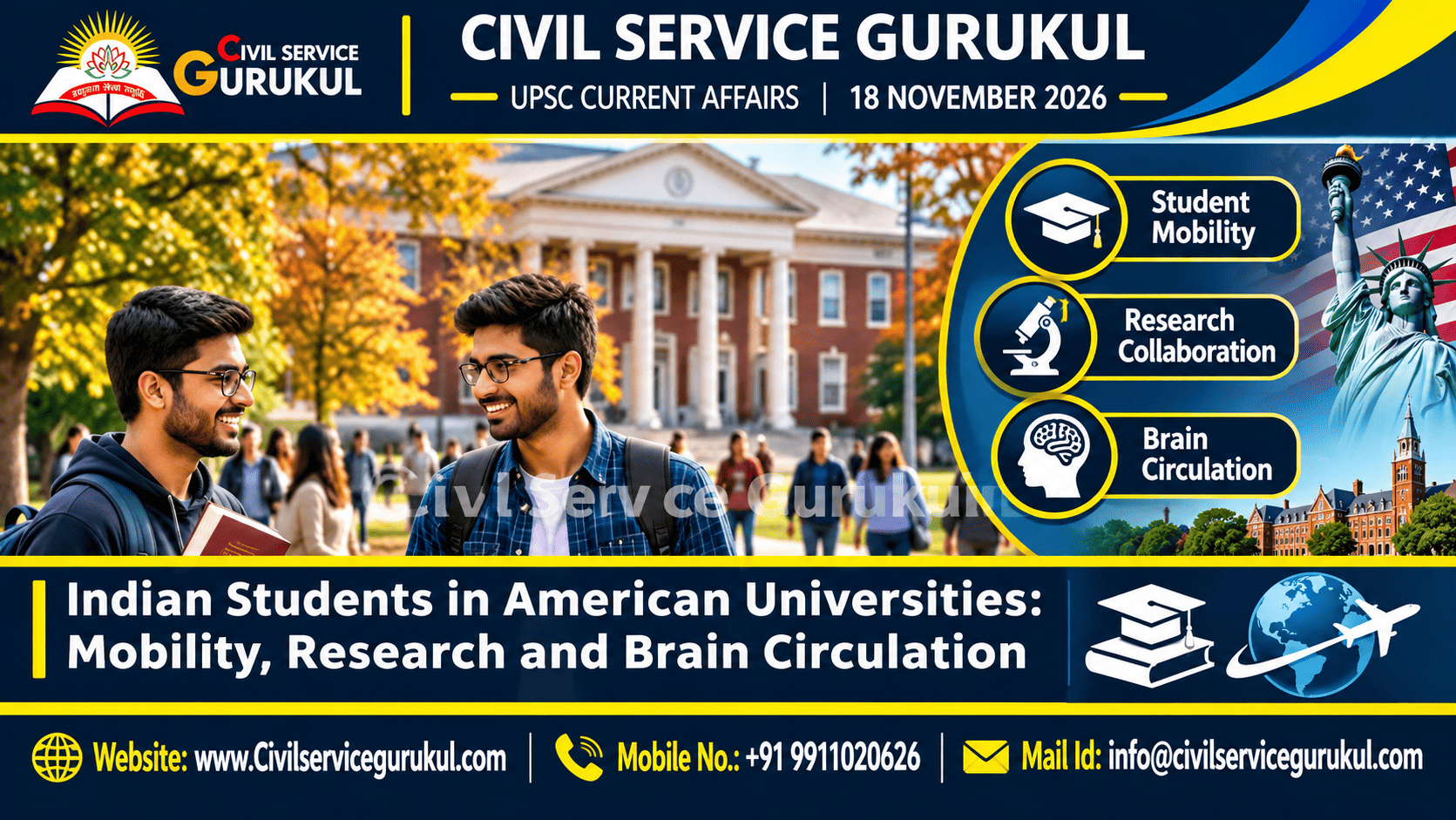
Indian Students in US Universities: Is Declining Student Mobility a Brain Drain Reversal or a New Challenge for India?
A comprehensive UPSC analysis of international student mobility, India–US education relations, brain drain, brain circulation, research collaboration and human-capital development.
1. Introduction: Why Indian Students in US Universities Matter
International higher education has become an important dimension of economic globalisation, skilled migration, research collaboration and international relations.
Indian students pursuing education in American universities participate in a wider system of cross-border knowledge exchange, academic mobility and professional networks.
A reported decline in their numbers raises questions about education costs, visa policies, employment prospects, university choices and India's domestic higher education ecosystem.
However, a single reported decline should not be treated as proof of a permanent shift in international student mobility.
2. What Is International Student Mobility?
International student mobility refers to the movement of students across national borders for educational purposes.
Such movement may involve degree programmes, research training, academic exchanges or other recognised educational activities.
Major Forms of Student Mobility
Students enrol in full academic degree programmes outside their home country.
Scholars participate in overseas research projects or advanced academic training.
Students undertake temporary academic exchanges under institutional arrangements.
Some graduates subsequently seek permitted professional opportunities, subject to immigration rules.
3. Why Do Indian Students Choose American Universities?
- Access to specialised academic programmes.
- Research infrastructure and laboratories.
- Opportunities for advanced scientific training.
- International faculty and academic networks.
- Industry and university research collaboration.
- Scholarships and other funding opportunities.
- Potential professional opportunities after graduation, subject to applicable rules.
The relative importance of these factors differs across students, institutions and academic disciplines.
4. Understanding the Reported Decline: Why Definitions Matter
A headline about fewer Indian students in American universities must be interpreted carefully.
Different datasets measure different aspects of student mobility and may refer to different time periods.
| Indicator | What It Measures | Why It Matters |
|---|---|---|
| New Admissions | Students newly admitted or beginning study during a period, depending on the dataset. | Indicates new student inflow. |
| Total Enrolment | Students enrolled at a specified point or during a reporting period. | Measures the student population covered by the dataset. |
| Visa Issuances | Visas issued during a specified period. | Does not directly equal university enrolment. |
| Active Student Records | Students recorded as active under a particular administrative system. | Depends on the system's definitions and reporting dates. |
| Graduates | Students completing qualifications during a period. | Relevant for education-to-employment transitions. |
Stock vs Flow: An Important UPSC Concept
New admissions during a year are a flow measure, whereas total students enrolled at a given point in time represent a stock measure.
Therefore, a decline in new admissions does not necessarily imply an immediate decline in the total stock of enrolled students.
5. How Should International Student Data Be Verified?
A reliable assessment should compare datasets on a consistent basis.
- Identify the statistical source and reporting agency.
- Check whether the figures concern new admissions or total enrolment.
- Use comparable academic or financial years.
- Separate visa data from university enrolment data.
- Distinguish provisional information from final statistics.
- Examine multiple years before claiming a sustained trend.
The Open Doors reporting framework, university enrolment information and relevant visa statistics may provide different but complementary perspectives.
6. Factors Influencing Indian Student Mobility to the United States
Higher education expenses influence affordability and destination choices.
Entry requirements and permitted study or work arrangements can affect student decisions.
Financial support can expand access to overseas education.
Expected career outcomes may influence programme and destination choices.
Currency movements affect the domestic-currency cost of overseas study.
Access to specialised facilities and academic networks can influence postgraduate choices.
7. The Role of Student Visa Policies
International students must comply with the immigration requirements of their destination country.
For the United States, different visa classifications apply to different educational and exchange activities.
The F-1 category is commonly associated with eligible academic study, while other categories may apply to different educational circumstances.
8. Brain Drain vs Brain Gain vs Brain Circulation
The movement of skilled people across countries has traditionally been discussed in terms of brain drain.
However, international mobility can also create knowledge networks, return migration, investment links and collaborative research.
| Concept | Meaning | Potential Outcome |
|---|---|---|
| Brain Drain | Loss of skilled human resources through emigration. | Possible reduction in domestic availability of specialised talent. |
| Brain Gain | Increase in available skills through migration, return or knowledge acquisition. | Strengthening of domestic human capital. |
| Brain Circulation | Two-way or networked movement of skills, knowledge and professional connections. | Research collaboration, entrepreneurship and knowledge exchange. |
Why Brain Circulation Is Important
- Overseas researchers can collaborate with Indian institutions.
- Returnees may bring specialised skills and experience.
- Professional networks can facilitate entrepreneurship.
- International academic partnerships can support joint research.
- Knowledge exchange can occur even without permanent return migration.
9. Potential Benefits of Overseas Higher Education for India
A. Advanced Skills
Students may acquire specialised academic and technical capabilities that can support professional development.
B. Research Collaboration
International academic networks can facilitate joint publications, knowledge exchange and research projects.
C. Entrepreneurship
Some graduates may participate in innovation, startups or cross-border business networks.
D. Diaspora Connections
Educational mobility can contribute to long-term professional and social networks between countries.
E. International Cooperation
Academic exchanges can support broader educational, scientific and diplomatic relationships.
10. Challenges Associated with International Student Mobility
High education costs can create pressure on students and families.
Financial resources and information gaps may limit participation.
Policy changes can complicate study and career planning.
Domestic institutions may face challenges retaining specialised researchers.
Students may require support for housing, safety and academic adjustment.
Inaccurate advice can expose students to avoidable risks.
11. International Student Mobility and Research Innovation
Universities and research institutions operate within increasingly international knowledge networks.
Graduate students and research scholars may contribute to scientific projects, technological development and academic collaboration.
However, the benefits for India depend on the strength of domestic research institutions and their capacity to maintain meaningful international partnerships.
12. Why Domestic Research Capacity Matters
- Strong laboratories can attract and retain research talent.
- Stable funding supports long-term scientific projects.
- University–industry partnerships can improve innovation outcomes.
- Transparent academic recruitment can strengthen institutional credibility.
- International collaboration can complement domestic research capabilities.
13. India–US Education Relations
Education and research cooperation form an important dimension of India–US relations.
Student exchanges, university partnerships and scientific collaboration can strengthen institutional and people-to-people ties.
At the same time, student mobility is affected by national immigration rules, economic conditions and the choices of individual students.
14. Equity and Social Justice in Overseas Education
International education opportunities are not equally accessible to all students.
Differences in family income, information, language preparation, academic networks and financing options can affect participation.
Policy evaluation should therefore consider not only total mobility but also who benefits from international education opportunities.
15. Policy Priorities for India
- Strengthen domestic universities: Improve teaching, infrastructure and research capacity.
- Expand research funding: Support competitive and sustained research programmes.
- Improve student information: Encourage transparent guidance on costs, admissions and immigration requirements.
- Support student welfare: Strengthen relevant assistance and grievance mechanisms.
- Promote academic partnerships: Encourage meaningful joint research and institutional collaboration.
- Facilitate knowledge exchange: Build channels for diaspora and returnee participation.
- Improve data quality: Track mobility indicators consistently over time.
- Address inequality: Expand fair access to scholarships and opportunities.
16. Brain Circulation as a Development Strategy
A brain-circulation approach recognises that knowledge can move across borders without requiring every skilled person to return permanently.
Research partnerships, joint supervision, professional networks and collaborative entrepreneurship can create channels for knowledge exchange.
However, such benefits require strong institutions, appropriate incentives and measurable outcomes.
17. Way Forward: From Student Counts to Human-Capital Outcomes
- Compare enrolment and visa statistics using consistent periods.
- Distinguish short-term fluctuations from sustained trends.
- Improve access to reliable education information.
- Strengthen domestic research and postgraduate education.
- Promote international academic partnerships.
- Develop channels for return migration and knowledge exchange.
- Monitor student welfare and educational outcomes.
- Evaluate policies through skills, research and social impact, not only headline counts.
18. UPSC Prelims 2027: Quick Revision
- New admissions and total enrolment are different indicators.
- Visa issuances do not necessarily equal university enrolment.
- New admissions are a flow measure; total enrolment is a stock measure.
- International mobility can support research networks and knowledge exchange.
- Brain drain and brain circulation are distinct concepts.
- Exchange rates can influence the domestic-currency cost of overseas education.
- Higher education mobility is relevant to human capital and international relations.
- A single-year decline does not establish a permanent trend.
19. Original UPSC Prelims MCQs with Explanations
Question 1
Consider the following statements:
- New international student admissions and total international student enrolment are identical statistical measures.
- A decline in new admissions need not imply an immediate decline in total enrolment.
- Visa issuances and actual university enrolment may differ.
Which statements are correct?
(A) 1 and 2 only
(B) 2 and 3 only
(C) 1 and 3 only
(D) 1, 2 and 3
Statement 1 is incorrect because admissions and total enrolment are different measures. Statements 2 and 3 are correct.
Question 2
Which of the following may influence international student mobility?
- Tuition and living costs
- Visa and immigration policies
- Research opportunities
- Exchange-rate movements
(A) 1 and 2 only
(B) 2 and 3 only
(C) 1, 3 and 4 only
(D) 1, 2, 3 and 4
All four factors can influence overseas education decisions.
Question 3
Which statement best describes brain circulation?
(A) Permanent loss of all skilled workers from a country
(B) Complete prohibition of international academic mobility
(C) Cross-border movement and exchange of skills, knowledge and networks
(D) A policy requiring every student to remain in the destination country
Brain circulation refers to cross-border flows and networks involving knowledge, skills and professional connections.
Question 4
Consider the following statements:
- International education may support research collaboration.
- Every student who studies abroad represents a permanent loss of human capital.
- Knowledge exchange can occur without permanent return migration.
(A) 1 and 2 only
(B) 1 and 3 only
(C) 2 and 3 only
(D) 1, 2 and 3
Statement 2 is incorrect because international mobility may generate return migration, research partnerships and knowledge exchange.
Question 5
Which of the following is the most appropriate approach for evaluating a reported decline in international students?
(A) Treat every visa statistic as identical to enrolment
(B) Assume a single decline proves a permanent trend
(C) Compare consistent datasets, definitions and reporting periods
(D) Ignore differences between new admissions and total enrolment
Reliable analysis requires consistent definitions, comparable periods and appropriate statistical sources.
20. UPSC Mains Practice Question
"Overseas higher education can generate both brain drain and brain circulation for India." Critically examine the opportunities and challenges associated with international student mobility.
Word Limit: 250 words
21. Model UPSC Mains Answer
Introduction
International student mobility involves cross-border movement for education and research. For India, it creates opportunities for advanced skills and global networks, but also raises concerns about talent retention, affordability and inequality.
Opportunities
- Human capital: Access to specialised training and academic resources.
- Research: International partnerships and collaborative projects.
- Innovation: Knowledge networks may support entrepreneurship.
- Diplomacy: Academic exchanges strengthen people-to-people ties.
Challenges
- High tuition and living costs may restrict access.
- Visa uncertainty can complicate educational planning.
- Persistent emigration may affect domestic talent availability.
- Unequal access can reinforce social and economic disparities.
Way Forward
India should strengthen domestic research funding, university infrastructure, student protections and international partnerships. A brain-circulation strategy can encourage return migration, collaborative research and diaspora knowledge exchange.
Conclusion
The developmental value of overseas education depends not only on student numbers but also on the skills, research networks and opportunities it creates for India.
22. Important Terms for UPSC
| Term | Meaning |
|---|---|
| International Student Mobility | Cross-border movement for educational purposes. |
| Brain Drain | Loss of skilled human resources through emigration. |
| Brain Gain | Increase in skills available through migration or knowledge acquisition. |
| Brain Circulation | Cross-border movement and exchange of skills, knowledge and networks. |
| Human Capital | Knowledge, skills and capabilities contributing to productive activity. |
| Student Enrolment | Students registered in an educational programme under a defined reporting system. |
| Student Admissions | Students admitted during a specified reporting period. |
| Education Diplomacy | Use of educational cooperation in international relationships. |
23. Frequently Asked Questions
Why are Indian students in US universities important for UPSC?
The issue connects international relations, education, migration, human capital, research and social inequality.
Does a decline in new admissions mean total Indian student enrolment has fallen?
Not necessarily. New admissions and total enrolment are different measures.
What is the difference between brain drain and brain circulation?
Brain drain emphasises the loss of skilled human resources, while brain circulation emphasises cross-border knowledge and skill networks.
What factors influence Indian students choosing US universities?
Costs, scholarships, academic opportunities, research infrastructure, visa requirements and career prospects may influence decisions.
Can overseas education benefit India without students returning permanently?
Yes. Research partnerships, professional networks and knowledge exchange may create benefits without permanent return.
How should a reported decline in Indian students be verified?
Compare the relevant enrolment, admissions and visa datasets using consistent definitions and periods.
24. Conclusion: From Brain Drain to Brain Circulation
The reported November 2026 decline in Indian students at American universities raises important questions about global education and India's human-capital development.
However, accurate interpretation requires distinguishing new admissions, total enrolment and visa data.
International education can create both risks and opportunities. The long-term outcome depends on domestic institutional strength, research capacity, student welfare and cross-border knowledge networks.
For UPSC aspirants, the central lesson is to evaluate international student mobility through human-capital outcomes rather than relying only on headline counts.
Master International Relations & Education for UPSC Prelims & Mains 2027
Prepare with Civil Service Gurukul through concept-based current affairs, international relations analysis, Prelims MCQs, Mains answer writing and structured mentoring.
CIVIL SERVICE GURUKUL
UPSC | IAS | State PCS | Prelims & Mains
Visit Our Website Call +91 9911020626 Email for Enquirywww.civilservicegurukul.com
Editorial Disclaimer: This educational article is based on the uploaded topic indexed on 17 November 2026 reporting a decline in Indian students at US universities. The source does not establish the exact statistical measure, reporting period or percentage change. The article therefore avoids unsupported numerical claims. Conceptual explanations, examples, UPSC MCQs and Mains material are provided for educational purposes. Current figures and immigration requirements should be checked against the relevant official datasets and regulations.
Prepare with Mentors Who Cleared the Exam
Get personalized study plans, evaluated answer models, and test series access.