Daily Current Affairs & News Analysis
Our daily news analysis consists of two integral parts — Daily News Analysis and Important Editorials curated rigorously from The Hindu, The Indian Express, LiveMint, PIB, and Sansad TV debates. Content is mapped directly to UPSC CSE and State PCS syllabi.
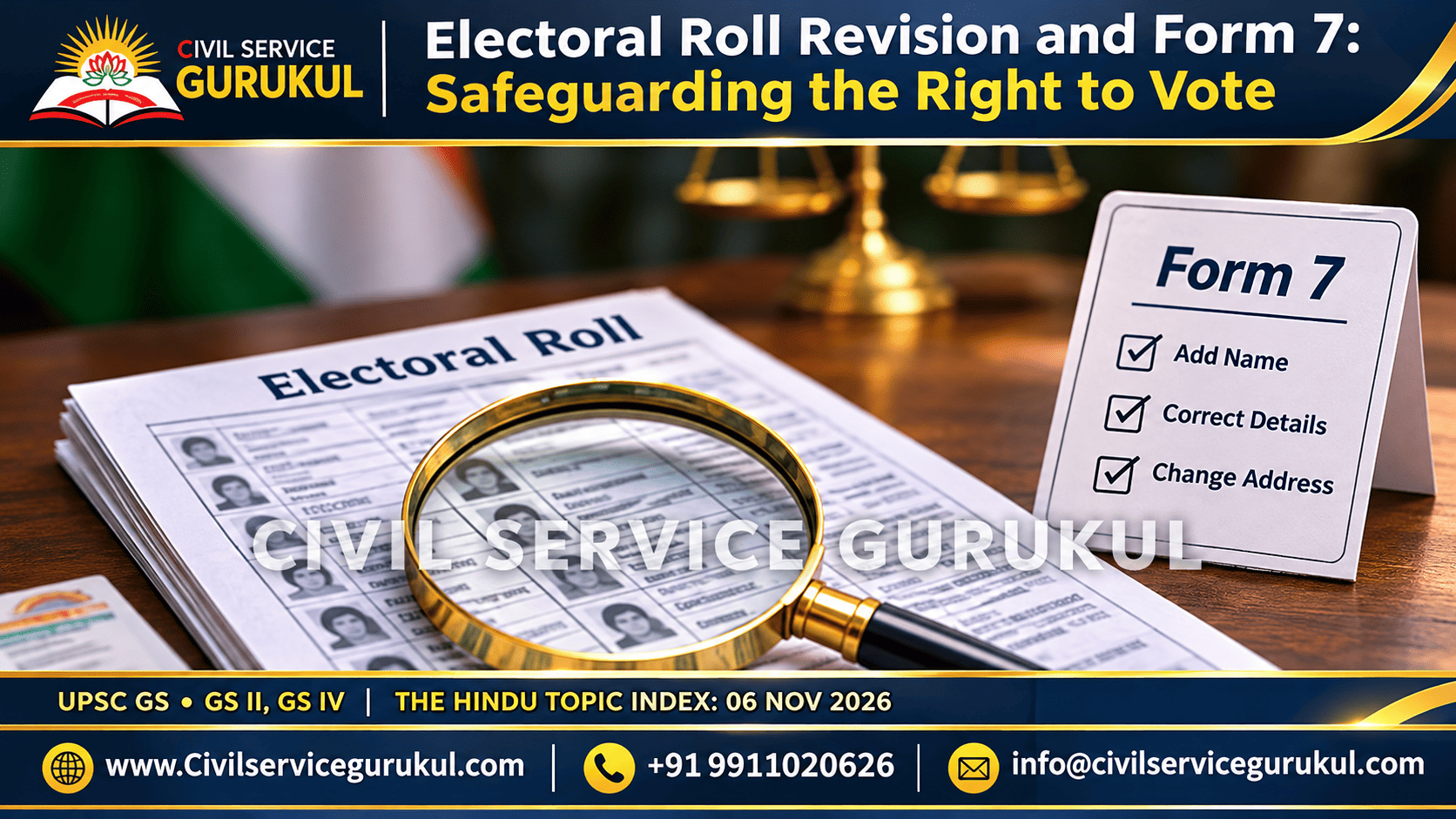
Electoral Roll Revision & Form 7: UPSC 2027 Notes
Electoral roll revision is a vital democratic exercise that aims to maintain accurate voter lists while protecting eligible citizens from wrongful exclusion. Recent reporting concerning electoral roll revisions and allegations of forged Form 7 objections has renewed attention to procedural fairness and electoral integrity. This UPSC 2027 article explains Article 324, the Representation of the People Act, 1950, the Registration of Electors Rules, 1960, and the roles of Forms 6 and 7. It also examines voter deletion safeguards, institutional accountability, the challenges faced by migrants and vulnerable voters, and the balance between electoral accuracy and inclusion. Includes Prelims revision notes, practice MCQs, GS-II and GS-IV analysis, Mains answer-writing guidance and FAQs.
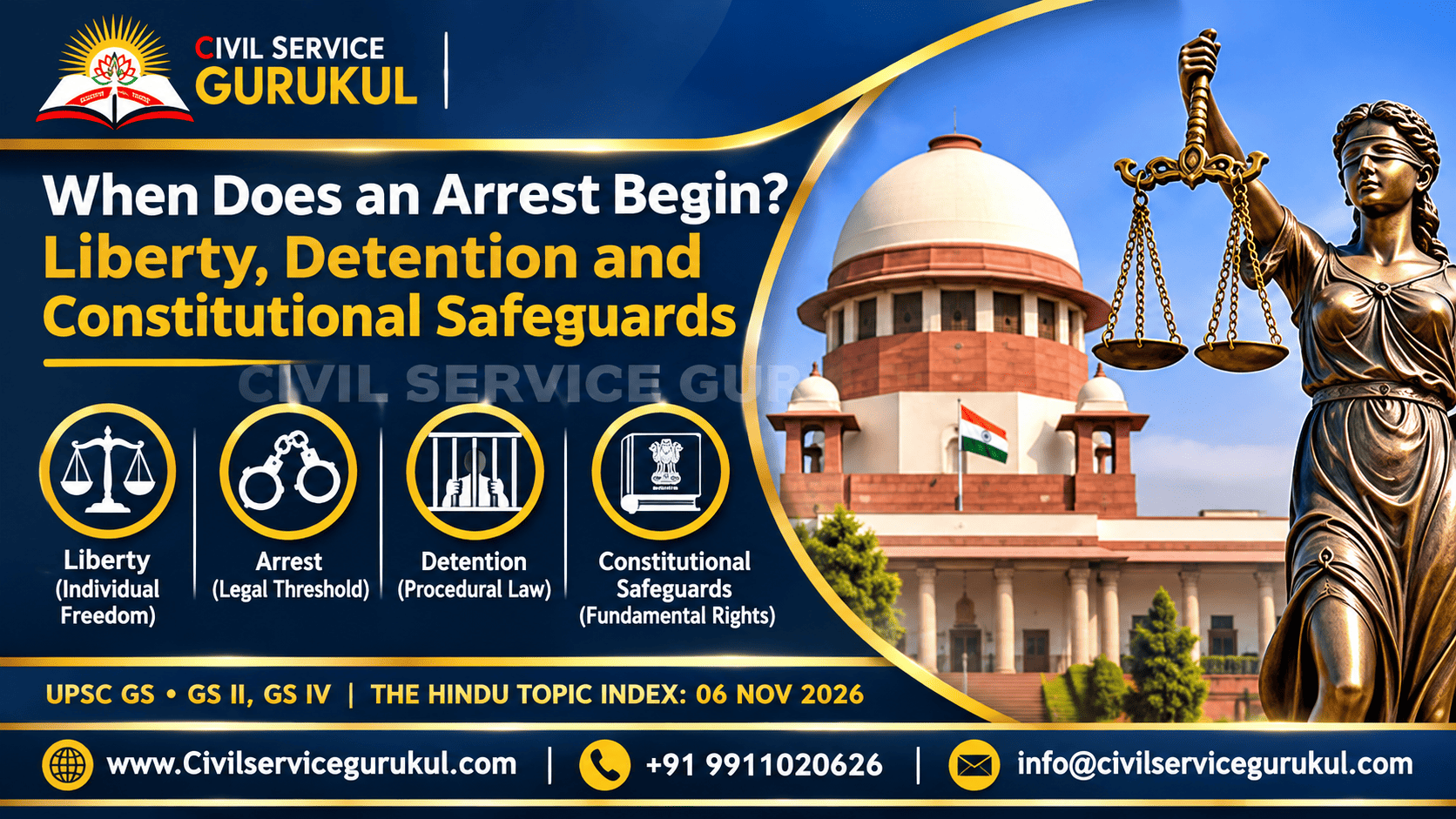
When Does Arrest Begin? Article 21 & 22 UPSC 2027
When does an arrest legally begin—when a person is physically restrained or when the police formally record the arrest? A Supreme Court observation reported in the 6 November 2026 newspaper index has brought renewed attention to this important constitutional question. This article examines the distinction between arrest, detention, custody, questioning and voluntary appearance under Indian law. It explains the significance of Article 21 and Article 22, the requirement to communicate grounds of arrest, the 24-hour magistrate-production safeguard and the risks associated with undocumented detention. Designed for UPSC Civil Services Examination 2027, the article provides balanced constitutional analysis, GS Paper II and GS Paper IV relevance, police accountability reforms, Prelims MCQs, Mains practice questions and answer-writing guidance.
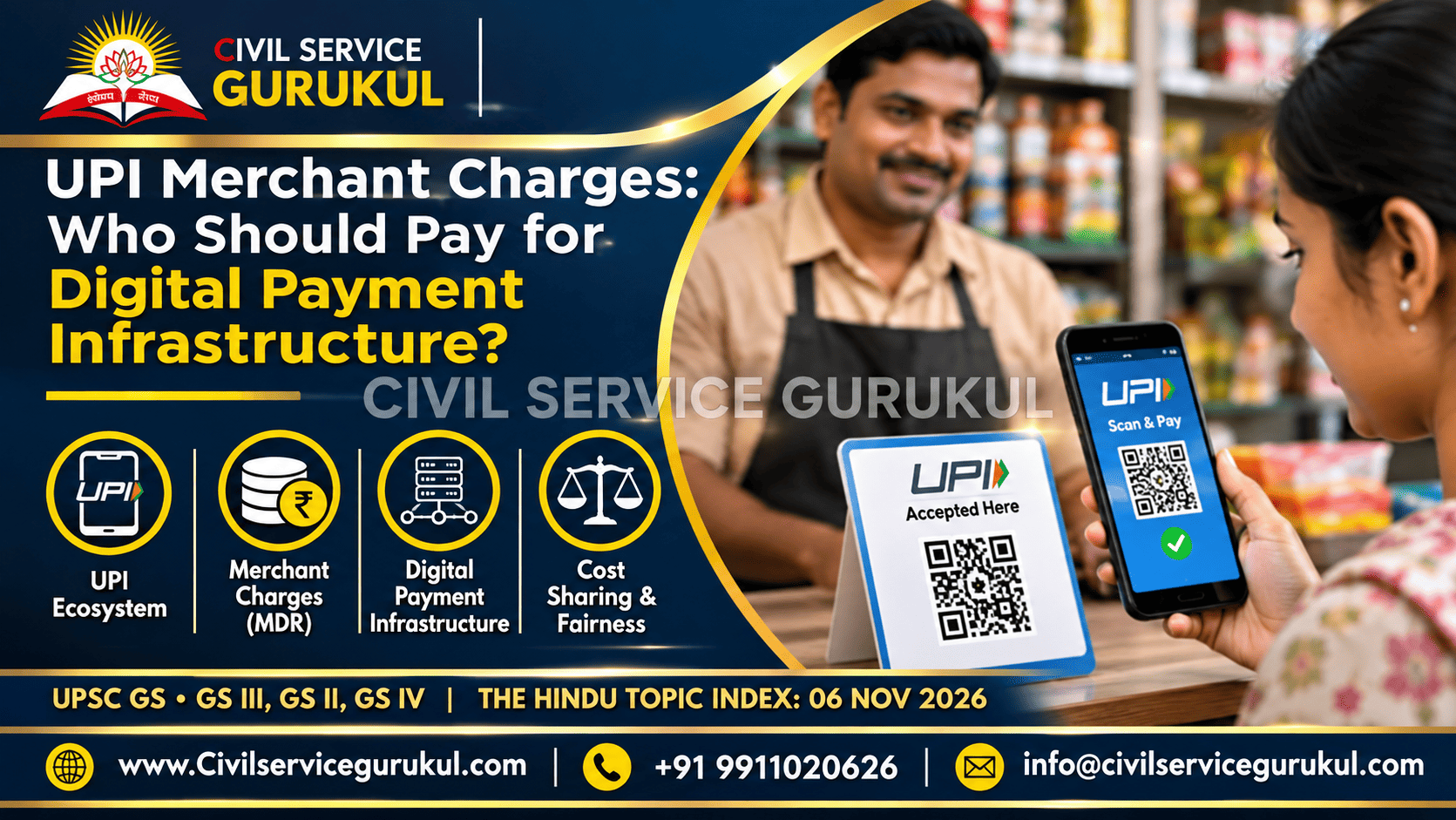
UPI Merchant Charges 2026: MDR & UPSC 2027 Notes
India's Unified Payments Interface (UPI) has transformed digital transactions by making payments convenient and widely accessible. However, maintaining this infrastructure requires investment in banking systems, cybersecurity, fraud prevention, dispute resolution and payment technology. A court-linked debate highlighted in the 6 November 2026 current-affairs index has renewed attention to who should bear the costs of UPI transactions. Should merchants pay transaction fees, should the government provide financial support, or should payment service providers develop alternative sustainable revenue models? This UPSC-focused article examines Merchant Discount Rate (MDR), NPCI, RBI, financial inclusion, the economics of digital public infrastructure and policy trade-offs. It includes GS Paper II, III and IV analysis, Prelims MCQs, Mains questions, model answer frameworks and FAQs.
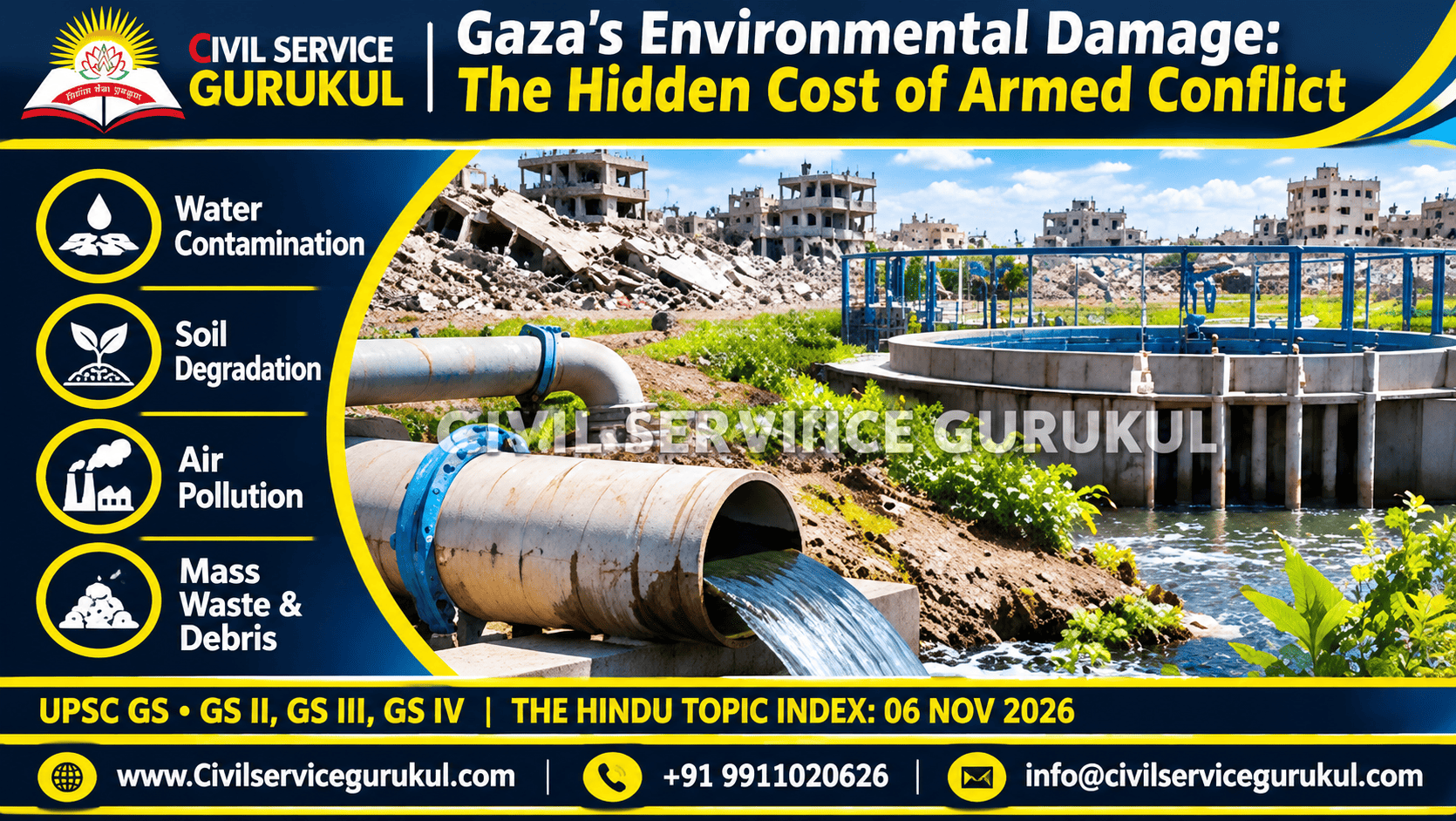
Gaza Environmental Damage: UPSC 2027 Analysis
The environmental consequences of armed conflict can persist long after fighting ends. The 6 November 2026 current-affairs editorial examines ecological damage in Gaza, including the destruction of water and wastewater infrastructure, soil contamination, hazardous debris and losses of vegetation. The source highlights UNEP's September 2025 assessment and the relationship between environmental degradation, public health risks, food insecurity and displacement. Contaminated water, damaged sanitation systems and unsafe debris can complicate humanitarian relief and long-term reconstruction. The article also examines international humanitarian law, the use and limitations of satellite-based environmental monitoring, the importance of ground-level verification and the distinction between documenting environmental harm and establishing legal responsibility. For UPSC Prelims and Mains 2027, the topic connects international relations, environmental governance, disaster management, public health and ethics. This article includes conceptual explanations, comparative tables, practice MCQs, Mains questions, an answer-writing framework and FAQs.
Cancer Drug Prices in India: UPSC 2027 Analysis
Reducing the maximum retail price (MRP) of cancer medicines can help patients, but it does not automatically make cancer treatment affordable. Patients may still face substantial expenses for diagnostics, hospital visits, multiple medicines, travel and lost wages. The 6 November 2026 current-affairs discussion highlights the distinction between a medicine's labelled price and the total cost of effective cancer care. It also examines the role of India's National Pharmaceutical Pricing Authority (NPPA), drug-price regulation, insurance coverage, medicine availability and quality-assured generic competition. This article analyses why price ceilings alone cannot guarantee equitable access to cancer treatment and explains how better procurement, stronger public oncology services, financial protection and patient-centred affordability indicators can improve outcomes. Designed for UPSC Prelims and Mains 2027, the article includes GS Paper II, III and IV analysis, practice MCQs, Mains questions, an answer-writing framework and FAQs.
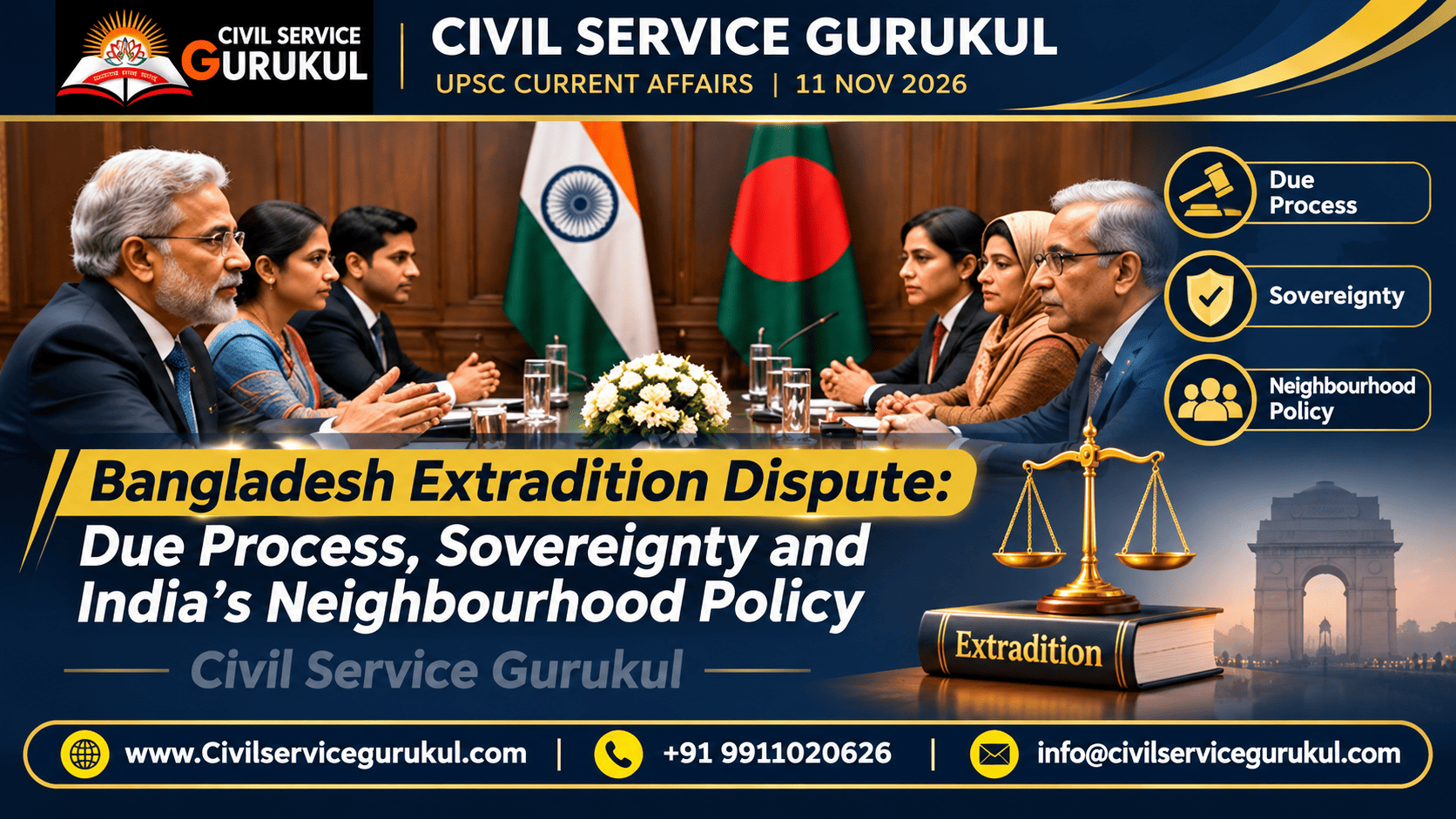
Sheikh Hasina Extradition Dispute 2026: India–Bangladesh Treaty, Due Process & Neighbourhood Policy | UPSC GS-II
The November 2026 developments surrounding former Bangladesh Prime Minister Sheikh Hasina's passport request and Bangladesh's extradition demand raise important questions about international law, sovereignty and India's neighbourhood diplomacy. This UPSC Civil Services Gurukul article examines the India–Bangladesh Extradition Treaty, 2013, political offence exceptions, statutory safeguards, the distinction between extradition and deportation, and implications for India–Bangladesh relations. Includes GS-II Mains analysis, a model answer, five Prelims MCQs and quick revision notes for UPSC CSE 2027.
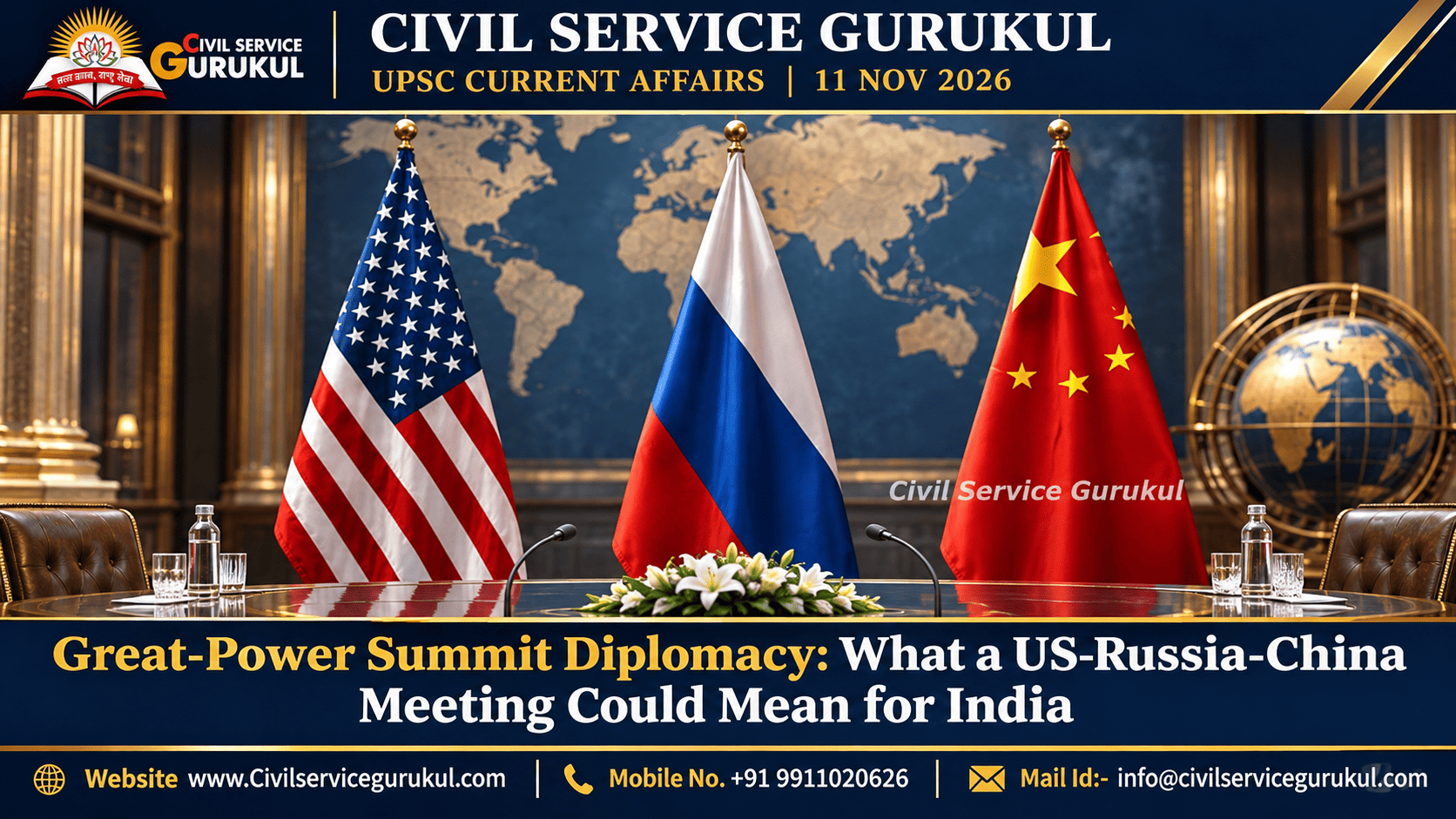
US–Russia–China Summit 2026: What Great-Power Diplomacy Means for India's Strategic Autonomy | UPSC GS-II
The proposed November 2026 trilateral summit between US President Donald Trump, Russian President Vladimir Putin and Chinese President Xi Jinping has renewed discussions about great-power diplomacy and the changing international order. Although the meeting has not been finalised, its possibility raises important questions about nuclear arms control, the Ukraine conflict, competing spheres of influence, multilateral institutions and India's strategic autonomy. This Civil Service Gurukul UPSC GS-II analysis examines the implications for India–US, India–Russia and India–China relations, the Indo-Pacific, global governance and multipolarity, with Mains answer-writing guidance and Prelims MCQs.
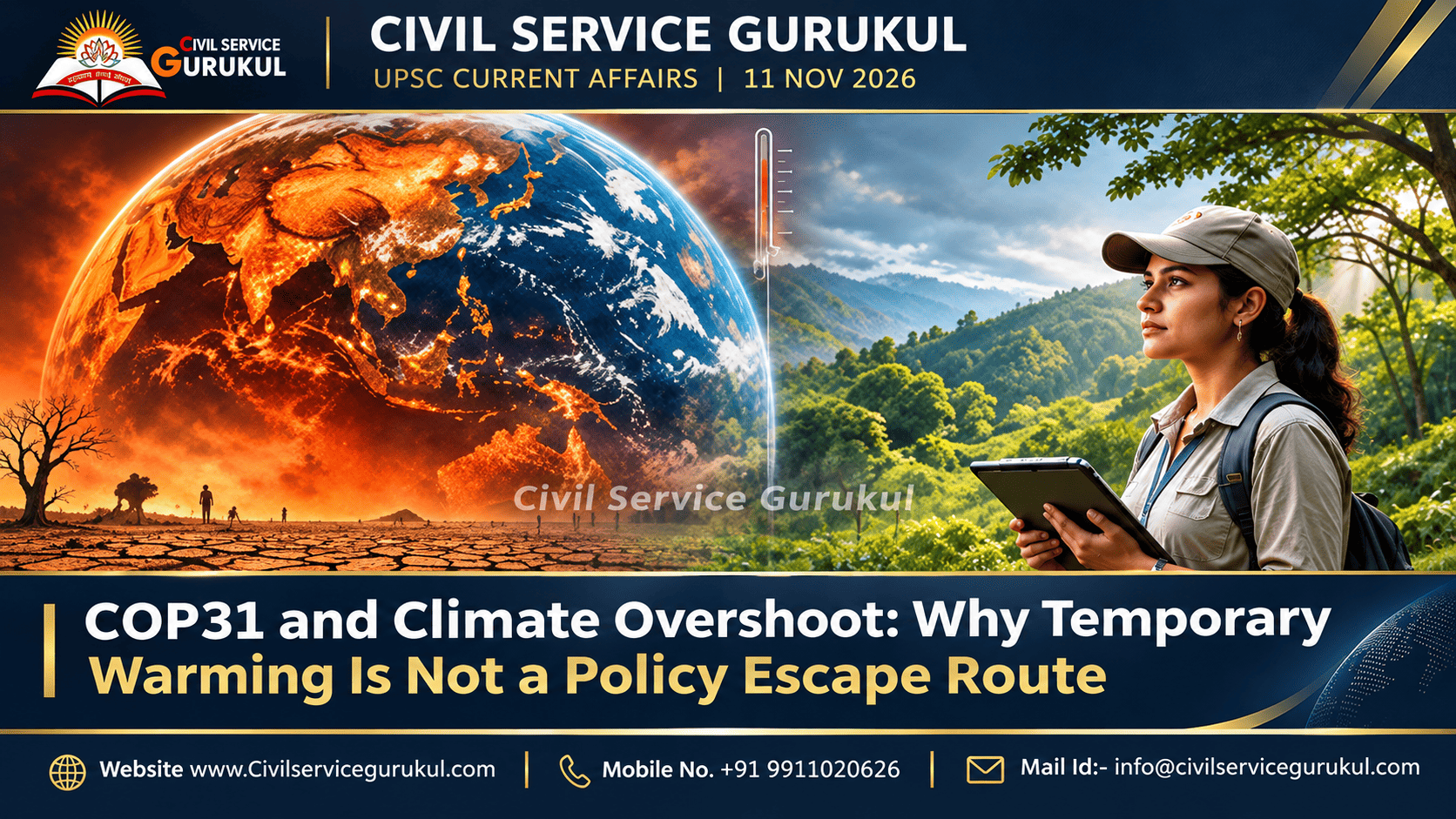
COP31 Climate Overshoot Explained: Why Crossing 1.5°C Risks Irreversible Damage | UPSC Environment 2027
COP31, taking place in Antalya, Türkiye, from 9 to 20 November 2026, has renewed attention on global climate commitments and the risks of exceeding the Paris Agreement's 1.5°C warming threshold. Climate overshoot refers to temporarily exceeding a specified warming level before returning below it, potentially through deep emissions cuts and carbon dioxide removal. However, the IPCC warns that overshoot can cause irreversible damage to ecosystems, glaciers and coastal regions. This Civil Service Gurukul article explains climate overshoot, mitigation, carbon dioxide removal, climate finance, India's adaptation priorities, GS-III Mains analysis and UPSC Prelims MCQs.
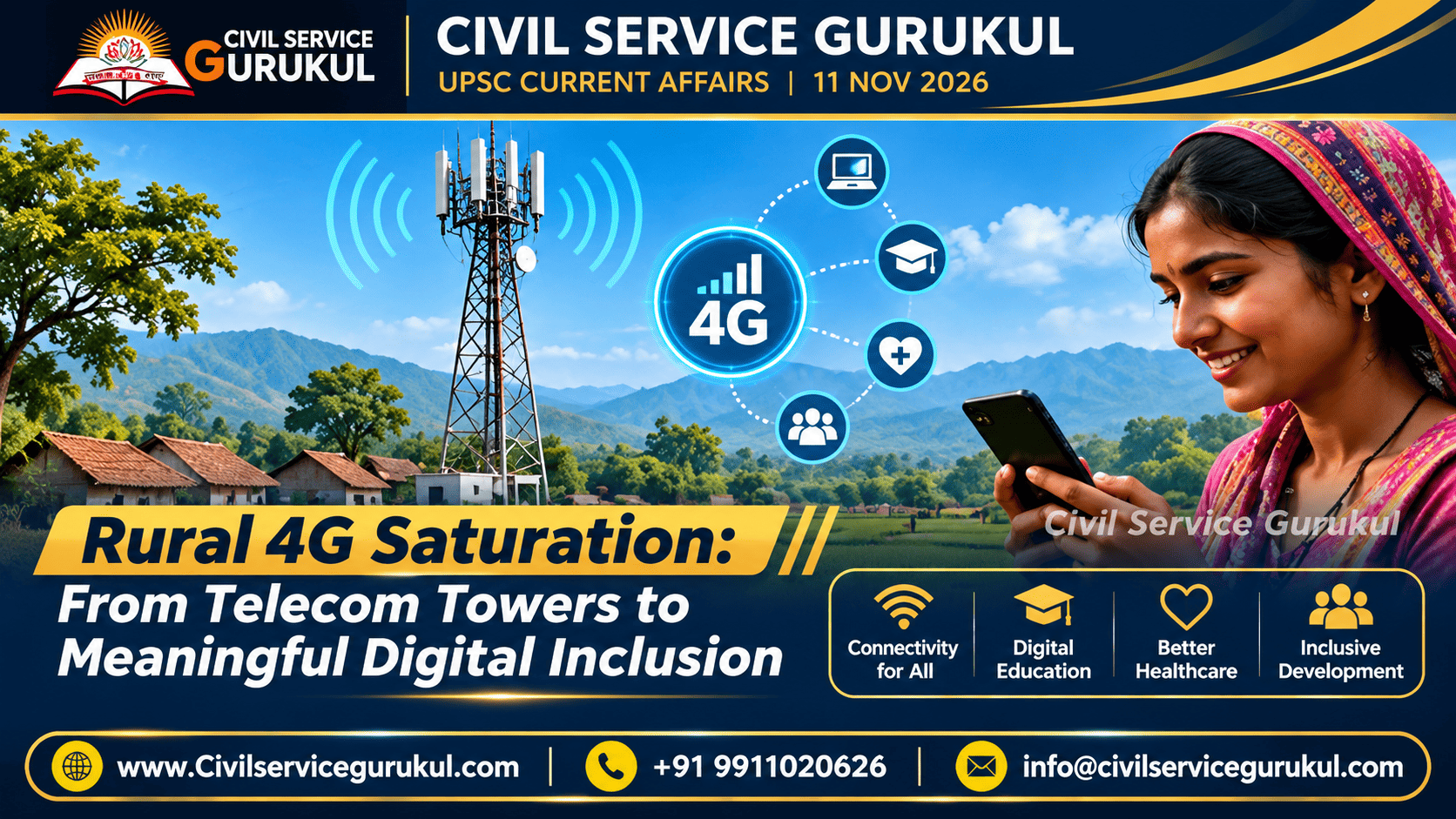
Rural 4G Saturation in India 2026: 75% Drop in Uncovered Villages, Digital Bharat Nidhi & Digital Inclusion | UPSC 2027
India has recorded a nearly 75% decline in villages without 4G connectivity, from 45,180 in 2022 to 11,372 in 2026, according to the Department of Telecommunications. The 4G Saturation Project, implemented by BSNL with public funding, is expanding mobile services in remote and underserved areas. However, universal network coverage does not automatically ensure affordable, reliable or meaningful digital access. This Civil Service Gurukul analysis examines Digital Bharat Nidhi, BharatNet, the rural digital divide, digital governance, financial inclusion, education and healthcare, along with UPSC GS-II and GS-III Mains analysis, Prelims MCQs and quick revision notes.
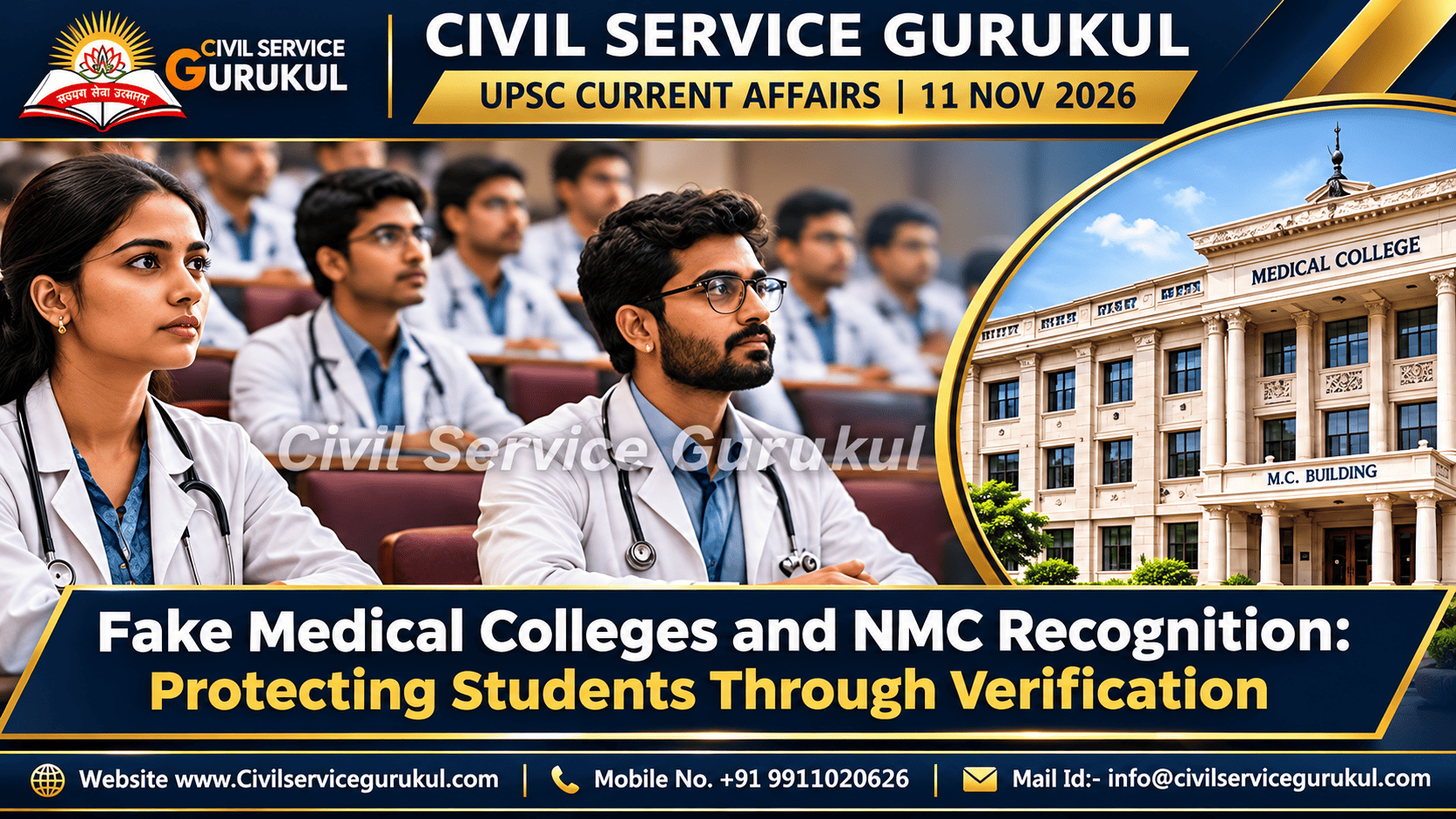
Fake Medical Colleges in India 2026: NMC Recognition, MBBS Admission Verification & Student Protection | UPSC 2027
The National Medical Commission issued an advisory on 6 November 2026 urging students and parents to verify medical colleges' regulatory approval before admission or payment. The warning highlights the risks associated with unauthorised medical institutions, misleading recognition claims, unapproved MBBS seats and fraudulent admission promises. This Civil Service Gurukul UPSC 2027 analysis explains the National Medical Commission Act, 2019, the role of NMC and its autonomous boards, medical college recognition, counselling verification, information asymmetry, student protection and regulatory accountability. Includes GS Paper II analysis, a Mains model answer, five Prelims MCQs and quick revision notes.
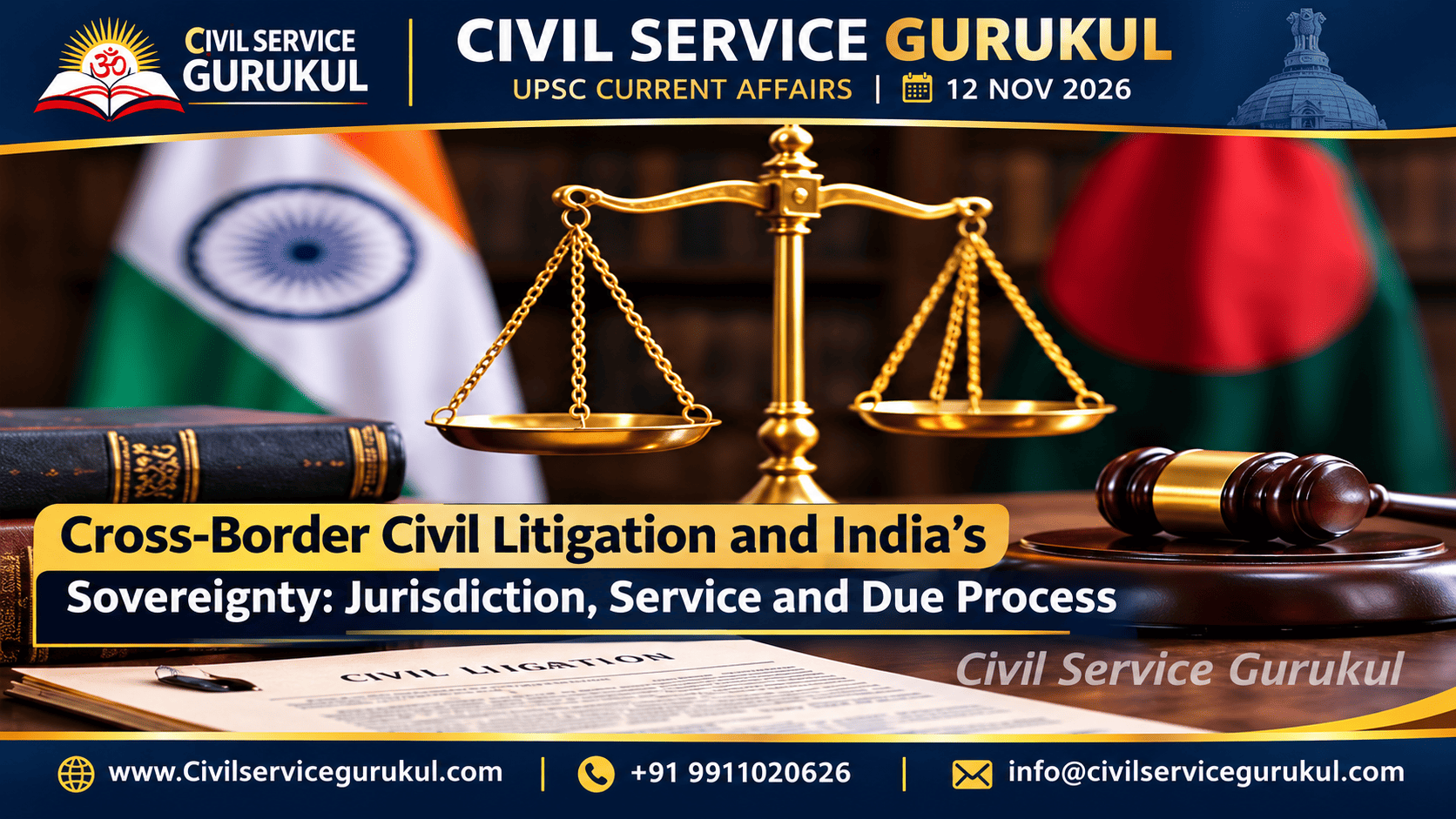
US Court Order and India's Sovereignty: Hague Service Convention, Jurisdiction and Due Process Explained for UPSC
A US federal court's November 2026 order permitting alternative service of civil court documents on two Indian officials through Indian judicial channels has raised important questions about sovereignty, cross-border litigation, jurisdiction and due process. The case provides a valuable UPSC GS Paper II example of how international conventions interact with domestic procedural law. This Civil Service Gurukul analysis explains the 1965 Hague Service Convention, the role of India's Ministry of Law and Justice, relevant provisions of the Code of Civil Procedure, sovereign immunity and the distinction between procedural service and legal liability. It includes verified legal context, balanced India–US relations analysis, Prelims facts, practice MCQs and a model Mains answer.
Ladakh Hill Council Elections 2026: December 4 Polls, Sixth Schedule Demands and Democratic Autonomy Explained for UPSC
The Ladakh administration has scheduled elections to eight Ladakh Autonomous Hill Development Councils for 4 December 2026, expanding local representative institutions across 100 constituencies. The elections follow the reorganisation of Ladakh into eight districts and coincide with continuing demands for statehood, Sixth Schedule safeguards, protection of land and employment rights, and greater democratic autonomy. Civil-society organisations have raised concerns about winter polling, delimitation and the adequacy of statutory local governance arrangements. This Civil Service Gurukul analysis examines the legal status of hill councils, the Sixth Schedule of the Indian Constitution, Ladakh's administration as a Union Territory without a legislature, democratic decentralisation, environmental challenges and the way forward. Includes Prelims revision facts, original practice MCQs and a GS-II Mains model answer.
Russia–Ukraine Peace Talks 2026: Abu Dhabi Negotiations, Prisoner Exchange, Ceasefire and Security Guarantees
Russia and Ukraine resumed US-mediated peace negotiations in Abu Dhabi on 10–11 November 2026, leading to an agreement in principle on a major prisoner exchange but no comprehensive ceasefire. Fundamental differences remain over territorial control, security guarantees, Europe's participation and the conditions for lasting peace. This Civil Service Gurukul article examines the diplomatic developments, distinction between a ceasefire and a peace treaty, principles of the UN Charter, Geneva Conventions, international humanitarian law and India's strategic interests. It also discusses civilian protection, humanitarian corridors, energy security, global economic consequences and the requirements of a sustainable peace settlement. The article includes UPSC Prelims revision, original MCQs and a GS-II Mains model answer.
Delhi Air Pollution 2026: Why the Supreme Court Wants Action Beyond Firecrackers | UPSC GS-III
The Supreme Court's 6 November 2026 order placed renewed emphasis on vehicular emissions as a major concern in Delhi-NCR's air-pollution crisis. While fireworks and crop-residue burning can worsen seasonal pollution, the problem also involves road dust, construction, industry, waste burning, transport emissions and unfavourable winter meteorology. The Court sought enforcement details and time-bound action plans from Delhi and neighbouring states. This Civil Service Gurukul analysis explains the National Air Quality Index, PM2.5 and PM10, the Commission for Air Quality Management (CAQM), the Graded Response Action Plan (GRAP), the National Clean Air Programme (NCAP), constitutional environmental principles and year-round strategies. Includes UPSC Prelims revision, original MCQs and a GS-III Mains model answer.
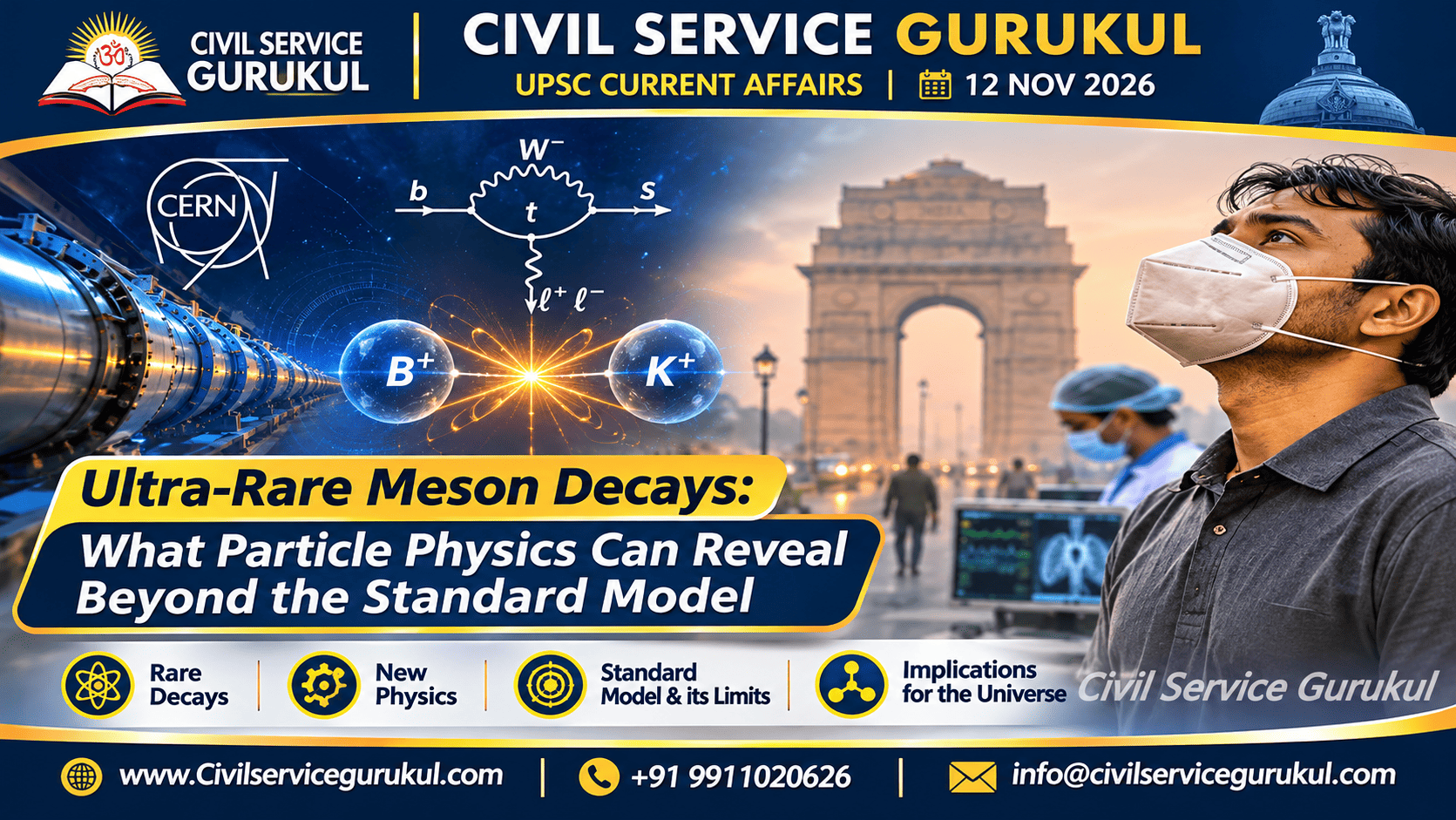
CERN Detects Evidence of Ultra-Rare B-Meson Decay: Standard Model, Muons and New Physics Explained for UPSC 2026
CERN's LHCb experiment announced evidence of the extremely rare decay of a neutral B meson into a muon–antimuon pair on 3 November 2026. The phenomenon occurs at roughly one in ten billion decays, and the combined analysis reached a significance of 3.2 sigma, below the 5-sigma benchmark used for a discovery. The result agrees with Standard Model predictions and places tighter constraints on possible new physics. This Civil Service Gurukul article explains mesons, quarks, leptons, muons, weak interactions, branching fractions, the Large Hadron Collider, statistical significance and the difference between evidence and discovery. It also examines India's particle-physics research ecosystem and includes UPSC Prelims MCQs and a GS-III Mains model answer.
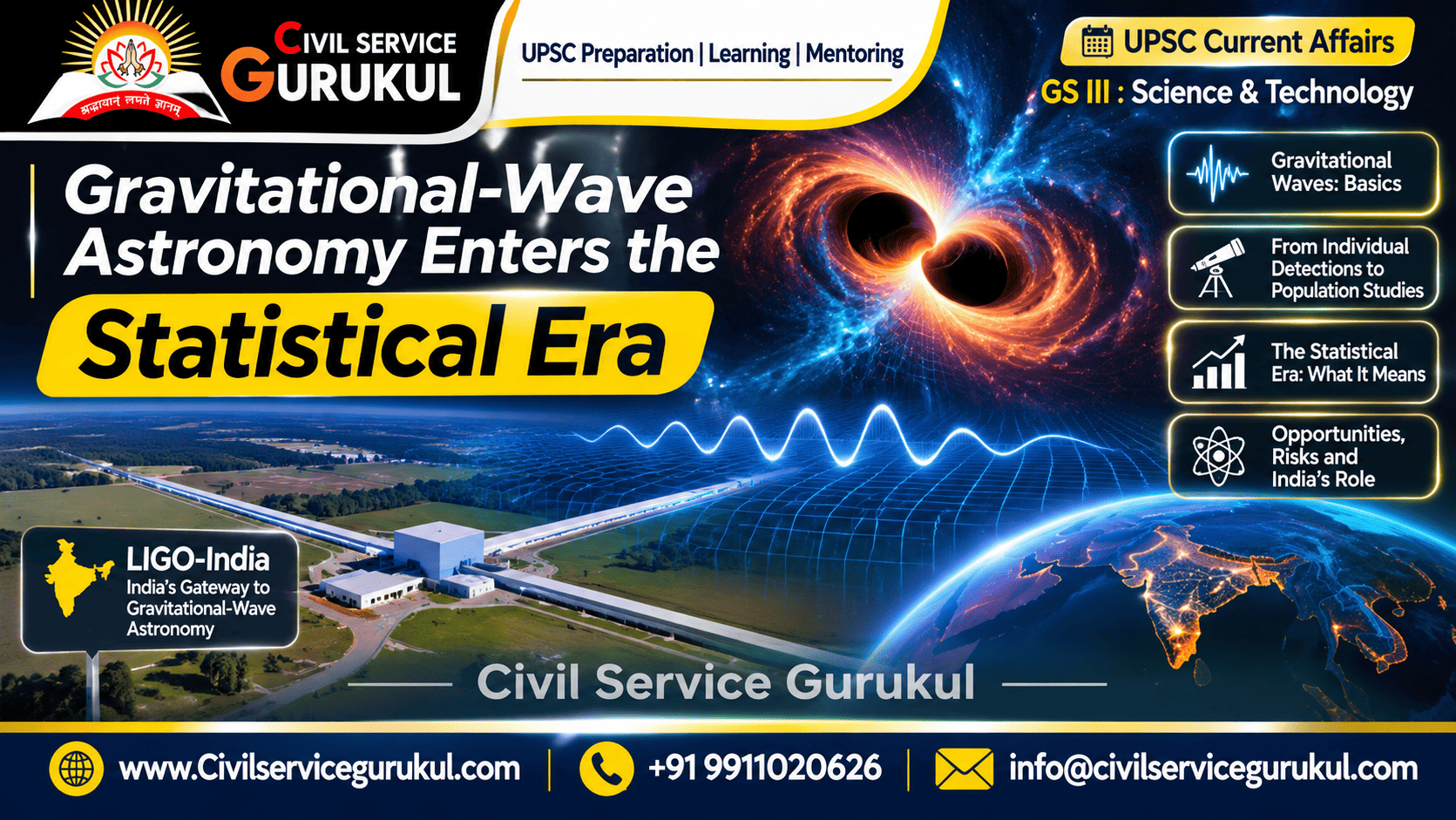
Gravitational-Wave Astronomy Enters Statistical Era: GWTC-5.0, 390 Detections and LIGO-India | UPSC 2027
Gravitational-wave astronomy has entered a statistical era as the international LIGO–Virgo–KAGRA collaboration expands its catalogue of cosmic events. The GWTC-5.0 release of May 2026 includes 390 cumulative significant detections, including 161 newly identified signals from the O4b observing period. Larger datasets allow researchers to examine black-hole populations, merger rates, cosmic evolution and general relativity with greater statistical confidence. For India, the development is especially important because of LIGO-India, the gravitational-wave observatory project being developed in Maharashtra. This Civil Service Gurukul UPSC 2027 analysis explains the science, key discoveries, detector network, statistical inference, India's contribution, limitations, Prelims concepts, original practice MCQs and Mains answer-writing strategy.
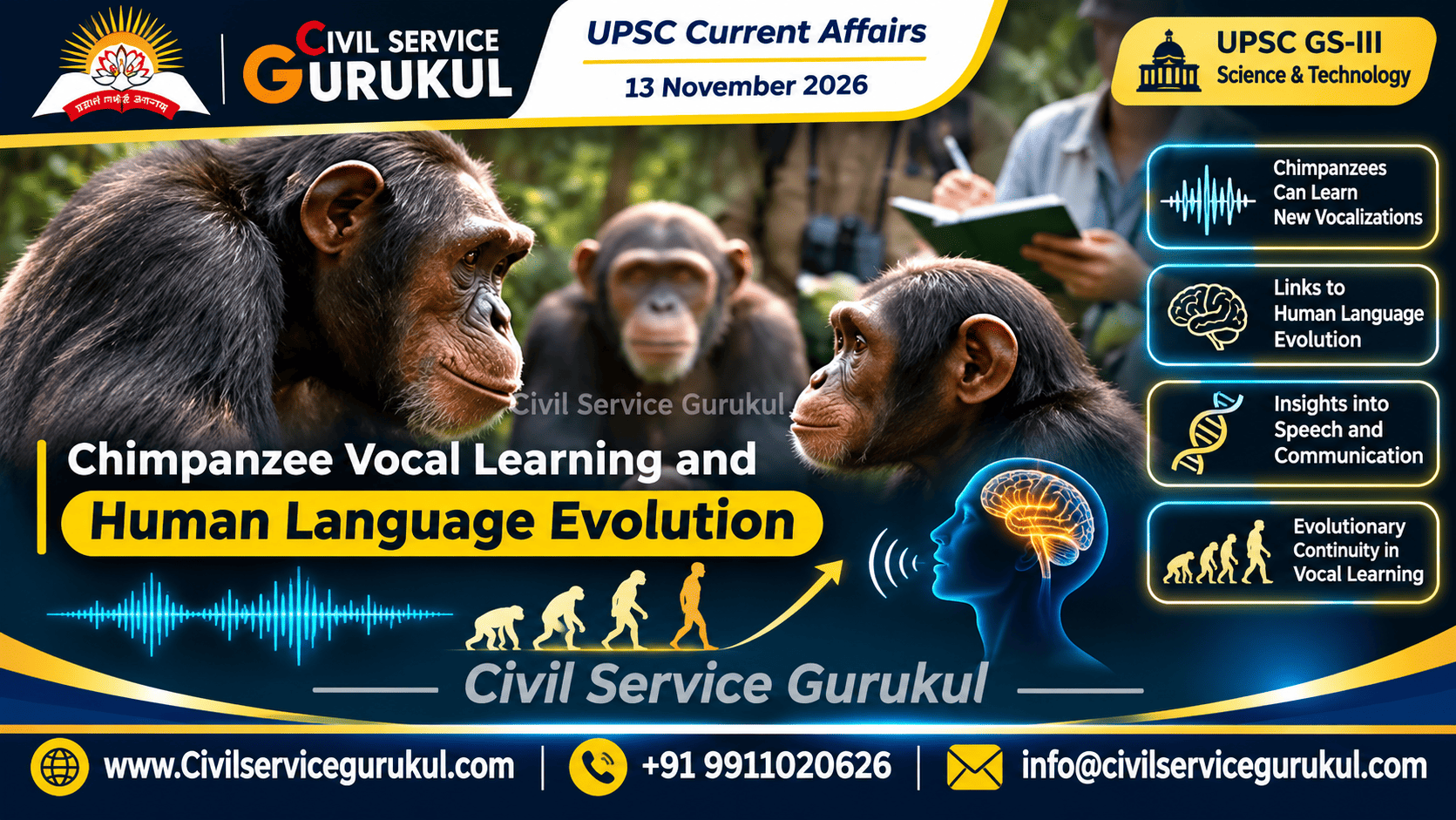
Chimpanzees Learn Vocal Calls from Adults: PNAS 2026 Study, Human Language Evolution and UPSC Analysis
A November 2026 PNAS study has found evidence that chimpanzees learn the social use of certain calls from adult role models, offering new insights into the evolutionary origins of human language. Researchers studied 91 chimpanzees across four wild communities in Taï National Park, Côte d’Ivoire, and four sanctuary groups at Tacugama in Sierra Leone. Wild chimpanzees used a raspberry-like sound predominantly during grooming, while orphaned groups without adult models used the call across varied social contexts. After an adult joined one sanctuary group, the juveniles' call use became more consistent. Civil Service Gurukul explains vocal usage learning, production learning, arbitrary conventions, social transmission, human language evolution, research limitations, species facts, UPSC Prelims MCQs and GS Mains analytical perspectives.
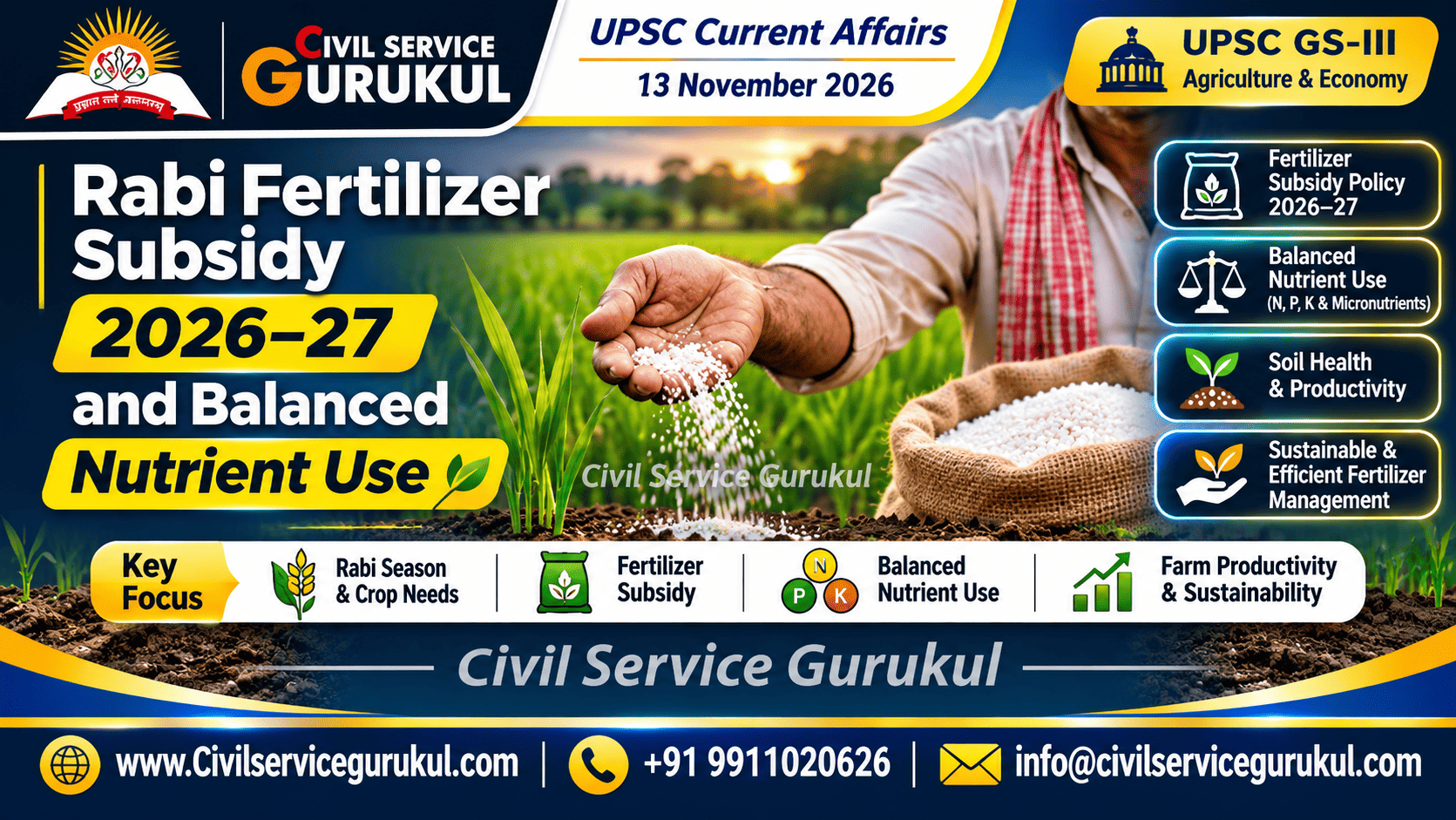
Rabi Fertiliser Subsidy 2026–27: 64% Increase, NBS Rates, Budget Impact & UPSC Analysis
India's Union Cabinet approved a tentative ₹62,370.02 crore subsidy requirement for phosphatic and potassic fertilisers during Rabi 2026–27, representing an approximately 64% increase over the previous Rabi season. The revised Nutrient Based Subsidy rates apply from 1 October 2026 to 31 March 2027 and cover nitrogen, phosphorus, potassium and sulphur content in 28 grades of P&K fertilisers. Along with the Kharif 2026 provision, the combined seasonal P&K requirement reaches approximately ₹1.04 lakh crore against the FY 2026–27 Budget Estimate of ₹54,000 crore. Civil Service Gurukul examines the NBS framework, DAP price protection, differences between urea and P&K subsidies, global price pressures, fiscal implications, soil nutrient imbalance, sustainable agriculture reforms, UPSC Prelims MCQs and a GS-III Mains model answer.
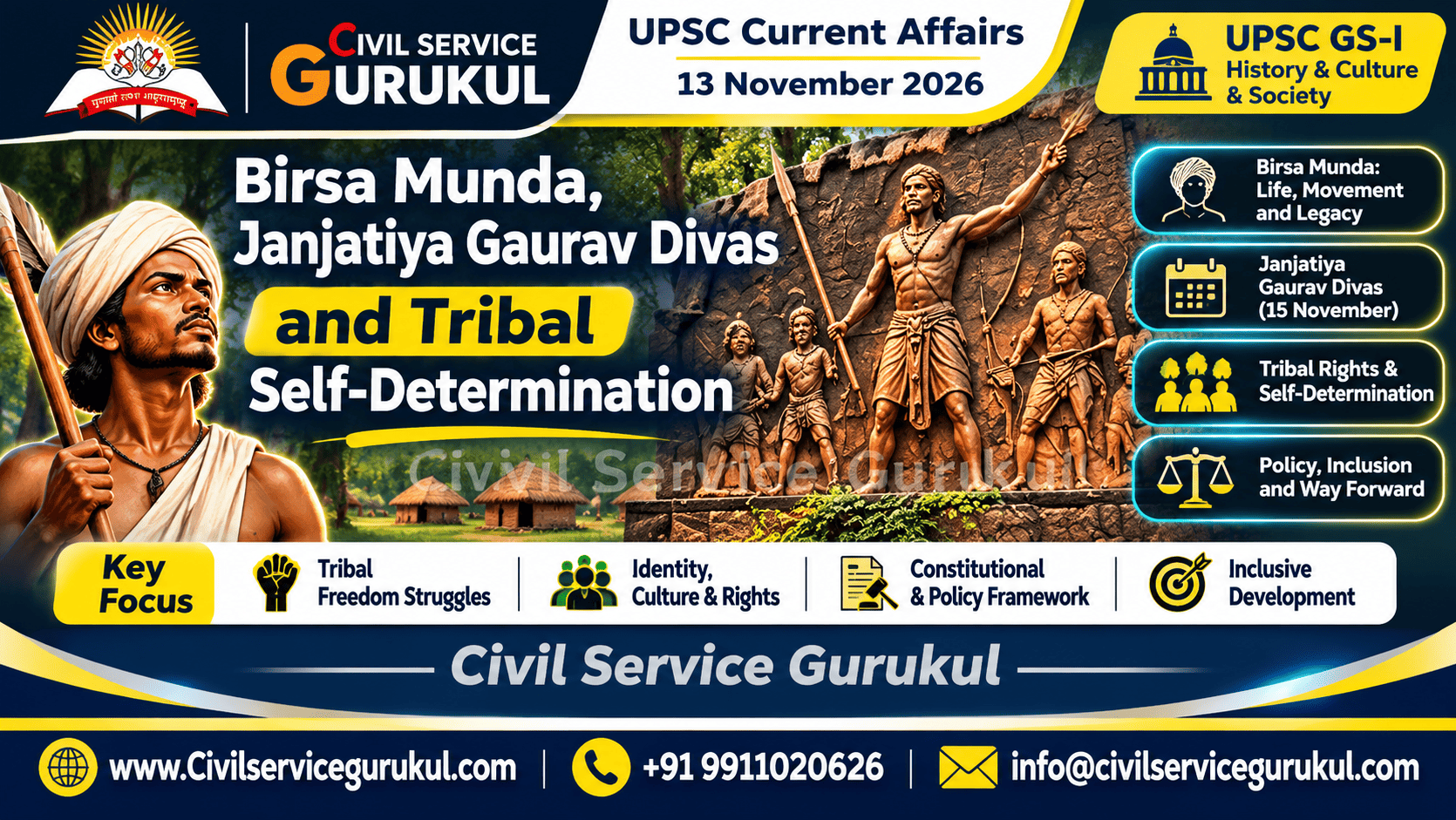
Birsa Munda & Janjatiya Gaurav Divas 2026: Ulgulan, PESA, FRA and Tribal Rights | UPSC 2027
Janjatiya Gaurav Divas is observed across India on 15 November to commemorate the birth anniversary of Birsa Munda, the tribal freedom fighter who led the Ulgulan movement against colonial authority and exploitative agrarian relations in Chotanagpur. The 2026 Janjatiya Gaurav Pakhwada runs from 1 to 15 November, with government-announced initiatives related to tribal education, culture, healthcare, forest rights and rural development. This Civil Service Gurukul UPSC 2027 article examines Birsa Munda's historical contributions, the Munda land system, colonial exploitation, the Ulgulan movement, the Chota Nagpur Tenancy Act, Fifth and Sixth Schedules, PESA 1996, Forest Rights Act 2006 and contemporary questions of community self-governance. It also provides original UPSC Prelims MCQs, GS-I and GS-II Mains analysis and a concise revision framework.
India Visa Reform 2026: 9 Categories, 70% Shorter Forms, e-Visa & UPSC GS-II Analysis
India has undertaken a major rationalisation of its visa regime, reducing the number of main categories from 13 to nine and sub-categories from 49 to 23, while cutting application-form fields by 65–70%. The reform includes renaming the Tourist Visa as the Visitor Visa, introducing differentiated provisions for business, medical treatment, AYUSH, education and research, and updating digital immigration systems. With e-Visa facilities available to nationals of 172 countries, the policy aims to improve tourism, investment, medical-value travel, international education and administrative efficiency. Civil Service Gurukul examines the Ministry of Home Affairs' November 2026 announcement, the nine-category structure, V-1 and V-2 visas, e-Visa versus regular visa, immigration governance, security and privacy concerns, implementation challenges, UPSC Prelims MCQs and a GS-II Mains model answer.