
COP31 Climate Overshoot Explained: Why Crossing 1.5°C Risks Irreversible Damage | UPSC Environment 2027
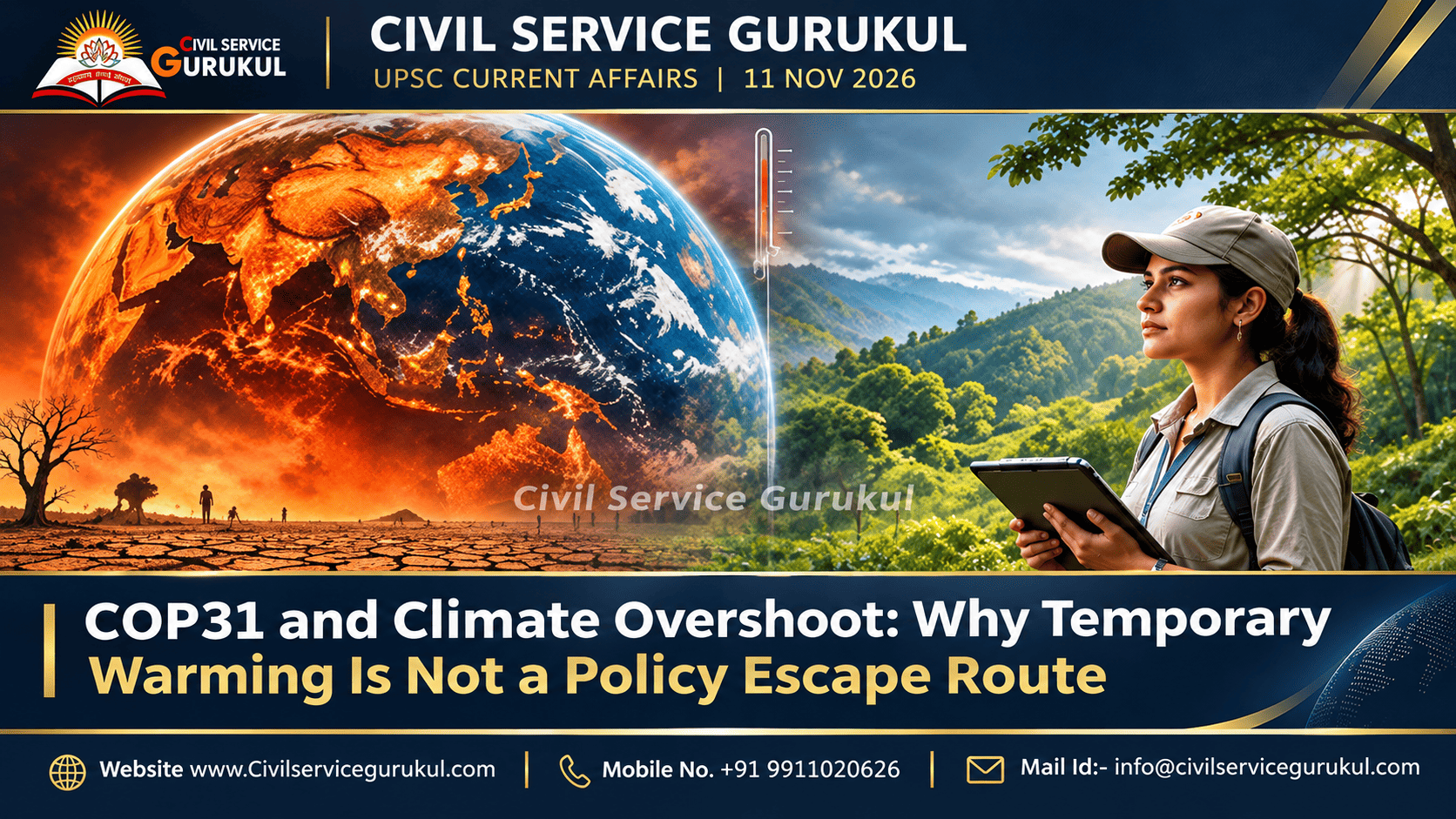
COP31 Climate Overshoot Explained: Why Crossing 1.5°C Risks Irreversible Environmental Damage
Understanding climate overshoot, the Paris Agreement, carbon removal, climate justice and India's mitigation and adaptation priorities.
Excerpt / Brief Summary
The 31st Conference of the Parties to the UN Framework Convention on Climate Change, COP31, is taking place in Antalya, Türkiye, from 9 to 20 November 2026.
An important concern in global climate discussions is climate overshoot: a situation where global warming temporarily exceeds a temperature threshold before returning below it.
Although some climate pathways depend on future carbon dioxide removal to reverse warming, the IPCC warns that overshoot can produce additional risks and irreversible environmental harm.
For UPSC aspirants, the topic connects climate mitigation, carbon budgets, adaptation, sustainable development and intergenerational justice.
Prelims: Ecology, Climate Change, Paris Agreement, Carbon Cycle, Global Stocktake.
GS Paper III: Environmental Conservation, Climate Change, Sustainable Development, Disaster Risk Reduction.
GS Paper II: International Climate Institutions and Agreements.
GS Paper IV: Environmental Ethics, Intergenerational Equity, Climate Justice.
1. Why in the News?
COP31 is being held from 9 to 20 November 2026 in Antalya, Türkiye.
The conference brings together governments, climate negotiators, scientists and other stakeholders to discuss global climate action.
A major scientific concern relevant to climate negotiations is the possibility of exceeding the 1.5°C global warming threshold.
Some climate scenarios project that temperatures could exceed the threshold temporarily before later declining through deep emissions cuts and large-scale carbon dioxide removal.
The IPCC warns that such overshoot pathways involve greater risks than pathways that avoid overshoot.
As of 11 November 2026, COP31 is underway. Its final negotiated outcomes cannot be described as already adopted.
Climate overshoot is a scientific and policy issue relevant to the negotiations; it should not be misrepresented as a new agreement already concluded at COP31.
2. What Is Climate Overshoot?
Climate overshoot occurs when global mean temperature temporarily exceeds a specified warming level, such as 1.5°C above the pre-industrial baseline, before subsequently falling below that level.
Simple Illustration
Suppose long-term global warming rises above 1.5°C and reaches 1.7°C.
If strong climate action later reduces warming to 1.5°C or below, the period above the threshold represents an overshoot.
This is a simplified illustration, not a prediction of future global temperature levels.
Why Does Overshoot Occur?
- Insufficient near-term emissions reductions.
- Continued greenhouse gas accumulation.
- Delayed decarbonisation of energy systems.
- Reliance on future negative emissions.
- Slow deployment of available climate solutions.
Why Is Duration Important?
The risks of overshoot increase with both the magnitude and duration of temperature exceedance.
A higher or longer-lasting overshoot can expose ecosystems and communities to more severe climate impacts.
3. Paris Agreement: Understanding the 1.5°C Goal
The Paris Agreement was adopted in 2015 under the United Nations Framework Convention on Climate Change.
Article 2 establishes a long-term temperature goal of holding the increase in global average temperature to well below 2°C above pre-industrial levels, while pursuing efforts to limit the increase to 1.5°C.
Why Is 1.5°C Important?
Climate risks increase with additional warming. Limiting the temperature increase can reduce harm to ecosystems, human health, agriculture and vulnerable communities.
Important Distinction: A Single Year vs Long-Term Warming
A single calendar year with an observed global temperature anomaly above 1.5°C is not the same as a formal determination that the Paris Agreement's long-term warming level has been crossed.
Long-term warming is assessed using climate averages rather than isolated annual fluctuations.
The Paris Agreement does not prescribe a simple absolute temperature ceiling of exactly 2°C.
Its temperature goal is to hold warming well below 2°C and pursue efforts toward 1.5°C.
4. COP31: Important Facts for UPSC 2027
| Particulars | Details |
|---|---|
| Conference | 31st Conference of the Parties to the UNFCCC |
| Dates | 9-20 November 2026 |
| Host City | Antalya, Türkiye |
| Host Country | Türkiye |
| COP President | Murat Kurum |
| President of Negotiations | Chris Bowen of Australia |
| Climate Convention | UNFCCC, adopted in 1992 |
| Paris Agreement | Adopted in 2015 |
| Related Sessions | COP31, CMP21 and CMA8 |
COP conferences are important forums for discussing mitigation, adaptation, climate finance, technology and international cooperation.
The final decisions of COP31 should be assessed only after they have been formally adopted.
5. Scientific Risks of Climate Overshoot
A. Glacier and Ice Loss
Additional warming can accelerate glacier melting and reduce the resilience of mountain ecosystems.
Some losses may not be reversed even if global temperatures later decline.
B. Sea-Level Rise
Ocean warming and land-ice loss contribute to sea-level rise.
Long-lived changes in sea level create serious risks for coastal settlements.
C. Biodiversity Damage
Higher temperatures can increase habitat loss, ecosystem stress and species extinction risks.
D. Extreme Heat
Heatwaves can create severe public-health risks and reduce labour productivity.
E. Food and Water Security
Changes in rainfall, drought frequency and extreme events can affect agricultural output and water availability.
F. Climate Feedbacks
Certain climate impacts can amplify warming through additional greenhouse gas releases or weakened natural carbon sinks.
Examples include permafrost thaw, peatland drying and some wildfire-related feedbacks.
The IPCC concludes that overshoot creates additional adverse impacts, including some irreversible changes, compared with avoiding the temperature exceedance.
Therefore, a later return below 1.5°C does not necessarily restore ecosystems to their earlier condition.
6. Carbon Dioxide Removal: Can Technology Reverse Global Warming?
Carbon dioxide removal, or CDR, refers to processes that remove CO2 from the atmosphere and store it for a relevant period.
Examples of Carbon Removal
- Afforestation and reforestation.
- Soil carbon enhancement.
- Bioenergy with carbon capture and storage.
- Direct air carbon dioxide capture and storage.
- Other scientifically assessed removal approaches.
Key Limitations
- High financial and energy costs for some technologies.
- Land and water requirements.
- Questions about storage permanence.
- Ecological and social impacts.
- Difficulty scaling deployment rapidly.
- Uncertainty in monitoring and verification.
Mitigation vs Carbon Removal
| Mitigation | Carbon Dioxide Removal |
|---|---|
| Prevents or reduces greenhouse gas emissions. | Removes CO2 already present in the atmosphere. |
| Examples: renewable energy, efficiency and methane reduction. | Examples: direct air capture and afforestation. |
| Essential for limiting future warming. | May complement emissions reduction and address residual emissions. |
| Reduces future emissions entering the atmosphere. | Requires reliable removal and storage accounting. |
Carbon dioxide removal may be necessary in some climate pathways, but it is not a substitute for immediate and sustained emissions reductions.
7. Why Climate Overshoot Matters for India
1. Himalayan Ecosystems
Himalayan glaciers and mountain communities face risks from rising temperatures, altered hydrology and extreme events.
2. Coastal Regions
Sea-level rise and coastal hazards threaten low-lying settlements, infrastructure and livelihoods.
3. Indian Agriculture
Heat stress, irregular rainfall and water scarcity can affect crop productivity and farm incomes.
4. Public Health
Extreme heat can increase heat-related illness, especially among vulnerable populations.
5. Water Security
Changes in rainfall and seasonal water availability can put pressure on urban and rural water management systems.
6. Economic Development
Climate shocks may increase infrastructure losses, health expenditures and costs of disaster recovery.
India's Policy Priorities
- Clean energy expansion.
- Energy efficiency and sustainable mobility.
- Climate-resilient agriculture.
- Urban heat action plans.
- Coastal adaptation and disaster preparedness.
- Climate finance and technology access.
- Protection of vulnerable communities.
8. Climate Justice and Intergenerational Ethics
Climate justice examines the unequal distribution of responsibility for emissions and the impacts of climate change.
Countries and communities with lower historical emissions may experience severe climate-related harm.
Common but Differentiated Responsibilities
The UNFCCC framework recognises common but differentiated responsibilities and respective capabilities.
This principle acknowledges that countries share climate responsibilities, but their circumstances and capacities differ.
Intergenerational Equity
Intergenerational equity recognises that present decisions can affect the well-being of future generations.
Delaying mitigation while assuming that future societies will remove large amounts of CO2 can transfer risk and costs to future generations.
The Moral Hazard of Overshoot
The expectation of future technological solutions may reduce the urgency of present emissions cuts.
This is particularly problematic when some impacts may be irreversible.
9. Way Forward: Climate Governance Beyond Overshoot
- Accelerate Mitigation: Reduce greenhouse gas emissions through measurable sectoral policies.
- Strengthen Adaptation: Invest in resilient infrastructure, agriculture and public health.
- Protect Carbon Sinks: Conserve forests, wetlands and other ecosystems.
- Evaluate Carbon Removal: Use rigorous scientific assessment and monitoring standards.
- Improve Climate Finance: Support predictable and accessible financing for developing countries.
- Strengthen NDC Implementation: Translate national climate commitments into practical sectoral action.
- Prioritise Vulnerable Groups: Address the needs of farmers, coastal residents and heat-exposed workers.
- Improve Accountability: Use transparent reporting and evidence-based assessment of climate outcomes.
10. UPSC Mains Practice Question
"Climate overshoot scenarios may provide technological flexibility, but they pose serious ecological and ethical risks."
Critically examine the statement with reference to the Paris Agreement and India's climate priorities.
Model Answer
Introduction: Climate overshoot occurs when global warming temporarily exceeds a specified temperature threshold before subsequently declining. Some climate pathways rely on deep emission cuts and carbon dioxide removal to reverse such warming.
Potential Advantages: Overshoot pathways may offer some modelling flexibility for hard-to-abate sectors and recognise the possible contribution of future carbon removal technologies.
Major Risks: However, the IPCC warns that overshoot increases risks of irreversible ecosystem damage, glacier loss, sea-level rise and extreme climate impacts.
Heavy dependence on future removal also creates technological, financial and ecological uncertainty.
India's Perspective: India faces climate risks affecting agriculture, Himalayan ecosystems, coastal settlements and public health. Therefore, adaptation, climate finance, renewable energy and responsible development remain essential.
Way Forward: Governments should prioritise rapid emissions reductions, strengthen adaptation, protect natural carbon sinks and apply strict standards to carbon removal projects.
Conclusion: Climate overshoot cannot be treated as a safe alternative to timely mitigation. A just climate strategy must minimise warming, protect vulnerable communities and safeguard future generations.
11. UPSC Prelims Practice MCQs
(a) Limit all warming to exactly 2°C
(b) Hold warming well below 2°C and pursue efforts towards 1.5°C
(c) End all greenhouse gas emissions immediately
(d) Regulate only industrial emissions
Show Answer and Explanation
Correct Answer: (b).
The Paris Agreement seeks to hold global warming well below 2°C while pursuing efforts to limit warming to 1.5°C.
(a) Permanent cooling below the pre-industrial temperature
(b) Temporary exceedance of a temperature threshold followed by a return below it
(c) Complete elimination of CO2 emissions
(d) A seasonal rise in temperature during summer
Show Answer and Explanation
Correct Answer: (b).
Climate overshoot involves temporarily exceeding a warming threshold before returning below it.
1. It includes methods that remove CO2 from the atmosphere.
2. It eliminates the need for immediate emissions reductions.
3. Some approaches face permanence and sustainability challenges.
Which statements are correct?
(a) 1 only
(b) 1 and 3 only
(c) 2 and 3 only
(d) 1, 2 and 3
Show Answer and Explanation
Correct Answer: (b) 1 and 3 only.
Carbon dioxide removal complements but does not replace emissions reductions. Some methods face substantial cost and sustainability constraints.
1. It is conducted under the Paris Agreement.
2. It collectively assesses progress towards the Agreement's goals.
3. It takes place every five years.
Which statements are correct?
(a) 1 and 2 only
(b) 2 and 3 only
(c) 1 and 3 only
(d) 1, 2 and 3
Show Answer and Explanation
Correct Answer: (d).
The Global Stocktake assesses collective progress under the Paris Agreement every five years. The first was completed in 2023.
1. COP31 is being held in Antalya, Türkiye.
2. Its scheduled dates are 9-20 November 2026.
3. COP31 is held under the Convention on Biological Diversity.
Which statements are correct?
(a) 1 and 2 only
(b) 2 and 3 only
(c) 1 and 3 only
(d) 1, 2 and 3
Show Answer and Explanation
Correct Answer: (a) 1 and 2 only.
COP31 is a Conference of the Parties to the UNFCCC, not the Convention on Biological Diversity.
12. Quick Revision Notes for UPSC 2027
- COP31: 9-20 November 2026, Antalya, Türkiye.
- Convention: UNFCCC, adopted in 1992.
- Paris Agreement: Adopted in 2015.
- Temperature Goal: Well below 2°C, pursuing efforts towards 1.5°C.
- Climate Overshoot: Temporary exceedance followed by a return below a warming threshold.
- IPCC Finding: Overshoot creates additional risks, some irreversible.
- CDR: Carbon Dioxide Removal.
- Net Negative CO2: More CO2 removed than emitted globally over the relevant period.
- Global Stocktake: Collective assessment every five years.
- NDC: Nationally Determined Contribution.
- CBDR-RC: Common But Differentiated Responsibilities and Respective Capabilities.
- India's Priorities: Mitigation, adaptation, climate finance and resilient development.
- GS-III Keywords: Carbon Budget, Climate Justice, Irreversible Impacts, Adaptation, Mitigation.
13. Frequently Asked Questions
What is climate overshoot?
Climate overshoot means temporarily exceeding a temperature threshold before returning below it.
Does reducing temperatures later reverse all climate damage?
No. Some impacts, including damage to vulnerable ecosystems and long-lived sea-level changes, may be irreversible.
Can carbon removal replace emissions reduction?
No. Carbon removal may complement deep emissions reductions but cannot be treated as a substitute for timely mitigation.
Where is COP31 being held?
COP31 is being held in Antalya, Türkiye, from 9 to 20 November 2026.
Why is climate overshoot relevant for India?
It increases concerns relating to agriculture, heat stress, Himalayan glaciers, coastal settlements, water security and vulnerable communities.
14. Conclusion: Climate Overshoot Is Not a Safe Shortcut
COP31 provides an important international setting for strengthening climate cooperation and implementation.
The debate around climate overshoot highlights the risks of delaying emissions reductions while relying on future carbon removal.
Scientific assessments show that even temporary additional warming can produce serious and irreversible impacts.
For India, a balanced approach requires clean energy, climate-resilient development, adaptation finance and protection of vulnerable communities.
The central UPSC takeaway is simple: future carbon removal cannot justify delayed climate action today.
15. Prepare for UPSC 2027 with Civil Service Gurukul
Civil Service Gurukul provides syllabus-based study material, current affairs analysis, revision notes and answer-writing practice for UPSC Civil Services aspirants.
Master Environment and Ecology for UPSC CSE 2027
Strengthen conceptual clarity through exam-oriented current affairs, Prelims MCQs, Mains model answers and systematic revision.
Explore Courses and Study ResourcesWebsite: www.civilservicegurukul.com
Mobile: +91 9911020626
Email: info@civilservicegurukul.com
Educational Disclaimer: This article is prepared for UPSC Civil Services Examination preparation using the scientific and institutional information available as of 11 November 2026. COP31 was underway at the time of preparation. Its final negotiated outcomes have not been assumed. Climate overshoot is a scientific scenario and policy consideration, not a final decision adopted by COP31. This article is independent educational content and is not an official UPSC publication.
Prepare with Mentors Who Cleared the Exam
Get personalized study plans, evaluated answer models, and test series access.