Sheikh Hasina Extradition Dispute 2026: India–Bangladesh Treaty, Due Process & Neighbourhood Policy | UPSC GS-II
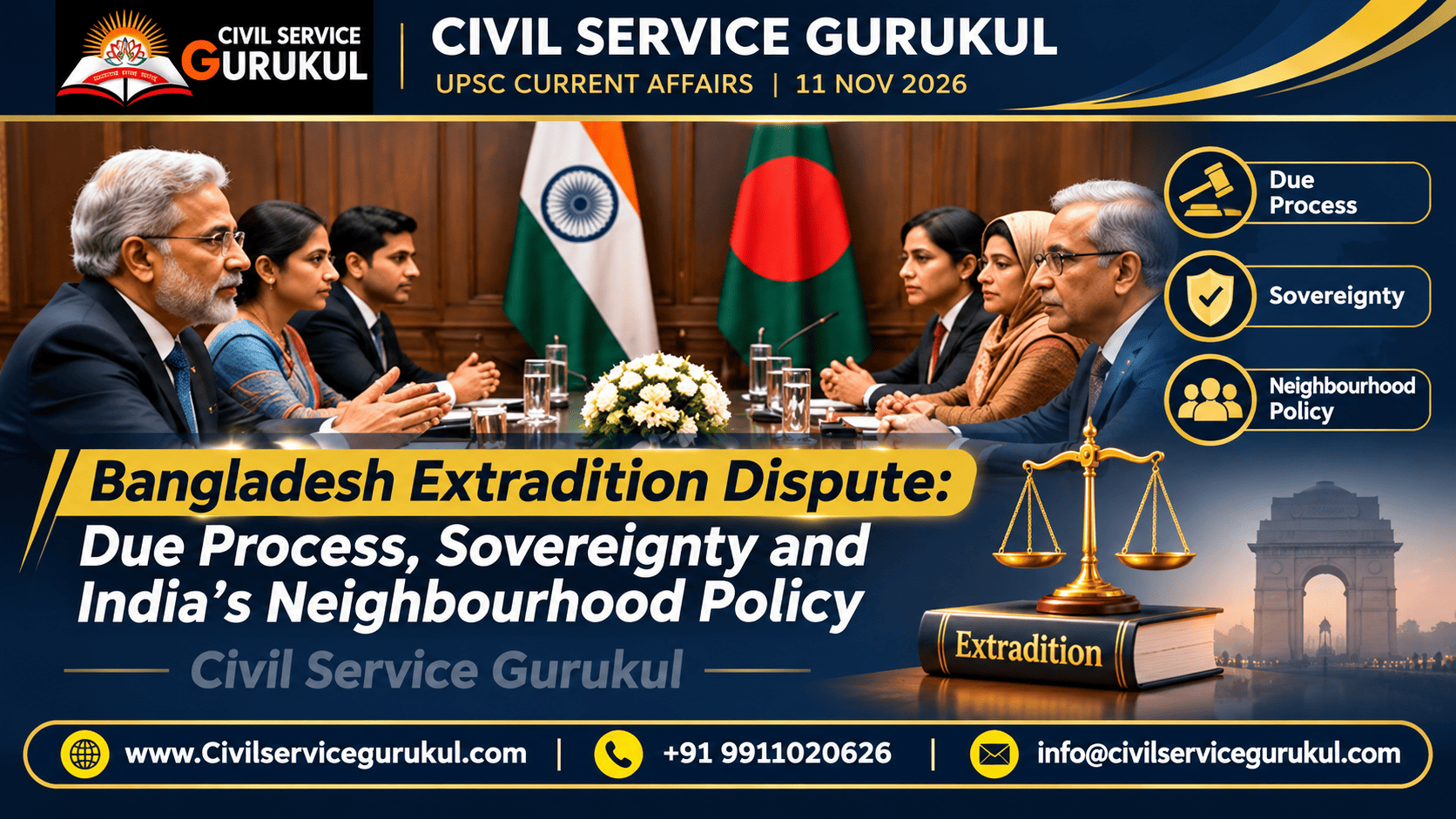
Sheikh Hasina Extradition Dispute 2026: India-Bangladesh Treaty, Due Process and India's Neighbourhood Policy
Understanding how international law, bilateral treaties, political sovereignty, judicial safeguards and strategic diplomacy intersect in a sensitive India-Bangladesh dispute.
Excerpt / Brief Summary
The November 2026 dispute over former Bangladesh Prime Minister Sheikh Hasina's proposed return from India has renewed attention on the India-Bangladesh Extradition Treaty.
Reports indicate that her legal representatives sought fresh passport and national identity documents, while Bangladeshi authorities continued to demand her extradition.
The issue raises questions about due process, treaty obligations, judicial safeguards, political offences, sovereignty and bilateral diplomacy.
For UPSC aspirants, the dispute provides an opportunity to understand international law and India's Neighbourhood First Policy.
GS Paper II: India and its Neighbourhood, Bilateral Relations, International Agreements, Effects of Foreign Policies on India's Interests.
Prelims: International Relations, Extradition Act, 1962, Bilateral Treaties and Constitutional Principles.
Essay: National Interest, Rule of Law, Human Rights and Sovereignty.
1. Why in the News?
In November 2026, former Bangladesh Prime Minister Sheikh Hasina's reported request for a fresh passport and national identity card created renewed diplomatic and legal discussion.
Hasina has been in India since 5 August 2024, following the political upheaval that ended her government.
Bangladesh continues to seek her extradition under the bilateral extradition treaty.
In November 2025, Bangladesh's International Crimes Tribunal sentenced Hasina to death following proceedings concerning the 2024 protest crackdown.
Hasina denies the allegations and challenges the legitimacy of the proceedings. The convictions and legal process remain subjects of political and legal controversy.
On 10 November 2026, India's Ministry of External Affairs stated that extradition was a legal matter requiring appropriate consideration.
The spokesperson also referred to the technical requirement for travel documentation, without announcing a final extradition decision.
A passport application, an extradition request, a judicial conviction and actual surrender are separate legal and administrative events.
One development does not automatically establish that all conditions for another have been satisfied.
2. Background and Timeline
| Year / Date | Development |
|---|---|
| 2013 | India and Bangladesh signed a bilateral extradition treaty. |
| 2016 | The extradition treaty was amended. |
| 5 August 2024 | Sheikh Hasina left Bangladesh and travelled to India following mass protests and political upheaval. |
| November 2025 | Bangladesh's International Crimes Tribunal sentenced Hasina in proceedings concerning the 2024 crackdown. |
| 9 November 2026 | Reports emerged regarding requests for fresh Bangladeshi travel and identity documents. |
| 10 November 2026 | India's MEA addressed questions about travel documents and the legal nature of extradition. |
| 11 November 2026 | The dispute continued to receive international attention, with extradition and due-process questions unresolved. |
The case illustrates how domestic political developments in one country can produce legal and diplomatic consequences for a neighbouring state.
3. What Is Extradition?
Extradition is a formal legal process through which one state surrenders a person to another state for criminal prosecution or punishment, subject to applicable law.
The requesting country is commonly called the requesting state, while the country receiving the request is the requested state.
Important Features
- It involves cooperation between states.
- It may operate through treaties or applicable domestic law.
- It requires examination of specified legal conditions.
- It may involve executive and judicial processes.
- It is not the same as deportation.
- An extradition request does not guarantee surrender.
Why Is Extradition Necessary?
Extradition helps prevent persons accused or convicted of serious crimes from avoiding the administration of criminal justice by crossing borders.
However, cooperation must remain consistent with applicable legal safeguards.
4. India-Bangladesh Extradition Treaty: Key Provisions for UPSC
India and Bangladesh signed an extradition treaty in 2013, subsequently amended in 2016.
The treaty provides a legal framework for considering eligible extradition requests between the two countries.
A. Central Authorities
Under Article 4, the designated central authority for India is the Ministry of External Affairs.
For Bangladesh, the designated central authority is the Ministry of Home Affairs.
B. Extradition of Nationals
Article 5 provides that nationality does not, by itself, prevent extradition under the treaty.
C. Political Offence Exception
Article 6 provides that extradition may be refused where the relevant offence is political in character.
However, the treaty specifically excludes several serious offences, including murder and certain violent acts, from the political offence category.
D. Additional Grounds for Refusal
Article 8 addresses grounds on which extradition may be refused or prohibited in specified circumstances.
These include relevant considerations relating to good faith, justice and certain previous criminal proceedings.
E. Applicable National Law
Treaty provisions must be considered alongside the domestic legal framework governing extradition.
India's Central Authority under the bilateral treaty: Ministry of External Affairs.
Bangladesh's Central Authority: Ministry of Home Affairs.
Political Offence Exception: Article 6.
Additional Refusal Grounds: Article 8.
5. Legal and Constitutional Issues Involved
1. Extradition Act, 1962
India's Extradition Act, 1962 provides a domestic statutory framework for extradition proceedings.
The specific procedure depends on the applicable treaty, notifications and circumstances of the request.
2. Due Process
Due process broadly requires legal decisions affecting individual rights to follow applicable procedural safeguards.
A high-profile political dispute does not automatically remove legal requirements.
3. Article 21
Article 21 of the Indian Constitution protects life and personal liberty and applies to persons, not only Indian citizens.
Its implications must be examined within the relevant legal context.
4. Sovereignty
State sovereignty recognises the authority of states within their respective legal and territorial systems.
The requesting state has an interest in enforcing its criminal law, while the requested state must assess its own legal obligations.
5. Human Rights
Extradition decisions may raise concerns relating to fair trials, detention conditions and treatment after surrender.
Such concerns must be examined under applicable law and evidence.
6. Diplomatic Relations
Legal proceedings may occur alongside sensitive diplomatic engagement.
However, political pressure cannot substitute for the statutory and treaty requirements.
6. Difference Between Extradition, Deportation and Asylum
| Concept | Meaning | Principal Purpose |
|---|---|---|
| Extradition | Formal surrender of a person to another state under applicable law | Criminal prosecution or punishment |
| Deportation | Removal of a non-citizen under immigration law | Enforcement of immigration rules |
| Asylum | Protection granted by a state to a person seeking refuge | Protection from specified threats or persecution |
| Voluntary Return | A person's return to another country through applicable travel procedures | Personal return subject to relevant rules |
These concepts must not be used interchangeably.
A voluntary return announcement does not itself resolve a pending extradition request.
7. Why the Dispute Matters for India-Bangladesh Relations
India and Bangladesh share important geographical, economic, security and cultural ties.
Bilateral relations involve considerably more than the status of any individual political leader.
A. Border Management
The countries share a land border of approximately 4,096.7 kilometres.
Cooperation is important for border security, cross-border movement and lawful trade.
B. Economic Cooperation
Bilateral trade, transport links and connectivity projects are important for economic development in both countries.
C. Connectivity
Road, rail, waterway and port connectivity can strengthen regional integration.
D. Water Cooperation
Shared rivers require continuous technical and diplomatic engagement.
E. Security Cooperation
Counterterrorism, border crime and regional security concerns require sustained institutional coordination.
F. People-to-People Relations
Family connections, education, culture and travel remain important components of bilateral relations.
8. Major Challenges: Law, Politics and Strategic Interests
1. Political Sensitivity
The case involves a former head of government and disputed legal proceedings.
2. Competing Expectations
Bangladesh seeks legal accountability through extradition, while India must assess applicable legal and diplomatic considerations.
3. Human Rights Concerns
Questions concerning procedural fairness and treatment following extradition require careful assessment.
4. Bilateral Trust
Prolonged disagreement could affect political confidence between the two countries.
5. Regional Stability
Political developments in Bangladesh may influence regional security, migration pressures and cross-border economic activity.
Bangladesh's perspective: The government seeks accountability through its legal institutions and the bilateral treaty.
India's perspective: The request must be considered under applicable legal procedures while protecting broader bilateral interests.
Rule-of-law perspective: Neither political influence nor international pressure should replace lawful review.
9. Way Forward: A Rules-Based Diplomatic Approach
- Follow Treaty Procedures: Examine the request under the bilateral agreement and domestic law.
- Preserve Due Process: Ensure decisions respect applicable procedural safeguards.
- Maintain Diplomatic Dialogue: Use official communication channels to prevent unnecessary escalation.
- Separate Legal and Political Questions: Avoid treating diplomatic preferences as substitutes for legal findings.
- Protect Bilateral Cooperation: Maintain engagement on trade, connectivity, water and security.
- Consider Human Rights: Evaluate relevant fair-trial and human-rights concerns within the applicable legal framework.
- Promote Regional Stability: Pursue a measured, institutional approach consistent with long-term interests.
10. UPSC Mains Practice: GS Paper II
"Extradition disputes between neighbouring countries involve a complex interaction of legal obligations, human rights and strategic interests."
Discuss with reference to recent developments in India-Bangladesh relations.
Model Answer
Introduction: Extradition is a formal legal process whereby one state surrenders a person to another for criminal prosecution or punishment. The recent India-Bangladesh dispute illustrates the intersection of international law, sovereignty and diplomacy.
Legal Dimensions: The India-Bangladesh Extradition Treaty provides a framework for cooperation. However, applicable domestic law, procedural safeguards and treaty exceptions must be examined.
Strategic Dimensions: India and Bangladesh share extensive cooperation in trade, border management, connectivity and security. A sensitive extradition dispute may affect bilateral trust if not handled carefully.
Human Rights: Fair-trial concerns, the nature of criminal proceedings and treatment after surrender may form part of a lawful assessment.
Way Forward: Both countries should follow treaty procedures, maintain transparent diplomatic communication and avoid politicising the legal process. Continuing cooperation on economic and security matters is equally important.
Conclusion: A rules-based approach that balances due process with legitimate security and diplomatic interests can strengthen long-term India-Bangladesh relations.
11. UPSC Prelims Practice MCQs
1. India and Bangladesh signed an extradition treaty in 2013.
2. Extradition and deportation are legally identical processes.
3. An extradition request does not automatically guarantee surrender.
Which statements are correct?
(a) 1 only
(b) 1 and 3 only
(c) 2 and 3 only
(d) 1, 2 and 3
Show Answer and Explanation
Correct Answer: (b) 1 and 3 only.
The treaty was signed in 2013. Extradition and deportation are distinct legal processes. An extradition request requires examination under applicable law.
(a) Ministry of Home Affairs
(b) Ministry of External Affairs
(c) Supreme Court of India
(d) Election Commission of India
Show Answer and Explanation
Correct Answer: (b) Ministry of External Affairs.
Article 4 identifies India's Ministry of External Affairs as the designated central authority.
(a) Automatically prohibits extradition in every politically sensitive case
(b) Allows refusal in specified cases, subject to treaty exceptions
(c) Applies only to economic offences
(d) Eliminates the requirement for domestic law
Show Answer and Explanation
Correct Answer: (b).
Article 6 provides a political offence exception but excludes certain serious offences from its scope.
(a) Both are always identical
(b) Extradition concerns inter-state surrender for criminal proceedings, while deportation concerns immigration-related removal
(c) Deportation requires a bilateral extradition treaty in every case
(d) Extradition grants citizenship
Show Answer and Explanation
Correct Answer: (b).
Extradition involves surrender for criminal prosecution or punishment. Deportation relates to removal under immigration law.
1. Border management
2. Connectivity
3. River-water cooperation
4. Trade and economic ties
Which are relevant to bilateral relations?
(a) 1 and 2 only
(b) 3 and 4 only
(c) 1, 2 and 3 only
(d) 1, 2, 3 and 4
Show Answer and Explanation
Correct Answer: (d).
All four are important dimensions of India-Bangladesh bilateral cooperation.
12. Quick Revision Notes for UPSC 2027
- Treaty: India-Bangladesh Extradition Treaty, 2013.
- Amendment: 2016.
- Indian Law: Extradition Act, 1962.
- India's Central Authority: Ministry of External Affairs.
- Bangladesh's Central Authority: Ministry of Home Affairs.
- Article 6: Political offence exception.
- Article 8: Specified grounds for refusal.
- Article 21: Protection of life and personal liberty.
- Extradition: Formal surrender for prosecution or punishment.
- Deportation: Immigration-related removal.
- GS-II Themes: Rule of law, sovereignty, bilateral relations and Neighbourhood First.
13. Frequently Asked Questions
Does an extradition request automatically require surrender?
No. The request must be considered under applicable treaty conditions, domestic laws and procedural safeguards.
What is the political offence exception?
It is a treaty provision allowing refusal of extradition for specified political offences, subject to exclusions for certain serious crimes.
Which law governs extradition in India?
The Extradition Act, 1962 is the principal Indian statutory framework, read with applicable treaty provisions and other relevant law.
Why is the Bangladesh extradition dispute important for UPSC?
It connects international law, constitutional principles, human rights, India's foreign policy and neighbourhood relations.
Has the November 2026 passport request resolved the extradition dispute?
No. The reported passport request and the pending extradition question remain legally distinct matters.
14. Conclusion: Law and Diplomacy Must Work Together
The India-Bangladesh extradition dispute illustrates the complex relationship between sovereignty, international cooperation and procedural justice.
While Bangladesh has expressed its desire for extradition, India must consider the request through the applicable legal framework.
The case also demonstrates why broader bilateral relations should not be reduced to a single controversial political issue.
For UPSC aspirants, the essential lesson is that sustainable foreign policy requires a balance between national interests, treaty obligations, constitutional values and diplomatic prudence.
15. Prepare for UPSC 2027 with Civil Service Gurukul
Civil Service Gurukul provides syllabus-oriented study resources, current affairs analysis, Prelims practice and Mains answer-writing guidance.
Master International Relations for UPSC CSE 2027
Strengthen GS Paper II preparation with conceptual explanations, contemporary case studies, structured revision and examination-focused practice.
Explore Courses and Study ResourcesWebsite: www.civilservicegurukul.com
Mobile: +91 9911020626
Email: info@civilservicegurukul.com
Educational Disclaimer: This article has been prepared for UPSC Civil Services Examination preparation. It discusses publicly reported developments as of 11 November 2026. Allegations, judicial findings and contested claims should be distinguished from independently established facts. The legal interpretation of extradition requests depends on specific treaty provisions, domestic legislation and procedural circumstances. This article is educational commentary and not an official UPSC publication or a legal opinion.
Prepare with Mentors Who Cleared the Exam
Get personalized study plans, evaluated answer models, and test series access.