
Gaza Environmental Damage: UPSC 2027 Analysis
UPSC CURRENT AFFAIRS | ENVIRONMENT | INTERNATIONAL RELATIONS
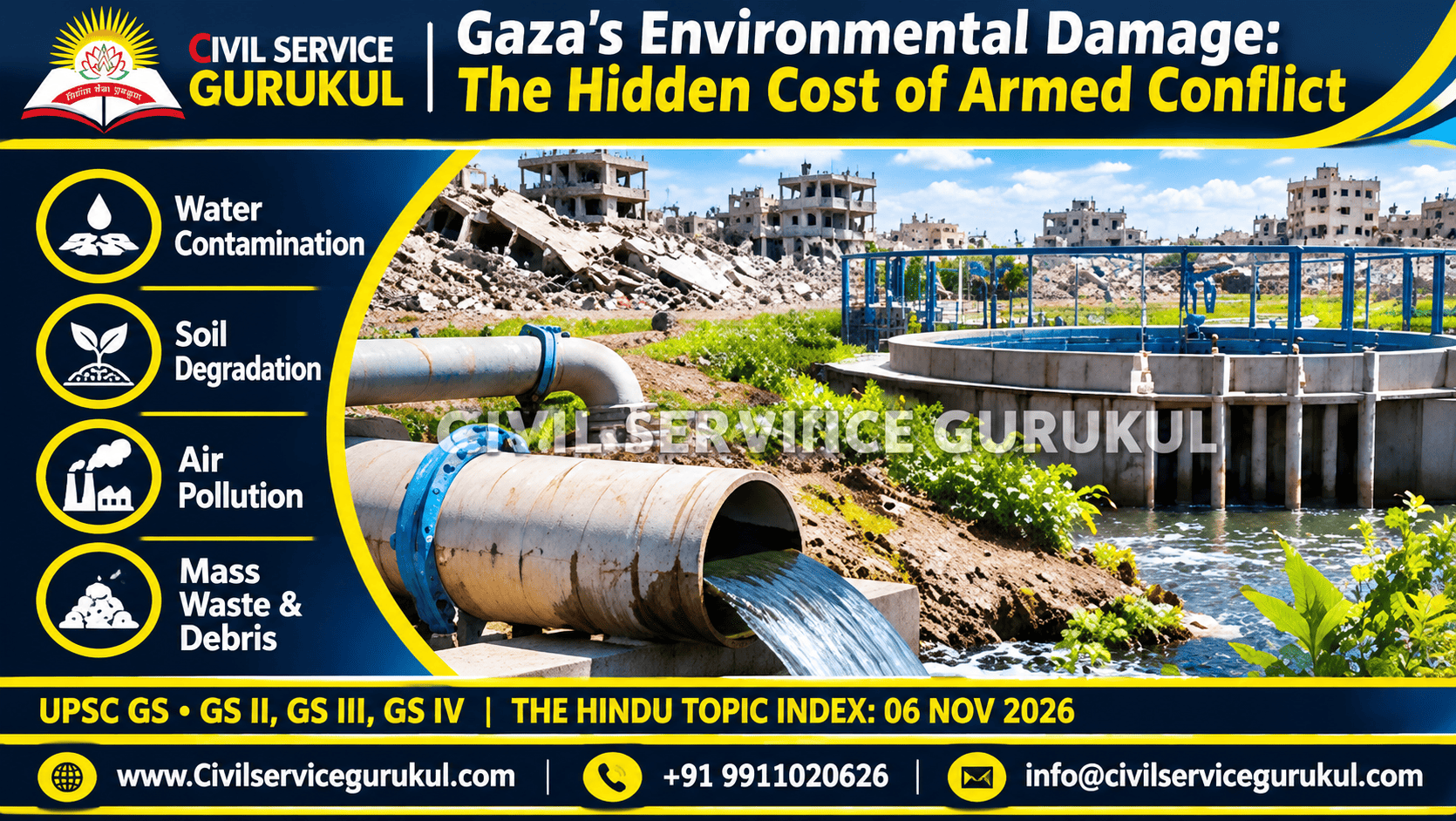
Gaza Environmental Crisis Explained: How War Damages Water, Soil, Food Security and Human Health
An in-depth UPSC analysis of environmental destruction during armed conflict, UNEP assessments, humanitarian law, public health and post-war ecological recovery.
Current Affairs | Source Topic: 6 November 2026
UPSC Examination Relevance
1. Why Is Gaza's Environmental Damage in the News?
The 6 November 2026 current-affairs edition includes an editorial examining the ecological consequences of armed conflict in Gaza.
The source highlights UNEP's September 2025 assessment, which documents extensive damage affecting freshwater, wastewater systems, soil and vegetation.
The central concern is that environmental harm can persist long after fighting ends.
2. Environmental Damage as a Hidden Cost of War
Armed conflict is commonly assessed through its immediate human and infrastructure consequences.
However, damage to ecosystems and environmental services can continue to affect communities after active fighting.
The supplied editorial identifies freshwater, wastewater, soil and vegetation as major areas of concern in Gaza.
Environmental recovery must therefore be considered an important component of post-conflict rehabilitation.
3. What Did UNEP's September 2025 Assessment Highlight?
The supplied source refers to UNEP's September 2025 assessment of environmental damage in Gaza.
It reports extensive damage to freshwater, wastewater systems, soil and vegetation.
The assessment also highlights serious contamination risks and major vegetation losses.
These findings demonstrate why environmental conditions are important for humanitarian relief and long-term recovery.
4. Water Pollution and Damaged Freshwater Systems
Damage to freshwater systems can create major challenges for affected populations.
The supplied report identifies freshwater damage as one of the significant environmental consequences of the conflict.
Contaminated aquifers can create public health risks and complicate access to safe water.
Restoring safe water access is therefore an important priority in environmental recovery.
5. Wastewater Infrastructure and Disease Risks
Wastewater infrastructure is essential for sanitation and public health.
The supplied editorial identifies damaged wastewater systems as a major environmental concern in Gaza.
Damaged treatment plants and contaminated water can increase disease risks.
Restoring sanitation systems should therefore be treated as a core element of humanitarian and environmental recovery.
6. Soil Contamination and Agricultural Damage
Soil contamination is among the environmental risks identified in the supplied report.
The destruction of farmland can also undermine agricultural activity and local food systems.
These impacts are particularly important because environmental degradation can contribute to food insecurity.
Environmental recovery should therefore include assessment of soil conditions and agricultural damage.
7. Vegetation Loss and Ecosystem Degradation
The supplied source notes major losses of vegetation in Gaza.
Vegetation loss is an important dimension of ecological damage because it affects the condition of local ecosystems.
The recovery of damaged landscapes may require long-term ecological restoration.
For UPSC, vegetation loss should be considered alongside water, soil and infrastructure damage when evaluating the environmental consequences of war.
8. War Debris, Hazardous Materials and Fuel Leaks
Environmental damage during armed conflict can arise from rubble, fuel leaks and hazardous debris.
The supplied report identifies these as important sources of environmental risk.
Debris clearance may require screening for hazardous materials and unexploded ordnance.
Safe debris management is therefore essential for both environmental protection and civilian safety.
9. Environmental Damage and Public Health
Environmental degradation can worsen public health conditions during and after armed conflict.
The supplied report identifies contaminated aquifers and damaged treatment plants as important health concerns.
Unsafe water and sanitation conditions can contribute to the spread of disease.
Humanitarian recovery should therefore integrate environmental monitoring with public health protection.
10. Food Insecurity and Displacement
Environmental degradation can intensify food insecurity and displacement.
The supplied source connects damage to environmental systems with broader humanitarian consequences.
The destruction of farmland and deterioration of essential services can complicate recovery for affected communities.
Environmental protection should therefore be considered alongside food security and humanitarian assistance.
11. International Humanitarian Law and Environmental Protection
International humanitarian law protects civilians and regulates conduct during armed conflict.
Environmental harm raises important questions about civilian protection and the consequences of military operations.
However, environmental assessments alone do not establish criminal liability.
Claims about specific perpetrators or legal responsibility require careful evidence and determination by competent legal authorities.
12. Remote Sensing and Satellite-Based Environmental Monitoring
Remote sensing can help map environmental damage over large areas.
Satellite-based observations can contribute to environmental assessments where ground access is difficult.
However, the supplied report cautions that remote sensing cannot fully replace ground sampling.
Reliable environmental assessment therefore requires appropriate methods and careful interpretation of available evidence.
13. Remote Sensing Versus Ground Sampling
| Method | Main Use | Limitation |
|---|---|---|
| Remote Sensing | Mapping visible environmental damage | Cannot fully substitute for field verification |
| Ground Sampling | Assessing local environmental conditions | May require safe physical access |
| Combined Assessment | Supporting more comprehensive evaluation | Requires coordination and reliable data |
14. Why Environmental Assessment Does Not Automatically Establish Legal Liability
Environmental assessments can document damage and identify contamination risks.
However, the existence of environmental harm does not by itself establish the legal responsibility of a particular individual or party.
The supplied editorial emphasises the need for careful evidence and competent legal determination.
For UPSC, it is important to distinguish environmental findings, allegations of responsibility and legally established conclusions.
15. Challenges in Post-Conflict Environmental Recovery
- Restoring safe water access.
- Repairing damaged sanitation systems.
- Identifying hazardous debris.
- Managing risks from unexploded ordnance.
- Assessing soil and vegetation damage.
- Ensuring humanitarian access.
- Conducting reliable environmental monitoring.
- Planning long-term ecosystem restoration.
16. Environmental Recovery and Humanitarian Assistance
The supplied report highlights that recovery requires both humanitarian access and technical environmental assessment.
Humanitarian assistance can address immediate civilian needs, while environmental assessment helps identify longer-term risks.
The protection of aid workers is also important for implementing recovery activities.
A coordinated approach should therefore integrate civilian protection, essential services and environmental restoration.
17. GS Paper II: International Relations and Humanitarian Law
Gaza's environmental damage is relevant to GS Paper II because it connects armed conflict with international humanitarian law and civilian protection.
Candidates should examine the role of international institutions and the need for evidence-based legal assessment.
A balanced answer should distinguish documented environmental harm from conclusions about individual legal responsibility.
The issue also demonstrates the importance of humanitarian access in post-conflict recovery.
18. GS Paper III: Environment and Disaster Management
The topic is relevant to GS Paper III because it concerns pollution, ecosystem degradation, hazardous debris and environmental recovery.
Candidates should examine the relationship between damaged water systems, contaminated soil, vegetation loss and public health risks.
Remote sensing and ground sampling are also important scientific tools for environmental assessment.
The central policy challenge is to combine immediate risk reduction with long-term ecosystem restoration.
19. GS Paper IV: Ethics of Environmental Protection During War
Environmental destruction during armed conflict raises ethical questions about civilian welfare and long-term responsibility.
Damage to essential environmental services can increase the vulnerability of affected populations.
The protection of aid workers and prioritisation of safe water and sanitation reflect important humanitarian responsibilities.
For GS Paper IV, candidates can connect the issue with human dignity, accountability, compassion and intergenerational environmental responsibility.
20. Way Forward: Environmental Recovery Priorities
1. Safe Water: Prioritise access to safe drinking water.
2. Sanitation: Restore essential wastewater and sanitation services.
3. Debris Risk Mapping: Identify hazardous materials and unexploded ordnance risks.
4. Independent Monitoring: Support credible environmental assessment and data collection.
5. Aid Worker Protection: Enable humanitarian and recovery operations.
6. Civilian Protection: Integrate environmental recovery with humanitarian safeguards.
7. Ecosystem Restoration: Plan long-term recovery of damaged environmental systems.
21. UPSC Prelims 2027: Quick Revision Notes
UNEP: United Nations Environment Programme.
Source Assessment: UNEP September 2025 environmental assessment of Gaza.
Major Environmental Concerns: Freshwater, wastewater, soil and vegetation damage.
Contamination Risks: Fuel leaks, hazardous debris and damaged sewage systems.
Humanitarian Impacts: Public health risks, food insecurity and displacement.
Scientific Tool: Remote sensing for damage mapping.
Important Limitation: Remote sensing cannot fully replace ground sampling.
Legal Principle: Environmental assessments alone do not establish criminal liability.
22. UPSC Prelims Practice MCQs
Question 1
Which organisation published major environmental assessments of damage in Gaza?
A. United Nations Environment Programme
B. World Trade Organization
C. International Civil Aviation Organization
D. World Intellectual Property Organization
UNEP has published environmental assessments concerning Gaza.
Question 2
Which of the following can contribute to environmental damage during armed conflict?
A. Fuel leaks
B. Damaged sewage systems
C. Hazardous debris
D. All of the above
All three are identified as potential sources of environmental harm.
Question 3
Consider the following statements:
1. Remote sensing can help map environmental damage.
2. Remote sensing can always fully replace ground sampling.
A. 1 only
B. 2 only
C. Both 1 and 2
D. Neither 1 nor 2
Remote sensing can support damage mapping, but it cannot fully substitute for ground sampling.
Question 4
Which statement about environmental assessments during armed conflict is most accurate?
A. They automatically establish criminal liability.
B. They can document damage but do not alone establish legal responsibility.
C. They eliminate the need for humanitarian access.
D. They make ground-level verification unnecessary.
Environmental assessments can document harm, while legal responsibility requires appropriate evidence and competent determination.
23. UPSC Mains Practice Questions
"Environmental destruction is an enduring humanitarian consequence of armed conflict." Analyse the relationship between environmental damage, international humanitarian law and post-conflict recovery, with reference to Gaza.
Discuss the environmental and public health challenges associated with damaged water systems, hazardous debris and vegetation loss in conflict-affected regions.
24. UPSC Mains Model Answer Framework
Introduction
Armed conflict can cause environmental harm that persists beyond active fighting, affecting public health, food security and post-conflict recovery.
Environmental Impacts
- Damage to freshwater and wastewater systems.
- Soil contamination and vegetation loss.
- Hazardous debris and fuel leaks.
- Risks associated with unexploded ordnance.
Humanitarian Implications
- Public health risks.
- Food insecurity.
- Displacement.
- Challenges in accessing essential services.
Legal and Institutional Dimensions
- International humanitarian law protects civilians and regulates armed conflict.
- UNEP assessments help document environmental damage.
- Remote sensing can support damage mapping.
- Ground sampling remains important for verification.
- Legal responsibility requires competent determination.
Way Forward
- Restore safe water and sanitation.
- Map hazardous debris risks.
- Support independent environmental monitoring.
- Protect aid workers and civilians.
- Plan long-term ecosystem restoration.
Conclusion
Post-conflict recovery must address both immediate humanitarian needs and the long-term environmental consequences of armed conflict through credible assessment, civilian protection and sustainable restoration.
25. Key Takeaways for UPSC 2027
✓ Armed conflict can cause environmental damage that persists beyond fighting.
✓ UNEP's September 2025 assessment highlights extensive environmental damage in Gaza.
✓ Major concerns include freshwater, wastewater, soil and vegetation damage.
✓ Hazardous debris and unexploded ordnance complicate recovery.
✓ Environmental degradation can worsen public health, food insecurity and displacement.
✓ Remote sensing can map damage but cannot fully replace ground sampling.
✓ Environmental assessments alone do not establish criminal liability.
✓ Safe water, sanitation, independent monitoring and ecosystem restoration are important recovery priorities.
26. Frequently Asked Questions
What is the main environmental concern in Gaza?
The supplied report highlights extensive damage affecting freshwater, wastewater systems, soil and vegetation, alongside contamination risks.
Which international organisation assessed environmental damage in Gaza?
The United Nations Environment Programme, or UNEP, published environmental assessments concerning Gaza.
How does war affect water and sanitation?
Damage to freshwater and wastewater systems can increase contamination risks and create public health challenges.
Why is war debris dangerous?
Debris may contain hazardous materials and unexploded ordnance, requiring careful risk assessment before clearance.
Can satellites fully assess environmental contamination?
No. Remote sensing can map damage, but ground sampling remains important for assessing local environmental conditions.
Does an environmental assessment establish criminal liability?
No. Legal responsibility requires appropriate evidence and determination by competent legal authorities.
What should be prioritised during environmental recovery?
Safe water, sanitation, debris risk mapping, environmental monitoring, civilian protection and ecosystem restoration are key priorities.
Why is Gaza's environmental damage important for UPSC?
It connects environmental governance, international humanitarian law, public health, disaster management and ethical responsibility.
27. Conclusion
The environmental consequences of armed conflict can continue to affect communities long after active fighting ends.
Gaza's damaged water systems, soil contamination risks, hazardous debris and vegetation loss demonstrate the importance of ecological considerations in humanitarian recovery.
Environmental assessments can support damage mapping and recovery planning, but legal responsibility requires separate and careful determination.
For UPSC aspirants, the central lesson is that post-conflict recovery must integrate civilian protection, environmental monitoring, essential services and long-term ecosystem restoration.
Prepare for UPSC Civil Services Examination with Civil Service Gurukul
UPSC Prelims 2027 | Mains Answer Writing | Environment | International Relations | Current Affairs | GS Mentorship
Explore Civil Service GurukulWebsite: www.civilservicegurukul.com
Mobile: +91 9911020626
Email: info@civilservicegurukul.com
Prepare with Mentors Who Cleared the Exam
Get personalized study plans, evaluated answer models, and test series access.