Electoral Roll Revision & Form 7: UPSC 2027 Notes
UPSC CURRENT AFFAIRS | INDIAN POLITY | GOVERNANCE
Electoral Roll Revision and Form 7 Explained: Constitutional Safeguards, Voter Deletion and UPSC 2027 Analysis
Understanding voter registration, electoral roll accuracy, democratic rights, Election Commission procedures and safeguards against wrongful deletion.
Current Affairs | Source Topic: 6 November 2026
UPSC Examination Relevance
1. Why Is Electoral Roll Revision in the News?
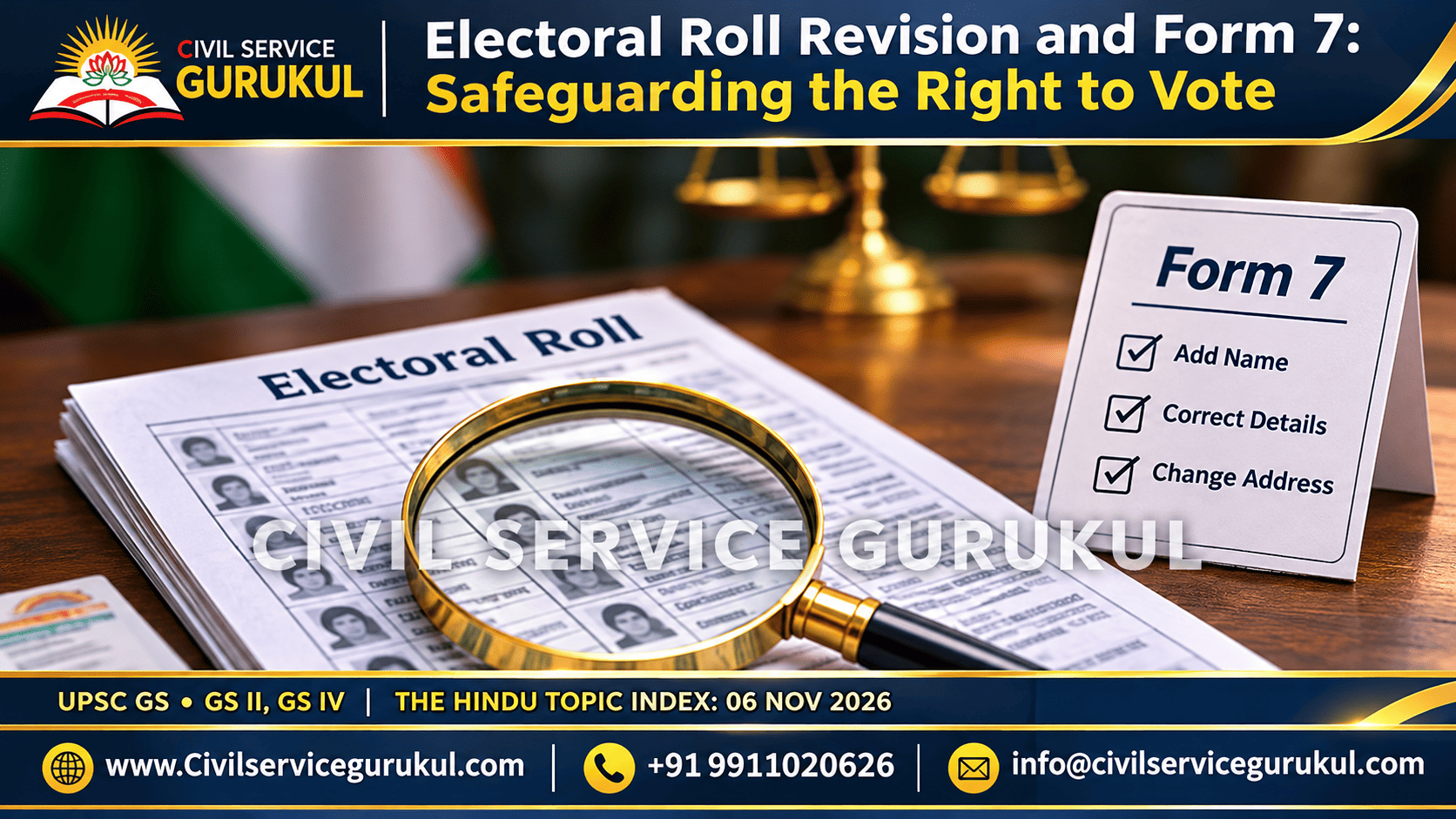
The newspaper topic dated 6 November 2026 highlights electoral roll revision in six States and Union Territories and allegations concerning forged Form 7 objections in a Delhi electoral-roll dispute.
These developments raise an important constitutional and administrative question: how can voter lists be corrected without wrongly excluding eligible citizens?
Electoral roll accuracy is essential for credible elections. At the same time, the removal of eligible voters can undermine electoral participation and public trust.
2. What Is an Electoral Roll?
An electoral roll is the official list of persons registered as electors in a particular constituency.
Its accuracy is essential for the administration of elections because electoral authorities rely on the roll to determine who is registered to vote.
Electoral roll revision helps address changes in voter eligibility, residence and registration records.
The administrative objective is to maintain an accurate list while protecting eligible electors against unjustified deletion.
3. Constitutional and Legal Framework
Article 324: Election Commission of India
Article 324 of the Constitution entrusts the superintendence, direction and control of electoral rolls and the conduct of specified elections to the Election Commission of India.
Representation of the People Act, 1950
The Representation of the People Act, 1950 provides the statutory framework for electoral registration and electoral rolls.
Registration of Electors Rules, 1960
These rules prescribe procedures and forms relevant to electoral registration, objections and corrections.
Article 326: Adult Suffrage
Article 326 provides for elections to the Lok Sabha and State Legislative Assemblies on the basis of adult suffrage, subject to constitutional and legal qualifications.
4. Form 6, Form 7 and Form 8: Key Differences
| Form | Ordinary Purpose | UPSC Relevance |
|---|---|---|
| Form 6 | Application for inclusion of name in electoral roll | New voter registration |
| Form 7 | Objection to inclusion or request for deletion | Voter deletion safeguards |
| Form 8 | Shifting of residence, correction and other prescribed updates | Electoral record updates |
5. What Is Form 7 and Why Does It Matter?
Form 7 is a prescribed electoral registration form used for objections to proposed inclusion or for seeking deletion of an entry from an electoral roll.
It provides a formal mechanism for raising concerns about entries that may not satisfy the applicable registration requirements.
However, the filing of an objection does not by itself establish that a voter is ineligible.
The relevant electoral authorities must examine the objection through the applicable legal procedure before taking a decision.
6. Why Is Electoral Roll Revision Necessary?
- To improve the accuracy of electoral registration records.
- To identify duplicate or otherwise ineligible entries.
- To address entries relating to deceased persons.
- To reflect changes in voter residence and eligibility.
- To strengthen public confidence in the electoral process.
- To support orderly election administration.
These objectives must be pursued without compromising the procedural rights of eligible electors.
7. Risks of Wrongful Voter Deletion
Electoral roll revision can create serious democratic concerns when verification processes are not sufficiently transparent or accessible.
Migrants, tenants, elderly citizens and persons with limited documentation may face particular difficulties in responding to registration queries.
Administrative errors or inadequate communication can create additional barriers to electoral participation.
The central policy challenge is to maintain accurate records without imposing disproportionate burdens on eligible citizens.
8. Procedural Safeguards Against Wrongful Deletion
↓
↓
↓
↓
This diagram is a simplified educational illustration of procedural fairness, not a substitute for the complete statutory process or current Election Commission instructions.
9. Electoral Accuracy Versus Voter Inclusion
Accurate electoral rolls are necessary to prevent errors and protect the integrity of elections.
At the same time, excessive or rigid verification requirements may create barriers for eligible voters.
Weak scrutiny can also permit fraudulent objections or inaccurate records.
Therefore, electoral administration must balance accuracy, accessibility, fairness and accountability rather than treating these objectives as mutually exclusive.
10. Digital Verification: Opportunities and Limitations
Digital tools can assist electoral authorities in identifying possible duplicate records and improving administrative efficiency.
However, automated matching may generate errors when names, addresses or other identifying details are incomplete or inconsistent.
Digital tools should support rather than replace individual scrutiny and procedural safeguards.
A technology-assisted electoral system must also remain accessible to citizens who lack reliable internet access or digital literacy.
11. GS Paper II: Governance and Constitutional Analysis
The issue is directly relevant to constitutional institutions, electoral governance, transparency and democratic participation.
A strong GS-II answer should examine the Election Commission's institutional role, the legal framework for electoral registration and the importance of procedural fairness.
It should also explain why accurate electoral rolls and voter inclusion are complementary democratic objectives.
The conclusion should recommend practical safeguards that are legally sound, accessible and administratively feasible.
12. GS Paper IV: Ethical Dimensions
Electoral roll revision also raises ethical questions about impartiality, integrity, accountability and respect for citizens.
Officials must apply registration procedures consistently and avoid prejudging objections or allegations.
Transparency, reasoned decision-making and accessible grievance mechanisms can help strengthen public trust.
The ethical objective is to ensure that administrative efficiency does not come at the cost of fairness and democratic dignity.
13. Challenges in Electoral Roll Management
- Errors in voter identification and record matching.
- Frequent changes in residence and migration.
- Limited awareness of objection and appeal procedures.
- Accessibility difficulties for elderly and vulnerable electors.
- Possibility of fraudulent or misleading objections.
- Administrative workload during large-scale revisions.
- Need for transparent and auditable decision-making.
14. Way Forward: Strengthening Electoral Integrity
1. Transparent Notice: Provide clear information to affected electors about objections and relevant procedures.
2. Accessible Hearings: Ensure that eligible citizens have a practical opportunity to respond.
3. Auditable Records: Maintain reliable records of Form 7 objections and decisions.
4. Offline Support: Assist citizens who face digital or documentation barriers.
5. Monitoring: Examine patterns of exclusion and administrative errors.
6. Accountability: Refer suspected forgery or misconduct to competent authorities without prejudging allegations.
15. UPSC Prelims 2027: Quick Revision Notes
Article 324: Election Commission's constitutional authority.
Article 326: Adult suffrage for Lok Sabha and State Assembly elections.
RPA 1950: Electoral registration framework.
Registration Rules 1960: Relevant registration procedures and forms.
Form 6: New inclusion.
Form 7: Objection or deletion request.
Form 8: Prescribed corrections and registration updates.
16. UPSC Prelims Practice MCQs
Question 1
Which form is ordinarily used to object to inclusion or seek deletion from an electoral roll?
A. Form 6
B. Form 7
C. Form 8
D. Form 26
Form 7 is associated with objections and deletion requests, while Form 6 ordinarily concerns new inclusion.
Question 2
Which Article of the Constitution entrusts electoral superintendence, direction and control to the Election Commission?
A. Article 280
B. Article 312
C. Article 324
D. Article 368
Article 324 establishes the relevant constitutional authority of the Election Commission.
Question 3
Consider the following statements:
1. Form 6 ordinarily concerns inclusion in electoral rolls.
2. A Form 7 objection automatically establishes that the elector is ineligible.
A. 1 only
B. 2 only
C. Both 1 and 2
D. Neither 1 nor 2
An objection requires examination through the applicable legal process and does not automatically prove ineligibility.
17. UPSC Mains Practice Questions
"Electoral roll revision must balance the need for accurate voter lists with the protection of universal adult franchise." Examine the constitutional and administrative safeguards necessary to achieve this balance.
Discuss the ethical responsibilities of electoral officials while handling voter deletion objections and allegations of fraudulent submissions.
18. UPSC Mains Model Answer Framework
Introduction
Electoral roll revision is an essential administrative exercise that aims to maintain accurate voter registration records while preserving democratic participation.
Constitutional and Legal Foundations
Article 324 provides the constitutional basis for the Election Commission's role, while the Representation of the People Act, 1950 and Registration of Electors Rules, 1960 provide the relevant statutory framework.
Key Challenges
- Risk of wrongful voter deletion.
- Documentation barriers faced by vulnerable citizens.
- Fraudulent or inaccurate objections.
- Administrative errors and weak communication.
- Limitations of automated verification.
Suggested Reforms
- Transparent notice and accessible response mechanisms.
- Individual scrutiny of objections.
- Reliable record-keeping and reasoned decisions.
- Offline assistance for vulnerable electors.
- Effective review and appeal mechanisms.
Conclusion
An inclusive and accurate electoral roll requires both effective verification and strong procedural safeguards. Electoral integrity is strengthened when eligible citizens can participate without arbitrary exclusion.
19. Key Takeaways for UPSC 2027
✓ Electoral roll revision supports accurate voter registration.
✓ Article 324 concerns the Election Commission.
✓ Form 7 is used for electoral objections and deletion requests.
✓ Filing an objection does not automatically justify deletion.
✓ Notice, scrutiny and accessible remedies are important safeguards.
✓ Electoral accuracy and inclusion must be pursued together.
✓ Allegations should be distinguished from established findings.
20. Frequently Asked Questions
What is electoral roll revision?
It is the process of updating electoral registration records to improve accuracy while protecting eligible voters.
What is Form 7?
Form 7 is used for objections to inclusion or requests for deletion from electoral rolls under the applicable registration procedure.
What is the difference between Form 6 and Form 7?
Form 6 ordinarily concerns new inclusion, while Form 7 concerns objections and deletion requests.
Which constitutional Article is relevant to the Election Commission?
Article 324 provides the relevant constitutional authority.
Can a voter be automatically deleted after a Form 7 objection?
No. An objection must be examined through the applicable legal procedure before a decision is made.
Why is electoral roll revision important for UPSC?
It connects constitutional law, electoral governance, democratic participation, administrative accountability and ethics.
What are the main concerns regarding voter deletion?
Wrongful exclusion, documentation barriers, inadequate notice and errors in verification are major concerns.
What should UPSC aspirants remember?
Article 324, Article 326, the Representation of the People Act, 1950, Registration of Electors Rules, 1960 and the differences between Forms 6, 7 and 8.
21. Conclusion
Electoral roll revision is essential for the credibility and effective administration of elections.
However, the accuracy of voter lists must be achieved through procedures that respect fairness, transparency and democratic inclusion.
Form 7 provides an important mechanism for raising electoral registration objections, but such objections must be examined carefully to prevent unjustified deletion.
For UPSC aspirants, the topic offers a valuable opportunity to connect constitutional provisions with contemporary governance challenges and the ethical responsibilities of public institutions.
Prepare for UPSC Civil Services Examination with Civil Service Gurukul
UPSC Prelims 2027 | Mains Answer Writing | Indian Polity | Current Affairs | GS Mentorship
Explore Civil Service GurukulWebsite: www.civilservicegurukul.com
Mobile: +91 9911020626
Email: info@civilservicegurukul.com
Prepare with Mentors Who Cleared the Exam
Get personalized study plans, evaluated answer models, and test series access.