Gravitational-Wave Astronomy Enters Statistical Era: GWTC-5.0, 390 Detections and LIGO-India | UPSC 2027
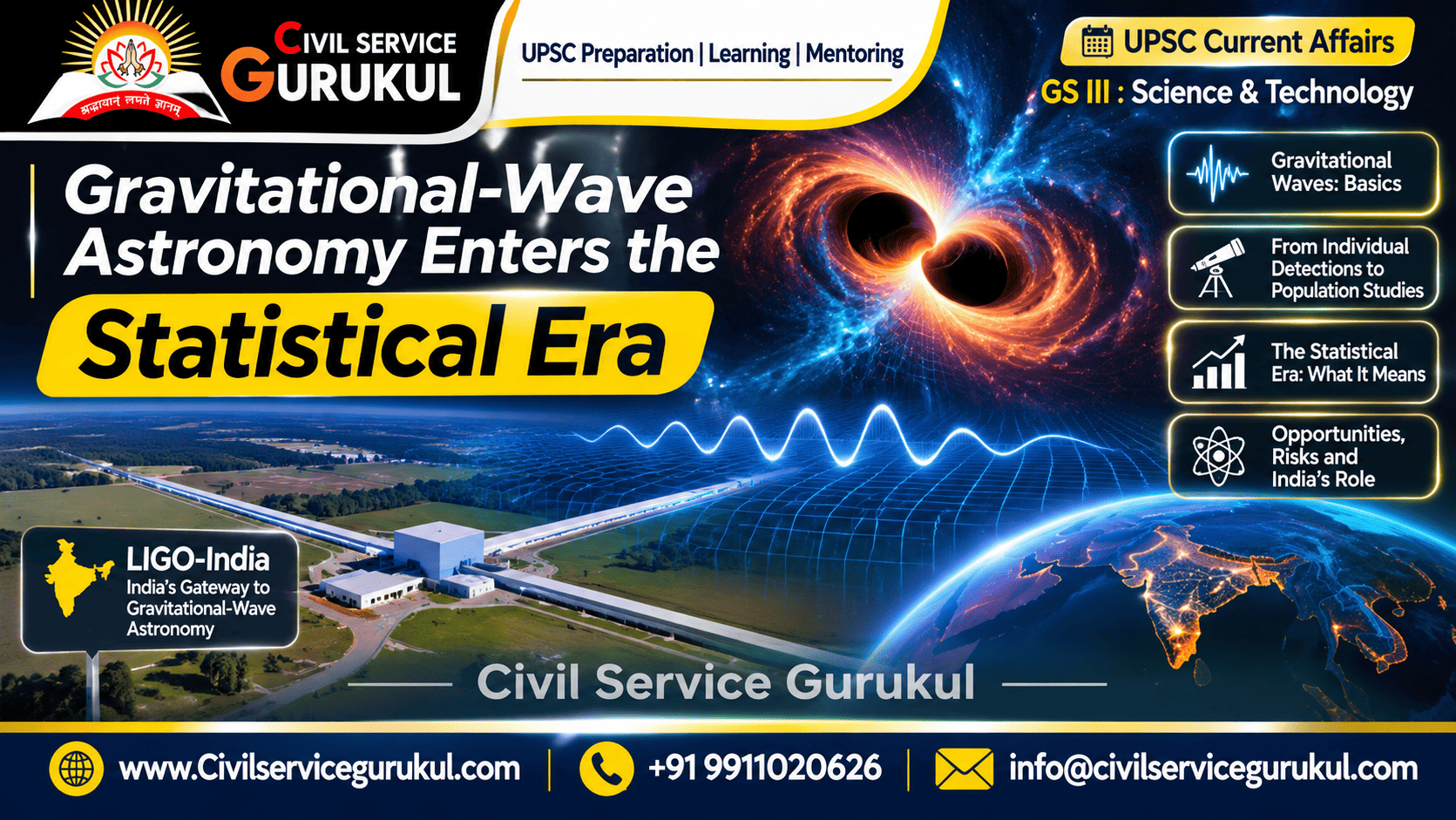
Gravitational-Wave Astronomy Enters the Statistical Era: 390 Cosmic Events, GWTC-5.0 and LIGO-India Explained
From Einstein's general relativity to black-hole populations, gravitational-wave catalogues are transforming our understanding of the Universe. Explore the latest developments, India's contribution and UPSC examination relevance.
Executive Summary / Brief Overview
Gravitational-wave astronomy is entering a statistical era, in which scientists use large catalogues of cosmic merger events to understand patterns across black-hole and neutron-star populations.
On 26 May 2026, the international LIGO–Virgo–KAGRA collaboration released the fifth version of its Gravitational-Wave Transient Catalog, known as GWTC-5.0.
The update added 161 significant signals from the second part of the fourth observing run, bringing the cumulative catalogue to 390 events.
The O4b observations were collected between April 2024 and January 2025.
The new O4b signals are consistent with binary black-hole mergers; no new neutron-star-containing events were identified in that subset.
A companion population study analysed 267 compact-binary mergers from the cumulative dataset to investigate the masses, spins, pairing behaviour and formation of black holes.
For India, the development is particularly important because of LIGO-India, a major gravitational-wave observatory project being developed in Hingoli district, Maharashtra.
The subject has direct UPSC relevance under GS Paper III Science and Technology, covering scientific discoveries, research infrastructure, international collaboration and India's technological capabilities.
Remember the sequence: Einstein's General Relativity → Gravitational Waves → Laser Interferometry → LIGO–Virgo–KAGRA → GWTC-5.0 → Statistical Population Studies → LIGO-India.
A common Prelims trap is to confuse the total number of catalogue events with the smaller number selected for detailed population analysis.
1. Why in the News?
The topic gained renewed current-affairs attention on 12 November 2026 as analysts examined how gravitational-wave astronomy is moving from individual discoveries towards population-level statistical research.
The underlying scientific milestone is the May 2026 release of GWTC-5.0 by the LIGO–Virgo–KAGRA collaboration.
Important Numbers
| Parameter | Verified Information |
|---|---|
| Latest Catalogue Discussed | GWTC-5.0 |
| Release Date | 26 May 2026 |
| Cumulative Significant Events | 390 |
| New O4b Signals | 161 |
| O4b Observation Period | April 2024–January 2025 |
| Population Study Dataset | 267 compact-binary mergers |
| Collaboration | LIGO–Virgo–KAGRA |
The figure of 267 is a scientific analysis sample and should not be confused with the cumulative catalogue of 390 reported events.
2. What Are Gravitational Waves?
Gravitational waves are ripples in the curvature of spacetime produced by changing distributions of mass and energy, especially powerful accelerating systems.
They were predicted by Albert Einstein through the General Theory of Relativity in 1916.
Sources of Gravitational Waves
- Binary black-hole mergers.
- Binary neutron-star mergers.
- Neutron-star and black-hole mergers.
- Asymmetric stellar explosions, in principle.
- Rapidly rotating asymmetric neutron stars.
- Possible gravitational-wave backgrounds.
Important Physical Properties
- They are disturbances of spacetime itself.
- They propagate at the speed of light in vacuum under general relativity.
- They do not require a material medium.
- They carry energy and angular momentum.
- They can cause extremely small changes in distances between freely moving objects.
- Their direct detection requires exceptionally sensitive instruments.
Einstein's Central Idea
General relativity describes gravitation through the curvature of spacetime caused by mass and energy.
Dynamic changes in the gravitational field can propagate outward as gravitational waves.
3. How Does LIGO Detect Gravitational Waves?
LIGO stands for Laser Interferometer Gravitational-Wave Observatory.
Its detectors use laser interferometry to measure minute changes in the relative lengths of perpendicular arms.
Detection Process
When a gravitational wave passes, it produces a tiny differential change in the relative arm lengths.
This alters the interference pattern, allowing scientists to analyse a possible gravitational-wave signal.
Why Two Perpendicular Arms?
The changing relative lengths of two arms provide a measurable interferometric signal.
What Is Strain?
Gravitational-wave strain is the fractional change in separation produced by a passing wave.
It is commonly represented as h = ΔL/L.
The changes measured by LIGO are extraordinarily small and require advanced isolation, optics and signal processing.
Historical Milestone
The first direct gravitational-wave detection, GW150914, occurred on 14 September 2015 and was announced in February 2016.
It originated from the merger of two black holes.
4. Understanding GWTC-5.0
GWTC means Gravitational-Wave Transient Catalog.
The catalogue contains reported short-duration gravitational-wave events, along with information about signal significance and inferred source properties.
Evolution of the Catalogue
| Catalogue | Milestone |
|---|---|
| GWTC-4.0 | 128 new significant signals, bringing the cumulative total to 218 in August 2025 |
| GWTC-5.0 | 161 additional significant signals, bringing the cumulative total to 390 in May 2026 |
Catalogues use specified statistical selection criteria and analysis procedures.
Not every candidate signal has identical confidence or measurement precision.
Why Catalogues Are Important
- They organise observations across many events.
- They support estimates of cosmic merger rates.
- They help determine black-hole mass distributions.
- They allow statistical studies of black-hole spins.
- They provide data for testing general relativity.
- They support estimates of cosmological properties.
5. What Does the Statistical Era Mean?
Early gravitational-wave astronomy concentrated on discovering and interpreting individual extraordinary events.
With a growing catalogue, researchers can instead ask broader questions about entire populations.
From Individual Events to Population Studies
| Earlier Emphasis | Statistical Era |
|---|---|
| Was a gravitational wave detected? | How frequently do compact objects merge? |
| What were the masses in one merger? | What is the population-wide mass distribution? |
| What happened in one unusual event? | How common are similar unusual events? |
| What does a single signal suggest? | Which astrophysical models best explain the full dataset? |
Population Inference
Scientists combine measurements from multiple events to estimate the underlying distribution of compact objects.
Important parameters include mass, spin, distance, merger rate and redshift.
Selection Effects
Not every cosmic merger is equally likely to be detected.
Stronger, closer or favourably oriented signals can be easier to identify.
Scientists must account for such detection biases before drawing conclusions about the underlying astrophysical population.
6. What Has GWTC-5.0 Revealed?
A. Black-Hole Mass Distributions
Population analysis reveals patterns in the masses of merging black holes, including features near approximately 10 solar masses and changes in the distribution at higher masses.
B. Black-Hole Spins
Researchers examine how rapidly black holes rotate and whether their spin directions align with orbital motion.
The GWTC-5.0 study reports evidence for multiple spin populations.
C. Hierarchical Mergers
Some highly spinning black holes may have formed from earlier black-hole mergers and then merged again.
This is known as a hierarchical merger.
The statistical evidence supports this possibility, although alternative formation mechanisms cannot yet be ruled out.
D. General Relativity
Gravitational-wave signals allow researchers to test predictions of Einstein's theory in strong-gravity environments.
E. Merger Rates
Larger catalogues allow scientists to improve estimates of how frequently compact-object mergers occur in the Universe.
UPSC Distinction
Evidence consistent with a theoretical model does not mean all competing astrophysical explanations have been conclusively excluded.
7. LIGO, Virgo and KAGRA: The Global Detector Network
| Observatory | Country | Key Feature |
|---|---|---|
| LIGO Hanford | United States | Ground-based laser interferometer |
| LIGO Livingston | United States | Ground-based laser interferometer |
| Virgo | Italy | European gravitational-wave observatory |
| KAGRA | Japan | Underground gravitational-wave detector with cryogenic mirror technology |
| LIGO-India | India | Approved observatory project in Maharashtra |
Why More Detectors Are Needed
- Improved confidence in signal detection.
- Better estimation of source direction.
- More complete observational coverage.
- Additional independent measurements.
- Stronger opportunities for multi-messenger follow-up.
Detector geometry and timing differences help researchers constrain the location of a gravitational-wave source.
A worldwide network is therefore scientifically valuable even where individual observatories have different sensitivities.
8. LIGO-India: India's Role in Gravitational-Wave Astronomy
LIGO-India is an approved project to develop a gravitational-wave observatory in Hingoli district of Maharashtra.
Key Project Facts
| Parameter | Details |
|---|---|
| Location | Aundha area, Hingoli district, Maharashtra |
| Government Approval | 6 April 2023 |
| Sanctioned Project Cost | Approximately ₹2,600 crore |
| Major Ministries / Departments | Department of Atomic Energy and Department of Science & Technology |
| Project Groundbreaking | 23 April 2026 |
| Project Completion Target | 30 April 2030 |
The project involves Indian scientific institutions including IUCAA, RRCAT, IPR and relevant institutions under the Department of Atomic Energy.
Scientific Benefits for India
- Participation in frontier astrophysics.
- Advanced precision measurement capabilities.
- Development of ultra-high-vacuum engineering expertise.
- Progress in optics, lasers and vibration isolation.
- Advanced data processing and computing.
- Scientific training and international collaboration.
Why Geographical Location Matters
An additional detector located far from existing observatories can improve the network's geometry.
This can help constrain source positions and improve international observational capability.
UPSC Caution
LIGO-India is a project under development. Do not describe it as an already operational detector in the global network.
The 2030 date is a stated project completion target, not a guarantee of the start of routine observations.
9. Multi-Messenger Astronomy: Combining Different Cosmic Signals
Multi-messenger astronomy combines information from different types of cosmic signals.
Major Messengers
- Gravitational waves.
- Electromagnetic radiation.
- Neutrinos.
- Cosmic rays.
Why It Matters
Different messengers can reveal different physical processes associated with the same astrophysical event.
Example: Neutron-Star Merger
The gravitational-wave event GW170817, detected in 2017, was associated with electromagnetic observations.
It became a landmark example of multi-messenger astronomy.
Scientific Significance
Combining observations can improve understanding of compact-object mergers, the formation of heavy elements and the expansion of the Universe.
10. Limitations and Scientific Challenges
A. Detection Bias
Some mergers are easier to detect than others.
Population estimates must correct for detector sensitivity and other selection effects.
B. Detector Noise
Seismic, thermal, quantum and instrumental noise can complicate the identification of extremely weak signals.
C. Source Localisation
Many gravitational-wave events cannot be located precisely on the sky.
This makes corresponding electromagnetic observations more difficult.
D. Parameter Uncertainty
Mass, spin and distance measurements are inferred with statistical uncertainty.
E. Model Dependence
Population estimates depend on statistical models and assumptions that must be tested.
F. Infrastructure Costs
Detectors require advanced engineering, stable operating conditions and specialised expertise.
11. Important Comparisons for UPSC Prelims
| Concept | Gravitational Waves | Electromagnetic Waves |
|---|---|---|
| Nature | Ripples in spacetime | Oscillations of electric and magnetic fields |
| Source | Changing mass-energy quadrupole and higher moments | Accelerating electric charges and other electromagnetic processes |
| Vacuum Propagation | Yes | Yes |
| Speed in Vacuum | Speed of light under general relativity | Speed of light |
| Detection | Laser interferometers, pulsar timing and other approaches | Optical telescopes, radio antennas and other detectors |
| Interaction | Generally very weak interaction with matter | Depends on wavelength and material |
Important Terminology
- Event: A reported astrophysical signal.
- Strain: Relative change in separation caused by a gravitational wave.
- Interferometer: Instrument that compares optical paths using interference.
- Compact Binary: A bound pair of compact objects such as black holes or neutron stars.
- Chirp: A signal whose frequency and amplitude typically increase as a compact binary approaches merger.
- Merger Rate: Estimated frequency of merger events per unit volume and time.
- Selection Effect: Distortion caused by unequal detection probabilities.
- Solar Mass: A unit of mass equal to the mass of the Sun.
12. UPSC Prelims 2027: High-Yield Revision Notes
- Einstein predicted gravitational waves in 1916.
- First direct detection: GW150914, observed in 2015.
- LIGO uses laser interferometry.
- Virgo is located in Italy.
- KAGRA is located in Japan.
- GWTC-5.0 was released in May 2026.
- The catalogue contains 390 cumulative significant detections.
- The O4b update added 161 significant signals.
- The population study used 267 mergers.
- LIGO-India is under development in Maharashtra.
- Gravitational waves do not need a material medium.
- Multi-messenger astronomy combines different types of astronomical signals.
13. Original UPSC Prelims Practice MCQs
Question 1
With reference to gravitational waves, consider the following statements:
- They are ripples in spacetime.
- They require an elastic material medium for propagation.
- They can be generated by merging black holes.
Which statements are correct?
(A) 1 and 2 only
(B) 1 and 3 only
(C) 2 and 3 only
(D) 1, 2 and 3
View Answer and Explanation
Statement 1 is correct. Gravitational waves are spacetime disturbances.
Statement 2 is incorrect. No material medium is required.
Statement 3 is correct. Binary black-hole mergers are major observed sources.
Question 2
The primary technique used by ground-based LIGO observatories is:
(A) Radar reflection
(B) Laser interferometry
(C) X-ray spectroscopy
(D) Radioisotope dating
View Answer and Explanation
LIGO detects minute changes in relative optical path lengths using interference of laser beams.
Question 3
Consider the following pairs:
- LIGO — United States
- Virgo — Italy
- KAGRA — Japan
How many pairs are correctly matched?
(A) Only one
(B) Only two
(C) All three
(D) None
View Answer and Explanation
All three observatory locations are correctly matched.
Question 4
With reference to GWTC-5.0, consider the following statements:
- It is associated with the LIGO–Virgo–KAGRA collaboration.
- Its May 2026 update added 161 significant signals.
- Every signal added in O4b involved at least one neutron star.
Which statements are correct?
(A) 1 and 2 only
(B) 2 and 3 only
(C) 1 and 3 only
(D) 1, 2 and 3
View Answer and Explanation
The collaboration released the catalogue with 161 new significant signals in May 2026.
The O4b signals were consistent with binary black-hole mergers.
No new neutron-star-containing events were identified in that subset.
Question 5
What is the main purpose of correcting for selection effects in gravitational-wave population studies?
(A) To increase the physical speed of waves
(B) To account for differences in detection probability
(C) To eliminate the need for multiple observatories
(D) To convert gravitational waves into electromagnetic radiation
View Answer and Explanation
Some sources are easier to detect because of their distance, orientation or signal strength.
Population studies must account for these differences to avoid biased conclusions.
Question 6
With reference to LIGO-India, consider the following statements:
- The project is located in Maharashtra.
- It is associated with gravitational-wave astronomy.
- It was fully operational before November 2026.
Which statements are correct?
(A) 1 only
(B) 1 and 2 only
(C) 2 and 3 only
(D) 1, 2 and 3
View Answer and Explanation
LIGO-India is an approved observatory project in Hingoli district, Maharashtra.
It remained under development as of November 2026.
14. UPSC Mains GS-III: Model Answer
"Gravitational-wave astronomy is moving from the discovery of individual events to the statistical study of cosmic populations." Explain the significance of this transition and discuss India's potential contribution.
Model Answer
Introduction: Gravitational waves are ripples in spacetime predicted by Einstein's General Theory of Relativity. Their direct detection in 2015 opened a new window into the Universe. The GWTC-5.0 catalogue, containing 390 significant events, illustrates the transition towards population-level astronomy.
Scientific Significance:
- Black-hole demographics: Large datasets reveal patterns in masses, spins and pairing behaviour.
- Stellar evolution: Merger populations help test models of compact-object formation.
- General relativity: Signals offer tests of gravity under extreme conditions.
- Cosmology: Gravitational-wave measurements can contribute to estimates of cosmic expansion.
- Multi-messenger research: Joint observations provide a more complete picture of astrophysical events.
India's Role: LIGO-India, being developed in Hingoli district, Maharashtra, can improve the global detector network's geographical coverage and source-localisation capability. The project can also strengthen national expertise in precision optics, vacuum engineering, computing and astrophysics.
Challenges: Detection biases, instrument noise, uncertain source parameters and high infrastructure costs require continued scientific investment and careful analysis.
Conclusion: India should prioritise timely implementation of LIGO-India, advanced research training and international data-sharing collaboration to participate effectively in the expanding field of gravitational-wave astronomy.
Mains Answer-Writing Framework
Introduction → Scientific transition → Importance of statistical datasets → India's contribution → Limitations → Way forward.
15. Key Takeaways for UPSC 2027
- Gravitational-wave astronomy is now able to study large populations of cosmic mergers.
- GWTC-5.0 contains 390 cumulative significant detections.
- Statistical inference requires corrections for observational selection bias.
- LIGO, Virgo and KAGRA form a major international research collaboration.
- Multiple detectors can improve source localisation and signal confidence.
- LIGO-India is an important future component of the international detector network.
- The topic connects modern physics, scientific infrastructure and India's research ambitions.
16. Frequently Asked Questions
What is the statistical era of gravitational-wave astronomy?
It refers to the use of large collections of detected events to infer properties of astrophysical populations rather than studying only individual mergers.
What is GWTC-5.0?
GWTC-5.0 is the fifth major version of the Gravitational-Wave Transient Catalog, released in May 2026.
How many events are in GWTC-5.0?
The cumulative catalogue includes 390 significant gravitational-wave detections.
What is the role of LIGO?
LIGO uses sensitive laser interferometers to observe tiny spacetime distortions caused by gravitational waves.
Where is LIGO-India located?
The LIGO-India project is being developed in Hingoli district of Maharashtra.
Why do scientists need multiple detectors?
They improve signal verification, timing comparisons and sky localisation.
What is multi-messenger astronomy?
It combines gravitational waves, electromagnetic radiation and other cosmic signals to study astrophysical events.
17. Prepare for UPSC 2027 With Civil Service Gurukul
Civil Service Gurukul provides structured UPSC Civil Services Examination preparation, covering Prelims, Mains, current affairs, test practice and mentoring.
Our Academic Focus
- UPSC GS Prelims Test Series.
- GS Mains Answer Writing Practice.
- Daily Current Affairs Analysis.
- Science and Technology Notes.
- Indian Polity, Economy, History and Geography.
- Environment and Ecology.
- Integrated GS Revision and Mentoring.
Prepare Smarter for UPSC Prelims & Mains 2027
Concept Clarity • Current Affairs • Prelims MCQs • Mains Analysis • Structured Mentorship
Explore Civil Service GurukulWebsite: www.civilservicegurukul.com
Mobile: +91 9911020626
Email: info@civilservicegurukul.com
Educational and Editorial Disclaimer: This article is an original Civil Service Gurukul UPSC preparation resource, updated on 13 November 2026. The catalogue figures are based on scientific publications and updates released by the LIGO–Virgo–KAGRA collaboration. LIGO-India details refer to publicly announced project plans and milestones. Scientific hypotheses and future project targets should not be treated as established outcomes. Practice MCQs and the Mains answer are original educational material, not official UPSC examination questions. Candidates should cross-check current official notifications and scientific updates where necessary.
Prepare with Mentors Who Cleared the Exam
Get personalized study plans, evaluated answer models, and test series access.