Gandhi Beyond 1947: The Unfinished Global Journey of Satyagraha
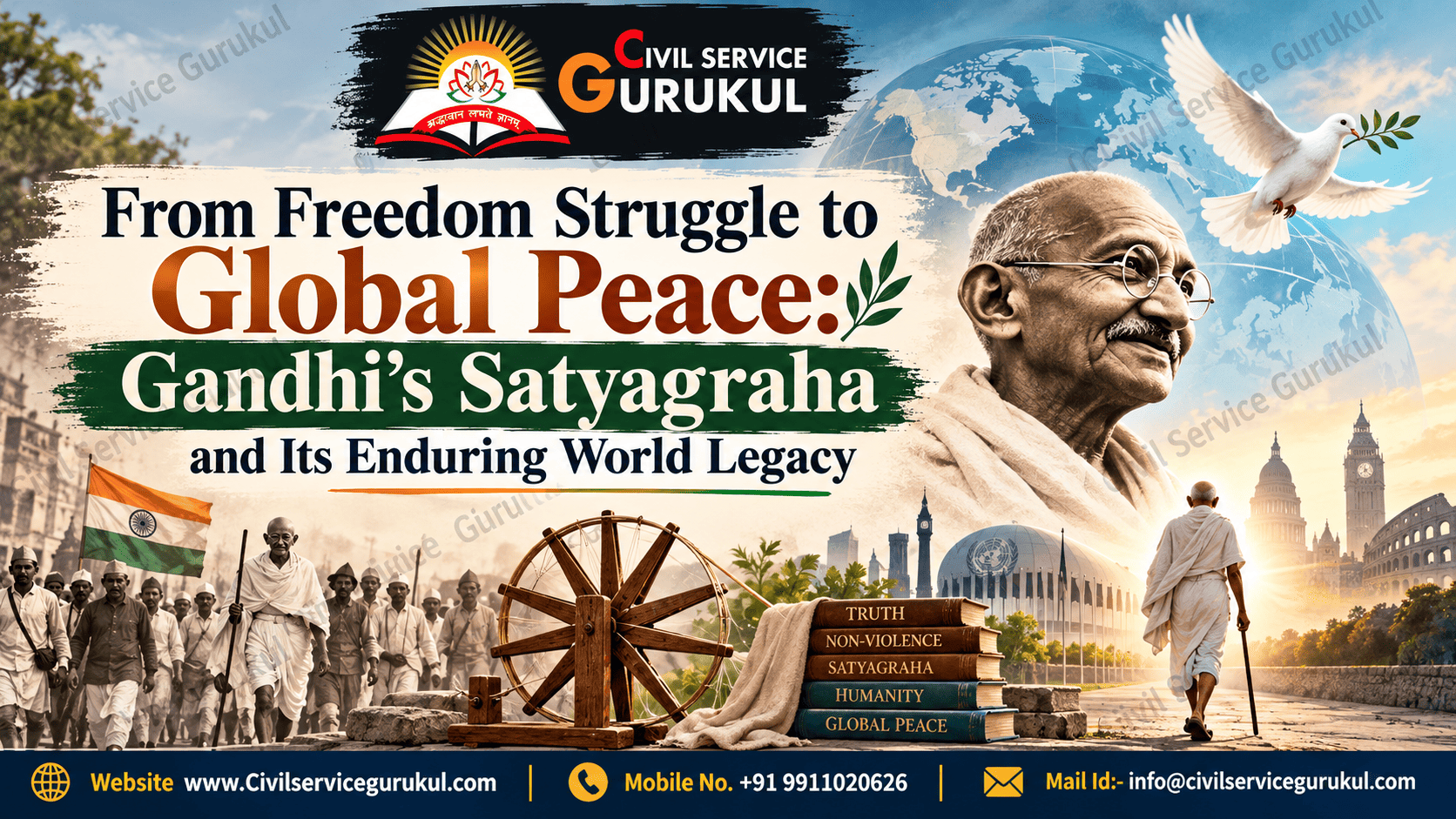
From Freedom Struggle to Global Peace: Gandhi’s Satyagraha and Its Enduring World Legacy
Understand Gandhi not merely as a leader of India's freedom movement, but as a global thinker whose philosophy of truth, non-violence and moral resistance reshaped political action.
Explore Mahatma Gandhi's vision of taking Satyagraha beyond India, its influence on global civil-rights movements, relevance to modern conflicts and its importance for UPSC Modern History, Ethics and Essay preparation.
Gandhi's Vision Beyond Indian Independence
Mahatma Gandhi's contribution to history did not end with India's independence in 1947.
His deeper ambition was to transform Satyagraha, non-violence and moral resistance into a global method for confronting injustice, conflict and oppression.
Gandhi saw Indian freedom not simply as the final destination, but as a platform from which the philosophy of non-violence could influence the wider world.
= Peaceful Political Transformation
The central Gandhian proposition was that injustice could be resisted without reproducing the violence that one sought to oppose.
Gandhi Was Still Politically Active in 1947
The image of Gandhi as politically exhausted after independence is incomplete.
During the final phase of his life, Gandhi remained engaged in:
- Communal harmony
- Protection of minorities
- Social reconciliation
- Peace-building
- Ethical pressure on political leadership
His interventions in Noakhali, Calcutta and Delhi demonstrated that he continued to regard moral action as a practical political instrument.
What Made Satyagraha Different?
Satyagraha should not be confused with passive submission. It represented a disciplined method of political resistance.
- Truth
- Non-violence
- Civil disobedience
- Voluntary sacrifice
- Mass mobilisation
- Moral pressure
- Willingness to accept consequences
This made Satyagraha both an ethical philosophy and a political strategy.
Global Influence of Gandhian Non-Violence
Gandhian methods later influenced international movements, including the American Civil Rights Movement.
Activists adapted techniques associated with non-violent resistance such as:
The wider importance of Satyagraha was that it demonstrated how disciplined non-violent resistance could travel across cultures and political systems.
Why Gandhi Wanted a Global Non-Violent Movement
Gandhi believed that violence generates further violence. He therefore sought to develop organised non-violence as a practical alternative for confronting:
- Colonial domination
- Racial injustice
- Political repression
- Communal conflict
- Unequal power relations
His larger project therefore extended beyond Indian nationalism. It represented an attempt to develop a universal language of ethical resistance.
The Unfinished Global Agenda
Before his assassination, Gandhi had expressed interest in a wider international movement for peace and non-violence.
The broader idea was to develop networks capable of preparing people for:
Although international gatherings on non-violence were held after his death, no permanent global institution emerged capable of translating the Gandhian vision into a coordinated worldwide movement.
Gandhi and the US Civil Rights Movement
Gandhi's influence was particularly visible in the struggle against racial segregation in the United States.
Civil-rights activists studied and adapted non-violent methods into campaigns involving:
- Sit-ins
- Boycotts
- Peaceful marches
- Civil disobedience
- Mass arrests
The central lesson was that non-violence could be strategically organised rather than merely morally admired.
Relevance of Gandhian Thought to Modern Conflicts
This question gives Gandhian thought continuing relevance to debates about contemporary conflict and political resistance.
In asymmetric conflicts, non-violent resistance can sometimes help weaker groups generate:
Balanced UPSC Analysis: Strengths & Limitations of Satyagraha
✓ Strengths
- Moral legitimacy
- Broad public participation
- International attention
- Reduced civilian harm
- Pressure without armed escalation
⚠ Limitations
- Dependence on disciplined leadership
- Potentially slow results
- Vulnerability to brutal repression
- Difficulty maintaining mass unity
- Limitations in certain armed conflicts
Gandhi and Moral Leadership — GS Paper IV
One of Gandhi's greatest political assets was his personal moral authority.
His leadership relied upon:
This made Gandhian politics unusually dependent on the credibility of leadership.
How to Use Gandhi Across the UPSC Syllabus
GS Paper I
- Gandhian phase of national movement
- Mass mobilisation
- Civil disobedience
- Non-violence
- Global impact of India's freedom struggle
GS Paper IV
- Ethics in politics
- Moral courage
- Non-violence
- Means and ends
- Ethical leadership
- Conflict resolution
Essay
- Peace
- Democracy
- Leadership
- Justice
- Civil resistance
- Moral authority
UPSC Mains Value Addition
Possible UPSC Mains Questions
- How did Gandhi transform non-violence into a mass political strategy?
- Discuss the global influence of Gandhian Satyagraha on civil-rights movements.
- Examine the relevance of Gandhian non-violence in contemporary conflicts.
- “Gandhi's political journey did not end with Indian independence.” Discuss.
How to Structure a UPSC Mains Answer
For a question on the global relevance of Satyagraha, a balanced answer can follow this structure:
Conclusion: From National Freedom to Universal Peace
Gandhi's importance extends far beyond India's freedom movement. His larger contribution was the demonstration that moral courage, disciplined non-violence and mass participation could become instruments of political transformation.
His global project remained incomplete, but the influence of Satyagraha survived through civil-rights movements, peace activism and continuing debates over non-violent resistance.
For UPSC aspirants, Gandhi should therefore be studied not only as a national leader but also as a global thinker on peace, ethics and political action.
Prepare Smarter for UPSC with Civil Service Gurukul
Use multidimensional current affairs and Mains enrichment to connect History, Ethics, Essay and contemporary issues.
Explore Civil Service GurukulFrequently Asked Questions
What is Satyagraha according to Mahatma Gandhi?
Satyagraha is a disciplined method of resistance based on truth, non-violence, moral courage, voluntary sacrifice and willingness to accept the consequences of civil resistance.
Why is Gandhian Satyagraha important for UPSC?
Satyagraha connects multiple areas of the UPSC syllabus, including Modern Indian History, the national movement, GS Paper IV Ethics, political leadership, conflict resolution and Essay topics dealing with peace and justice.
What is the global significance of Gandhian non-violence?
Gandhian non-violence demonstrated that peaceful resistance could be organised as a form of political action and subsequently influenced civil-rights and peace movements beyond India.
What are the limitations of Satyagraha?
Satyagraha can depend heavily on disciplined leadership and mass unity, may produce slow results, can face severe repression, and may have limitations in certain armed or highly coercive conflicts.
How can Gandhi be used in GS Paper IV Ethics?
Gandhi can be cited as an example of ethical leadership, integrity, courage of conviction, self-restraint, personal example and consistency between means and ends.
Prepare with Mentors Who Cleared the Exam
Get personalized study plans, evaluated answer models, and test series access.