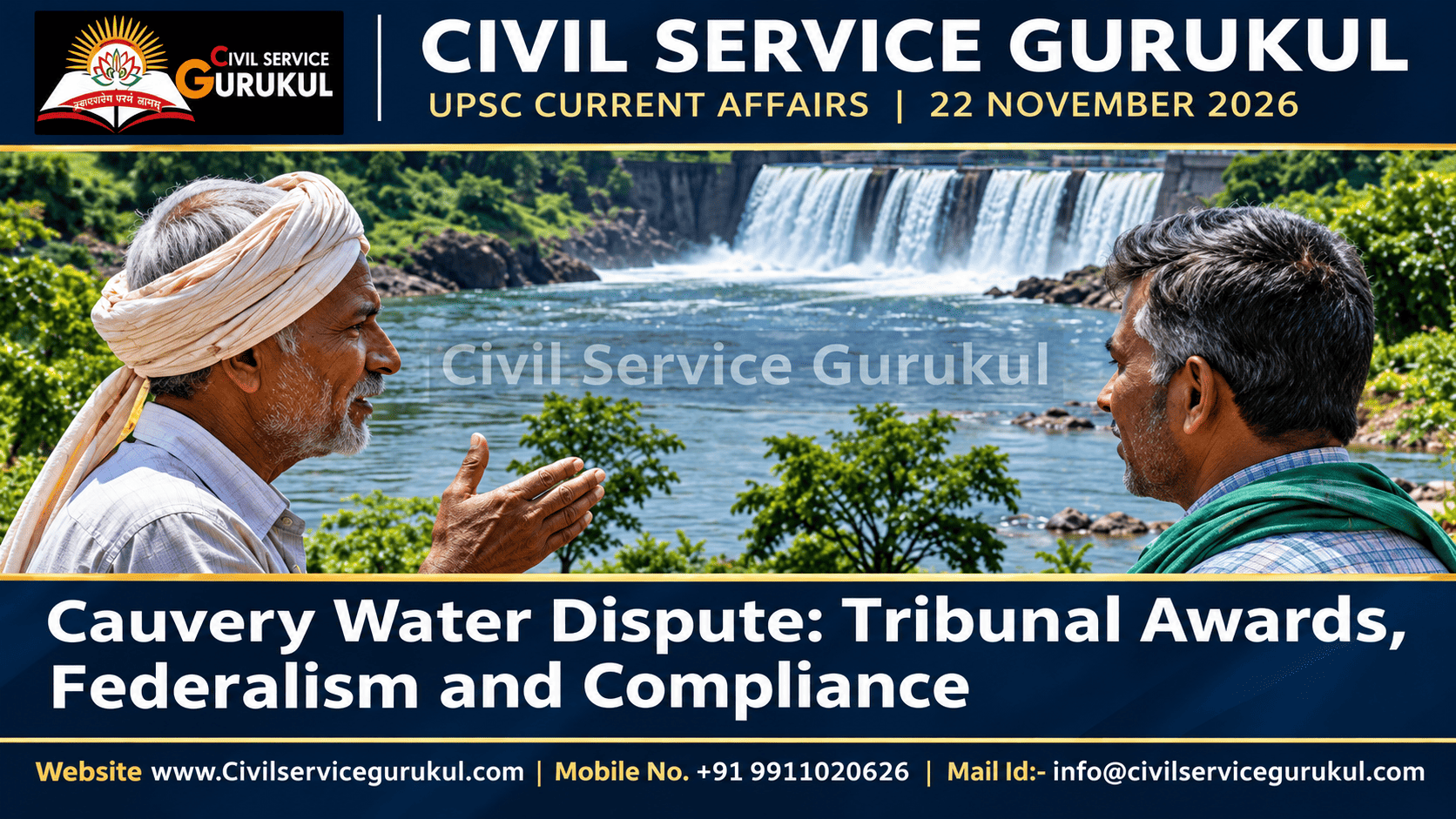
1. Why Is the Cauvery Water Dispute in the News?
On 20 November 2026, the Supreme Court of India dismissed applications filed by the Tamil Nadu government seeking directions for additional releases of Cauvery river water by Karnataka.
Tamil Nadu alleged a shortfall in water deliveries under the existing water-sharing arrangement. Karnataka disputed the allegations and maintained that it had complied with the directions of the Cauvery Water Management Authority (CWMA).
A Supreme Court Bench comprising Justice Vikram Nath and Justice Aparesh Kumar Singh declined to assume responsibility for continuous monitoring of the inter-state water-release schedule.
The Court emphasised the role of the Cauvery Water Management Authority (CWMA) and the Cauvery Water Regulation Committee (CWRC), which were constituted to oversee implementation of the existing water-sharing framework.
2. Understanding the Cauvery River System
The Cauvery River, also known as Kaveri, is one of the major east-flowing peninsular rivers of India.
It originates at Talakaveri in the Brahmagiri Hills of the Western Ghats, in the Kodagu district of Karnataka.
The river flows principally through Karnataka and Tamil Nadu before discharging into the Bay of Bengal. Its wider basin also includes parts of Kerala and the Union Territory of Puducherry.
Important Geographical Facts
- Origin: Talakaveri, Brahmagiri Hills, Karnataka.
- Mountain Range: Western Ghats.
- Direction: Predominantly eastward.
- Mouth: Bay of Bengal.
- Major Tributaries: Kabini, Hemavati, Bhavani, Amaravati, Harangi and Arkavati.
- Important Reservoirs: Krishnaraja Sagara, Kabini and Mettur Reservoir.
- Participating States and UT: Karnataka, Tamil Nadu, Kerala and Puducherry.
3. Historical Background of the Cauvery Water Dispute
The Cauvery dispute has historical roots in competing irrigation and water-utilisation claims between the erstwhile Mysore State and Madras Presidency.
Its evolution demonstrates how historical agreements, agricultural development, changing population needs and federal institutions interact in the management of common resources.
An agreement concerning the regulation of irrigation works was concluded between the then Mysore and Madras administrations.
A further agreement addressed irrigation development and water utilisation between Mysore and Madras.
The Central Government constituted the Cauvery Water Disputes Tribunal under the Inter-State River Water Disputes Act, 1956.
The Cauvery Water Disputes Tribunal delivered its final award concerning allocation and regulation of Cauvery river water.
The Tribunal's final award was published in the Official Gazette.
The Supreme Court modified the Tribunal's allocations and addressed the implementation framework.
The Central Government notified the Cauvery Water Management Scheme, 2018, providing for the CWMA and CWRC.
The Supreme Court dismissed Tamil Nadu's applications seeking additional Cauvery water releases, emphasising the responsibilities of the designated monitoring bodies.
4. Cauvery Water Disputes Tribunal: The 2007 Award
The Cauvery Water Disputes Tribunal (CWDT) was constituted in 1990 under the Inter-State River Water Disputes Act, 1956.
Its final award of 5 February 2007 assessed the water available for allocation in a normal year and distributed shares among the participating States and Union Territory.
The Tribunal's award adopted a total of 740 TMC for its normal-year allocation framework.
Original Tribunal Allocations
| State / UT | 2007 Award |
|---|---|
| Tamil Nadu | 419 TMC |
| Karnataka | 270 TMC |
| Kerala | 30 TMC |
| Puducherry | 7 TMC |
| Environmental Protection | 10 TMC |
| Inevitable Escape into Sea | 4 TMC |
| Total | 740 TMC |
TMC stands for thousand million cubic feet, a unit commonly used to express large volumes of water.
5. Supreme Court Judgment of 2018: Revised Water Allocation
On 16 February 2018, the Supreme Court modified the water-sharing allocations under the Tribunal's award.
The judgment increased Karnataka's share by 14.75 TMC and reduced Tamil Nadu's allocation by an equivalent quantity.
| State / UT | 2007 Award | 2018 Revised Allocation |
|---|---|---|
| Karnataka | 270 TMC | 284.75 TMC |
| Tamil Nadu | 419 TMC | 404.25 TMC |
| Kerala | 30 TMC | 30 TMC |
| Puducherry | 7 TMC | 7 TMC |
| Environmental allocation | 10 TMC | 10 TMC |
| Inevitable escape into sea | 4 TMC | 4 TMC |
What Is the Significance of 177.25 TMC?
Under the revised arrangement, Karnataka was required to make available 177.25 TMC of water at the inter-state contact point at Billigundulu (Biligundlu) for Tamil Nadu in a normal water year.
This measurement-point requirement should not be confused with Tamil Nadu's total 404.25 TMC basin allocation.
In years of reduced water availability, the framework provides for proportionate adjustments to allocated shares.
- Karnataka: 284.75 TMC
- Tamil Nadu: 404.25 TMC
- Kerala: 30 TMC
- Puducherry: 7 TMC
- Billigundulu normal-year requirement: 177.25 TMC
6. What Happened in the November 2026 Supreme Court Case?
Tamil Nadu approached the Supreme Court alleging inadequate receipt of Cauvery water under the existing arrangement.
The State raised concerns regarding an alleged accumulated deficit in the water received at the inter-state measuring station.
One reported calculation placed the alleged shortfall at approximately 11.719 TMC up to 6 October 2026.
Karnataka challenged the claims, maintaining that actual releases, rainfall conditions and subsequent flows should be considered when evaluating compliance.
What Did the Supreme Court Decide?
The Supreme Court dismissed the applications seeking additional judicial directions for water releases.
The Court's reasoning emphasised that the CWMA and CWRC were specifically established to monitor water-sharing compliance, assess hydrological conditions and address operational disputes.
The Court also took account of the expert body's assessment concerning the alleged backlog.
The decision therefore highlighted a distinction between:
- Judicial adjudication and interpretation of legal rights.
- Technical assessment of water availability.
- Continuous monitoring of reservoir levels and inter-state releases.
- Administrative implementation of an existing water-sharing framework.
7. Article 262: Constitutional Framework for Water Disputes
Article 262 of the Constitution of India deals with the adjudication of disputes relating to waters of inter-state rivers and river valleys.
Article 262(1)
Parliament may by law provide for adjudication of disputes or complaints concerning the use, distribution or control of the waters of inter-state rivers or river valleys.
Article 262(2)
Parliament may by law provide for the exclusion of the jurisdiction of the Supreme Court and other courts in respect of specified water disputes.
The scope of this jurisdictional exclusion must be understood alongside the governing statute and relevant Supreme Court decisions. It does not mean that the Supreme Court can never hear any matter connected with an inter-state river dispute.
Related Constitutional Entries
| Provision | Significance |
|---|---|
| Article 262 | Adjudication of inter-state water disputes |
| Entry 17, State List | Water, irrigation, canals, drainage and related matters, subject to Entry 56 of the Union List |
| Entry 56, Union List | Regulation and development of inter-state rivers and river valleys to the extent declared expedient in the public interest by Parliament |
| Article 131 | Original jurisdiction of the Supreme Court in certain federal disputes, subject to applicable constitutional limitations |
8. Inter-State River Water Disputes Act, 1956
The Inter-State River Water Disputes Act, 1956 provides a statutory mechanism for resolving disputes over inter-state river waters.
Important Provisions
- Section 3: Allows a State Government to request intervention when a water dispute has arisen or is likely to arise.
- Section 4: Provides for the constitution of a Water Disputes Tribunal under prescribed conditions.
- Section 5: Deals with adjudication and the Tribunal's decision.
- Section 6: Concerns publication and legal effect of a Tribunal's decision.
- Section 6A: Provides for schemes to implement Tribunal decisions.
- Section 11: Addresses the exclusion of court jurisdiction over water disputes covered by the statutory framework.
9. Cauvery Water Management Authority (CWMA)
The Cauvery Water Management Authority was established under the Cauvery Water Management Scheme, 2018.
It is responsible for overseeing implementation of the Tribunal's award as modified by the Supreme Court in 2018.
Main Responsibilities
- Supervising water sharing among the participating States and Union Territory.
- Regulating water releases under the established allocation and scheduling framework.
- Monitoring reservoir operations and relevant hydrological conditions.
- Reviewing compliance with applicable water-sharing directions.
- Coordinating with the CWRC and participating governments.
- Seeking Central Government assistance where necessary under the scheme.
10. Cauvery Water Regulation Committee (CWRC)
The Cauvery Water Regulation Committee provides technical and operational support for implementing the Cauvery water-sharing framework.
Main Responsibilities
- Collecting reservoir water-level and storage information.
- Monitoring inflows and outflows across identified reservoirs.
- Reviewing water-release data and compliance with directions.
- Providing relevant technical information to the CWMA.
- Preparing periodic water accounts and implementation reports.
CWMA versus CWRC
| Basis | CWMA | CWRC |
|---|---|---|
| Nature | Management Authority | Regulation Committee |
| Primary Role | Implementation oversight and regulatory directions | Technical monitoring and operational assistance |
| Focus | Water allocation compliance and management | Reservoir data, flows and monitoring |
| Legal Framework | Cauvery Water Management Scheme, 2018 | |
11. Cauvery Dispute and Cooperative Federalism
The Cauvery water dispute is an important case study in cooperative federalism.
Cooperative federalism requires the Union and State Governments to coordinate in areas involving shared resources, overlapping interests and collective developmental responsibilities.
A. Shared Natural Resources
An inter-state river cannot be managed effectively through the perspective of only one participating State. Upstream and downstream decisions are interconnected.
B. Competing Public Needs
Karnataka and Tamil Nadu must balance multiple demands, including irrigation, drinking water, industrial requirements and ecological protection.
C. Role of the Union Government
The Union Government provides an institutional framework for dispute resolution and implementation under the applicable legislation.
D. Institutional Trust
Cooperative federalism is strengthened when participating governments accept transparent data, communicate through established institutions and comply with lawful directions.
E. Conflict Resolution
Institutional consultation, shared monitoring and negotiated implementation can reduce repeated litigation and political confrontation.
12. Why Do Inter-State Water Disputes Continue?
1. Monsoon Dependence
Seasonal and spatial variations in rainfall create uncertainty about the quantity and timing of water availability.
2. Upstream-Downstream Conflict
Upstream storage and release decisions can influence the water available to downstream regions.
3. Agricultural Requirements
Irrigated agriculture depends on predictable water availability. Changes in crop area and cropping patterns may intensify water demand.
4. Growing Urban Demand
Population growth and urbanisation increase demand for domestic and industrial water.
5. Political Contestation
Inter-state water disputes may become politically sensitive, particularly during droughts and agricultural crises.
6. Information and Compliance Gaps
Disagreement over water availability, release data or interpretation of compliance can prolong conflict.
7. Climate Change
Changing precipitation patterns, higher temperatures and more frequent extreme events can complicate long-term basin planning.
13. Challenges in Implementing Water-Sharing Awards
- Variability in actual river flows.
- Disputes over reservoir storage and water releases.
- Differences in interpretation of distress-year sharing.
- Conflicting agricultural and urban water requirements.
- Limited availability of transparent real-time data.
- Potential delays in administrative coordination and implementation.
- Ecological degradation and pressure on river-basin ecosystems.
14. Way Forward: Sustainable Cauvery Basin Governance
- Strengthen CWMA and CWRC: Support effective implementation through timely monitoring, technical capacity and institutional coordination.
- Improve Data Transparency: Maintain reliable and accessible information on rainfall, reservoir storage and river flows.
- Develop Distress-Sharing Protocols: Use transparent, scientifically informed procedures during low-water-availability periods.
- Promote Water-Use Efficiency: Encourage micro-irrigation, improved agricultural practices and efficient water distribution.
- Encourage Crop Diversification: Support appropriate cropping patterns based on local water availability and agricultural conditions.
- Strengthen Inter-State Dialogue: Use continuous consultation rather than relying only on crisis-driven litigation.
- Adopt Basin-Level Planning: Integrate agriculture, domestic needs, industry, environmental flows and climate resilience.
- Protect River Ecology: Recognise the ecological requirements of river systems alongside economic water demand.
15. UPSC Prelims 2027: Quick Revision
- Cauvery River originates at Talakaveri in Karnataka.
- Its origin lies in the Western Ghats.
- Cauvery is an east-flowing river.
- It drains into the Bay of Bengal.
- Article 262 concerns inter-state water disputes.
- Inter-State River Water Disputes Act: 1956.
- Cauvery Water Disputes Tribunal constituted: 1990.
- Tribunal final award: 2007.
- Major Supreme Court allocation judgment: 16 February 2018.
- Cauvery Water Management Scheme: 2018.
- Karnataka allocation: 284.75 TMC.
- Tamil Nadu allocation: 404.25 TMC.
- Billigundulu normal-year requirement: 177.25 TMC.
- Recent Supreme Court decision: 20 November 2026.
16. Original UPSC Prelims Practice Questions
Question 1
With reference to Article 262 of the Constitution of India, consider the following statements:
- Parliament may provide by law for the adjudication of inter-state river-water disputes.
- Article 262 itself specifies the annual quantity of water to be allocated to each State.
- Parliament may provide by law for exclusion of court jurisdiction over specified inter-state water disputes.
Which of the statements given above are correct?
(A) 1 and 2 only
(B) 1 and 3 only
(C) 2 and 3 only
(D) 1, 2 and 3
View Answer & Explanation
Correct Answer: (B) 1 and 3 only
Statement 1 is correct because Article 262 authorises Parliament to legislate for adjudication of inter-state water disputes.
Statement 2 is incorrect because Article 262 does not itself determine water allocations.
Statement 3 is correct because Article 262(2) enables Parliament to legislate for the exclusion of court jurisdiction in the specified category of disputes.
Question 2
Which of the following institutions was established to supervise implementation of the Cauvery water-sharing framework?
(A) National Green Tribunal
(B) Finance Commission
(C) Cauvery Water Management Authority
(D) Inter-State Council
View Answer & Explanation
Correct Answer: (C)
The Cauvery Water Management Authority was established under the Cauvery Water Management Scheme, 2018.
Question 3
With reference to the Supreme Court judgment of February 2018, which one of the following statements is correct?
(A) Karnataka's allocation
was reduced by 14.75 TMC.
(B) Tamil Nadu's allocation
was increased to 419 TMC.
(C) Karnataka's allocation
was increased to 284.75 TMC.
(D) Kerala's allocation
was increased to 50 TMC.
View Answer & Explanation
Correct Answer: (C)
The Supreme Court increased Karnataka's allocation by 14.75 TMC, resulting in 284.75 TMC.
Tamil Nadu's allocation was reduced to 404.25 TMC.
Question 4
Consider the following rivers:
- Kabini
- Hemavati
- Bhavani
- Son
How many of the above are tributaries of the Cauvery River?
(A) Only one
(B) Only two
(C) Only three
(D) All four
View Answer & Explanation
Correct Answer: (C) Only three
Kabini, Hemavati and Bhavani are tributaries of the Cauvery. Son is a tributary of the Ganga river system.
17. UPSC Mains Practice – GS Paper II
Mains Question – 15 Marks | 250 Words
"Inter-state river water disputes expose the tension between constitutional federalism and the practical management of shared natural resources."
Critically examine the statement with reference to the Cauvery water dispute and the role of institutional mechanisms in ensuring compliance.
Suggested Answer-Writing Framework
Introduction: Explain the Cauvery dispute as an example of competing claims over an inter-state river. Mention Article 262 and the Inter-State River Water Disputes Act, 1956.
Body – Constitutional Dimension: Discuss distribution of legislative powers, tribunal adjudication and the Supreme Court's role in the dispute.
Body – Governance Dimension: Explain the functions of the CWMA and CWRC, and the significance of the November 2026 Supreme Court decision.
Challenges: Analyse monsoon dependence, irrigation requirements, conflicting State interests, data reliability and institutional compliance.
Way Forward: Recommend transparent river-flow information, scientific distress-sharing, inter-state cooperation and integrated basin management.
Conclusion: Effective water governance requires both enforceable legal arrangements and sustained political and administrative cooperation.
18. Ethics and Governance Linkage – GS Paper IV
The Cauvery dispute also offers lessons for public administration and ethical governance.
- Equity: Balancing the legitimate needs of upstream and downstream populations.
- Accountability: Ensuring that public authorities implement lawful decisions.
- Transparency: Sharing credible hydrological and reservoir information.
- Empathy: Recognising the needs of farmers and vulnerable communities during drought.
- Cooperation: Promoting institutional dialogue among participating governments.
19. Frequently Asked Questions
What is the Cauvery water dispute?
It is a long-running dispute concerning the sharing and management of Cauvery river water, principally involving Karnataka and Tamil Nadu, with Kerala and Puducherry also part of the allocation framework.
What happened in the Supreme Court in November 2026?
On 20 November 2026, the Supreme Court dismissed Tamil Nadu's applications seeking additional water releases from Karnataka, emphasising the implementation responsibilities of the CWMA and CWRC.
Which constitutional article deals with inter-state water disputes?
Article 262 of the Constitution of India.
What is the role of the CWMA?
The Cauvery Water Management Authority supervises implementation of the Cauvery water-sharing framework and related regulatory directions.
What was Karnataka's allocation after the 2018 judgment?
Karnataka's revised allocation was 284.75 TMC.
What is the significance of Billigundulu?
Billigundulu is the inter-state measuring point used to assess water delivery from Karnataka towards Tamil Nadu under the Cauvery framework.
Why is the Cauvery dispute important for UPSC?
It connects constitutional law, Indian federalism, water governance, tribunal adjudication, geography, environmental management and current affairs under GS Papers I, II and III.
20. Conclusion
The Cauvery water dispute illustrates the complexity of allocating a shared natural resource within India's federal system.
The Supreme Court's November 2026 decision reinforces the importance of designated expert bodies in implementing existing water-sharing arrangements and monitoring compliance.
However, institutional mechanisms alone cannot eliminate recurring conflict when rainfall variability, agricultural demand, political concerns and environmental pressures persist.
India's long-term approach to inter-state water governance must combine constitutional principles, credible monitoring, efficient water utilisation and cooperative federalism.
Prepare UPSC 2027 with Concept-Based Current Affairs
UPSC Prelims | UPSC Mains | Indian Polity | Governance | Geography | Current Affairs
Learn through detailed analysis, topic-wise revision, original MCQs and answer-writing practice.
Website:
www.civilservicegurukul.com
Mobile:
+91 9911020626
Email:
info@civilservicegurukul.com