
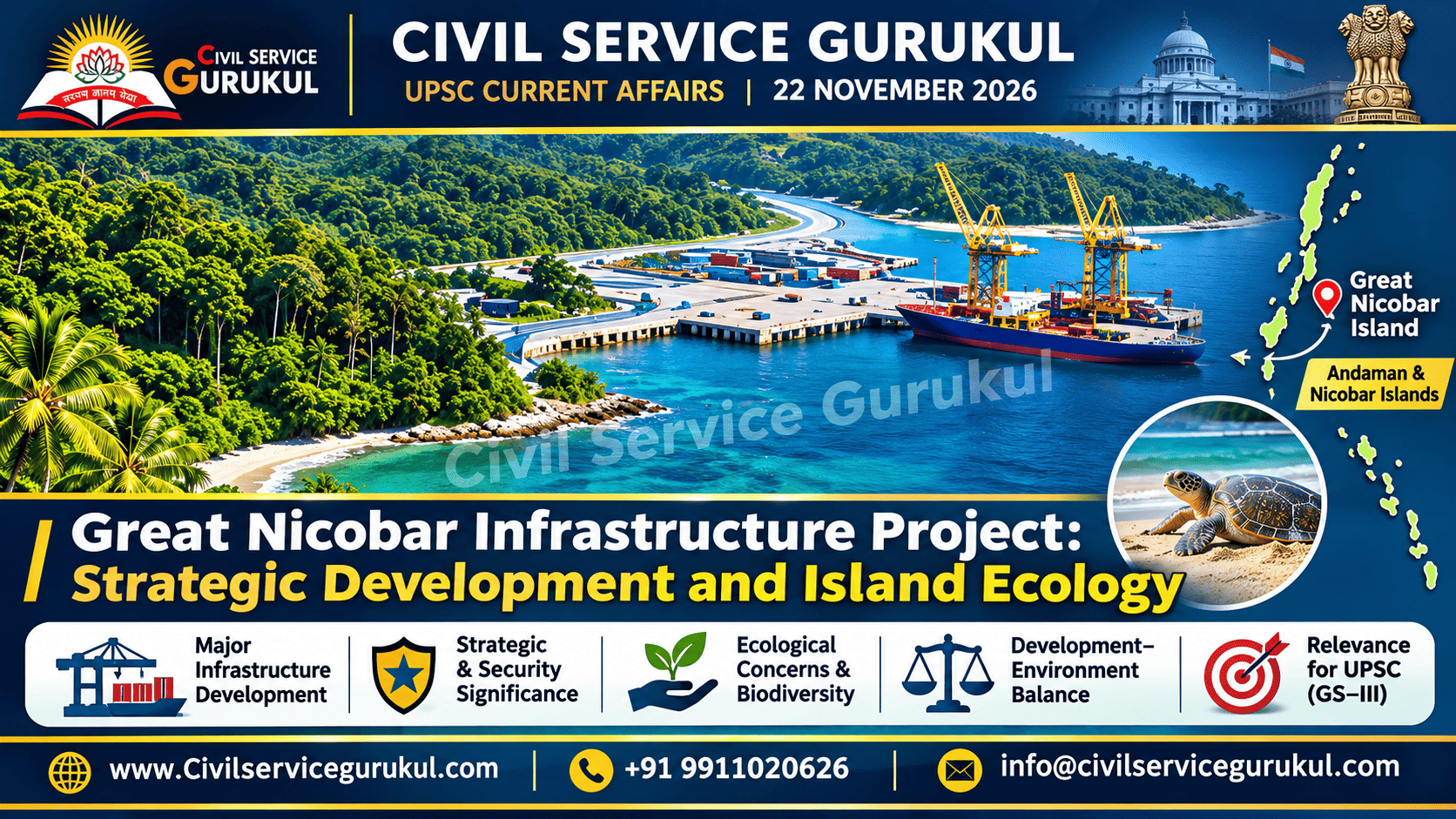
1. Why Is the Great Nicobar Project in the News?
The Great Nicobar Island Holistic Development Project has returned to the national debate following the issuance of a tender for the construction of reinforced cement concrete boundary pillars on Great Nicobar Island.
The Andaman and Nicobar Islands administration invited bids for surveying, demarcating and erecting boundary pillars along approximately 43.4 kilometres of forest boundary associated with the proposed infrastructure development.
The tender relates to an overall project area of approximately 166.1 square kilometres. Contemporary reporting describes the broader development programme as a project of approximately ₹92,000 crore, although cost estimates have varied across project documents and reporting periods.
The development has attracted attention because challenges concerning forest clearance and alleged non-compliance with the Forest Rights Act remain before the Calcutta High Court.
As of 22 November 2026, hearings concerning those challenges are scheduled for 25–26 November 2026. No outcome of those future hearings is assumed here.
2. What Is the Great Nicobar Island Project?
The Great Nicobar Island Project is a large-scale infrastructure development initiative intended to strengthen India's maritime connectivity, strategic capabilities and economic presence in the Indian Ocean Region.
The development plan includes an international container transshipment terminal, a greenfield airport, a township and supporting power infrastructure.
Its strategic rationale is based largely on Great Nicobar's geographical position near major international shipping routes connecting the Indian Ocean with Southeast Asia.
Four Major Components
| Component | Proposed Development | Purpose |
|---|---|---|
| International Container Transshipment Terminal | Deep-water container port at Galathea Bay | International shipping, cargo handling and logistics |
| Greenfield International Airport | New airport infrastructure | Air connectivity, strategic access and regional development |
| Township Development | Residential, commercial and institutional facilities | Support population and infrastructure requirements |
| Power Infrastructure | Proposed gas and solar-based power generation | Reliable electricity supply for project operations |
The official project framework describes the port as having a planned capacity of approximately 14.2 million TEUs and the associated power facility as approximately 450 MVA.
TEU stands for Twenty-Foot Equivalent Unit, a standard measure of container-handling capacity.
3. Geographical Location of Great Nicobar Island
Great Nicobar is the southernmost major island of the Andaman and Nicobar Islands, a Union Territory of India situated in the eastern Indian Ocean.
It lies to the south of the other Nicobar Islands and near important maritime routes connecting the Bay of Bengal, Andaman Sea and Strait of Malacca.
Important Geographical Facts
- Archipelago: Andaman and Nicobar Islands.
- Location: Eastern Indian Ocean.
- Union Territory: Andaman and Nicobar Islands.
- Southernmost point: Indira Point.
- Important coastal location: Galathea Bay.
- Important national parks: Campbell Bay National Park and Galathea National Park.
- Strategic importance: Proximity to international east-west maritime trade routes.
4. Why Is Great Nicobar Strategically Important?
A. Proximity to the Strait of Malacca
The Strait of Malacca is one of the world's most important maritime passages, connecting the Andaman Sea with the Strait of Singapore and onward routes toward the South China Sea.
Great Nicobar's geographical position gives India an important strategic advantage for monitoring maritime activity in the eastern Indian Ocean.
B. International Maritime Trade
A significant volume of international container trade passes through Indo-Pacific maritime routes.
The Government has highlighted the island's proximity, approximately 40 nautical miles, to an important east-west international shipping route.
A deep-water transshipment terminal could potentially attract cargo currently handled through established foreign transshipment hubs.
C. National Security
Greater maritime infrastructure could support strategic logistics, surveillance, transport connectivity and India's defence presence.
Such infrastructure has particular relevance in the context of maritime security challenges in the Indo-Pacific.
D. Act East Policy
The project could strengthen India's economic and logistical connectivity with Southeast Asia.
Its location is therefore relevant to India's broader Act East Policy and Indo-Pacific engagement.
E. Maritime Supply-Chain Resilience
Additional domestic maritime handling capacity may help India diversify logistics options and reduce dependence on selected overseas transshipment facilities.
5. What Is the Importance of Galathea Bay?
Galathea Bay is located near the southern part of Great Nicobar Island and has been identified as the proposed location for an international container transshipment terminal.
The location offers deep-water characteristics and access to important shipping routes.
At the same time, Galathea Bay is ecologically sensitive and internationally significant for the nesting of the leatherback sea turtle.
What Is a Transshipment Port?
A transshipment port is a maritime logistics hub where cargo containers are transferred between ships before proceeding to their final destinations.
Such ports allow shipping networks to combine large international vessels with smaller regional services.
Potential Advantages
- Greater international container-handling capacity.
- Improved shipping connectivity.
- Potential reduction in reliance on foreign transshipment hubs.
- New investment and logistics opportunities.
- Strengthening India's maritime presence.
Important Ecological Risks
- Alteration of coastal habitats.
- Dredging and sediment disturbance.
- Disturbance to turtle nesting and movement.
- Artificial lighting and increased vessel traffic.
- Potential effects on marine biodiversity.
6. Great Nicobar Island: Ecological Significance
Great Nicobar is known for its tropical evergreen forests, coastal habitats, wetlands and exceptional biological diversity.
The island forms part of the Great Nicobar Biosphere Reserve, included in UNESCO's World Network of Biosphere Reserves in 2013.
The biosphere reserve contains a wide range of terrestrial and coastal ecosystems and provides habitat for several endemic and threatened species.
Important Species
| Species / Group | Ecological Significance |
|---|---|
| Leatherback Sea Turtle | Threatened marine turtle that nests on Great Nicobar beaches |
| Nicobar Megapode | Distinctive ground-nesting bird associated with island habitats |
| Nicobar Long-tailed Macaque | Primate associated with the Nicobar island ecosystem |
| Saltwater Crocodile | Important coastal and estuarine predator |
| Corals and Coastal Marine Life | Support biodiversity, fisheries and coastal ecosystem processes |
7. Leatherback Sea Turtle: An Important UPSC Topic
The leatherback sea turtle (Dermochelys coriacea) is the largest living species of sea turtle.
Unlike most other sea turtles, it does not have a conventional hard, bony shell. Its flexible carapace has a leathery surface.
The species undertakes long-distance migrations and is closely associated with marine food webs.
Why Is Galathea Bay Important?
Galathea Bay provides important nesting habitat for leatherback turtles.
Recent observations and reported nesting records have renewed concerns about the potential long-term effects of large-scale port development in the area.
Potential Environmental Impacts
- Loss or modification of suitable nesting beaches.
- Artificial light affecting nesting turtles and hatchlings.
- Underwater noise from marine construction and vessels.
- Changes to sediment movement and coastal morphology.
- Disturbance caused by increased human activity.
8. Indigenous Communities: Shompen and Nicobarese
Great Nicobar is home to indigenous communities with distinct cultural, social and ecological relationships with the island.
A. Shompen Community
The Shompen are an indigenous community recognised among India's Particularly Vulnerable Tribal Groups (PVTGs).
They have traditionally maintained close relationships with the forest environment and include groups with limited sustained contact with outside populations.
Large-scale infrastructure development raises concerns about cultural disruption, outside contact, disease exposure, forest access and long-term community welfare.
B. Nicobarese Community
The Nicobarese are another indigenous community associated with the Nicobar Islands.
Their livelihoods, settlement patterns and cultural traditions have historically been closely linked to coastal and island environments.
The 2004 Indian Ocean tsunami also caused major disruption to communities in the Nicobar Islands.
Why Are Tribal Rights Important?
- Recognition of customary and legally protected rights.
- Meaningful community consultation and participation.
- Protection of traditional livelihoods and cultural identity.
- Safeguards against unwanted displacement.
- Access to effective grievance redressal.
9. Forest Rights Act, 2006: Legal Issues
The Scheduled Tribes and Other Traditional Forest Dwellers (Recognition of Forest Rights) Act, 2006 recognises specified individual and community forest rights.
The Act is intended to address historical injustices experienced by eligible forest-dwelling communities.
Major Principles
- Recognition of eligible individual and community forest rights.
- Protection of customary forest-dependent livelihoods.
- Role of the Gram Sabha in the prescribed rights-recognition process.
- Safeguards against eviction before completion of the applicable recognition and verification procedures.
- Community participation in conservation and management.
Challenges to the Great Nicobar project have raised questions concerning the application of these legal safeguards.
The proper validity of the challenged decisions depends on the applicable legal provisions, administrative records and judicial findings.
10. Environmental Clearance and Coastal Regulation
Large infrastructure projects may require environmental assessment and statutory permissions under applicable Indian environmental laws.
Important Legal Frameworks
| Law / Framework | Relevance |
|---|---|
| Environment (Protection) Act, 1986 | Umbrella environmental regulatory framework |
| EIA Notification, 2006 | Environmental appraisal and prior clearance for covered activities |
| Island Coastal Regulation Zone Notification, 2019 | Regulation of specified activities in island coastal areas |
| Forest Conservation Framework | Approvals and conditions for diversion of forest land |
| Wild Life (Protection) Act, 1972 | Protection of wildlife and protected habitats |
| Forest Rights Act, 2006 | Recognition and protection of specified forest rights |
Project-Specific Environmental Measures
The Government's May 2026 project backgrounder stated that environmental clearance was granted under the applicable framework and contained 42 specific compliance conditions.
These conditions address areas including air, water, noise, waste, marine ecology, public health and disaster management.
The Government also reported the formation of separate monitoring committees covering pollution, biodiversity and tribal welfare.
Whether the safeguards are sufficient and how effectively they are implemented remain important matters for environmental monitoring and public accountability.
11. Forest Diversion and Biodiversity Concerns
The overall project development area is approximately 166.1 sq. km.
Official project documentation describes approximately 130.75 sq. km of forest land within the development area, along with approximately 35.35 sq. km of revenue land.
The potential effects of forest diversion are significant because tropical island forests provide habitat, store carbon, stabilise soil and support watershed functions.
Key Ecological Concerns
- Habitat fragmentation and biodiversity loss.
- Disturbance to endemic and threatened species.
- Alteration of coastal and forest ecosystems.
- Effects on freshwater and watershed conditions.
- Increased pressure from human settlement and transport networks.
- Cumulative impacts of multiple infrastructure components.
Compensatory afforestation can be an important mitigation measure, but it cannot automatically reproduce the ecological complexity of mature tropical forests.
12. Natural Disaster Vulnerability
Great Nicobar lies in a seismically active part of the Indian Ocean region.
The island experienced severe effects from the 26 December 2004 Indian Ocean earthquake and tsunami.
Coastal infrastructure must therefore address high-impact natural hazards.
Important Disaster Risks
- Earthquakes and strong ground shaking.
- Tsunami inundation and coastal damage.
- Coastal erosion and shoreline changes.
- Intense rainfall and associated flooding.
- Disruption of critical transport, power and communication infrastructure.
13. Legal Developments up to November 2026
The project received environmental clearance subject to applicable conditions and safeguards.
The National Green Tribunal considered challenges to the project and directed further examination of specified environmental concerns through a high-powered committee.
The National Green Tribunal declined to interfere further with the environmental clearance, while emphasising strict compliance with the applicable conditions.
The Supreme Court declined to interfere with the Calcutta High Court's decision to entertain petitions challenging aspects of the project's clearance process.
The boundary-demarcation tender attracted attention as questions concerning forest rights and clearance procedures remained before the Calcutta High Court.
14. Development versus Environment: A Balanced Assessment
| Potential Development Benefits | Potential Risks and Challenges |
|---|---|
| Stronger maritime connectivity | Coastal habitat disturbance |
| Improved strategic infrastructure | Sensitive island ecology |
| Potential logistics and trade opportunities | Forest diversion and habitat fragmentation |
| Regional infrastructure and service development | Pressure on freshwater and waste systems |
| Greater transport connectivity | Indigenous community welfare concerns |
| Enhanced strategic resilience | Earthquake and tsunami exposure |
The central challenge is not simply choosing between development and environmental protection.
It is ensuring that project choices are supported by credible evidence, lawful processes, effective safeguards and a transparent assessment of alternatives.
15. What Should Be the Way Forward?
- Independent Environmental Monitoring: Conduct long-term studies of forest, coastal and marine ecosystems with transparent reporting.
- Protect Sensitive Habitats: Use avoidance and impact-minimisation measures for critical nesting beaches and biodiversity areas.
- Strengthen Tribal Safeguards: Ensure lawful recognition of rights, meaningful consultation and protection of vulnerable communities.
- Improve Disaster Resilience: Integrate earthquake, tsunami and coastal hazard considerations into infrastructure design.
- Assess Project Alternatives: Evaluate location, design and operating alternatives to minimise irreversible ecological harm.
- Transparent Compliance: Publish monitoring findings, clearance-condition compliance and grievance outcomes.
- Phased Development: Link future stages to measurable environmental and social performance.
- Integrated Island Planning: Coordinate maritime, ecological, community and disaster-management objectives.
16. UPSC Prelims 2027: Rapid Revision
- Great Nicobar is part of the Andaman and Nicobar Islands.
- It lies in the eastern Indian Ocean.
- Indira Point is India's southernmost point.
- The proposed container transshipment port is at Galathea Bay.
- The island is strategically important due to its proximity to major shipping routes.
- Great Nicobar Biosphere Reserve entered UNESCO's World Network in 2013.
- The Shompen are a Particularly Vulnerable Tribal Group.
- Leatherback turtles nest on Great Nicobar beaches.
- The project includes a port, airport, township and power plant.
- The relevant island coastal framework includes the ICRZ Notification, 2019.
- Forest Rights Act: 2006.
- The 2026 boundary tender concerns approximately 43.4 km of boundary.
- The overall proposed development area is approximately 166.1 sq. km.
17. Original UPSC Prelims Practice MCQs
Question 1
With reference to Great Nicobar Island, consider the following statements:
- It is part of the Andaman and Nicobar Islands.
- It is located in the Arabian Sea.
- Indira Point lies on Great Nicobar Island.
Which of the statements given above are correct?
(A) 1 and 2 only
(B) 1 and 3 only
(C) 2 and 3 only
(D) 1, 2 and 3
View Answer and Explanation
Correct Answer: (B)
Statements 1 and 3 are correct.
Statement 2 is incorrect because Great Nicobar lies in the eastern Indian Ocean, not the Arabian Sea.
Question 2
Which of the following communities associated with Great Nicobar is classified as a Particularly Vulnerable Tribal Group?
(A) Toda
(B) Shompen
(C) Khasi
(D) Bhil
View Answer and Explanation
Correct Answer: (B) Shompen
The Shompen are an indigenous PVTG community associated with the forests of Great Nicobar.
Question 3
Consider the following statements regarding Galathea Bay:
- It has been identified for a proposed international container transshipment port.
- It provides important nesting habitat for leatherback sea turtles.
- It is located in Lakshadweep.
Which of the above statements are correct?
(A) 1 only
(B) 2 only
(C) 1 and 2 only
(D) 1, 2 and 3
View Answer and Explanation
Correct Answer: (C)
Statements 1 and 2 are correct.
Statement 3 is incorrect. Galathea Bay is located on Great Nicobar Island.
Question 4
With reference to Environmental Impact Assessment (EIA), consider the following statements:
- It helps evaluate likely environmental effects of proposed projects.
- It can support decisions on mitigation and environmental safeguards.
- An environmental clearance automatically removes all other applicable statutory obligations.
Select the correct answer:
(A) 1 and 2 only
(B) 2 and 3 only
(C) 1 and 3 only
(D) All three
View Answer and Explanation
Correct Answer: (A)
Statements 1 and 2 are correct.
Statement 3 is incorrect because environmental clearance does not automatically eliminate other legal requirements or continuing compliance obligations.
18. UPSC Mains Practice – GS Paper III
15 Marks | 250 Words
"The Great Nicobar Infrastructure Project reflects the challenge of reconciling India's strategic and economic objectives with biodiversity conservation and indigenous rights."
Critically examine the statement with reference to the environmental and governance issues associated with the project.
Suggested Answer Structure
Introduction: Briefly explain Great Nicobar's strategic location and the main components of the project.
Strategic Importance: Discuss maritime connectivity, logistics, national security and Indo-Pacific opportunities.
Environmental Concerns: Discuss forest diversion, marine biodiversity, leatherback turtle nesting and disaster vulnerability.
Social Concerns: Explain Shompen and Nicobarese community welfare, forest rights and consultation.
Way Forward: Recommend transparent monitoring, stronger community safeguards, scientific alternatives and sustainable island planning.
Conclusion: Long-term strategic development should be assessed through ecological resilience, social inclusion and effective legal compliance.
19. GS Paper IV: Ethical Dimensions
The Great Nicobar Project also offers a case study in ethical public decision-making.
- Intergenerational Equity: Balancing present development needs with future ecological well-being.
- Justice: Protecting the rights and interests of vulnerable communities.
- Transparency: Ensuring access to reliable environmental and compliance information.
- Accountability: Making authorities answerable for implementation outcomes.
- Precautionary Principle: Taking appropriate preventive action where serious ecological harm is possible.
- Public Interest: Evaluating national benefits without overlooking local costs and risks.
20. Frequently Asked Questions
What is the Great Nicobar Project?
It is a proposed integrated infrastructure development programme involving an international container transshipment terminal, airport, township and power infrastructure.
Why is the Great Nicobar Project in the news in November 2026?
A tender for surveying and constructing boundary pillars along approximately 43.4 km of project-related forest boundary attracted attention amid continuing legal and environmental concerns.
Where is Galathea Bay located?
Galathea Bay is located on Great Nicobar Island in the Andaman and Nicobar archipelago.
Why is Great Nicobar strategically important?
Its proximity to international shipping routes provides potential advantages for maritime logistics, connectivity, national security and India's Indo-Pacific presence.
Which indigenous communities are associated with Great Nicobar?
The Shompen and Nicobarese communities are associated with Great Nicobar Island.
Why are leatherback turtles important in this debate?
Galathea Bay is an important nesting area for leatherback sea turtles, and infrastructure activity may alter sensitive nesting and marine habitats.
Does the project's environmental clearance eliminate all legal concerns?
No. Environmental clearance is subject to applicable conditions, and separate legal requirements or judicial proceedings may remain relevant.
21. Conclusion
The Great Nicobar Infrastructure Project illustrates the complex relationship between strategic infrastructure development and ecological sustainability.
Its geographical location offers India significant opportunities to strengthen maritime connectivity and regional logistics.
At the same time, Great Nicobar's tropical forests, coastal ecosystems, indigenous communities and disaster exposure make it an exceptionally sensitive development setting.
The November 2026 boundary-demarcation tender and associated legal debate underline the importance of transparent procedures and continuing compliance with applicable safeguards.
For UPSC aspirants, the central lesson is that sustainable development requires balancing economic and strategic objectives with biodiversity protection, community rights and accountable governance.
Prepare UPSC Prelims & Mains 2027
Comprehensive Current Affairs | Concept-Based Learning | Prelims MCQs | Mains Answer Writing
Your Partner in Civil Services Preparation
Website: www.civilservicegurukul.com
Mobile: +91 9911020626
Email: info@civilservicegurukul.com