First Female Farmer Worker Conference: Women Farmers, Land Rights, Credit & Rural Empowerment
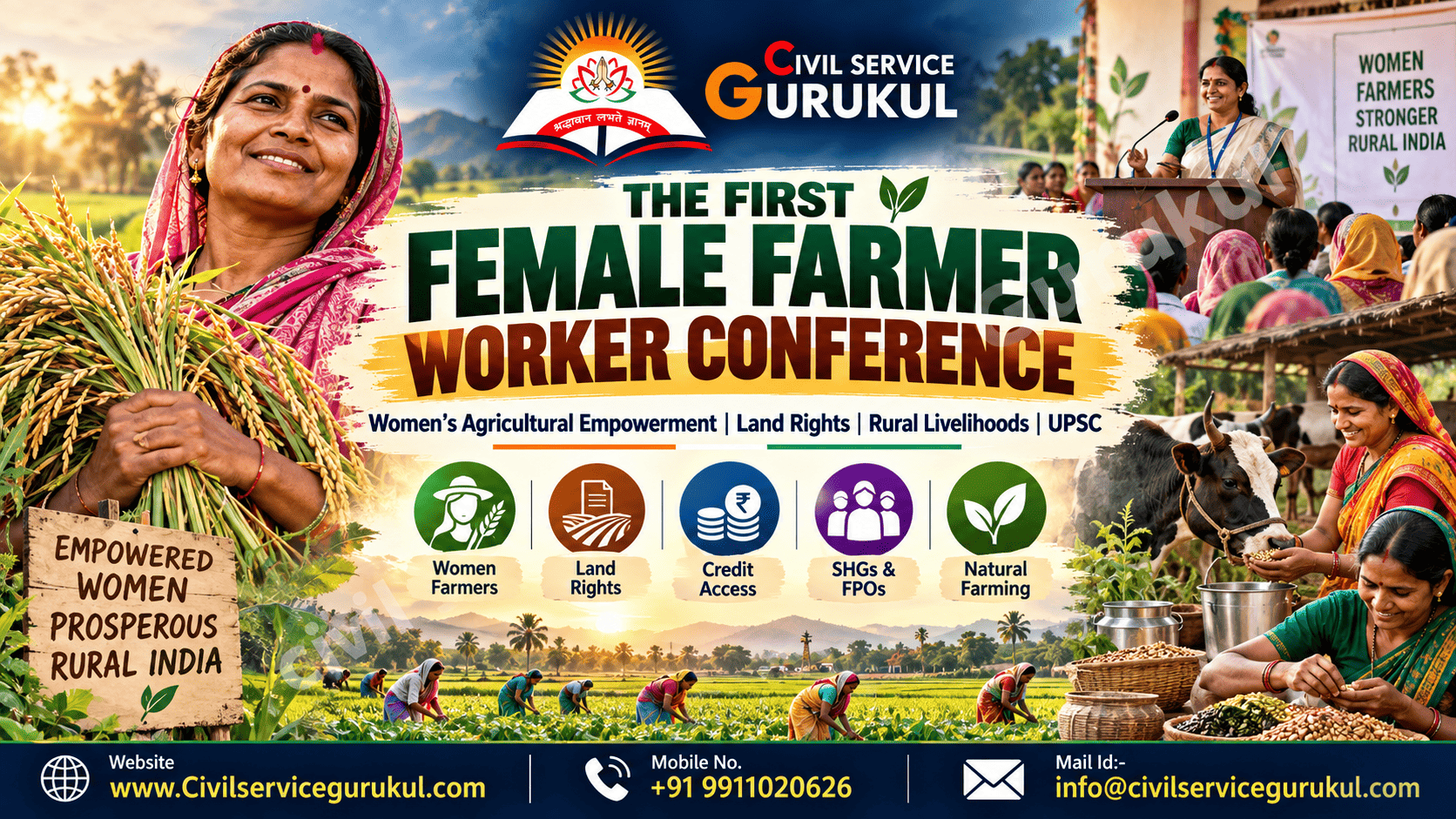
India’s First Female Farmer Worker Conference has brought renewed attention to the role of women in agriculture and the structural barriers they continue to face in rural India. The conference was held in New Delhi and focused on recognising women not merely as agricultural labourers or unpaid family helpers, but as legitimate farmers with rights, access to land, credit and institutional support. It also coincided with the UN-designated International Year of the Woman Farmer 2026. Insights IAS
For UPSC aspirants, this topic is important for GS Paper II – Social Justice, GS Paper III – Agriculture, Essay and questions related to women-led development, rural livelihoods and inclusive growth.
What is the First Female Farmer Worker Conference?
The conference is a national-level platform created to recognise the contribution of:
- women farmers,
- agricultural labourers,
- pastoralists,
- women-led SHGs,
- women-led Farmer Producer Organisations,
- and rural women engaged in allied activities.
It was organised by the Bharatiya Kisan Sangh (BKS) and aimed to strengthen the formal social and legal identity of women as farmers. Insights IAS
Why Was the Conference Important?
Women play a major role in Indian agriculture, yet their formal ownership of agricultural assets remains limited.
The source notes that women contribute a large share of manual farm work, but fewer than 14% own land. This gap directly affects their access to formal credit, government benefits and institutional recognition. Insights IAS
This creates a major policy challenge:
High Agricultural Participation + Low Asset Ownership = Weak Economic Empowerment
Key Objectives of the Conference
The conference focused on several structural issues faced by women in agriculture.
1. Recognition of Women as Farmers
Many rural women work extensively in agriculture but are still identified as helpers rather than farmers.
Formal recognition can improve access to:
- government schemes,
- agricultural credit,
- crop insurance,
- subsidies,
- training,
- and market support.
2. Land Rights
One of the major issues discussed was the lack of land titles in women’s names.
The conference highlighted measures such as joint pattas and stronger institutional land rights. Insights IAS
Land ownership matters because it improves:
- bargaining power,
- access to institutional credit,
- household decision-making,
- and long-term economic security.
3. Access to Credit
Without ownership documents, women may struggle to obtain formal agricultural loans.
This can push them toward informal credit sources.
Improving credit access can help women invest in:
- seeds,
- farm machinery,
- livestock,
- irrigation,
- food processing,
- and small agribusinesses.
4. Promotion of Women-Led FPOs and SHGs
The conference highlighted the role of Farmer Producer Organisations (FPOs) and Self-Help Groups (SHGs) in moving women from subsistence activity to organised agribusiness. Insights IAS
Collectivisation can improve:
- bargaining power,
- market access,
- procurement,
- value addition,
- branding,
- and access to finance.
5. Support for Natural and Sustainable Farming
The conference recognised women involved in:
- organic farming,
- natural farming,
- indigenous seed conservation,
- animal husbandry,
- food processing,
- and traditional agro-ecological practices. Insights IAS
This is important because women often preserve local knowledge related to seeds, biodiversity and household nutrition.
Link with International Year of the Woman Farmer 2026
The conference was aligned with the International Year of the Woman Farmer 2026.
The broader objective is to highlight gender inequality in agrifood systems and recognise the economic contribution of women farmers globally. Insights IAS
For UPSC, this gives the topic an international social-development dimension.
Major Challenges Faced by Women Farmers
Despite their contribution, women in agriculture face several barriers:
- lack of land ownership,
- limited institutional credit,
- restricted access to machinery,
- inadequate market linkages,
- unpaid or underpaid labour,
- limited representation in farmer institutions,
- low access to technology,
- and weak participation in agricultural decision-making.
These barriers reduce productivity and reinforce rural inequality.
Why Land Ownership Matters
Land ownership is not only an economic asset.
It affects access to:
Credit → Subsidies → Insurance → Institutional Support → Decision-Making
Therefore, improving women’s land rights can have a multiplier effect across the rural economy.
Role of Women in Sustainable Agriculture
Women are often central to:
- seed preservation,
- mixed farming,
- livestock care,
- household nutrition,
- composting,
- biodiversity conservation,
- and small-scale food processing.
Their empowerment can therefore support:
- natural farming
Prepare with Mentors Who Cleared the Exam
Get personalized study plans, evaluated answer models, and test series access.