Daily Current Affairs & News Analysis
Our daily news analysis consists of two integral parts — Daily News Analysis and Important Editorials curated rigorously from The Hindu, The Indian Express, LiveMint, PIB, and Sansad TV debates. Content is mapped directly to UPSC CSE and State PCS syllabi.
Audit Trail Verification Article 1789742966
Test SectionVerifying cryptographic hash chaining.
Audit Trail Verification Article 1789743846
Test SectionVerifying cryptographic hash chaining.
Audit Trail Verification Article 1789744362
Test SectionVerifying cryptographic hash chaining.
Audit Trail Verification Article 1789750162
Test SectionVerifying cryptographic hash chaining.
Audit Trail Verification Article 1789751908
Test SectionVerifying cryptographic hash chaining.
Audit Trail Verification Article 1789752183
Test SectionVerifying cryptographic hash chaining.
Audit Trail Verification Article 1789752556
Test SectionVerifying cryptographic hash chaining.
Audit Trail Verification Article 1789753141
Test SectionVerifying cryptographic hash chaining.
Audit Trail Verification Article 1789754908
Test SectionVerifying cryptographic hash chaining.
Audit Trail Verification Article 1789755840
Test SectionVerifying cryptographic hash chaining.
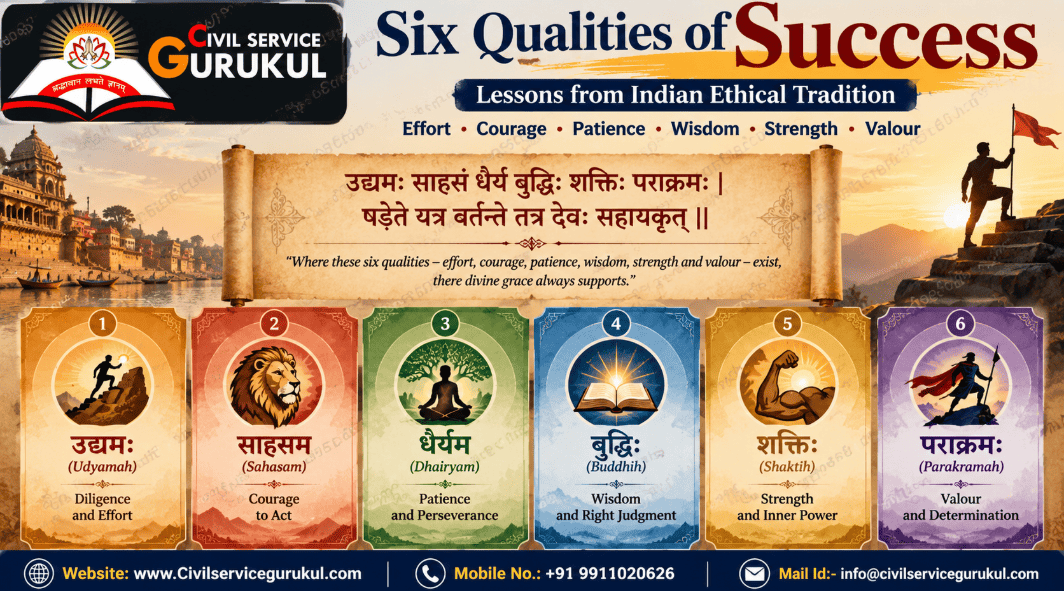
Six Qualities of Success: Lessons from Indian Ethical Tradition
Six Qualities of Success: Lessons from Indian Ethical Tradition Sanskrit Subhashitam “उद्यमः साहसं धैर्यं बुद्धिः शक्तिः पराक्रमः। षडेते यत्र वर्तन्ते तत्र दैवं सहायकृत्॥” Meaning: Where six qualities—diligence, courage, patience, wisdom, strength and valour—exist in an individual, even destiny is said to support such a person. The Subhashitam reflects an important principle of Indian ethical thought: success is not merely a product of fortune; it is built through character, effort, courage and purposeful action.
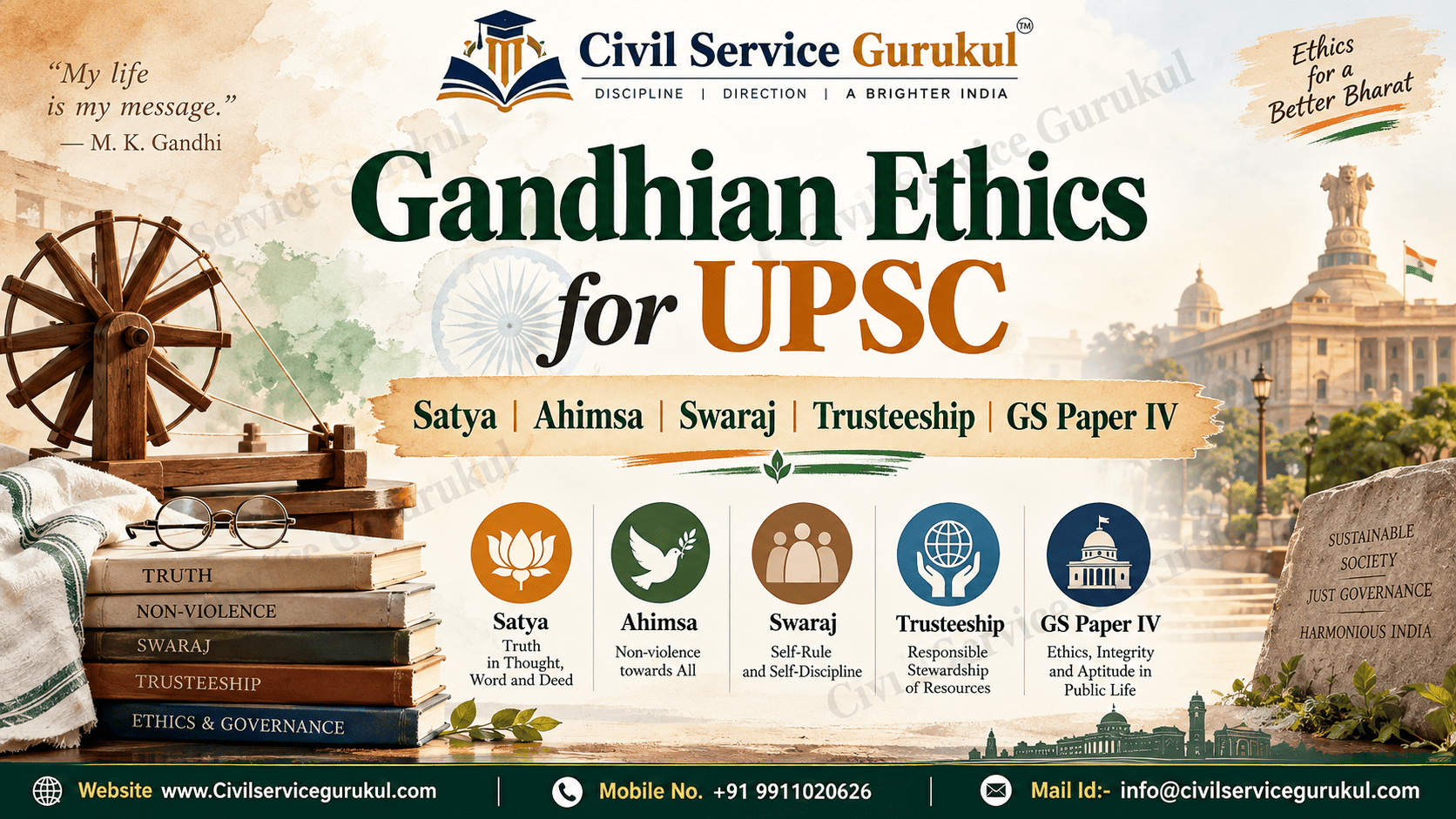
Gandhian Ethics for UPSC: Satya, Ahimsa, Swaraj, Trusteeship & Relevance in the 21st Century
Explore Gandhian ethics for UPSC through Satya, Ahimsa, Satyagraha, Swaraj, Trusteeship, Sarvodaya and Antyodaya, with direct applications to GS Paper IV, Essay, governance and contemporary ethical challenges.
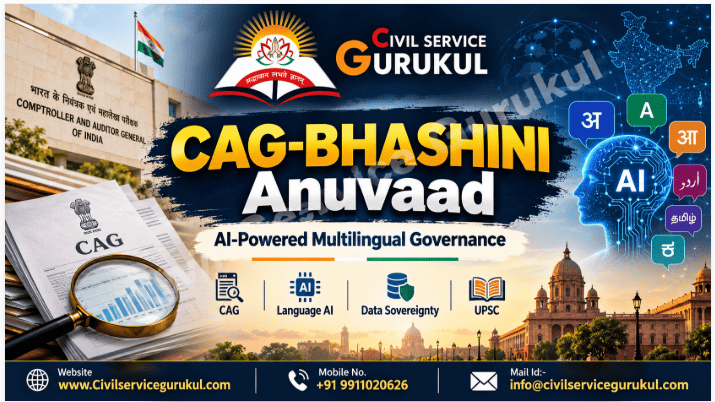
CAG-BHASHINI Anuvaad: AI-Powered Multilingual Audit Translation for Inclusive Governance
CAG-BHASHINI Anuvaad is an AI-powered multilingual translation solution designed for CAG’s official and audit documents. It combines Language AI, human oversight, secure data processing and linguistic inclusion, making it highly relevant for UPSC GS II, GS III and Ethics.
Lal Bahadur Shastri: Simplicity, Integrity and Nation-Building for UPSC Preparation
Lal Bahadur Shastri, India’s second Prime Minister, is remembered for his simplicity, integrity and decisive leadership. His role in the freedom struggle, resignation as Railway Minister on moral grounds, leadership during the 1965 war and contribution to agricultural self-reliance make him highly relevant for UPSC Prelims, Mains and Ethics.

First Female Farmer Worker Conference: Women Farmers, Land Rights, Credit & Rural Empowerment
India’s First Female Farmer Worker Conference highlighted women’s vital role in agriculture and the need for stronger recognition, land rights, institutional credit, SHGs, FPOs and sustainable farming. The topic is highly relevant for UPSC GS II, GS III, Essay and women-led development.

Gandhi Beyond 1947: The Unfinished Global Journey of Satyagraha
Mahatma Gandhi is usually studied in the context of India’s freedom struggle, but his larger vision extended beyond Indian independence. In the years immediately before his assassination, Gandhi was actively thinking about how Satyagraha and non-violent mass action could become a global force for peace, justice and conflict resolution. The idea was not simply moral preaching; it was about institutionalising non-violent resistance as a practical strategy against injustice.

Powering India’s Green Grid: PM-DHARA Scheme and the Next Leap in Renewable Energy Transmission
PM-DHARA is a major green-energy transmission and storage programme aimed at strengthening electricity networks within States and Union Territories. Its principal objectives are to: - develop stronger intra-state transmission systems, - facilitate evacuation of renewable electricity, - reduce grid congestion, - support large-scale battery storage, - improve grid flexibility, - and enable greater integration of solar and wind power. The scheme is expected to facilitate the evacuation of up to 135 GW of renewable energy capacity across States and Union Territories.
UPSC Current Affairs 5 October 2026: From Industrial Corridors to Quantum Security
UPSC Current Affairs for 5 October 2026 covers major developments in industrial infrastructure, GST reforms, diplomacy, quantum communication, heritage conservation, rural housing and biodiversity. This Civil Service Gurukul guide presents each topic with Prelims facts, GS paper relevance and Mains-ready analysis.
Industrial Corridors and India’s Manufacturing Future: Understanding NICDP for UPSC
The National Industrial Corridor Development Programme is reshaping India’s manufacturing geography by integrating industrial nodes with freight corridors, expressways, ports, logistics networks and planned smart cities. This Civil Service Gurukul guide explains NICDP from a UPSC perspective with Prelims facts, GS Paper 1 and GS Paper 3 relevance, challenges and Mains-ready analysis.
Next-Gen GST and India’s Growth Story: Reform, Formalisation & the Road Ahead
Next-Gen GST marks a new phase in India’s indirect tax reform, focused on rate rationalisation, easier compliance, faster refunds, correction of inverted duty structures and deeper economic formalisation. This Civil Service Gurukul analysis explains its impact on growth, MSMEs, GST collections, Input Tax Credit, GSTAT and its relevance for UPSC GS Paper 3.