
CAG-BHASHINI Anuvaad: AI-Powered Multilingual Audit Translation for Inclusive Governance
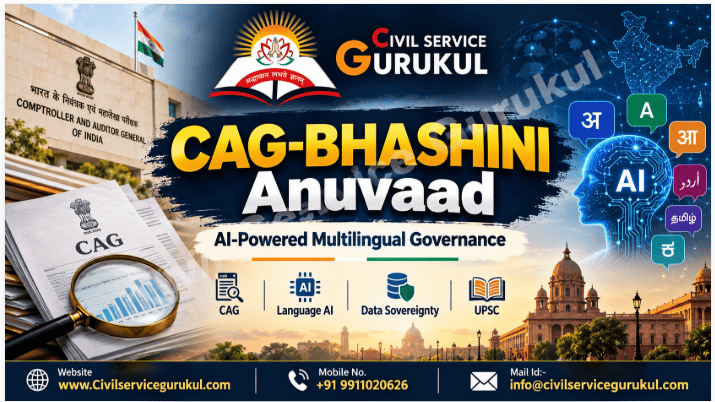
India is rapidly expanding the use of Artificial Intelligence in governance, and CAG-BHASHINI Anuvaad is an important example of how AI can support transparency, accessibility and linguistic inclusion.
CAG-BHASHINI Anuvaad is an AI-powered multilingual translation solution developed for the Comptroller and Auditor General of India (CAG). It is designed to translate official and audit-related documents into multiple languages while retaining human oversight, accuracy, security and data sovereignty.
For UPSC aspirants, this topic is highly relevant for GS Paper II – Governance, GS Paper III – Science & Technology, Ethics and Essay.
What is CAG-BHASHINI Anuvaad?
CAG-BHASHINI Anuvaad is a specialised Language AI solution created to support translation of CAG documents and audit-related content.
It combines:
Artificial Intelligence + Indian Languages + Human Review + Secure Government Infrastructure
The objective is not simply to automate translation, but to make important public documents easier to understand across India’s diverse linguistic landscape.
Who Developed It?
The initiative brings together:
- Digital India BHASHINI Division
- Comptroller and Auditor General of India
BHASHINI is India’s language-technology ecosystem designed to make digital services more accessible across Indian languages.
Key Features
1. AI-Powered Translation
The platform uses artificial intelligence to translate official documents faster and more consistently.
2. Multilingual Access
It enables government and audit information to reach citizens in multiple Indian languages.
This improves accessibility for people who may not be comfortable reading official material in English.
3. Human-in-the-Loop
One of the most important features is that AI-generated translations are not treated as final automatically.
Human review remains essential for:
- legal terminology,
- financial language,
- contextual accuracy,
- and quality assurance.
This makes the initiative a useful example of responsible AI governance.
4. Data Sovereignty
Government audit documents may contain sensitive financial and administrative information.
Therefore, the platform emphasises secure processing, controlled access and protection of institutional data.
5. Integration With Government Workflow
The system is intended to work within CAG’s existing processes rather than functioning as an unrelated external tool.
That can help improve efficiency while preserving institutional accountability.
Why Is It Important?
Strengthening Transparency
CAG reports examine how public money is used.
Making these reports available in multiple languages can help a wider section of society understand:
- government expenditure,
- audit findings,
- financial irregularities,
- and performance of public institutions.
Promoting Linguistic Inclusion
India is a multilingual democracy.
If citizens can access government information in their own language, governance becomes more inclusive.
A useful principle for UPSC answers is:
Language should not become a barrier between citizens and public accountability.
Improving Citizen-Centric Governance
CAG-BHASHINI can improve the accessibility of audit information for:
- citizens,
- State governments,
- public representatives,
- students,
- researchers,
- and civil society.
This makes transparency more meaningful.
Importance of CAG for UPSC
The Comptroller and Auditor General of India is a constitutional authority responsible for auditing government receipts and expenditure.
The institution plays a key role in:
- financial accountability,
- parliamentary control over public expenditure,
- government auditing,
- public-sector oversight,
- and transparency.
CAG-BHASHINI therefore represents the convergence of:
Constitutional Accountability + Artificial Intelligence
Relevance for GS Paper II
This topic can be used under:
- Governance
- Transparency
- Accountability
- Constitutional Bodies
- e-Governance
- Citizen-Centric Administration
- Digital Inclusion
Mains Value Addition
“Technology strengthens governance when it expands access to accountability rather than merely digitising administrative processes.”
Relevance for GS Paper III
CAG-BHASHINI is also important for Science & Technology because it involves:
- Artificial Intelligence
- Language AI
- Digital India
- indigenous technology
- secure digital infrastructure
- data sovereignty
- responsible AI
Ethical Dimension of AI
Government use of AI raises important ethical questions.
These include:
- Who is responsible if AI makes an error?
- How is sensitive information protected?
- Can algorithms introduce language bias?
- Should final decisions be left entirely to machines?
CAG-BHASHINI addresses some of these concerns by retaining human oversight.
A useful GS IV line:
AI should assist public institutions, but accountability must remain human and institutional.
What Is Data Sovereignty?
Data sovereignty means that sensitive information should remain under appropriate legal and institutional control.
It is especially important for government systems dealing with:
- audit records,
- public finance,
- departmental information,
- confidential reports,
- and policy documents.
India’s development of domestic AI and language infrastructure can therefore have strategic importance.
Benefits of Language AI in Governance
Language AI can be used in:
- government portals,
- welfare schemes,
- audit reports,
- public notices,
- grievance redressal,
- education,
- healthcare communication,
- and judicial or administrative services.
This can significantly improve last-mile governance.
Challenges
Despite its advantages, Language AI has limitations.
Translation Accuracy
Technical and legal terminology may be difficult for AI to interpret correctly.
Linguistic Bias
Languages with larger datasets may receive better results than low-resource languages.
Cybersecurity
Sensitive government documents require strong protection.
Human Accountability
AI-generated content must remain subject to institutional review.
Contextual Understanding
Literal translation may sometimes alter the intended meaning.
Way Forward
India can strengthen AI-based governance through:
- high-quality multilingual datasets,
- specialised government AI models,
- continuous human validation,
- strong cybersecurity,
- transparent accountability,
- standardised terminology,
- and regular performance audits.
The guiding principle should be:
AI for Inclusion + AI for Efficiency + Human Accountability
UPSC Prelims Quick Revision
CAG-BHASHINI Anuvaad: AI-powered multilingual translation solution.
Institution: Comptroller and Auditor General of India.
Technology Partner: Digital India BHASHINI ecosystem.
Key Themes: Language AI, multilingual governance, human oversight, data sovereignty.
UPSC Relevance: GS II + GS III + Ethics.
Possible UPSC Mains Questions
Q1. How can AI-based language technologies strengthen transparency and citizen-centric governance in India?
Q2. Discuss the importance of human oversight and data sovereignty in the use of AI by public institutions.
Q3. CAG-BHASHINI Anuvaad represents the convergence of constitutional accountability and emerging technology. Discuss.
Conclusion
CAG-BHASHINI Anuvaad is an important example of how Artificial Intelligence can be used to make public institutions more accessible without compromising human accountability.
Its focus on multilingual access, secure processing, human review and institutional integration makes it relevant not only for governance but also for India’s broader Digital Public Infrastructure and responsible AI strategy.
For UPSC aspirants, the topic should be connected with:
CAG + Governance + AI + Linguistic Inclusion + Data Sovereignty + Accountability
Prepare with Mentors Who Cleared the Exam
Get personalized study plans, evaluated answer models, and test series access.