
Infrastructure-Led Nation Building: UPSC Notes 2026
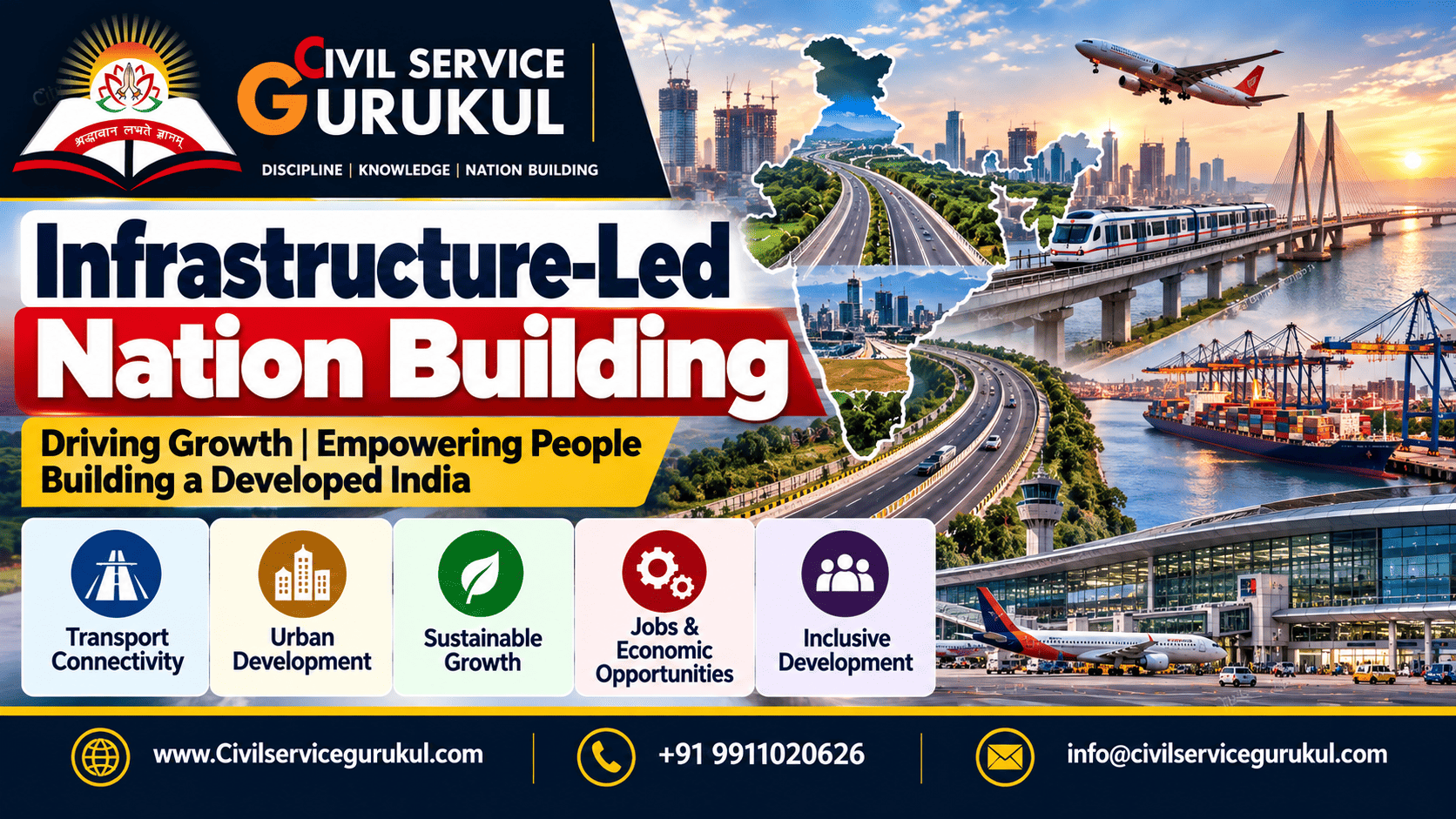
INDIAN ECONOMY | GS PAPER III | 2026
Infrastructure-Led Nation Building: India's Growth Strategy and the Road to Viksit Bharat 2047
Complete UPSC notes on infrastructure investment, PM GatiShakti, transport, digital connectivity, energy security, fiscal policy and sustainable development.
Updated: 24 October 2026
Infrastructure-led nation building is a development strategy in which investment in productive public assets supports economic growth, employment, competitiveness and social inclusion.
India's Union Budget 2026–27 provides a capital expenditure outlay of ₹12.2 lakh crore, reflecting the importance of long-term asset creation.
Programmes such as PM GatiShakti, the National Logistics Policy, Bharatmala, Sagarmala, railway modernisation and Digital India aim to improve connectivity and economic efficiency.
The central challenge is to ensure that infrastructure is financially sustainable, environmentally responsible and socially inclusive.
1. What Is Infrastructure-Led Nation Building?
Infrastructure-led nation building refers to the strategic use of public and private investment in essential physical, digital and social systems to support national development.
Infrastructure reduces the economic distance between people, markets, production centres and public services.
It creates the foundation on which agriculture, industry, services, education and healthcare can become more productive.
2. Types of Infrastructure
Roads, railways, ports, airports, power networks, industrial corridors and logistics facilities.
Broadband, telecommunications, digital identity, payments, data systems and public digital platforms.
Schools, hospitals, drinking water, sanitation, housing and community facilities.
Renewable energy, public transport, energy storage, waste management and climate-resilient systems.
3. Economic Rationale: Why Infrastructure Drives Growth
A. Investment Multiplier
Infrastructure construction generates demand for steel, cement, machinery, engineering services and labour.
This can stimulate economic activity beyond the initial government expenditure.
B. Productivity Improvement
Better transport and energy networks reduce delays, production interruptions and business costs.
C. Crowding-In of Private Investment
Public infrastructure can encourage private investment by improving the commercial viability of factories, warehouses and services.
D. Employment Generation
Infrastructure investment creates construction jobs and may support long-term employment through expanded economic activity.
E. Regional Integration
Improved connectivity helps integrate remote and underserved regions with larger markets.
4. India's Public Capital Expenditure Strategy
The Union government has substantially increased its capital expenditure outlay over the past decade.
| Financial Year | Capital Outlay |
|---|---|
| FY 2014–15 | Approximately ₹2 lakh crore |
| FY 2025–26 | Approximately ₹11.2 lakh crore, Budget Estimate |
| FY 2026–27 | ₹12.2 lakh crore, Budget Estimate |
Capital expenditure generally creates assets or reduces liabilities.
It differs from revenue expenditure, which largely supports the day-to-day functioning of government.
A capital expenditure allocation is not the same as actual expenditure.
Budget Estimates, Revised Estimates and Actuals must be clearly distinguished in examination answers.
5. PM GatiShakti National Master Plan
PM GatiShakti was launched in October 2021 to improve integrated infrastructure planning.
It uses a GIS-based digital platform to support coordination among ministries, departments and implementing agencies.
The objective is to identify connectivity gaps, improve last-mile access and reduce project delays.
Key Developments in 2026
- 58 ministries and departments integrated into the planning framework.
- More than 3,291 data layers available as of August 2026.
- 396 projects evaluated through the Network Planning Group by 11 August 2026.
- Estimated value of evaluated projects: approximately ₹18.66 lakh crore.
These figures represent planning and appraisal progress, not completed infrastructure of equivalent value.
6. National Logistics Policy
The National Logistics Policy, launched in September 2022, aims to improve India's logistics ecosystem through coordinated planning, digitalisation and process reforms.
Efficient logistics can reduce freight delays, inventory requirements and transaction costs.
This supports manufacturing, agriculture, exports and e-commerce.
Important UPSC Concepts
- Multimodal connectivity.
- Last-mile infrastructure.
- Logistics efficiency.
- Supply-chain integration.
- Trade competitiveness.
- Digital logistics systems.
7. Roads and Highways
Road infrastructure connects rural settlements, industrial centres, agricultural markets and major cities.
National highway development, economic corridors and rural connectivity are important elements of India's transport strategy.
Major Initiatives
- Bharatmala Pariyojana.
- National Highway development.
- PM Gram Sadak Yojana.
- Economic corridors and expressways.
- Border and strategic roads.
Better road connectivity can improve access to employment, education, healthcare and agricultural markets.
8. Railway Infrastructure Modernisation
Indian Railways plays a central role in passenger mobility, freight transport and national integration.
Modernisation includes electrification, station redevelopment, dedicated freight corridors, safety systems and upgraded rolling stock.
Railway Developments in 2026
| Indicator | Reported Status |
|---|---|
| Railway Budgetary Support, FY27 | Approximately ₹2.78 lakh crore |
| Broad-Gauge Network Electrification | Approximately 99.6% by July 2026 |
| Kavach Version 4.0 | Commissioned on 2,633 route km by July 2026 |
| Mumbai–Ahmedabad High-Speed Rail | 508 km corridor under development |
| Amrit Bharat Station Scheme | 1,340 stations identified for redevelopment |
Railways can help reduce road congestion, support lower-emission transport and improve freight efficiency.
9. Ports, Shipping and Sagarmala
Maritime infrastructure supports India's international trade and coastal economy.
The Sagarmala Programme promotes port-led development, connectivity and coastal economic activity.
Efficient ports and hinterland connectivity can improve export competitiveness and reduce cargo handling delays.
10. Aviation and Regional Connectivity
Airport infrastructure connects economic centres and improves access to remote regions.
The UDAN regional connectivity scheme aims to make air travel more accessible and support regional aviation connectivity.
Aviation infrastructure can support tourism, investment, healthcare access and business mobility.
11. Industrial Corridors and Manufacturing
Industrial corridors combine transport networks, industrial land, power supply, water systems and logistics facilities.
They aim to create efficient manufacturing ecosystems and attract private investment.
As of 2026, 20 industrial smart cities had been approved across seven corridors and 13 states.
These projects can support industrial clusters, exports and integration into global value chains.
12. Digital Public Infrastructure
Digital infrastructure is increasingly important for public service delivery, financial inclusion and economic participation.
Examples
- Aadhaar-based digital identity.
- Unified Payments Interface (UPI).
- DigiLocker.
- Digital connectivity and broadband.
- Public digital platforms for service delivery.
Digital systems can lower transaction costs, improve access and support more efficient administration.
However, digital inclusion requires affordable connectivity, cybersecurity and strong data protection.
13. Energy Infrastructure and Security
Reliable energy supply is essential for industrial growth, transport systems and household welfare.
India's energy infrastructure strategy includes electricity generation, transmission networks, renewable energy, energy storage and grid modernisation.
A resilient power system supports economic growth while helping manage energy transition risks.
14. Infrastructure and Climate Sustainability
Infrastructure development can create environmental pressures through land-use changes, resource consumption and emissions.
Climate-resilient planning must consider floods, heatwaves, coastal risks and extreme weather.
Key Policy Priorities
- Climate-resilient design standards.
- Environmental impact assessment.
- Renewable energy integration.
- Low-emission public transport.
- Water-efficient construction.
- Lifecycle maintenance and monitoring.
15. Financing India's Infrastructure
Infrastructure projects often require substantial upfront investment and generate returns over long periods.
| Financing Mechanism | Purpose |
|---|---|
| Budgetary Capital Expenditure | Direct public investment in infrastructure assets. |
| Public-Private Partnerships | Allocate project responsibilities and risks between public and private entities. |
| Infrastructure Investment Trusts | Pool investment in eligible infrastructure assets. |
| Asset Monetisation | Unlock value from existing public assets. |
| Municipal Bonds | Finance eligible urban infrastructure requirements. |
| Development Finance Institutions | Provide long-term infrastructure finance. |
16. Union Budget 2026–27: Infrastructure Initiatives
The Union Budget 2026–27 continued the focus on infrastructure creation.
- ₹12.2 lakh crore public capital expenditure outlay.
- Proposed Infrastructure Risk Guarantee Fund.
- Proposed Surat–Dankuni dedicated freight corridor.
- Plan to operationalise 20 new national waterways over five years.
- Proposed high-speed rail corridors between selected cities.
- Support for City Economic Regions.
Budget announcements must be distinguished from projects already completed or operational.
17. Major Challenges in Infrastructure Development
Delays, compensation disputes and rehabilitation concerns.
Coordination problems, clearances and implementation bottlenecks.
Long repayment periods, cost overruns and financial risk.
Ecological impacts, climate vulnerability and resource pressures.
Fragmented institutions, weak municipal finances and planning gaps.
Insufficient resources for upkeep of existing infrastructure.
18. Infrastructure and Inclusive Development
Nation building requires more than large infrastructure projects.
Infrastructure must also improve access for rural communities, women, persons with disabilities and economically disadvantaged groups.
Affordable public transport, safe drinking water, digital connectivity and reliable electricity can strengthen social and economic inclusion.
19. Way Forward: A Balanced Infrastructure Strategy
- Adopt integrated and evidence-based project planning.
- Prioritise projects with strong economic and social returns.
- Strengthen public-private risk allocation.
- Improve project appraisal and execution monitoring.
- Ensure environmental and climate resilience.
- Strengthen municipal and state-level institutions.
- Allocate sufficient funding for maintenance.
- Improve transparency and public accountability.
20. UPSC Prelims Practice Questions
Q1. PM GatiShakti National Master Plan was launched in which year?
Answer: 2021. It supports integrated infrastructure planning.
Q2. What is the primary objective of the National Logistics Policy?
Answer: Improving logistics efficiency and competitiveness through coordination and reform.
Q3. What is the capital expenditure outlay in Union Budget 2026–27?
Answer: ₹12.2 lakh crore.
Q4. Sagarmala is primarily associated with which sector?
Answer: Port-led and maritime development.
Q5. What is the purpose of Dedicated Freight Corridors?
Answer: Improving freight transport capacity and operational efficiency.
Q6. What does DPI stand for?
Answer: Digital Public Infrastructure.
Q7. Why can public infrastructure investment crowd in private investment?
Answer: It can reduce business costs and improve the commercial viability of private projects.
21. UPSC Mains Practice Question
"Infrastructure development is not merely an economic activity but an instrument of comprehensive nation building." Discuss with reference to India's infrastructure strategy and Viksit Bharat 2047.
Model Answer
Introduction: Infrastructure-led development creates the productive foundation for economic growth, social inclusion and national integration. India's ₹12.2 lakh crore capital expenditure outlay for FY2026–27 reflects this policy priority.
Economic Significance:
- Transport and logistics reduce transaction costs and improve competitiveness.
- Public investment can stimulate private investment and employment.
- Industrial corridors support manufacturing and exports.
- Digital infrastructure strengthens financial inclusion and public service delivery.
- Energy infrastructure supports industrial productivity and energy security.
Nation-Building Dimension: Better connectivity integrates remote regions, expands access to services and strengthens cooperative federalism.
Challenges: Land acquisition, project delays, financing constraints, environmental damage and inadequate maintenance remain significant obstacles.
Way Forward: India should adopt integrated planning, transparent project appraisal, climate-resilient design, sustainable financing and inclusive infrastructure development.
Conclusion: Infrastructure can become a foundation for Viksit Bharat 2047 when investment is combined with institutional efficiency, environmental sustainability and equitable access.
22. Quick Revision for UPSC
- PM GatiShakti: Launched in October 2021.
- National Logistics Policy: Launched in September 2022.
- Union Budget FY27 Capex: ₹12.2 lakh crore.
- Bharatmala: Road and highway connectivity.
- Sagarmala: Port-led development.
- UDAN: Regional air connectivity.
- DPI: Digital Public Infrastructure.
- PPP: Public-Private Partnership.
- Viksit Bharat: Long-term development vision for 2047.
23. Conclusion
Infrastructure-led nation building is central to India's long-term economic transformation.
Investment in roads, railways, ports, energy networks and digital systems can improve productivity, market access and public service delivery.
However, effective nation building requires more than large budget allocations.
The quality of project selection, execution, maintenance, environmental protection and social inclusion will determine the lasting value of infrastructure investment.
Prepare Indian Economy with Civil Service Gurukul
Build conceptual clarity through current affairs, UPSC Prelims practice and analytical Mains answer writing.
Explore Civil Service Gurukul
Website:
www.civilservicegurukul.com
Mobile:
+91 9911020626
Email:
info@civilservicegurukul.com
This article is intended for UPSC educational preparation. Financial allocations are Budget Estimates unless stated otherwise. Infrastructure project statistics refer to their reported dates and stages.
Prepare with Mentors Who Cleared the Exam
Get personalized study plans, evaluated answer models, and test series access.