
India's Energy Security Amid Conflicts: UPSC 2026
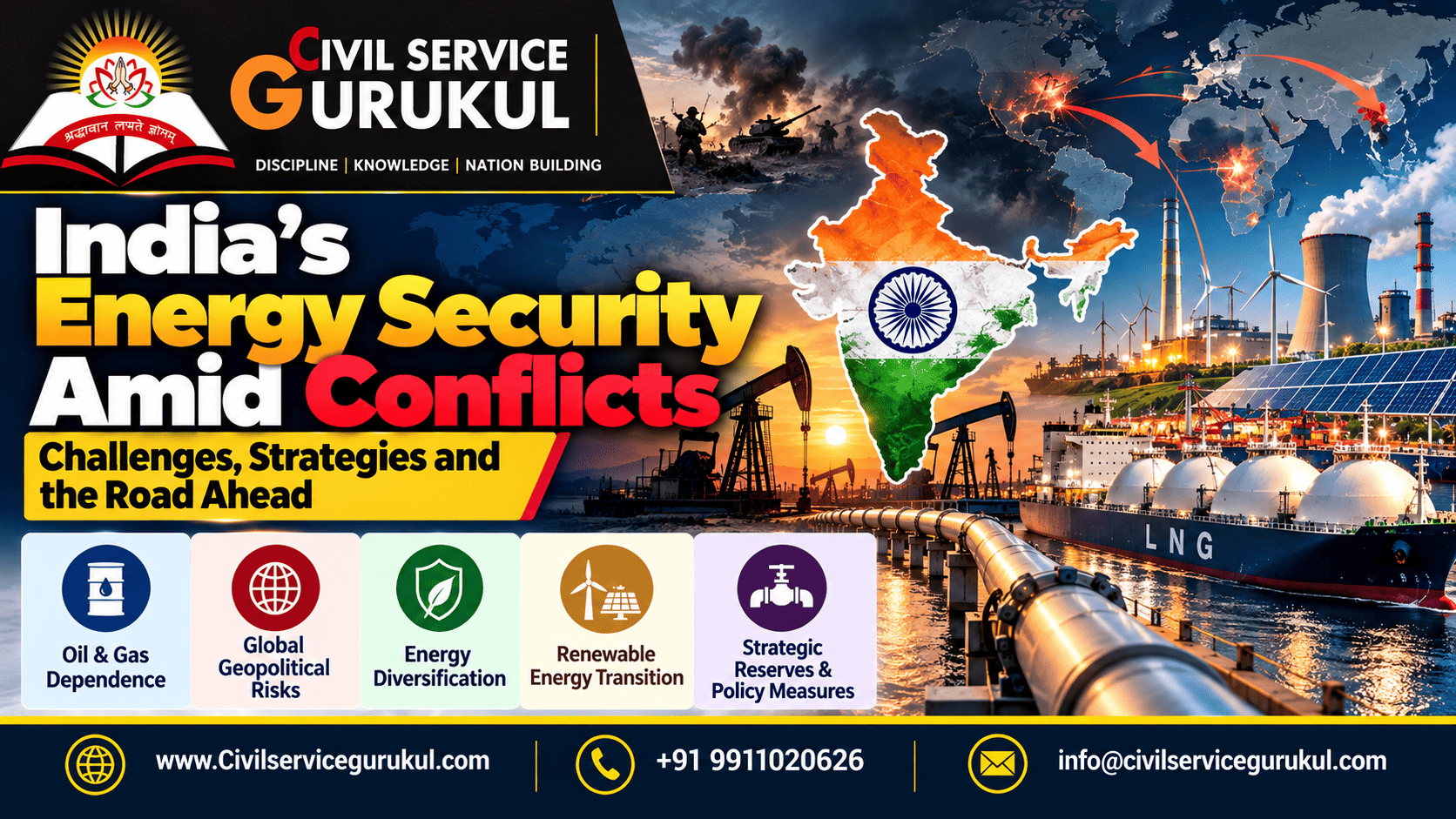
INTERNATIONAL RELATIONS | INDIAN ECONOMY | GS II & III
India's Energy Security Amid Global Conflicts: Oil Diplomacy, Strategic Reserves and the Road to Energy Independence
Complete UPSC notes on energy geopolitics, crude oil imports, West Asia, Russia–Ukraine conflict, maritime chokepoints, strategic reserves and clean energy.
Updated: 24 October 2026
India's energy security is closely linked to developments in international oil and gas markets.
The Russia–Ukraine conflict, the 2026 West Asia crisis and disruptions around the Strait of Hormuz have highlighted the vulnerability of countries dependent on imported energy.
India's strategy combines diversification of suppliers, strategic petroleum reserves, energy diplomacy, domestic production, renewable energy and greater energy efficiency.
Long-term energy independence will require reduced dependence on imported fossil fuels and stronger domestic clean-energy capabilities.
1. What Is Energy Security?
Energy security refers to reliable access to sufficient energy at affordable prices, while maintaining resilience against supply disruptions.
It includes the availability of energy resources, reliability of infrastructure, affordability for consumers and sustainability of the energy system.
For India, energy security is essential for economic growth, industrial production, agriculture, transport and household welfare.
2. Why Is Energy Security Important for India?
India is among the world's largest energy consumers and crude oil importers.
Domestic crude oil production does not meet national demand, creating substantial dependence on international suppliers.
This exposes the economy to external price changes, geopolitical tensions and maritime disruptions.
- Energy imports affect the trade balance.
- Fuel prices influence inflation.
- Natural gas is important for fertiliser production.
- Petroleum fuels support transport and logistics.
- Reliable energy strengthens manufacturing.
- Energy affordability supports household welfare.
3. India's Energy Import Dependence
According to a 2026 assessment by the Council on Energy, Environment and Water, India imported approximately 88% of its crude oil and 48% of its natural gas requirements in 2024.
The study also estimated that India imported about 26% of its coal requirements.
| Energy Source | Import Dependence |
|---|---|
| Crude Oil | Approximately 88% |
| Natural Gas | Approximately 48% |
| Coal | Approximately 26% |
These figures relate to 2024 and should not be presented as October 2026 import shares.
4. Global Conflicts and Energy Supply Disruptions
Geopolitical conflicts can disrupt oil production, shipping routes, insurance markets, financial transactions and energy trade.
Even when physical supplies remain available, the fear of disruption can increase market volatility.
Sanctions, shipping restrictions and changes in trade flows have influenced global oil and gas markets.
Military tensions have increased risks to energy infrastructure, shipping and supply chains.
Disruptions at critical sea routes can delay energy shipments and increase costs.
Restrictions on suppliers, insurers and payment systems can complicate energy trade.
5. Strait of Hormuz: A Strategic Chokepoint
The Strait of Hormuz connects the Persian Gulf with the Gulf of Oman and the Arabian Sea.
It is one of the world's most important maritime routes for oil and LNG trade.
Before the 2026 West Asia crisis, approximately 45% of India's crude oil imports transited this route, according to the Union Petroleum Minister's March 2026 statement.
Disruptions can affect shipping availability, freight costs, insurance premiums and delivery schedules.
The Strait of Hormuz lies between Iran to the north and Oman, including the Musandam Peninsula, to the south.
6. India's Response to the 2026 West Asia Crisis
The Government of India undertook measures to maintain fuel availability during disruptions in West Asia.
These included alternative crude sourcing, inventory monitoring, refinery coordination and diplomatic engagement.
In March 2026, the government stated that non-Hormuz sourcing had increased to approximately 70% of crude imports, compared with 55% before the conflict.
A 24-hour monitoring mechanism was also established to assess petroleum supply conditions.
7. Russia's Role in India's Oil Security
Russia became a major supplier of crude oil to India following changes in global energy trade after 2022.
Russian crude helped Indian refiners diversify away from exclusive dependence on traditional suppliers.
However, sanctions, shipping arrangements and payment restrictions create their own risks.
India must balance commercial considerations, international obligations and strategic autonomy.
8. India's Energy Diplomacy
Energy diplomacy involves using international partnerships to secure reliable energy supplies and technology access.
India engages with oil-producing countries, major energy consumers and international institutions.
Important Partners
- Russia.
- Saudi Arabia.
- Iraq.
- United Arab Emirates.
- United States.
- Qatar.
- Other emerging oil and gas suppliers.
Diversification reduces dependence on any single supplier or region.
9. Strategic Petroleum Reserves
Strategic Petroleum Reserves are emergency crude oil storage facilities intended to provide a buffer against supply disruptions.
India's existing strategic reserve capacity is 5.33 million metric tonnes.
| Location | Storage Capacity |
|---|---|
| Visakhapatnam, Andhra Pradesh | 1.33 MMT |
| Mangaluru, Karnataka | 1.50 MMT |
| Padur, Karnataka | 2.50 MMT |
| Total | 5.33 MMT |
Additional facilities have been approved at Chandikhol and Padur.
Existing SPR capacity corresponds to approximately 9.5 days of crude requirements.
This figure is different from total national storage capacity, which also includes operational inventories held by oil companies.
10. Why Strategic Reserves Matter
- Provide short-term supply protection.
- Support emergency response.
- Improve procurement flexibility.
- Reduce vulnerability to temporary disruptions.
- Strengthen national economic resilience.
However, reserves cannot fully replace normal commercial supply chains during prolonged crises.
11. LNG and LPG Supply Security
Natural gas supports fertiliser production, industry, power generation and urban gas distribution.
LPG is important for household cooking and commercial activities.
India depends on international markets for significant portions of these fuels.
The 2026 West Asia crisis highlighted the need for diversified suppliers, storage infrastructure and alternative energy options.
12. Economic Impact of Higher Oil Prices
A sustained rise in crude oil prices can affect several parts of India's economy.
| Economic Area | Potential Impact |
|---|---|
| Inflation | Higher transport and production costs. |
| Current Account | Higher energy import expenditure. |
| Rupee | Potential pressure from increased foreign currency demand. |
| Government Finances | Possible subsidy and fiscal pressures. |
| Industry | Higher input and logistics costs. |
| Households | Pressure on fuel and cooking energy affordability. |
The actual impact depends on exchange rates, tax policies, pricing mechanisms, global demand and the duration of the disruption.
13. Maritime Security and Energy Trade
India's maritime security is closely connected to the safety of international shipping routes.
Important routes include the Strait of Hormuz, Bab-el-Mandeb, Suez Canal and Strait of Malacca.
Naval cooperation, maritime surveillance and diplomatic engagement can support safer energy transportation.
14. Renewable Energy as a Strategic Solution
Renewable energy can reduce long-term dependence on imported fossil fuels.
Solar, wind, hydropower and other domestic energy resources can strengthen supply diversification.
However, renewable energy systems require reliable grids, storage technologies and access to critical materials.
15. National Green Hydrogen Mission
The National Green Hydrogen Mission aims to develop domestic green hydrogen production and support industrial decarbonisation.
Green hydrogen may eventually reduce fossil fuel dependence in selected sectors, including fertilisers, refining and hard-to-abate industries.
Commercial success will depend on production costs, infrastructure, technology and demand.
16. Nuclear Energy and Energy Security
Nuclear power provides a source of low-carbon electricity generation.
It can complement renewable energy by providing dispatchable generation.
Important considerations include safety, fuel supply, waste management and financing.
17. Critical Minerals and New Energy Dependence
The transition to clean energy creates demand for lithium, cobalt, nickel, graphite and rare earth elements.
These minerals are important for batteries, electric vehicles, motors and renewable energy systems.
India's energy security strategy must therefore include mineral supply diversification, domestic processing, recycling and international partnerships.
18. Energy Security and Strategic Autonomy
Strategic autonomy refers to the ability of a country to pursue independent foreign policy choices based on national interests.
High dependence on vulnerable energy supply chains can restrict policy flexibility.
Energy diversification, domestic capacity and secure maritime routes can strengthen India's strategic autonomy.
19. Key Challenges
High exposure to international crude oil markets.
Conflicts and sanctions can disrupt energy trade.
Strategic reserves provide only short-term protection.
Storage, transport and gas distribution require further investment.
Clean-energy supply chains may create new external dependencies.
High energy prices can affect households and industry.
20. Way Forward for India
- Diversify crude oil, LNG and LPG supply sources.
- Expand strategic petroleum storage and evaluate gas reserves.
- Strengthen domestic oil and gas exploration.
- Improve maritime security cooperation.
- Accelerate renewable energy deployment.
- Promote commercially viable electric mobility.
- Expand energy efficiency and demand management.
- Secure critical mineral supply chains.
- Develop battery recycling and domestic manufacturing.
- Maintain balanced and pragmatic energy diplomacy.
21. UPSC Prelims Practice Questions
Q1. The Strait of Hormuz connects which two water bodies?
Answer: Persian Gulf and Gulf of Oman.
Q2. Which organisation manages India's strategic petroleum reserve facilities?
Answer: Indian Strategic Petroleum Reserves Limited (ISPRL).
Q3. Which of the following is NOT an existing SPR location: Padur, Mangaluru, Visakhapatnam, Chandikhol?
Answer: Chandikhol. It is a planned additional facility, not one of the three existing operational locations.
Q4. Which conflict significantly changed India's crude oil import sourcing after 2022?
Answer: Russia–Ukraine conflict.
Q5. What is the primary objective of strategic petroleum reserves?
Answer: To provide an emergency buffer against crude oil supply disruptions.
Q6. Which mineral is widely used in lithium-ion batteries?
Answer: Lithium.
Q7. India's net-zero emissions target year is?
Answer: 2070.
Q8. Why is the Strait of Hormuz important to India?
Answer: A substantial share of India's crude oil and gas imports has historically passed through this maritime route.
22. UPSC Mains Practice Question
"Global geopolitical conflicts have transformed energy security from an economic concern into a strategic national security priority." Examine India's vulnerabilities and suggest measures for building long-term energy resilience.
Model Answer
Introduction: Energy security ensures reliable, affordable and sustainable energy supplies. India's substantial dependence on imported crude oil makes it vulnerable to global conflicts and price volatility.
Major Vulnerabilities:
- High crude oil import dependence.
- Exposure to West Asian shipping routes.
- Disruptions from sanctions and conflicts.
- Limited strategic storage capacity.
- Price shocks affecting inflation and external balances.
- Emerging dependence on critical minerals.
Government Response: India has diversified energy suppliers, strengthened diplomatic engagement, maintained strategic petroleum reserves and expanded clean-energy initiatives.
Way Forward: A comprehensive strategy should expand storage, strengthen maritime security, increase domestic production, accelerate electrification, promote renewable energy and secure critical mineral supply chains.
Conclusion: India must move from merely managing import risks towards building a resilient and diversified energy system that supports strategic autonomy and sustainable growth.
23. Quick Revision for UPSC 2027
- Crude Oil Import Dependence: About 88% in 2024.
- Critical Maritime Route: Strait of Hormuz.
- Existing SPR Capacity: 5.33 MMT.
- SPR Locations: Visakhapatnam, Mangaluru, Padur.
- Major Energy Challenges: Import dependence, conflict, prices and storage.
- Long-Term Solutions: Renewables, electrification, storage and diversification.
- Green Hydrogen: Important for industrial decarbonisation.
- Net-Zero Target: 2070.
- UPSC Papers: GS II, GS III and Essay.
24. Conclusion
India's energy security is inseparable from its economic resilience, foreign policy and national security.
The global conflicts of recent years have demonstrated the risks of relying on concentrated suppliers and vulnerable maritime routes.
Diversification, strategic reserves and pragmatic diplomacy are essential short-term safeguards.
Over the longer term, domestic clean energy, electrification, critical mineral security and resilient infrastructure will be central to India's journey towards energy independence.
Master International Relations and Economy with Civil Service Gurukul
Prepare UPSC current affairs through conceptual explanations, Prelims practice, Mains answer writing and integrated syllabus coverage.
Explore Civil Service Gurukul
Website:
www.civilservicegurukul.com
Mobile:
+91 9911020626
Email:
info@civilservicegurukul.com
This article is prepared for educational purposes using government statements, energy-sector assessments and policy research available up to 24 October 2026.
Import shares and storage figures relate to specified reporting periods and may change.
Prepare with Mentors Who Cleared the Exam
Get personalized study plans, evaluated answer models, and test series access.