
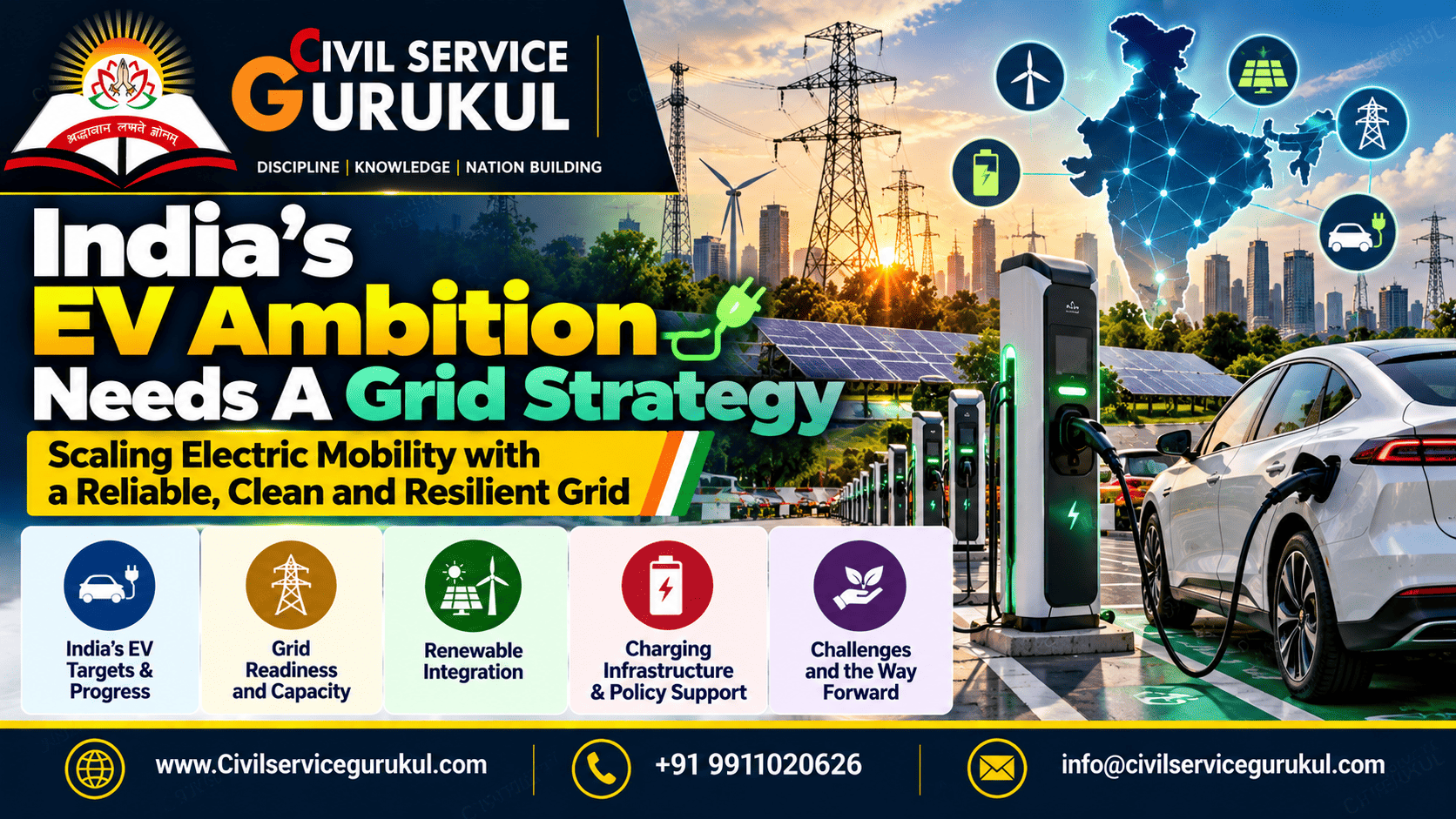
India's electric vehicle revolution can strengthen energy security, reduce urban air pollution and support cleaner transport. However, the success of this transition depends on an electricity system capable of meeting the new demand.
Large-scale electric mobility requires coordinated planning between the transport sector and electricity utilities.
Electric vehicles create additional electricity demand, particularly when many vehicles charge at the same time.
Heavy commercial vehicles pose an especially important challenge because of their large battery capacities and high daily energy consumption.
India therefore needs smart charging, stronger distribution networks, renewable energy integration, storage systems and reliable high-power charging corridors.
1. What Is an EV Grid Strategy?
An EV grid strategy is an integrated approach that aligns electric vehicle adoption with electricity generation, transmission, distribution, charging infrastructure and energy storage.
It recognises that EVs are not simply battery-powered vehicles. They are also electricity consumers whose charging behaviour affects the power system.
The objective is to ensure that electric mobility grows without compromising grid reliability, affordability or sustainability.
2. Why Is India Discussing an EV Grid Strategy?
India's dependence on imported petroleum products exposes the economy to geopolitical risks and international oil-price volatility.
Electric mobility can reduce petrol and diesel consumption, particularly when electricity comes from domestic resources.
However, replacing fuel demand with electricity demand creates new infrastructure needs.
- Higher electricity consumption.
- More pressure on local transformers.
- New demand from commercial fleets.
- Need for reliable public charging.
- Greater integration of renewable energy.
- Additional investment in grid infrastructure.
3. How Much Electricity Could India's EV Transition Require?
A scenario discussed in 2026 policy analysis estimates that full electrification of approximately 420 million registered vehicles could require 900–1,100 terawatt-hours of additional electricity annually.
A scenario involving 50% fleet electrification by 2047 suggests approximately 500 TWh of additional annual electricity demand.
| Illustrative Scenario | Additional Annual Demand |
|---|---|
| Full fleet electrification | 900–1,100 TWh |
| 50% fleet electrification by 2047 | Approximately 500 TWh |
These are illustrative scenario estimates, not official government targets or forecasts.
Actual future electricity demand will depend on fleet composition, vehicle efficiency, travel distances, technology improvements and charging patterns.
4. Why Electric Trucks Matter More Than Their Numbers Suggest
Heavy commercial vehicles account for a relatively small share of registered vehicles, but they consume large quantities of energy.
A 2026 scenario analysis estimated that electrifying India's heavy goods vehicle fleet could require roughly 450–565 TWh annually.
This reflects the high energy intensity of long-distance freight transport.
Unlike electric scooters, commercial trucks may need high-power charging within limited operational windows.
Policy Implication
Freight electrification must be planned together with high-capacity substations, charging depots, logistics hubs and highway infrastructure.
5. The Problem of Simultaneous Charging
One of the most serious grid challenges arises when large numbers of electric vehicles charge simultaneously.
For example, many commuters may return home in the evening and connect their vehicles between 6 PM and 10 PM.
This can coincide with existing household electricity demand.
The result may be higher peak demand, transformer overloading and greater need for expensive network upgrades.
Illustrative Calculation
This simplified example shows why the timing of charging matters.
It does not represent a forecast for any particular Indian city.
6. Smart Charging: The Core Solution
Smart charging allows electric vehicle charging to respond to electricity prices, grid conditions, renewable energy availability and user requirements.
Instead of charging every vehicle immediately, the system can shift flexible demand to more suitable periods.
Vehicles charge during preselected periods, such as late night or surplus solar hours.
Charging power is adjusted to avoid exceeding local electrical capacity.
Charging can be encouraged when solar or wind generation is abundant.
Compatible charging systems exchange operational information with network operators.
7. Time-of-Day Electricity Tariffs
Time-of-Day or ToD tariffs apply different electricity rates during different periods of the day.
Higher prices during peak periods can discourage unnecessary charging, while lower prices during off-peak periods can encourage demand shifting.
| Charging Pattern | Likely Grid Impact |
|---|---|
| Unmanaged evening charging | Can increase peak demand. |
| Scheduled off-peak charging | Can improve load distribution. |
| Solar-aligned daytime charging | Can support renewable energy utilisation. |
| Managed depot charging | Can reduce local infrastructure stress. |
The benefits depend on the tariff design, generation mix, consumer response and local network conditions.
8. Vehicle-to-Grid Technology
Vehicle-to-Grid, or V2G, is a technology that can allow compatible electric vehicles to return electricity from their batteries to the power system.
Potential applications include grid balancing, backup supply and demand response.
However, widespread V2G deployment requires compatible vehicles, bidirectional chargers, commercial arrangements, communication standards and battery-warranty safeguards.
V1G: Managed one-way charging.
V2G: Bidirectional power exchange between an EV and the electricity grid.
9. Why India's DISCOMs Are Critical
Distribution companies, or DISCOMs, supply electricity to consumers through local distribution networks.
Even if national generation capacity is sufficient, local transformers and feeders may not be capable of supporting large EV charging loads.
Major Challenges
- Financial constraints.
- Distribution transformer overloads.
- Delayed new electricity connections.
- High infrastructure upgrade costs.
- Uneven EV adoption across regions.
- Limited real-time load visibility.
The Revamped Distribution Sector Scheme (RDSS) is important for distribution infrastructure modernisation and smart metering.
10. National Electricity Plan and Grid Expansion
The National Electricity Plan (Transmission), 2024 outlines India's transmission development requirements through 2032.
The planned transmission network expansion is intended to support rising demand, renewable energy integration and interregional electricity transfer.
| Transmission Indicator | June 2026 | 2032 Plan |
|---|---|---|
| Transmission Network | 5.09 lakh circuit km | 6.48 lakh circuit km |
| Transformation Capacity | 1,478 GVA | 2,345 GVA |
| Interregional Transfer Capacity | 120 GW | 168 GW |
Transmission expansion is necessary but insufficient without corresponding distribution-level investment.
11. PM E-DRIVE Scheme
The PM Electric Drive Revolution in Innovative Vehicle Enhancement (PM E-DRIVE) Scheme supports the transition towards electric mobility.
The scheme has an approved outlay of ₹10,900 crore.
It includes support for eligible EV categories, electric buses, electric trucks and public charging infrastructure.
An allocation of ₹2,000 crore has been provided for EV public charging stations.
12. Public EV Charging Infrastructure
According to government data, India had 52,718 public EV charging stations as of July 2026.
Of these, 16,561 were reported to have fast charging facilities for electric cars.
However, the number of installed stations does not alone determine the quality of charging infrastructure.
Important performance indicators include:
- Charger availability and uptime.
- Charging speed and compatibility.
- Transparent electricity pricing.
- Ease of payment and access.
- Reliable grid connections.
- Safety and maintenance.
- Coverage of highways and rural areas.
13. Renewable Energy and the EV Transition
Electric vehicles eliminate tailpipe emissions, but their overall environmental impact also depends on electricity generation and battery production.
Charging with low-carbon electricity can improve lifecycle emissions performance.
India must therefore expand renewable generation while maintaining power system reliability.
Key Technologies
- Solar photovoltaic power.
- Onshore and offshore wind.
- Hydropower.
- Battery energy storage systems.
- Pumped-storage hydropower.
- Flexible electricity generation.
14. Battery Energy Storage Systems
Battery Energy Storage Systems, or BESS, store electricity for use at a later time.
They can help absorb surplus renewable generation and supply electricity during higher-demand periods.
For EV charging, storage may reduce short-duration grid stress at selected charging hubs.
However, storage economics depend on capital cost, utilisation, tariffs, battery degradation and grid service revenues.
15. EV Freight Corridors
Electrifying freight transport requires a different approach from supporting private electric two-wheelers.
Electric trucks may require high-power charging, larger grid connections and carefully located charging facilities.
Priority planning areas include major industrial corridors, ports, logistics parks and national highways.
Charging infrastructure must be coordinated with expected traffic volumes, freight schedules and power network capacity.
16. EV Battery Recycling and Circular Economy
Electric mobility also creates challenges related to battery materials and end-of-life management.
Lithium, nickel, cobalt and graphite are important materials for many battery technologies.
Recycling can help recover valuable materials, reduce waste and improve supply-chain resilience.
India's Battery Waste Management Rules, 2022 provide an important regulatory framework.
17. Challenges in India's EV Grid Strategy
| Challenge | Policy Concern |
|---|---|
| Peak Demand | Simultaneous charging can strain local networks. |
| DISCOM Finances | Weak finances can delay grid investment. |
| Freight Electrification | Heavy trucks require high-capacity connections. |
| Coal-Based Generation | Can reduce the emissions benefits of EV adoption. |
| Charging Reliability | Downtime and poor interoperability discourage users. |
| Regional Inequality | Charging networks remain unevenly distributed. |
| Battery Supply Chains | Critical mineral dependence creates strategic risks. |
| Investment Requirements | Grid upgrades and charging hubs require capital. |
18. Government Policy Framework
Supports eligible EV adoption and public charging infrastructure.
Supports distribution reforms, infrastructure modernisation and smart metering.
Provides a framework for power system capacity expansion.
Provide a framework for charging infrastructure installation and operation.
Support responsible battery waste management and recycling.
Encourages domestic advanced battery-cell manufacturing capacity.
19. Way Forward: A Comprehensive Grid Strategy
- Make smart charging capability a priority for future charging infrastructure.
- Coordinate transport planning with electricity network planning.
- Expand high-capacity connections along freight corridors.
- Encourage flexible charging through well-designed time-of-day tariffs.
- Strengthen distribution transformers, feeders and substations.
- Improve DISCOM finances and operational efficiency.
- Expand renewable generation and energy storage.
- Develop reliable, interoperable public chargers.
- Support domestic battery manufacturing and recycling.
- Promote transparent data sharing between utilities, charging operators and transport authorities.
20. UPSC Prelims Practice Questions
Q1. What is the main objective of an EV grid strategy?
Answer: To coordinate electric vehicle adoption with electricity generation, transmission, distribution and charging requirements.
Q2. What does V2G stand for?
Answer: Vehicle-to-Grid.
Q3. Which scheme supports India's electricity distribution reforms?
Answer: Revamped Distribution Sector Scheme (RDSS).
Q4. What is the approved outlay of PM E-DRIVE?
Answer: ₹10,900 crore.
Q5. What is the purpose of Time-of-Day tariffs?
Answer: To encourage electricity consumption during more suitable periods through differentiated pricing.
Q6. Why are electric trucks important for grid planning?
Answer: They have high energy requirements and may need high-power charging infrastructure.
Q7. What does BESS stand for?
Answer: Battery Energy Storage System.
Q8. Which institution prepares India's National Electricity Plan?
Answer: Central Electricity Authority under the Ministry of Power.
21. UPSC Mains Practice Question
"India's electric vehicle ambition cannot succeed without a comprehensive electricity grid strategy." Examine the challenges of large-scale transport electrification and suggest measures for sustainable grid integration.
Model Answer
Introduction: India's electric mobility transition offers opportunities to improve energy security and reduce transport emissions. However, large-scale EV adoption will create substantial new electricity demand.
Major Challenges:
- Simultaneous charging can increase peak demand.
- Heavy commercial vehicles require high-power charging infrastructure.
- Distribution networks may face transformer and feeder constraints.
- Financially stressed DISCOMs may struggle to fund upgrades.
- Coal-based electricity can reduce lifecycle emissions benefits.
- Uneven charging coverage may create regional disparities.
Government Initiatives: PM E-DRIVE, the National Electricity Plan, RDSS and the EV Charging Infrastructure Guidelines provide important policy support.
Way Forward: India should promote smart charging, time-of-day tariffs, renewable energy integration, battery storage, freight corridor electrification and coordinated grid planning.
Conclusion: India must treat electric mobility as an integrated transport and power sector transformation. A reliable, affordable and cleaner grid will be essential for sustainable EV adoption.
22. Quick Revision for UPSC 2027
- Core Issue: EV adoption must align with grid capacity.
- Biggest Energy Challenge: Large-scale freight electrification.
- Peak Load Risk: Simultaneous vehicle charging.
- Key Solution: Smart charging and demand management.
- V2G: Vehicle-to-Grid technology.
- ToD: Time-of-Day electricity tariffs.
- RDSS: Distribution sector reform.
- PM E-DRIVE: ₹10,900 crore approved outlay.
- Charging Stations: 52,718 reported as of July 2026.
- Energy Storage: BESS and pumped storage.
- UPSC Relevance: GS II, GS III and Essay.
23. Conclusion: From Electric Vehicles to an Electric Mobility Ecosystem
India's EV transition represents an opportunity to strengthen energy security, improve air quality and modernise transport.
However, EV sales and charging station numbers are only part of the solution.
The deeper challenge is to build a power system that can deliver reliable, affordable and increasingly clean electricity wherever vehicles need it.
A successful EV strategy must therefore integrate transport policy, electricity infrastructure, renewable energy, smart charging, energy storage and institutional reform.
This coordinated approach can make electric mobility an important contributor to Viksit Bharat 2047.
Prepare UPSC Current Affairs with Civil Service Gurukul
Strengthen your preparation through detailed concept notes, Prelims practice questions, Mains answer writing and syllabus-oriented analysis.
Explore Civil Service Gurukul
Website:
www.civilservicegurukul.com
Mobile:
+91 9911020626
Email:
info@civilservicegurukul.com
This article is independently prepared for educational purposes using publicly available policy information up to 24 October 2026.
Long-term EV electricity demand estimates are scenario-based. Government programme outlays and project plans should not be interpreted as completed expenditure or operational capacity.