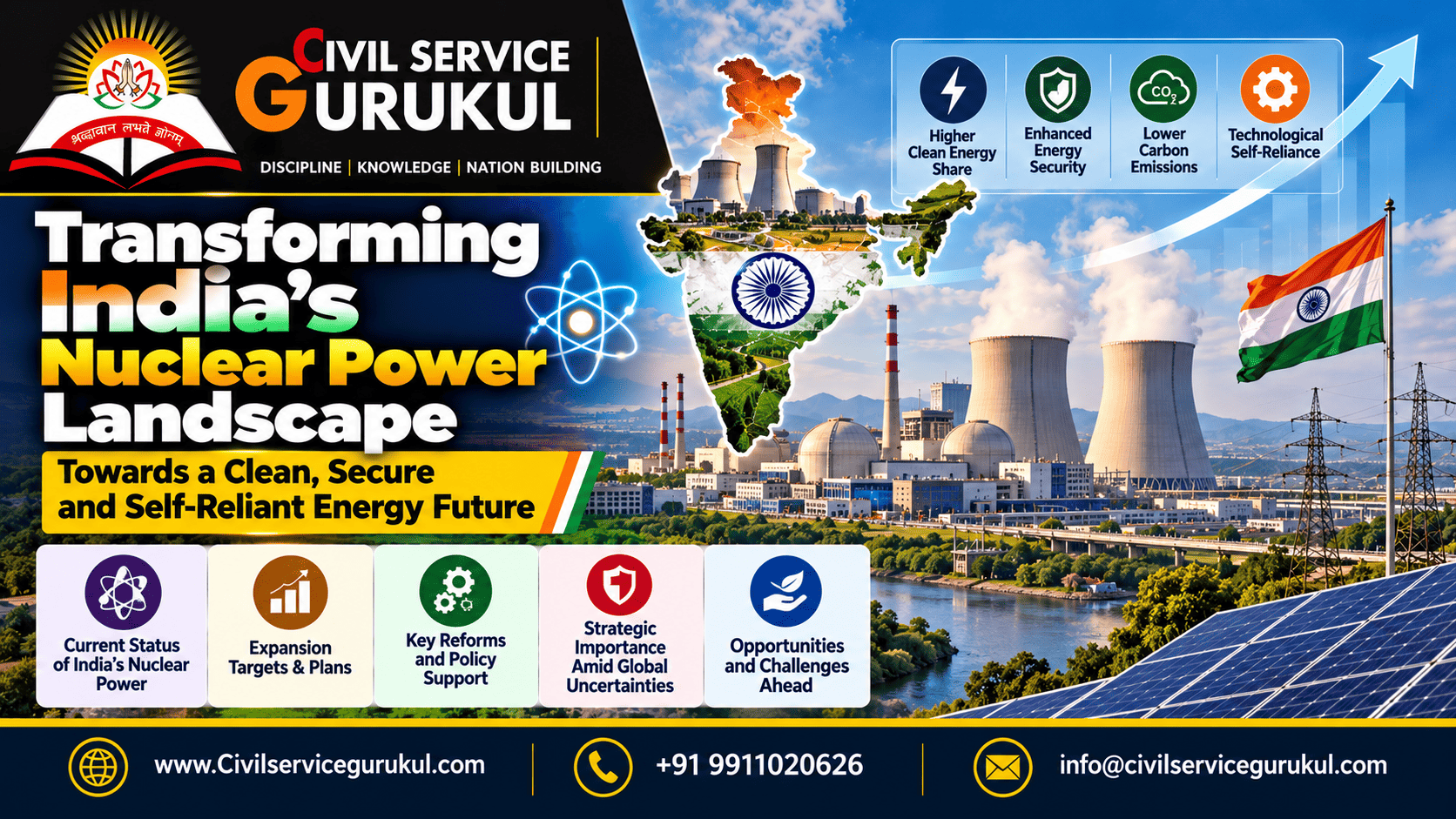
India's nuclear power sector is undergoing a major policy and technological transformation. The country aims to expand nuclear capacity, strengthen domestic manufacturing, introduce advanced reactor technologies and attract wider participation in civil nuclear energy.
India has set a target of reaching 100 GW of installed nuclear power capacity by 2047.
As of July 2026, the country had 24 operating nuclear reactors with 8.78 GW of installed capacity.
The Nuclear Energy Mission supports indigenous Small Modular Reactors, while the SHANTI Act, 2025 introduces important legal reforms for the civil nuclear sector.
The transformation seeks to improve energy security, provide reliable low-carbon electricity and strengthen India's technological self-reliance.
1. Why Is India Expanding Nuclear Power?
India's economic growth, urbanisation, industrialisation and increasing electrification are creating greater demand for reliable electricity.
Nuclear energy can provide large quantities of low-carbon electricity with high availability.
It can complement solar and wind generation, which vary with weather conditions and time of day.
Nuclear power also supports the diversification of India's electricity generation mix.
2. What Is Nuclear Power?
Nuclear power is electricity generated using heat released from controlled nuclear reactions.
Commercial nuclear reactors primarily use nuclear fission, in which a heavy atomic nucleus splits into smaller nuclei and releases energy.
The heat is transferred through an engineered system to produce steam or drive another power cycle, which operates turbines and electrical generators.
3. India's Nuclear Power Status in 2026
| Indicator | Status |
|---|---|
| Installed Capacity | 8,780 MW, July 2026 |
| Operating Reactors | 24 |
| Share of Electricity Generation | Approximately 3.1% in FY 2025–26 |
| Expected Capacity by 2031–32 | Approximately 22 GW |
| Long-Term Target | 100 GW by 2047 |
| Net-Zero Emissions Target | 2070 |
These figures distinguish existing installed capacity from future targets and planned additions.
4. Nuclear Energy Mission for Viksit Bharat
The Nuclear Energy Mission was announced in Union Budget 2025–26.
The mission forms part of India's long-term strategy to increase nuclear electricity generation and develop indigenous reactor technologies.
Major Objectives
- Reach 100 GW nuclear capacity by 2047.
- Develop and operationalise at least five indigenous SMRs by 2033.
- Strengthen nuclear research and development.
- Expand domestic reactor manufacturing.
- Encourage appropriate private participation.
- Support reliable low-carbon power generation.
The Budget announced ₹20,000 crore for research and development of Small Modular Reactors.
5. The 100 GW Nuclear Power Roadmap
India's expansion roadmap combines large nuclear reactors, indigenous technologies, Small Modular Reactors and wider institutional participation.
| Milestone | Capacity / Objective |
|---|---|
| 2026 Baseline | 8.78 GW |
| 2031–32 | Approximately 22 GW |
| 2047: NPCIL Roadmap | Approximately 54 GW |
| 2047: Other Entities | Approximately 46 GW |
| 2047: National Vision | 100 GW |
The roadmap envisages participation by public sector enterprises, private companies and joint ventures, subject to applicable legal and regulatory requirements.
Achieving these targets will depend on financing, fuel availability, project execution, regulatory approvals and supply-chain readiness.
6. What Are Small Modular Reactors?
Small Modular Reactors, or SMRs, are nuclear reactors designed with smaller unit capacities than conventional large reactors.
They may use modular construction methods and standardised designs to improve manufacturing and deployment efficiency.
However, their commercial benefits depend on actual construction costs, licensing, deployment scale and operational performance.
Potential Advantages
- Smaller individual generation units.
- Possible phased capacity expansion.
- Potential use in industrial clusters.
- Applications at retiring thermal power sites.
- Potential supply for remote or specialised locations.
- Opportunities for standardised manufacturing.
7. India's Indigenous SMR Technologies
| Reactor | Capacity | Primary Application |
|---|---|---|
| Bharat Small Modular Reactor (BSMR-200) | 220 MWe | Electricity generation |
| SMR-55 | 55 MWe | Electricity generation |
| High Temperature Gas Cooled Reactor | Up to 5 MWth | Process heat and hydrogen research |
The Bhabha Atomic Research Centre is developing these technologies.
The distinction between MWe and MWth is important: MWe refers to electrical output, while MWth refers to thermal output.
A 5 MWth research reactor does not necessarily generate 5 MWe of electricity. Thermal and electrical capacities are different quantities.
8. Bharat Small Reactor Versus SMR
The terms Bharat Small Reactor and Small Modular Reactor are sometimes used interchangeably, but they should be understood carefully.
A Bharat Small Reactor may refer to an adaptation of an existing indigenous reactor design for specific industrial applications.
A newly designed SMR may incorporate a different reactor configuration, manufacturing approach or deployment model.
The precise design and licensing characteristics must be examined for each reactor project.
9. SHANTI Act, 2025: A Major Nuclear Policy Reform
The Sustainable Harnessing and Advancement of Nuclear Energy for Transforming India (SHANTI) Act, 2025 introduced a new legal framework for India's civil nuclear sector.
The legislation enables wider participation by Indian private entities and joint ventures in nuclear power development.
It also strengthens the statutory framework for nuclear regulation and supports expansion of domestic capabilities.
Why Is the SHANTI Act Important?
- Supports wider civil nuclear investment.
- Encourages domestic engineering capabilities.
- Facilitates public-private collaboration.
- Provides a framework for new reactor projects.
- Strengthens nuclear regulatory arrangements.
- Supports the Nuclear Energy Mission.
Private participation remains subject to licensing, safety, security, safeguards and other statutory conditions.
10. Evolution of India's Nuclear Legal Framework
| Law / Reform | Significance |
|---|---|
| Atomic Energy Act, 1962 | Established the earlier legal framework for atomic energy activities. |
| Civil Liability for Nuclear Damage Act, 2010 | Provided the earlier statutory framework for civil nuclear damage liability. |
| SHANTI Act, 2025 | Reformed the civil nuclear framework and enabled wider participation. |
For current-affairs questions, aspirants should distinguish the historical legal framework from the reforms introduced under the SHANTI Act.
11. India's Three-Stage Nuclear Power Programme
India's three-stage nuclear programme was conceptualised to make long-term use of domestic nuclear fuel resources, particularly thorium.
Stage I: Pressurised Heavy Water Reactors
The first stage primarily uses natural uranium in Pressurised Heavy Water Reactors.
It generates electricity and produces plutonium in spent nuclear fuel.
Stage II: Fast Breeder Reactors
The second stage uses fast breeder reactor technology to generate energy and breed additional fissile material.
It supports the development of a more advanced nuclear fuel cycle.
Stage III: Thorium-Based Reactors
The third stage aims to utilise thorium-232 by converting it into fissile uranium-233.
This is central to India's long-term thorium strategy.
↓
Stage II: Fast Breeder Reactors↓
Stage III: Thorium–Uranium-233 Fuel Cycle12. Why Is Thorium Important for India?
India possesses significant thorium-bearing mineral resources, especially in coastal heavy mineral sands.
Important regions include parts of Kerala, Tamil Nadu, Andhra Pradesh and Odisha.
Thorium-232 is fertile, not directly fissile with ordinary thermal neutrons.
It must be converted into uranium-233 through neutron absorption and subsequent radioactive decay.
Thorium-232 is a fertile material. Uranium-233 is a fissile material that can be produced from thorium-232.
13. Kalpakkam Prototype Fast Breeder Reactor
The Prototype Fast Breeder Reactor at Kalpakkam, Tamil Nadu, is a significant milestone in India's second-stage nuclear power programme.
The 500 MWe reactor achieved first criticality on 6 April 2026.
Criticality means that a self-sustaining nuclear chain reaction has been established.
It should not be confused with commercial electricity generation or full-power operation.
14. Major Nuclear Power Stations in India
| Power Station | State |
|---|---|
| Tarapur | Maharashtra |
| Rawatbhata / Rajasthan Atomic Power Station | Rajasthan |
| Kalpakkam / Madras Atomic Power Station | Tamil Nadu |
| Kudankulam | Tamil Nadu |
| Narora | Uttar Pradesh |
| Kakrapar | Gujarat |
| Kaiga | Karnataka |
Aspirants should remember the locations of these stations for map-based and matching-type questions.
15. Nuclear Energy and India's Climate Goals
Nuclear electricity generation produces very low direct carbon dioxide emissions during reactor operation.
Lifecycle emissions also include construction, uranium mining, fuel processing and decommissioning.
Nuclear power can complement renewable energy by supplying reliable low-carbon electricity.
India's broader climate commitments include its net-zero emissions target for 2070.
16. Nuclear Energy and Energy Security
Nuclear power can improve electricity supply diversity and reduce dependence on fossil-fuel-based generation.
However, nuclear fuel supply chains also require careful planning, including uranium procurement, fuel fabrication and strategic inventory management.
Energy security therefore depends on both domestic technological capacity and reliable international fuel partnerships.
17. India–Australia Nuclear Cooperation in 2026
In July 2026, India and Australia finalised an administrative arrangement under their civil nuclear cooperation framework.
The arrangement supports long-term uranium supply for peaceful nuclear purposes under applicable international safeguards.
This can contribute to greater fuel security for India's expanding nuclear power programme.
18. Role of Major Nuclear Institutions
| Institution | Major Role |
|---|---|
| Department of Atomic Energy | Atomic energy policy and programme administration. |
| NPCIL | Development and operation of commercial nuclear power plants. |
| BARC | Nuclear research, reactor technologies and advanced applications. |
| IGCAR | Fast reactor and advanced nuclear fuel-cycle research. |
| AERB | Nuclear and radiation safety regulation. |
| IAEA | International nuclear cooperation, safeguards and safety standards. |
19. Nuclear Safety and Regulatory Oversight
Nuclear safety is essential because accidents can have serious consequences for human health, the environment and public confidence.
Important safety principles include defence-in-depth, redundancy, independent safety systems, emergency preparedness and continuous monitoring.
The SHANTI Act provides statutory status to the Atomic Energy Regulatory Board.
Effective regulation also requires institutional capacity, transparency, technical expertise and credible enforcement.
20. Radioactive Waste Management
Nuclear power generation produces radioactive waste that must be managed according to its radiological characteristics.
Management may involve treatment, conditioning, shielded storage, reprocessing where appropriate and long-term disposal planning.
High-level radioactive waste requires particularly careful long-term management.
A sustainable nuclear programme must account for the full lifecycle of nuclear materials.
21. Economic Challenges of Nuclear Power
Large reactors require substantial investment before electricity generation begins.
Delays can increase financing costs and postpone revenues.
Safety licensing and technical reviews require specialised expertise.
Reliable uranium supply and fuel-cycle infrastructure remain important.
Safe handling and long-term management create continuing obligations.
Communities may raise concerns about safety, water use, land and livelihoods.
22. Nuclear Power Versus Solar and Wind
| Parameter | Nuclear | Solar / Wind |
|---|---|---|
| Operational Carbon Emissions | Very low | Very low |
| Generation Profile | Generally high availability | Weather dependent |
| Fuel Requirement | Nuclear fuel | Sunlight / wind |
| Project Development | Often long and capital intensive | Often shorter for individual projects |
| Key Challenges | Safety, finance, waste and fuel | Variability, land, storage and grid integration |
These technologies should not be viewed as mutually exclusive.
A diversified electricity mix can combine nuclear power, renewables, storage, hydropower and other suitable resources.
23. Way Forward for India's Nuclear Sector
- Strengthen transparent and independent safety regulation.
- Accelerate indigenous reactor research and manufacturing.
- Develop commercially viable Small Modular Reactors.
- Improve project execution and financial planning.
- Secure long-term nuclear fuel supplies.
- Advance the three-stage nuclear programme.
- Invest in radioactive waste management.
- Support skilled workforce development and research.
- Engage local communities through credible public consultation.
- Integrate nuclear expansion with national electricity and climate planning.
24. UPSC Prelims Practice Questions
Q1. What is India's nuclear power capacity target for 2047?
Answer: 100 GW.
Q2. Which organisation is developing indigenous SMR technologies?
Answer: Bhabha Atomic Research Centre (BARC).
Q3. What does SMR stand for?
Answer: Small Modular Reactor.
Q4. Which Act introduced major civil nuclear reforms in 2025?
Answer: SHANTI Act, 2025.
Q5. Which isotope is produced from thorium-232 for use as nuclear fuel?
Answer: Uranium-233.
Q6. Where is India's Prototype Fast Breeder Reactor located?
Answer: Kalpakkam, Tamil Nadu.
Q7. What is nuclear reactor criticality?
Answer: The achievement of a self-sustaining nuclear fission chain reaction.
Q8. What is the difference between MWth and MWe?
Answer: MWth measures thermal power; MWe measures electrical power.
Q9. Which organisation regulates nuclear safety in India?
Answer: Atomic Energy Regulatory Board.
Q10. Which country finalised a uranium supply arrangement with India in July 2026?
Answer: Australia.
25. UPSC Mains Practice Question
"India's nuclear power transformation is essential for achieving energy security and long-term decarbonisation, but it also raises significant economic, environmental and regulatory challenges." Critically examine.
Model Answer
Introduction: India's Nuclear Energy Mission aims to increase nuclear capacity to 100 GW by 2047. The strategy combines large reactors, indigenous SMRs and reforms under the SHANTI Act, 2025.
Significance:
- Nuclear power supplies reliable low-carbon electricity.
- It diversifies India's electricity generation mix.
- It can complement variable renewable energy.
- Indigenous reactor development supports technological self-reliance.
- Advanced nuclear technologies may support industrial energy applications.
Challenges: High capital costs, construction delays, nuclear safety, radioactive waste, fuel security and public acceptance remain important concerns.
Way Forward: India should strengthen regulatory independence, improve financing, support domestic manufacturing, advance SMR research, ensure long-term fuel security and adopt transparent waste-management practices.
Conclusion: Nuclear energy can become an important pillar of India's low-carbon energy transition if capacity expansion is matched by rigorous safety standards, economic viability and public accountability.
26. Quick Revision for UPSC 2027
- Nuclear Capacity, July 2026: 8.78 GW.
- Operating Reactors: 24.
- 2047 Target: 100 GW.
- 2033 Target: At least five indigenous SMRs.
- Major Legal Reform: SHANTI Act, 2025.
- SMR Research: BARC.
- Fast Reactor Research: IGCAR.
- Power Plant Operator: NPCIL.
- Safety Regulator: AERB.
- Thorium Fuel Cycle: Uranium-233.
- PFBR Location: Kalpakkam.
- Net-Zero Target: 2070.
27. Conclusion: Nuclear Power and Viksit Bharat 2047
India's nuclear power landscape is changing through technology development, institutional reform and long-term capacity planning.
The 100 GW ambition represents an opportunity to strengthen reliable low-carbon electricity supply and domestic engineering capabilities.
However, ambitious targets alone cannot guarantee success.
The future of India's nuclear energy sector will depend on project execution, safety governance, financial sustainability, fuel security and public confidence.
A balanced nuclear strategy can contribute meaningfully to India's energy security, industrial development and Viksit Bharat 2047.
Master Science & Technology with Civil Service Gurukul
Prepare for UPSC Civil Services and State PCS examinations through concept-based current affairs, Prelims practice, Mains answer writing and integrated syllabus coverage.
Explore Civil Service Gurukul
Website:
www.civilservicegurukul.com
Mobile:
+91 9911020626
Email:
info@civilservicegurukul.com
This educational article reflects publicly reported policy information available up to 24 October 2026. Future capacity figures are government targets or projections, not operational achievements.