
50th PRAGATI Meeting: Digital Governance & Federalism for UPSC
UPSC CURRENT AFFAIRS GS PAPER II POLITY & GOVERNANCE
PRAGATI at 50: Digital Governance, Cooperative Federalism and UPSC PYQs
A comprehensive UPSC and State PCS guide to the 50th PRAGATI Meeting, key governance features, project monitoring, achievements and previous year questions.
1. Why Is the 50th PRAGATI Meeting Important?
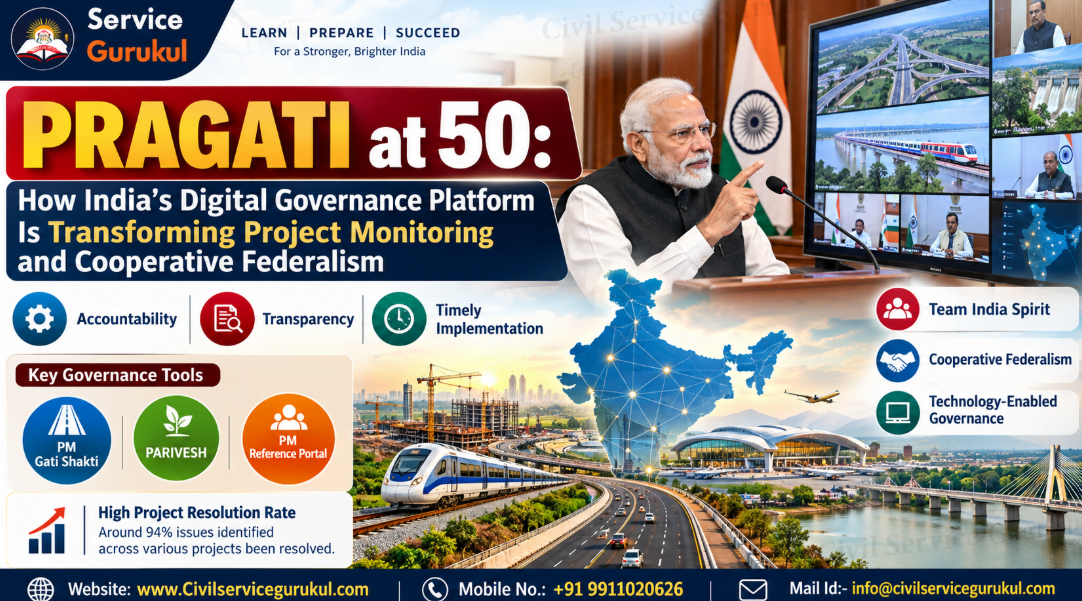
The 50th meeting of PRAGATI represents a milestone in India's efforts to strengthen technology-enabled, accountable and outcome-oriented governance.
PRAGATI stands for Pro-Active Governance and Timely Implementation.
Launched in 2015, PRAGATI integrates accountability, transparency and timely decision-making into administrative processes.
It enables high-level review of major projects and coordination between Union ministries and State administrations.
2. What Is the PRAGATI Platform?
PRAGATI is a multi-purpose and multi-modal technology-enabled governance platform designed to support administrative coordination and project monitoring.
Main Objectives
- Improve timely project implementation.
- Promote administrative accountability.
- Strengthen transparency in monitoring.
- Resolve coordination bottlenecks.
- Encourage Union–State cooperation.
- Reduce avoidable project delays.
- Improve implementation outcomes.
3. Key Features of PRAGATI
Prime Minister-Led Review
Review meetings are chaired by the Prime Minister.
Team India Spirit
Encourages Union and State authorities to work together.
Technology-Enabled Monitoring
Facilitates review of project implementation challenges.
Administrative Accountability
Encourages responsible authorities to address pending issues.
Cross-Department Coordination
Helps departments overcome administrative silos.
Timely Decision-Making
Supports coordinated action on implementation bottlenecks.
4. Important Governance Tools
The supplied study material identifies the following tools in the broader PRAGATI governance context.
| Tool | Primary Function |
|---|---|
| PM Gati Shakti | Integrated infrastructure planning and coordination. |
| PARIVESH | Digital environmental and related clearance processes. |
| PM Reference Portal | Administrative reference and follow-up processes. |
5. PRAGATI and Cooperative Federalism
Cooperative federalism means collaboration between different levels of government to achieve shared national and development objectives.
PRAGATI encourages the Union Government and State administrations to work collectively on project implementation.
How PRAGATI Supports Cooperative Federalism
- Direct communication between senior officials.
- Joint resolution of implementation issues.
- Improved Centre–State coordination.
- Reduction of departmental fragmentation.
- Shared responsibility for project outcomes.
- More effective intergovernmental dialogue.
6. Reported Achievements of PRAGATI
According to the supplied current-affairs material, PRAGATI has recorded the following milestones.
Beginning of the PRAGATI governance platform.
Reported participation by Government of India Secretaries and State Chief Secretaries since inception.
Reported resolution of identified project-related issues.
7. Major Infrastructure Projects
A. Jammu–Udhampur–Srinagar–Baramulla Rail Link
- Major railway connectivity project.
- Located in Jammu and Kashmir.
- The supplied material identifies 1994 as the approval year.
- It records commissioning in 2025.
- Illustrates long-term infrastructure coordination.
B. Navi Mumbai International Airport
- Major aviation infrastructure development.
- Involves coordination across multiple authorities.
- Highlights the importance of project monitoring.
C. Bogibeel Rail-cum-Road Bridge
- Located over the Brahmaputra River.
- Combines railway and road connectivity.
- Illustrates complex infrastructure implementation.
8. Global Recognition of PRAGATI
According to the supplied material, an external study by Oxford University's Saïd Business School described PRAGATI as a global benchmark for real-time project monitoring.
It reportedly characterised PRAGATI as a "single source of truth" for monitoring project information.
Governance Significance
- Shared visibility of project information.
- Better administrative coordination.
- Improved tracking of pending issues.
- Greater focus on implementation outcomes.
- Potential reduction in information fragmentation.
9. Constitutional and Socio-Economic Significance
Constitutional and Governance Impact
- Strengthens cooperative federalism.
- Promotes intergovernmental coordination.
- Encourages administrative accountability.
- Supports transparent monitoring.
- Improves implementation-focused governance.
Socio-Economic Impact
- Timely infrastructure can improve connectivity.
- Reduced delays can limit avoidable costs.
- Better coordination can improve public service delivery.
- Infrastructure development can support regional growth.
- Effective implementation can improve development outcomes.
10. Challenges and Way Forward
Potential Challenges
- Accuracy and timeliness of project data.
- Coordination across multiple departments.
- Different administrative capacities across States.
- Risk of excessive dependence on centralised review.
- Balancing speed with environmental safeguards.
- Evaluating actual outcomes beyond issue closure.
Way Forward
- Strengthen monitoring indicators.
- Improve digital interoperability.
- Build administrative capacity.
- Encourage timely follow-up.
- Maintain environmental and social safeguards.
- Assess long-term project outcomes.
11. Quick Revision for UPSC Prelims
| Topic | Important Fact |
|---|---|
| Full Form | Pro-Active Governance and Timely Implementation |
| Launch Year | 2015 |
| Nature | Multi-purpose, multi-modal governance platform |
| Review Chairperson | Prime Minister |
| Key Principle | Team India Spirit |
| Federal Dimension | Cooperative federalism |
| Major Focus | Accountability, transparency and timely implementation |
| Reported Issue Resolution | Approximately 94% |
12. How to Use PRAGATI in UPSC Mains Answers
GS Paper II – Governance
Use PRAGATI as an illustration of technology-enabled monitoring, administrative accountability and interdepartmental coordination.
GS Paper II – Federalism
Explain how coordinated reviews can support cooperation between Union and State administrations.
GS Paper III – Infrastructure
Discuss the importance of timely project implementation, coordination and reduction of avoidable delays.
13. Conclusion
The 50th PRAGATI meeting highlights the importance of combining digital governance, administrative leadership and cooperative federalism.
PRAGATI demonstrates how coordinated monitoring can support timely implementation and improve administrative problem-solving.
14. UPSC Previous Year Questions: 6 PYQs with Answers and Explanations
The following six previous year questions cover digital governance, cooperative federalism and Centre–State relations. These topics are closely connected with the PRAGATI platform.
Digital India Programme
Which of the following statements describe the aims of the Digital India Plan?
- Creating India's own internet companies on the Chinese model.
- Encouraging foreign big-data companies to establish data centres in India through a dedicated policy framework.
- Connecting villages to the internet and extending Wi-Fi access to schools and public places.
Options:
(A) 1 and 2 only
(B) 3 only
(C) 2 and 3 only
(D) 1, 2 and 3
View Correct Answer and Detailed Explanation
Statement 1: Incorrect.
Digital India was not designed specifically to create Indian internet companies on the Chinese model.
Statement 2: Incorrect.
The stated aims did not include the particular policy described in this statement.
Statement 3: Correct.
Expanding digital connectivity and access to digital infrastructure is an important objective of Digital India.
Connection with PRAGATI:
Digital India focuses on broad digital transformation, while PRAGATI focuses on high-level administrative review and implementation monitoring.
E-Governance and Accountability
GS Paper II
E-governance is more than applying digital technology to routine service delivery. Evaluate the Interactive Service Model in promoting transparency and accountability.
View Suggested Answer and Explanation
Introduction:
E-governance refers to the use of information and communication technologies to improve government processes and public services.
Key Dimensions:
- Transparency through accessible government information.
- Accountability through tracking and review mechanisms.
- Interactive communication between authorities and stakeholders.
- Improved grievance redressal and administrative responsiveness.
- Reduced information gaps and procedural delays.
Challenges:
- Digital divide and accessibility barriers.
- Weak feedback mechanisms.
- Inadequate digital literacy.
- Cybersecurity and privacy concerns.
PRAGATI Link:
PRAGATI demonstrates technology-enabled interaction among senior administrators. It is an example of government coordination, although it should not be confused with a citizen-facing service-delivery model.
Conclusion:
E-governance succeeds when technology improves transparency, participation, responsiveness and accountability.
Centre–State Relations and Federalism
GS Paper II
Examine recent changes in Centre–State relations and suggest measures to strengthen trust and federalism in India.
View Suggested Answer and Explanation
Introduction:
India's federal system distributes powers between the Union and States while maintaining a strong national framework.
Important Issues:
- Fiscal relations and resource distribution.
- Consultation in policy implementation.
- Role of Governors.
- Administrative coordination.
- Political differences between governments.
Measures to Build Trust:
- Strengthen institutional dialogue.
- Respect constitutional distribution of powers.
- Improve fiscal consultation.
- Encourage joint implementation reviews.
- Promote transparent dispute resolution.
PRAGATI Link:
PRAGATI offers an example of Union–State administrative coordination for resolving project-related issues.
Conclusion:
Cooperative federalism works best when consultation, trust and constitutional autonomy reinforce one another.
101st Constitutional Amendment and Federalism
GS Paper II
Explain the significance of the 101st Constitutional Amendment and assess how it reflects the accommodative spirit of federalism.
View Suggested Answer and Explanation
Key Provisions:
- Article 246A provides special legislative powers relating to GST.
- Article 269A deals with GST on inter-State supplies.
- Article 279A establishes the GST Council.
Federal Significance:
- Joint participation of Union and States.
- Institutionalised fiscal consultation.
- Scope for negotiated tax policy.
- Shared responsibility for implementation.
Limitations:
- Differences over fiscal autonomy.
- Disputes over revenue sharing.
- Unequal bargaining capacities.
PRAGATI Link:
Both the GST Council and PRAGATI illustrate intergovernmental coordination, but their legal character differs.
The GST Council is a constitutional body. PRAGATI is an administrative governance mechanism.
Conclusion:
The amendment illustrates cooperative federalism through institutionalised consultation on indirect taxation.
Cooperation, Competition and Confrontation
GS Paper II
How have cooperation, competition and confrontation shaped the nature of Indian federalism? Explain with examples.
View Suggested Answer and Explanation
Cooperation:
- Joint policy implementation.
- Intergovernmental consultation.
- Coordination in infrastructure projects.
- Institutions such as the GST Council.
Competition:
- Competition for investment.
- Improving ease of doing business.
- Innovation in public service delivery.
- Improved administrative performance.
Confrontation:
- Disputes over legislative powers.
- Fiscal disagreements.
- Political and administrative conflicts.
- Inter-State disputes.
PRAGATI Link:
PRAGATI is an illustration of the cooperative dimension, as it promotes joint problem-solving between Union and State authorities.
Conclusion:
Healthy federalism requires cooperation alongside constructive competition, while resolving confrontation through constitutional mechanisms.
Cooperative Federalism
GS Paper II | 12.5 Marks
Highlight the shortcomings in India's existing federal structure and examine the extent to which cooperative federalism can address these limitations.
View Suggested Answer and Explanation
Introduction:
India has a federal constitutional structure with a comparatively strong Union Government.
Existing Shortcomings:
- Fiscal imbalances between Union and States.
- Administrative coordination challenges.
- Centralised decision-making in some areas.
- Political disagreements.
- Unequal institutional capacities.
Role of Cooperative Federalism:
- Encourages policy consultation.
- Improves joint implementation.
- Strengthens intergovernmental trust.
- Supports coordinated development planning.
- Promotes shared accountability.
PRAGATI Link:
Launched in 2015, PRAGATI offers a relevant example of administrative coordination between Union and State authorities.
Critical Analysis:
Cooperative mechanisms can improve coordination, but cannot independently remove constitutional, fiscal or political disagreements.
Conclusion:
Effective cooperative federalism requires institutional dialogue, constitutional respect, fiscal fairness and shared responsibility.
- 2018 Prelims: Digital India – Correct answer: Option B (3 only).
- 2024 Mains: Interactive Service Model of e-governance.
- 2024 Mains: Centre–State relations and federal trust.
- 2023 Mains: 101st Constitutional Amendment and federalism.
- 2020 Mains: Cooperation, competition and confrontation.
- 2015 Mains: Cooperative federalism and structural shortcomings.
Prepare UPSC & State PCS with Civil Service Gurukul
Strengthen your preparation with conceptual notes, current affairs, previous year questions and structured answer-writing practice.
Explore Our Courses Enquire on WhatsAppPrepare with Mentors Who Cleared the Exam
Get personalized study plans, evaluated answer models, and test series access.