
Romeo–Juliet Clause in POCSO Act: Supreme Court's Observations, Child Protection and Adolescent Rights
UPSC CURRENT AFFAIRS 2026 GS PAPER II SOCIAL JUSTICE
Romeo–Juliet Clause in POCSO Act: Can India Protect Children Without Criminalising Adolescent Relationships?
Supreme Court observations, adolescent rights, child protection, constitutional principles and UPSC previous year questions.
1. Why Is the Romeo–Juliet Clause in the News?
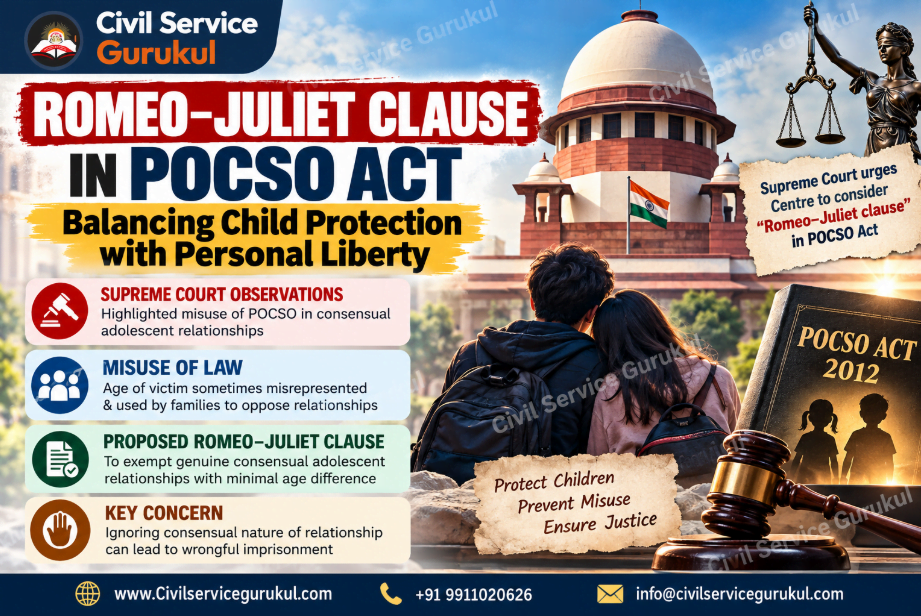
The Supreme Court of India has highlighted concerns regarding the application of the Protection of Children from Sexual Offences Act, 2012, to genuine consensual adolescent relationships.
In January 2026, the Court urged the Union Government to consider introducing a Romeo–Juliet clause to address cases involving adolescents who are close in age.
The proposal seeks to distinguish genuine peer relationships from sexual exploitation and abuse.
2. Supreme Court Judgment: Key Facts
| Particular | Details |
|---|---|
| Case | State of Uttar Pradesh v. Anurudh & Anr. |
| Judgment Date | 9 January 2026 |
| Citation | 2026 INSC 47 |
| Judges | Justice Sanjay Karol and Justice N. Kotiswar Singh |
| Principal Concern | Age determination, proper judicial procedure and misuse of protective laws |
| Reform Suggested | Consideration of a Romeo–Juliet clause |
Major Observations
- Protective legislation may be misapplied in some cases involving young people in relationships.
- Families opposing relationships may sometimes initiate criminal proceedings.
- Disputes about age must be examined using lawful procedures.
- The Court raised concerns about misuse of criminal law to settle personal scores.
- The Union Government was asked to consider suitable legislative measures.
3. What Is the POCSO Act, 2012?
The Protection of Children from Sexual Offences Act, 2012 is a special law designed to protect children from sexual assault, sexual harassment and offences involving child sexual abuse material.
Key Features
Child Protection
A child is a person below 18 years of age.
Gender-Neutral Protection
The Act protects children irrespective of gender.
Special Courts
Provides for designated courts to handle offences.
Child-Friendly Procedures
Seeks to reduce trauma during investigation and trial.
Mandatory Reporting
Provides reporting duties for specified offences.
Confidentiality
Protects the identity and privacy of children.
Important Provisions
| Provision | Subject |
|---|---|
| Section 2(d) | Definition of a child: below 18 years |
| Sections 3–6 | Penetrative sexual assault and aggravated forms |
| Sections 7–10 | Sexual assault and aggravated sexual assault |
| Sections 11–12 | Sexual harassment |
| Section 19 | Reporting of offences |
| Section 34 | Procedure where the accused is a child and age determination by the Special Court |
4. What Is a Romeo–Juliet Clause?
A Romeo–Juliet clause generally refers to a narrowly framed legal exception or safeguard for genuine consensual relationships between young people close in age.
Its purpose is to distinguish peer relationships from coercion, exploitation, abuse of authority and predatory conduct.
Illustrative Safeguards
- Clearly defined age-proximity limits.
- Careful examination of coercion and exploitation.
- Safeguards against abuse of power or authority.
- Protection of children's privacy and welfare.
- Independent judicial scrutiny.
- Retention of strong penalties for sexual abuse.
5. Why Is Such a Clause Being Discussed?
A. Consensual Adolescent Relationships
Some cases involve young people who are close in age and describe their relationship as consensual.
The legal challenge is to distinguish such situations from genuine abuse and sexual exploitation.
B. Family Opposition
Courts have expressed concern that protective legislation may sometimes be invoked by families opposing relationships between young people.
C. Consequences of Criminal Proceedings
Criminal prosecution can have significant consequences for the young people involved, including disruption of education, family life and psychological well-being.
D. Need for Proportionate Justice
A carefully designed law must protect children while ensuring that criminal sanctions are applied fairly.
6. Constitutional Dimensions
| Provision | Relevance |
|---|---|
| Article 14 | Equality before law and non-arbitrariness |
| Article 15(3) | Special provisions for children |
| Article 21 | Life, personal liberty, dignity and privacy |
| Article 39(e) and (f) | Directive Principles concerning child welfare and protection |
The central constitutional challenge is balancing the State's obligation to protect children with fairness, dignity and personal liberty.
Children's evolving capacities and developmental needs are relevant to policy design, but do not automatically remove statutory safeguards.
7. Arguments For and Against Reform
Arguments Supporting a Narrow Exception
- Could reduce disproportionate criminalisation of genuine peer relationships.
- May prevent misuse of criminal proceedings in family disputes.
- Could improve proportionality in criminal justice.
- May encourage a more child-sensitive legal response.
Concerns About Introducing an Exception
- Consent may be affected by pressure or manipulation.
- Age gaps alone may not capture unequal power dynamics.
- A poorly designed exception could be exploited by offenders.
- Children may face pressure to describe abuse as consensual.
- Investigators and courts would need clear safeguards.
8. Way Forward
- Consider a narrowly drafted close-in-age safeguard after consultation with child-rights experts.
- Establish clear rules for assessing coercion, exploitation and power imbalance.
- Strengthen lawful and reliable age-determination procedures.
- Provide child-sensitive investigation and legal assistance.
- Improve awareness of POCSO protections and obligations.
- Ensure strong safeguards against fabricated complaints without discouraging genuine reporting.
- Maintain effective prosecution of actual sexual abuse.
9. UPSC Prelims Quick Revision
| Topic | Important Fact |
|---|---|
| POCSO Full Form | Protection of Children from Sexual Offences |
| Enactment | 2012 |
| Definition of Child | Person below 18 years |
| Nature | Gender-neutral child-protection legislation |
| Important Section | Section 2(d): Definition of child |
| Supreme Court Case | State of Uttar Pradesh v. Anurudh & Anr. |
| Judgment Date | 9 January 2026 |
| Romeo–Juliet Clause | Proposed close-in-age legal safeguard |
| Current Position | No general statutory Romeo–Juliet exception under POCSO |
10. UPSC Mains Answer-Writing Strategy
GS Paper II – Social Justice
Discuss the protection of vulnerable children, access to justice and child-sensitive institutions.
GS Paper II – Constitution
Analyse Article 14, Article 21, privacy, dignity and proportionality.
GS Paper II – Judiciary
Examine judicial observations, legislative reform and the separation of powers.
11. Conclusion
The Romeo–Juliet clause debate highlights a complex challenge in child-protection law.
The law must continue to protect children from sexual exploitation, coercion and abuse. At the same time, policymakers must examine whether genuine close-in-age adolescent relationships require a more proportionate legal response.
The Supreme Court's 2026 observations invite legislative consideration, not an automatic exemption from the existing law.
12. UPSC PYQs and Practice Questions with Answers
Part A: Relevant UPSC Mains PYQs
PYQ 1: National Policy for Children
Examine the principal provisions of the National Policy for Children and assess the status of its implementation.
Suggested Answer and Explanation
The National Policy for Children, 2013 recognises children as a priority in national development.
- Health and nutrition.
- Education and development.
- Protection from violence and exploitation.
- Participation in matters affecting children.
- Coordination among implementing agencies.
Implementation challenges include uneven institutional capacity, awareness gaps, resource constraints and access to services.
POCSO Link: The Act is an important legal instrument for protecting children from sexual offences.
PYQ 2: Right to Privacy
Examine the scope of Fundamental Rights in light of the Supreme Court's recognition of the Right to Privacy.
Suggested Answer and Explanation
In K.S. Puttaswamy v. Union of India (2017), the Supreme Court recognised privacy as a fundamental right.
- Privacy is connected with Article 21.
- It also relates to dignity and autonomy.
- Privacy is not an absolute right.
- Restrictions require constitutional justification.
POCSO Link: Child protection must be balanced with confidentiality, dignity and lawful procedure.
PYQ 3: Right to Education
Analyse the limitations of the Right of Children to Free and Compulsory Education Act, 2009, in encouraging education and awareness.
Suggested Answer and Explanation
- Article 21A protects elementary education.
- The RTE Act provides an institutional framework.
- Awareness affects access to entitlements.
- Quality and inclusion remain important.
- Child protection supports educational continuity.
POCSO Link: Child-sensitive legal procedures can help reduce disruption to education and well-being.
PYQ 4: Gender Justice
Explain the constitutional dimensions of gender justice with relevant provisions and judicial decisions.
Suggested Answer and Explanation
- Article 14: Equality before law.
- Article 15: Prohibition of discrimination.
- Article 15(3): Special provisions for women and children.
- Article 21: Life and personal liberty.
- Judicial protection of dignity and autonomy.
POCSO Link: POCSO is gender-neutral and protects children irrespective of gender.
PYQ 5: Welfare of Vulnerable Groups
Critically examine whether development and welfare schemes for vulnerable groups necessarily involve a differentiated approach.
Suggested Answer and Explanation
Special provisions can address structural disadvantage and unequal access to public services.
- Targeted welfare can improve inclusion.
- Children require age-sensitive protection.
- Safeguards must avoid arbitrariness.
- Policies should be evidence-based.
POCSO Link: Special legal protection for children reflects their vulnerability and developmental needs.
PYQ 6: Privacy and Personal Liberty
Explain why the Right to Privacy is intrinsic to Article 21, and discuss the legal issues surrounding prenatal DNA testing for determining paternity.
Suggested Answer and Explanation
- Article 21 protects life and personal liberty.
- Privacy includes bodily and informational dimensions.
- Medical procedures raise consent concerns.
- Competing rights require careful balancing.
- Legal intervention must respect applicable safeguards.
POCSO Link: Child-related legal proceedings must protect privacy and dignity while ensuring effective investigation.
Part B: Original UPSC-Style Practice MCQs
Definition of Child
Under the POCSO Act, 2012, a child is a person:
(A) Below 14 years
(B) Below 16 years
(C) Below 18 years
(D) Below 21 years
Correct Answer and Explanation
Section 2(d) of POCSO defines a child as a person below 18 years of age.
Nature of POCSO
Which statement is correct?
(A) POCSO protects only girls.
(B) POCSO is gender-neutral in protecting children.
(C) POCSO applies only to married persons.
(D) POCSO excludes online offences.
Correct Answer and Explanation
POCSO protects children irrespective of gender and addresses several forms of sexual offences, including specified online-related conduct.
Romeo–Juliet Clause
Which statement best describes the 2026 Supreme Court observations?
(A) The Court repealed POCSO.
(B) The Court enacted a new age-of-consent rule.
(C) The Court suggested consideration of a close-in-age exception.
(D) The Court removed all penalties for child sexual abuse.
Correct Answer and Explanation
The Supreme Court urged consideration of a Romeo–Juliet clause. It did not amend the POCSO Act.
Constitutional Protection
Which constitutional provision permits special provisions for women and children?
(A) Article 15(3)
(B) Article 19(1)(a)
(C) Article 32
(D) Article 368
Correct Answer and Explanation
Article 15(3) permits the State to make special provisions for women and children.
- 6 relevant UPSC Mains PYQs, with years and suggested answers.
- 4 original practice MCQs, with correct options and explanations.
- Major themes: child rights, privacy, gender justice, social welfare and constitutional safeguards.
Prepare UPSC & State PCS with Civil Service Gurukul
Learn Indian Polity, Governance, Social Justice and Current Affairs through conceptual notes, PYQs and structured answer-writing practice.
Explore Civil Service Gurukul Enquire on WhatsAppPrepare with Mentors Who Cleared the Exam
Get personalized study plans, evaluated answer models, and test series access.