
NCERT Foundation for UPSC & State PCS | Complete Preparation Guide 2026–27
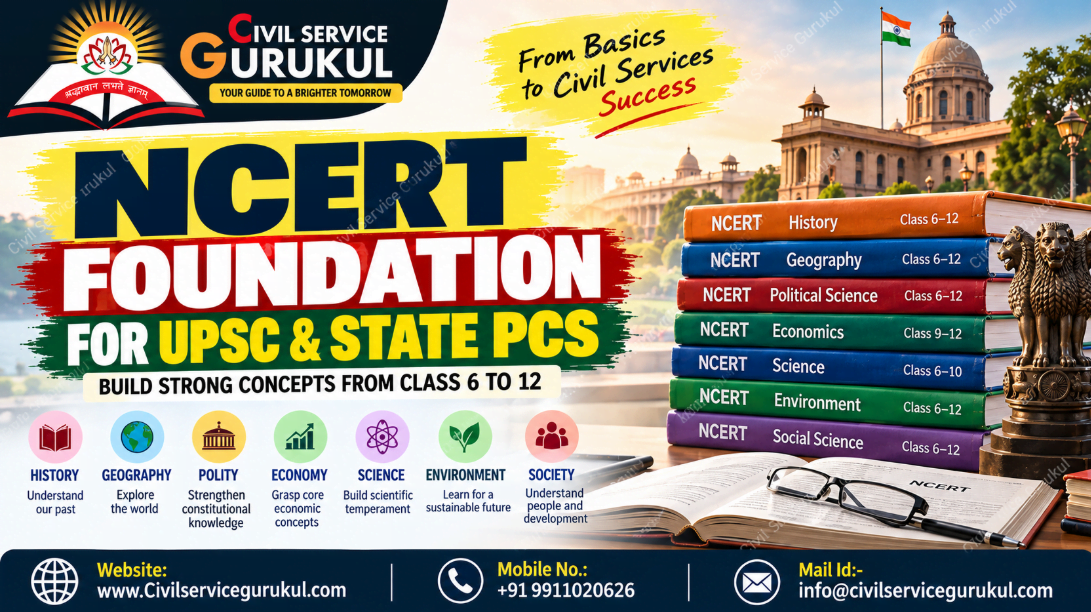
NCERT Foundation for UPSC: Complete Class 6–12 Study Guide, Subject-Wise Strategy & Preparation Roadmap
Build strong fundamentals in History, Geography, Indian Polity, Economy, Science, Environment and Society through a structured NCERT-based learning approach.
Understand Concepts. Develop Analytical Thinking. Prepare with Confidence.
1. Introduction: Why NCERT Foundation Matters for UPSC
The Union Public Service Commission Civil Services Examination is among India's most demanding competitive examinations. Preparing for UPSC requires conceptual clarity, analytical thinking, consistent revision and an understanding of national and international developments.
For beginners, NCERT textbooks provide an important foundation because they introduce fundamental concepts in a systematic and accessible manner.
The NCERT Foundation for UPSC focuses on building knowledge from Classes 6 to 12 and connecting that knowledge with the requirements of UPSC Prelims, Mains and State PCS examinations.
Instead of relying only on memorisation, aspirants should develop the ability to understand concepts, interpret information and apply knowledge to examination-oriented questions.
2. Why Are NCERT Books Important for UPSC Preparation?
- Conceptual Clarity: NCERT textbooks explain important concepts in simple and structured language.
- Fundamental Knowledge: They develop a foundation in subjects relevant to General Studies.
- Systematic Learning: Topics progress from basic concepts to more advanced academic understanding.
- UPSC Syllabus Relevance: Selected NCERT chapters correspond to important Prelims and Mains syllabus areas.
- Analytical Development: Conceptual learning supports critical thinking and the ability to connect different subjects.
- Preparation for Advanced Books: NCERT study helps aspirants understand standard reference books more effectively.
- Revision-Friendly Content: Clear explanations, diagrams and chapter structures support regular revision.
3. Subject-Wise NCERT Foundation for UPSC
History
Ancient India, Medieval India, Modern India, Indian National Movement, historical developments and cultural heritage.
Geography
Physical Geography, Indian Geography, world geography, climate, resources, landforms and human-environment relationships.
Indian Polity
Indian Constitution, democracy, Fundamental Rights, governance, Parliament, judiciary and federalism.
Economy
Economic development, poverty, employment, money, banking, national income and basic macroeconomic concepts.
Science
Basic Physics, Chemistry, Biology, scientific principles, human health and everyday applications.
Environment & Society
Ecology, biodiversity, conservation, sustainability, social institutions, inequality and social change.
4. NCERT Class 6–12: Subject-Wise Preparation Guide
| Subject | Recommended NCERT Level | Important Topics | UPSC Relevance |
|---|---|---|---|
| History | Classes 6–12 | Ancient, Medieval and Modern India, National Movement and culture | Prelims and GS Paper I |
| Geography | Classes 6–12 | Physical Geography, climate, resources and Indian Geography | Prelims and GS Paper I |
| Polity | Classes 6–12 | Constitution, democracy, rights, federalism and institutions | Prelims and GS Paper II |
| Economy | Classes 9–12 and relevant earlier concepts | Development, employment, money, banking and national income | Prelims and GS Paper III |
| Science | Classes 6–10 and selected higher-level topics | Physics, Chemistry, Biology and scientific applications | Prelims and GS Paper III |
| Environment | Relevant chapters across Classes 6–12 | Ecology, biodiversity, conservation and pollution | Prelims and GS Paper III |
| Society | Selected Social Science and Sociology texts | Social institutions, diversity and social change | GS Paper I and Essay |
5. Three Key Dimensions of NCERT Foundation Learning
An effective NCERT Foundation strategy should develop conceptual understanding along with constitutional awareness, socio-economic analysis and a global perspective.
Dimension 1: Detailed Explanation and Empirical Evidence
- Develop conceptual clarity through NCERT textbooks from Classes 6 to 12.
- Build foundational knowledge across major General Studies subjects.
- Integrate relevant facts, statistical data, government reports and research findings.
- Understand causes, consequences and relationships between concepts.
- Develop scientific reasoning and logical problem-solving skills.
- Use maps, diagrams, timelines, flowcharts and comparative tables.
- Connect textbook concepts with UPSC syllabus requirements.
- Apply foundational knowledge to Prelims and Mains questions.
Dimension 2: Constitutional and Socio-Economic Impact
- Understand the Indian Constitution, Fundamental Rights, Directive Principles and Fundamental Duties.
- Study democratic institutions, federalism and governance structures.
- Examine transparency, accountability and decentralisation.
- Understand poverty, unemployment, inequality and inclusive development.
- Develop awareness of social justice, gender equality and constitutional values.
- Study public finance, economic development and resource distribution.
- Understand government policies and their socio-economic implications.
- Connect static subjects with governance and contemporary issues.
Dimension 3: International Benchmarks and Best Practices
- Develop awareness of global developments and international institutions.
- Understand comparative governance and public administration models.
- Study the United Nations, World Bank, IMF and WHO.
- Understand the Sustainable Development Goals.
- Develop basic knowledge of global economic systems and indicators.
- Study international approaches to education, healthcare and sustainability.
- Compare Indian policies with international practices.
- Develop balanced analytical perspectives for UPSC Mains.
6. How NCERT Foundation Helps in UPSC Prelims and Mains
UPSC Prelims Preparation
- Strengthens factual and conceptual knowledge.
- Improves understanding of objective questions.
- Supports logical elimination of incorrect options.
- Builds familiarity with important General Studies topics.
- Provides a foundation for standard reference books.
- Supports revision and previous-year question practice.
UPSC Mains Preparation
- Develops clarity in explaining important concepts.
- Strengthens analytical and critical thinking.
- Helps connect static topics with current affairs.
- Supports structured answer-writing practice.
- Improves the use of diagrams, examples and relevant facts.
- Encourages multidimensional analysis of issues.
7. Step-by-Step NCERT Study Strategy for UPSC Beginners
- Understand the UPSC Syllabus: Identify important General Studies topics before beginning textbook preparation.
- Select Relevant NCERT Books: Prioritise subject-wise textbooks and chapters.
- Build Conceptual Understanding: Focus on understanding explanations rather than memorising paragraphs.
- Prepare Short Notes: Create revision-friendly notes, flowcharts, timelines and diagrams.
- Practise MCQs: Solve topic-wise objective questions after completing important chapters.
- Connect with Current Affairs: Relate foundational concepts to relevant contemporary developments.
- Begin Answer Writing: Practise concise, structured responses for analytical questions.
- Revise Regularly: Use weekly and monthly revision to strengthen long-term retention.
8. Suggested 16-Week NCERT Foundation Study Roadmap
The following is an illustrative study plan for aspirants who want to complete a structured first reading of important NCERT subjects.
| Weeks | Subject | Learning Focus |
|---|---|---|
| 1–3 | History | Chronology, historical concepts and major developments |
| 4–6 | Geography | Physical Geography, Indian Geography and maps |
| 7–9 | Indian Polity | Constitution, democracy and political institutions |
| 10–11 | Economy | Development, money, banking and economic fundamentals |
| 12–13 | Science | Scientific concepts and practical applications |
| 14 | Environment and Society | Ecology, sustainability and social concepts |
| 15 | Integrated Revision | Concept strengthening and subject-wise revision |
| 16 | Practice and Assessment | MCQs, previous-year questions and introductory answer writing |
The actual time required will depend on the aspirant's educational background, daily study hours and familiarity with General Studies subjects.
9. NCERT Foundation for State PCS Examinations
NCERT textbooks also provide a useful foundation for many State Public Service Commission examinations.
UPPSC Preparation
Supplement NCERT study with Uttar Pradesh History, Geography, Economy, governance, government schemes and state current affairs.
BPSC Preparation
Include Bihar-specific History, Geography, Economy, culture and governance.
MPPSC Preparation
Study Madhya Pradesh History, Geography, Economy, culture and state-specific General Studies.
Other State PCS Examinations
Follow the respective commission's latest syllabus, examination pattern and previous-year papers.
10. Common Mistakes to Avoid During NCERT Preparation
- Reading textbooks without understanding the UPSC syllabus.
- Memorising information without conceptual clarity.
- Ignoring maps, diagrams and important timelines.
- Preparing excessively lengthy notes.
- Skipping revision and self-assessment.
- Ignoring previous-year questions.
- Depending only on NCERT books for complete UPSC preparation.
- Starting too many advanced reference books simultaneously.
- Neglecting current affairs and answer-writing practice.
11. Expected Learning Outcomes
- Strong conceptual foundation in General Studies.
- Improved analytical and logical thinking.
- Better understanding of constitutional principles.
- Greater awareness of socio-economic issues.
- Ability to interpret facts, data and diagrams.
- Understanding of global developments and institutions.
- Improved integration of static subjects with current affairs.
- Stronger concept-based Prelims preparation.
- Development of multidimensional Mains answer-writing skills.
- Readiness for advanced UPSC and State PCS preparation.
12. NCERT-Based UPSC Practice MCQs
A. Part II
B. Part III
C. Part IV
D. Part V
Answer: B – Part III
A. Earth's rotation alone
B. Earth's axial tilt and revolution around the Sun
C. Distance between Earth and Moon
D. Ocean currents
Answer: B
A. Total government expenditure
B. Total exports of a country
C. Value of final goods and services produced
within a country's territory during a specified period
D. Total tax collection
Answer: C
13. Frequently Asked Questions
Q1. What is NCERT Foundation for UPSC?
It is a structured approach to building fundamental General Studies knowledge using relevant NCERT textbooks from Classes 6 to 12.
Q2. Which NCERT classes are important for UPSC?
Relevant textbooks from Classes 6 to 12 are commonly used, depending on the subject and examination syllabus.
Q3. Can beginners start UPSC preparation with NCERT books?
Yes. NCERT textbooks are suitable starting resources for building conceptual understanding.
Q4. Are NCERT books sufficient for UPSC?
No. They should be supplemented with standard books, current affairs, previous-year questions, tests and answer-writing practice.
Q5. Is NCERT Foundation useful for State PCS?
Yes. It provides a common General Studies foundation, but state-specific subjects must also be prepared.
Q6. How long does NCERT Foundation preparation take?
The duration varies according to the learner's background and available study hours. A 16-week first-reading roadmap is one possible approach.
14. Conclusion: Build Your UPSC Preparation on Strong Fundamentals
NCERT Foundation for UPSC is an important starting point for developing conceptual clarity and systematic study habits.
By studying relevant NCERT textbooks, connecting concepts with current affairs, practising objective questions and developing analytical thinking, aspirants can create a strong base for advanced examination preparation.
The most effective preparation strategy combines foundational knowledge, regular revision, examination-oriented practice and disciplined learning.
NCERT FOUNDATION COURSE FOR UPSC AND STATE PCS PREPARATION
Ready to take the next step in your civil services preparation?
Build strong fundamentals with structured NCERT-based learning covering Classes 6 to 12, General Studies concepts, UPSC Prelims, Mains and State PCS preparation.
Start Your Civil Services Journey with Civil Service Gurukul!
ENROLL NOW → ENQUIRE ON WHATSAPPEnrollment Assistance: +91 9911020626
Email: info@civilservicegurukul.com
Daily Current Affairs Quiz — Test 1789755835
Test instructions for candidates.
Prepare with Mentors Who Cleared the Exam
Get personalized study plans, evaluated answer models, and test series access.