
India's Wildlife Conservation Success Story 2026: Endangered Species Recovery, Biodiversity Challenges & UPSC GS-3 Analysis
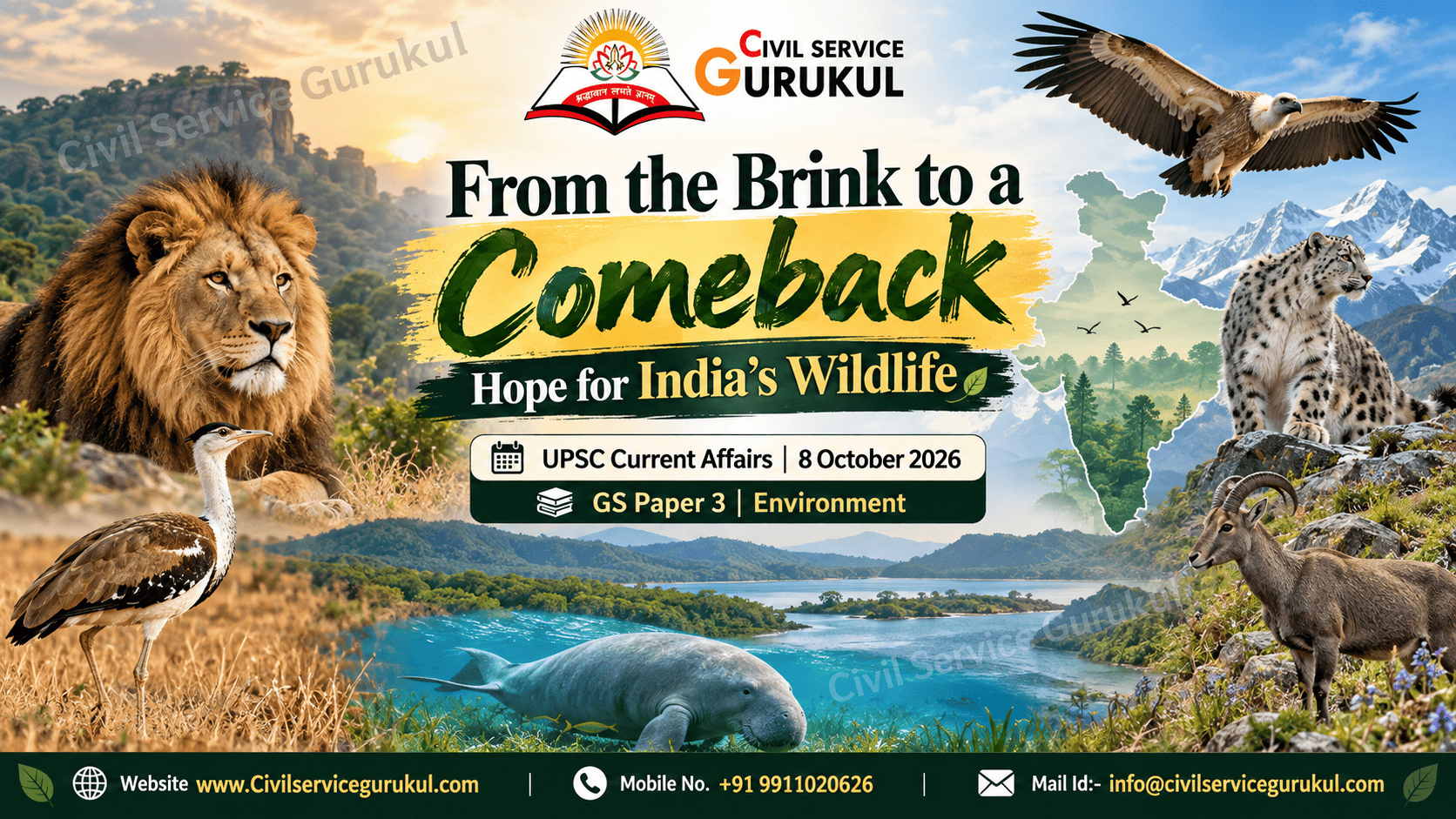
India's Wildlife Conservation Success Story 2026: Endangered Species Recovery, Biodiversity Challenges and UPSC GS-3 Analysis
From the recovery of Asiatic lions to the protection of the critically endangered Great Indian Bustard, India's conservation journey highlights the importance of scientific management, habitat protection and community participation.
Why Is This Topic Important?
India is witnessing encouraging progress in the conservation of several threatened wildlife species. However, growing infrastructure pressure, habitat fragmentation, ecological degradation and inadequate monitoring continue to threaten long-term biodiversity.
The natural hatching of a Great Indian Bustard chick in Gujarat's Kutch region has highlighted the importance of protecting endangered species in their natural habitats.
For UPSC aspirants, this topic connects biodiversity, environmental governance, conservation programmes, ecological security and sustainable development.
1. Context: Wildlife Conservation in News
During Wildlife Week 2026, the reported natural hatching of a Great Indian Bustard chick in Kutch, Gujarat, became a significant conservation development.
The Great Indian Bustard is among India's most threatened birds. Its survival depends on the protection of arid grasslands, safe breeding habitats and mitigation of threats from overhead power lines.
This development also brings attention to the recovery of species such as the Asiatic lion, vulture, Nilgiri tahr and dugong, demonstrating that sustained conservation interventions can produce meaningful results.
2. India's Extraordinary Biodiversity
India is internationally recognised as one of the world's megadiverse countries. Despite its relatively limited land area, the country supports an extraordinary variety of ecosystems, flora and fauna.
Four Biodiversity Hotspots Associated with India
- Himalaya: Mountain ecosystems, alpine biodiversity and endemic species.
- Indo-Burma: Northeastern Indian ecosystems with rich biological diversity.
- Western Ghats–Sri Lanka: Exceptional endemic plants, amphibians, reptiles and mammals.
- Sundaland: Includes India's Nicobar Islands and their island biodiversity.
Biodiversity is more than the number of species. It includes genetic diversity, species diversity and ecosystem diversity.
3. Major Wildlife Recovery Trends in India
Recent conservation assessments point toward encouraging recovery in selected wildlife populations. The following figures refer to the specified survey years.
| Wildlife Species | Reported Population | Conservation Significance |
|---|---|---|
| Asiatic Lion | 674 (2020); 891 (2025) | Population growth across the Gir and greater Saurashtra landscape. |
| Vultures | 8,397 (2019); 12,981 (2025) | Figures from Madhya Pradesh surveys indicate improvement in monitored populations. |
| Nilgiri Tahr | 1,303 (2025); 1,364 (2026) | Reported improvement in surveys covering the Western Ghats population. |
| Dugong | 270 (2026 reported baseline) | Marine mammal conservation around Palk Bay and the Gulf of Mannar. |
| Snow Leopard | 718 (2024 national assessment) | Establishment of a national scientific population baseline. |
These numbers originate from different assessment programmes and geographic scopes. They should not be interpreted as directly comparable national trends for every species.
4. Asiatic Lion: A Major Conservation Achievement
The Asiatic lion is predominantly associated with Gujarat's Gir landscape. Conservation efforts involving legal protection, habitat management and community participation have contributed to population recovery.
Key Achievements
- Expansion of lions into habitats beyond the core Gir forest.
- Improved monitoring and veterinary response mechanisms.
- Greater involvement of forest-dependent and pastoral communities.
- Landscape-level conservation planning across the Saurashtra region.
Continuing Challenges
- Dependence on a geographically concentrated population.
- Risk of epidemics and disease outbreaks.
- Human-lion conflict near settlements.
- Habitat connectivity and road-related risks.
5. Vulture Conservation: Protecting Nature's Clean-Up System
Vultures perform essential ecological functions by consuming animal carcasses. Their decline can affect sanitation, disease ecology and carcass disposal.
Indian vulture populations suffered severe historical declines associated with veterinary diclofenac exposure. This drug can cause fatal kidney damage in susceptible vultures that consume contaminated carcasses.
Important Conservation Measures
- Prohibition of veterinary diclofenac and efforts to prevent its misuse.
- Captive breeding and conservation breeding programmes.
- Monitoring of nesting and feeding habitats.
- Promotion of safer veterinary medicines.
- Public awareness and coordinated population assessments.
6. Nilgiri Tahr: Conservation of Western Ghats Biodiversity
The Nilgiri tahr is an endangered mountain ungulate endemic to the southern Western Ghats. It inhabits steep, rocky slopes and montane grassland ecosystems.
Project Nilgiri Tahr
Conservation programmes aim to improve population assessments, restore degraded habitats, strengthen ecological research and coordinate management activities.
Challenges include grassland degradation, invasive plant species, habitat fragmentation and changing climatic conditions.
7. Dugong Conservation: India's Marine Biodiversity
The dugong, commonly called the sea cow, is a marine herbivorous mammal that primarily feeds on seagrass.
Seagrass ecosystems support marine biodiversity, contribute to blue-carbon storage and provide important habitat for marine fauna.
Dugong Conservation Reserve
India's first Dugong Conservation Reserve was established in Palk Bay, Tamil Nadu, covering approximately 448 square kilometres.
Major Threats
- Accidental entanglement in fishing gear.
- Damage to seagrass meadows.
- Coastal pollution and habitat disturbance.
- Unregulated marine activity.
Conservation Priorities
- Restoration of seagrass habitats.
- Community-led marine conservation.
- Bycatch reduction and safe release of accidentally entangled animals.
- Incentives and compensation mechanisms for affected fishing communities.
8. Great Indian Bustard: A Critical Conservation Challenge
The Great Indian Bustard is a critically endangered bird strongly associated with arid grassland habitats.
Although grasslands are sometimes mistakenly treated as degraded forests or wastelands, they are distinct ecosystems that support specialised biodiversity.
Why Is the Species Threatened?
- Loss and fragmentation of grasslands.
- Collisions with overhead transmission lines.
- Disturbance of breeding habitats.
- Land-use changes and infrastructure expansion.
- Small and vulnerable breeding populations.
What Should India Do?
- Protect and restore priority grassland habitats.
- Implement scientifically appropriate power-line mitigation measures.
- Strengthen conservation breeding alongside the protection of wild populations.
- Ensure coordinated action across landscape and administrative boundaries.
- Support local communities that participate in habitat protection.
9. India's Wildlife Conservation Framework
A. Constitutional Provisions
- Article 48A: Directs the State to protect and improve the environment and safeguard forests and wildlife.
- Article 51A(g): Establishes the fundamental duty of citizens to protect and improve the natural environment.
- Article 21: Judicial interpretation has connected the right to life with environmental protection.
B. Major Legal and Policy Instruments
| Legal Framework | Core Purpose |
|---|---|
| Wild Life (Protection) Act, 1972 | Protection of wildlife, regulation of relevant activities and legal framework for protected areas. |
| Environment (Protection) Act, 1986 | Broad framework for environmental protection and regulatory measures. |
| Biological Diversity Act, 2002 | Conservation, sustainable utilisation and access-and-benefit-sharing. |
| National Wildlife Action Plan 2017–2031 | Strategic guidance for wildlife protection and ecosystem management. |
| Integrated Development of Wildlife Habitats | Central support for protected habitats and species recovery initiatives. |
10. Major Challenges Facing Wildlife Conservation
1. Habitat Fragmentation
Roads, railways, transmission lines and other infrastructure can interrupt wildlife movement and reduce ecological connectivity.
2. Human-Wildlife Conflict
Competition over land and resources can increase encounters between wild animals and local communities, creating economic and safety concerns.
3. Climate Change
Changing temperatures, precipitation patterns and extreme weather can alter species ranges, food availability and reproductive conditions.
4. Inadequate Ecological Data
Many lesser-known species lack comprehensive population and habitat assessments. Conservation planning is difficult without reliable scientific baselines.
5. Unequal Conservation Attention
Large and charismatic wildlife species often attract greater public support, while amphibians, invertebrates, reptiles and other ecologically important species may receive less attention.
6. Financial and Institutional Constraints
Long-term conservation requires dependable funding, trained field staff, transparent monitoring and coordination among institutions.
11. Way Forward: A Sustainable Conservation Strategy
- Adopt landscape-level conservation: Protect connected habitats, ecological corridors and essential breeding grounds.
- Strengthen community participation: Recognise local knowledge, livelihood concerns and community-based monitoring.
- Develop reliable biodiversity databases: Expand population surveys, ecological mapping and long-term scientific assessments.
- Improve conservation financing: Mobilise accountable public funding, CSR support and carefully designed conservation partnerships.
- Integrate infrastructure planning: Identify environmentally sensitive areas before undertaking major projects.
- Protect neglected ecosystems: Give greater attention to grasslands, wetlands, seagrass meadows and lesser-known species.
- Use appropriate technology: Deploy camera traps, remote sensing, GIS and other non-invasive tools where scientifically suitable.
- Strengthen inter-state coordination: Manage species populations and habitats that extend beyond administrative boundaries.
12. UPSC Prelims Quick Revision
| Species | Important Location | Remember |
|---|---|---|
| Asiatic Lion | Gir and Saurashtra, Gujarat | Major wild population in India |
| Great Indian Bustard | Rajasthan and Gujarat | Critically Endangered |
| Nilgiri Tahr | Southern Western Ghats | Endangered mountain ungulate |
| Dugong | Palk Bay and Gulf of Mannar | Marine herbivore; seagrass-dependent |
| Snow Leopard | Trans-Himalayan regions | High-altitude mountain predator |
| Vultures | Multiple Indian landscapes | Scavengers; veterinary drug threats |
13. UPSC Prelims Practice MCQs
- It is a herbivorous marine mammal.
- It is closely associated with seagrass ecosystems.
- India's first Dugong Conservation Reserve is located in Palk Bay.
Which of the statements given above are correct?
(A) 1 and 2 only
(B) 2 and 3 only
(C) 1 and 3 only
(D) 1, 2 and 3
All three statements are correct.
(A) Great Indian Bustard
(B) Nilgiri Tahr
(C) Dugong
(D) Gharial
Nilgiri tahr inhabits the southern Western Ghats, particularly montane grassland landscapes.
(A) Excessive consumption of seagrass
(B) Veterinary diclofenac exposure
(C) Ocean acidification
(D) Introduction of marine invasive species
Veterinary diclofenac exposure was a major cause of catastrophic declines in susceptible vulture populations.
14. UPSC Mains Answer Writing Practice
"Species recovery without habitat integrity is conservation in appearance, not substance." Critically examine this statement with reference to India's wildlife conservation programmes.
Suggested Answer Structure
Introduction: Define species recovery and explain the importance of habitat integrity.
Body:
- Highlight positive examples involving Asiatic lions, vultures and Nilgiri tahrs.
- Explain fragmentation and power-line risks affecting the Great Indian Bustard.
- Discuss disease threats, ecological connectivity and genetic resilience.
- Analyse community participation, financing and ecosystem-based approaches.
Conclusion: Emphasise that sustainable biodiversity conservation must protect ecosystems rather than only increasing species counts.
15. Mains Value Addition: Five Key Concepts
- Ecosystem-Based Conservation: Conservation that addresses the ecological system and its interconnected components.
- Habitat Connectivity: The ability of organisms to move between suitable habitats and populations.
- Ecological Resilience: The capacity of an ecosystem to absorb disturbances while maintaining key functions.
- Community-Based Conservation: Conservation that meaningfully involves local communities in decision-making and implementation.
- Adaptive Management: Using scientific monitoring and evidence to continually improve conservation decisions.
16. Conclusion
India's wildlife recovery initiatives offer important lessons in ecological governance and sustainable development. Progress involving lions, vultures, Nilgiri tahrs and marine species demonstrates the value of long-term public investment, scientific research and community involvement.
However, species recovery cannot remain an isolated numerical achievement. Future conservation policies must protect ecological processes, restore degraded habitats and maintain viable wildlife populations across connected landscapes.
For India, the next phase of biodiversity governance should combine conservation science, accountable institutions, sustainable financing and community participation.
Key Takeaways for UPSC Aspirants
- India's conservation achievements must be understood alongside habitat risks.
- The Great Indian Bustard highlights the ecological importance of grasslands.
- The dugong demonstrates the need to protect marine habitats and seagrass.
- Wildlife corridors and habitat connectivity are essential for long-term survival.
- Community participation improves conservation sustainability.
- GS Paper III answers should link scientific evidence with governance reforms.
Final UPSC Message: Protecting wildlife means protecting ecosystems, ecological balance and India's natural heritage.
Prepare with Mentors Who Cleared the Exam
Get personalized study plans, evaluated answer models, and test series access.