India and the WHO Pandemic Agreement: Equity, Sovereignty and Global Health Diplomacy
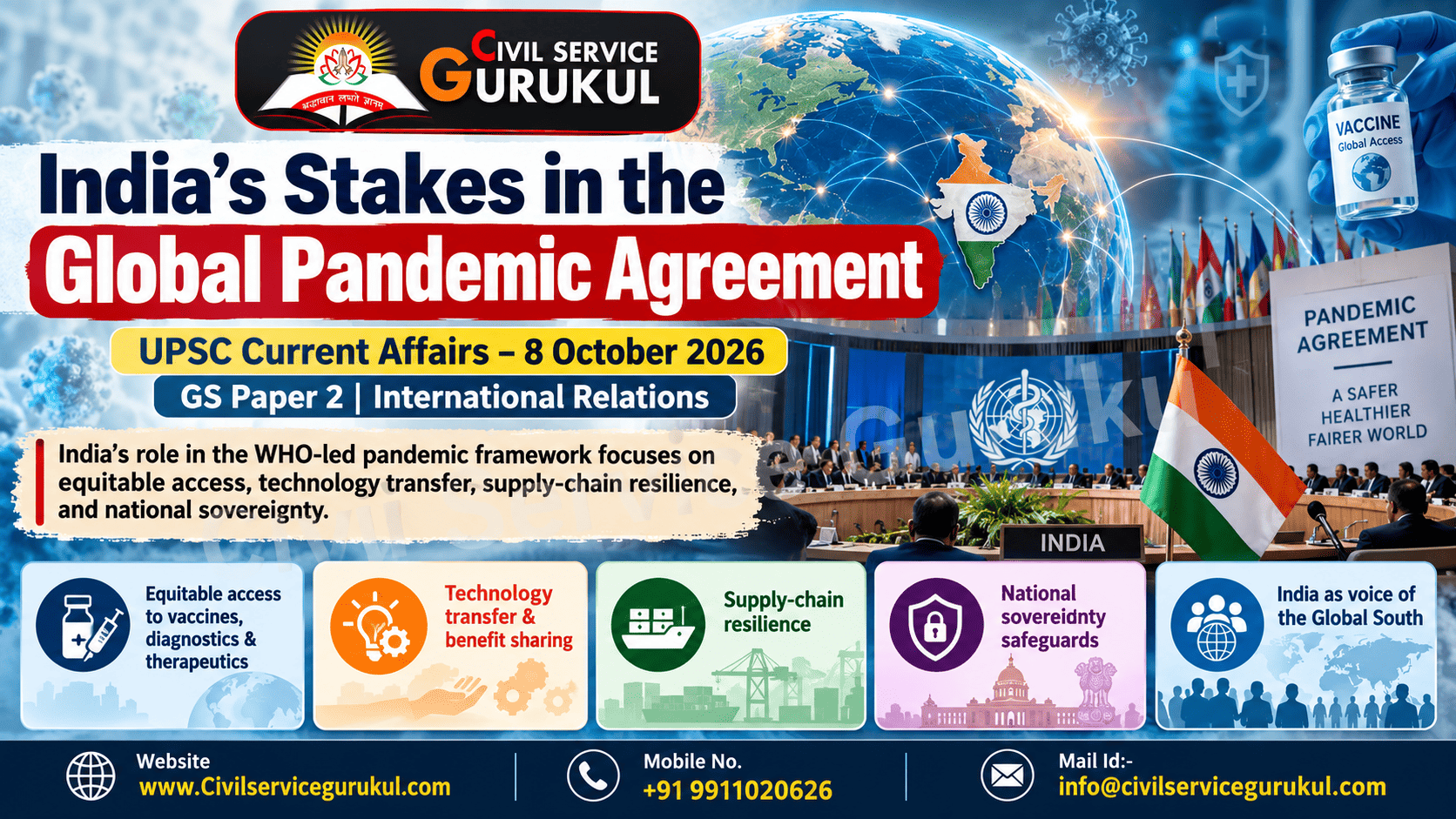
India and the WHO Pandemic Agreement: Equity, Sovereignty and Global Health Diplomacy
The debate over pandemic preparedness is no longer only about medicine. It is equally about technology access, intellectual property, global supply chains, national sovereignty and whether developing countries receive a fair share of life-saving countermeasures.
Excerpt / Brief Summary
What Is the WHO Pandemic Agreement?
The WHO Pandemic Agreement is an international framework designed to improve global cooperation in pandemic prevention, preparedness and response.
It emerged from the lessons of COVID-19, when the world witnessed severe disparities in access to:
- Vaccines;
- Diagnostics;
- Therapeutics;
- Medical oxygen;
- Protective equipment;
- Manufacturing capacity;
- Critical health technologies.
The agreement seeks to strengthen global coordination while ensuring that future public-health emergencies do not reproduce the same inequalities.
Why Did the World Need a Pandemic Agreement?
COVID-19 demonstrated that disease outbreaks may be global, but access to countermeasures remains deeply unequal.
- Vaccine nationalism;
- Concentration of manufacturing capacity;
- Supply-chain disruptions;
- Unequal access to diagnostics;
- Dependence on limited pharmaceutical suppliers;
- Weak international coordination;
- Insufficient surveillance capacity in poorer countries.
The central objective of a global pandemic framework is therefore to balance rapid information sharing with equitable access to the benefits created from that information.
Core Architecture of the Pandemic Agreement
| Component | Purpose |
|---|---|
| Pandemic Prevention | Reduce the probability of large-scale outbreaks |
| Preparedness | Strengthen surveillance, laboratories and health systems |
| Response | Enable coordinated action during emergencies |
| Equitable Access | Improve availability of vaccines, diagnostics and treatments |
| Technology Transfer | Expand manufacturing capacity across regions |
| Supply-Chain Resilience | Reduce vulnerability to export bans and shortages |
| Pathogen Sharing | Enable faster research and development |
What Is the PABS System?
One of the most important elements of the global debate is the Pathogen Access and Benefit-Sharing (PABS) System.
The basic idea is that countries which share pathogens, biological samples or genetic sequence information should also receive fair and affordable access to the vaccines, diagnostics and therapeutics developed from that material.
Pathogen sharing should not become a one-way system in which developing countries provide biological data while wealthy countries retain exclusive control over the resulting medical technologies.
The Central Global Divide
The Pandemic Agreement reflects a broader divide between high-income countries and developing economies.
| Developed Country Concerns | Developing Country Concerns |
|---|---|
| Protection of intellectual property | Guaranteed access to vaccines |
| Voluntary technology transfer | Affordable technology transfer |
| Rapid pathogen sharing | Fair benefit-sharing |
| Strong surveillance obligations | Financial support for surveillance capacity |
| Protection of private innovation incentives | Prevention of monopoly during emergencies |
Why the Agreement Is Strategically Important for India
1. India Is the Pharmacy of the World
India is one of the world’s most important manufacturers of generic medicines and vaccines. This gives the country a major role in global health supply chains.
During global emergencies, Indian manufacturing capacity can become critical for ensuring affordable access to medical countermeasures.
2. India Is Also a Technology Recipient
India has strong manufacturing capability, but several advanced pharmaceutical technologies remain concentrated in developed markets.
These include technologies connected with:
- Advanced vaccine platforms;
- mRNA technologies;
- Novel therapeutics;
- Specialised biological manufacturing;
- Advanced manufacturing equipment.
India therefore has a dual interest: protecting innovation while ensuring access to essential technology during emergencies.
API Dependence: India’s Strategic Vulnerability
India’s pharmaceutical industry is globally competitive in formulations, but dependence on imported Active Pharmaceutical Ingredients, Key Starting Materials and specialised equipment creates vulnerabilities.
A country may have strong pharmaceutical manufacturing capability yet remain strategically vulnerable if critical upstream inputs are concentrated abroad.
A pandemic treaty therefore connects not only with health policy, but also with:
- Industrial policy;
- Supply-chain resilience;
- National security;
- Trade policy;
- Strategic autonomy.
National Sovereignty: India’s Second Major Concern
India supports stronger global health cooperation, but international agreements must also respect domestic policy autonomy.
The sovereignty issue becomes relevant when international frameworks address:
- Disease surveillance;
- Emergency declarations;
- Movement restrictions;
- Livestock monitoring;
- Health regulations;
- Data sharing;
- Implementation obligations.
India’s position seeks to balance global solidarity with sovereign implementation.
The One Health Dimension
Future pandemics may emerge from interactions among humans, animals and the environment.
The One Health approach therefore integrates:
- Human health;
- Animal health;
- Wildlife surveillance;
- Environmental monitoring;
- Zoonotic disease prevention.
However, expanding surveillance creates significant financial and administrative burdens for developing countries.
International surveillance obligations should not become unfunded mandates that poorer countries lack the infrastructure to implement.
Technology Transfer: Voluntary or Mandatory?
One of the most contested questions is whether pharmaceutical companies should be required to transfer technology during global emergencies.
Developed economies often prefer voluntary licensing and negotiated commercial arrangements. Developing countries argue that extraordinary global health emergencies may require stronger mechanisms to prevent supply monopolies.
India’s Role as a Bridge Between Global North and Global South
India occupies a unique diplomatic position.
It has:
- Large pharmaceutical manufacturing capacity;
- Strong relations with developing countries;
- Growing technological capabilities;
- Experience in digital public infrastructure;
- Participation in major multilateral institutions.
This allows India to act as a bridge between countries demanding stronger intellectual-property protection and those seeking broader access to medical technology.
Digital Public Infrastructure as Health Diplomacy
India’s experience in digital health systems can support global health cooperation.
Open-source and interoperable digital platforms can help developing countries improve:
- Disease surveillance;
- Vaccination records;
- Public-health monitoring;
- Laboratory reporting;
- Emergency communication.
India can therefore contribute not only pharmaceutical products, but also low-cost digital public infrastructure.
India’s Strategic Priorities
- Equitable access to medical countermeasures;
- Fair pathogen benefit-sharing;
- Affordable technology transfer;
- Protection of national sovereignty;
- Stronger domestic API production;
- Regional manufacturing capacity;
- Global South representation;
- Affordable One Health surveillance systems.
Way Forward for India
1. Strengthen Domestic API Manufacturing
India should reduce dependence on imported critical pharmaceutical inputs through targeted manufacturing incentives and research support.
2. Build Regional Biomanufacturing Hubs
India can partner with African and Asian countries to establish decentralised vaccine and pharmaceutical production capacity.
3. Strengthen Access-and-Benefit-Sharing Laws
Domestic biological-resource and patent frameworks should align with the principles India advocates internationally.
4. Expand One Health Capacity
India should strengthen animal disease surveillance, public-health laboratories and ecological monitoring.
5. Promote Open and Affordable Health Technology
Indian digital platforms and low-cost health technologies can strengthen South-South cooperation.
6. Negotiate for Fair PABS Rules
Pathogen-sharing obligations should be matched with real, predictable and affordable access to resulting countermeasures.
UPSC GS Paper II Relevance
- Global institutions and multilateral governance;
- India and WHO;
- Global South diplomacy;
- India’s strategic autonomy;
- North-South divide.
- Public health;
- Access to medicines;
- Healthcare inequality;
- Pandemic preparedness.
- International cooperation;
- Digital public infrastructure;
- Centre-State coordination in health emergencies.
UPSC Mains Answer Framework
Begin by explaining that pandemics are transnational threats, but access to countermeasures remains deeply unequal.
Body:
- Explain the WHO Pandemic Agreement.
- Discuss PABS and vaccine equity.
- Highlight technology-transfer disputes.
- Explain India’s pharmaceutical strength.
- Discuss API dependency.
- Add sovereignty and One Health concerns.
- Highlight India’s Global South leadership.
Argue that global health security must combine solidarity, fairness, resilience and respect for national sovereignty.
UPSC Practice Question
“The WHO Pandemic Agreement is as much about equity and geopolitics as it is about public health.” Discuss India’s strategic interests in shaping the emerging global pandemic governance architecture.
Suggested Marks: 15
Suggested Word Limit: 250 words
Prelims Quick Revision
- The WHO Pandemic Agreement concerns pandemic prevention, preparedness and response.
- It focuses on equitable access to vaccines, diagnostics and therapeutics.
- PABS stands for Pathogen Access and Benefit-Sharing.
- One Health links human, animal and environmental health.
- India is a major global pharmaceutical and vaccine producer.
- India also seeks stronger technology access and resilient API supply chains.
Key Terms for Answer Enrichment
Conclusion
The WHO Pandemic Agreement represents an attempt to build a fairer and more resilient global health architecture after the failures exposed by COVID-19.
For India, the negotiations go far beyond healthcare. They touch upon pharmaceutical security, intellectual property, technology access, national sovereignty and its leadership role in the Global South.
India’s long-term objective should be to ensure that future pandemic governance is based on reciprocity: countries that share risks, data and biological resources must also share fairly in the benefits of scientific progress.
SEO Tags
Prepare with Mentors Who Cleared the Exam
Get personalized study plans, evaluated answer models, and test series access.