
Smartphone Addiction in Children: Causes, Impacts and Solutions
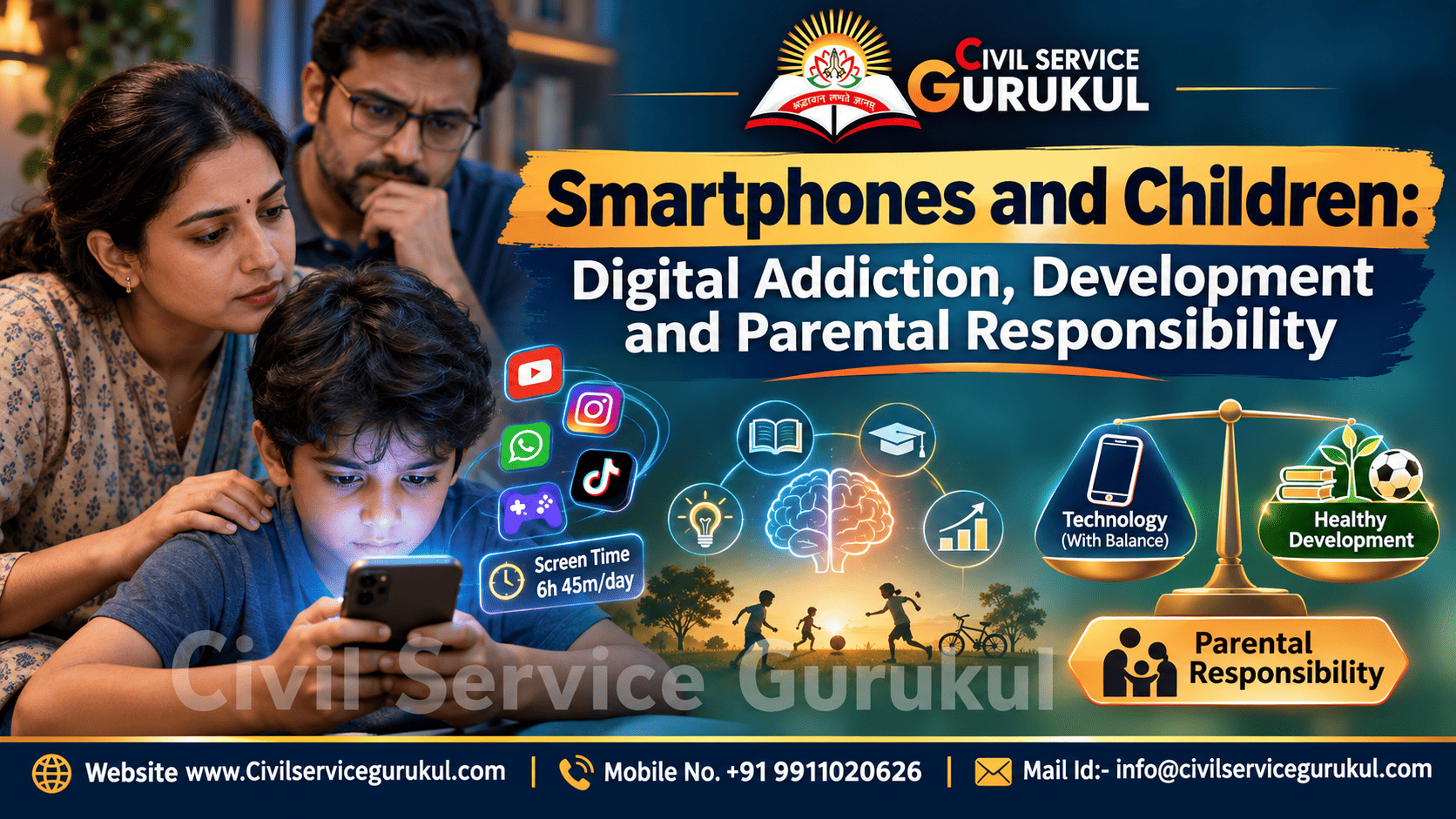
Growing Up in the Digital Age: Smartphone Addiction, Child Development and the Responsibility of Parents, Society and Government
A comprehensive examination of digital addiction, child psychology, mental health, education, cyber safety, parental responsibility and public policy from the UPSC perspective.
Published: | Civil Service Gurukul Editorial Team
Smartphones have transformed childhood by expanding access to education, communication, entertainment and information. However, excessive or poorly regulated digital engagement can displace activities essential for healthy development.
The challenge is not simply to reduce screen time, but to create an environment in which technology supports learning, creativity, social development and well-being without undermining children's physical and emotional needs.
Parents, educational institutions, technology companies and governments must collectively promote responsible digital citizenship.
UPSC Syllabus Mapping
| UPSC Paper | Relevant Syllabus Area |
|---|---|
| GS Paper I | Indian Society, role of family, social change and impact of globalisation on Indian society. |
| GS Paper II | Social Justice, education, health, vulnerable sections and government policies. |
| GS Paper III | Information Technology, cybersecurity and applications of science and technology. |
| GS Paper IV | Ethics, human values, emotional intelligence, responsibility and technological ethics. |
| Essay Paper | Technology and humanity, modern childhood, family values and digital civilisation. |
| Preliminary Examination | Child rights, international organisations, government initiatives and digital legislation. |
1. Why Are Smartphones and Children an Important Issue?
Children today are growing up in an increasingly connected digital environment. Smartphones are used for school assignments, educational videos, online communication, gaming and entertainment.
However, the growing integration of digital devices into everyday life raises important questions about the quality of childhood.
Why This Issue Deserves Public Policy Attention
- Increasing dependence on digital entertainment.
- Displacement of outdoor physical activities.
- Changing patterns of family communication.
- Exposure to age-inappropriate online content.
- Cyberbullying and online exploitation risks.
- Concerns regarding sleep and emotional well-being.
- Commercial exploitation of children's attention.
- Unequal access to quality digital education.
The American Academy of Pediatrics updated its digital media policy in January 2026, emphasising that children's digital well-being is influenced not only by individual behaviour but also by families, communities and the broader technology ecosystem.
Problematic smartphone use should be understood as a multidimensional social, educational, public health and governance challenge rather than merely a failure of parental discipline.
2. What Is Digital Addiction?
Digital addiction is a commonly used expression for excessive or difficult-to-control engagement with digital devices, applications or online activities that interferes with everyday functioning.
Frequent smartphone use does not automatically indicate addiction. The purpose of use, degree of control and impact on daily life are important.
Healthy Digital Use vs Problematic Digital Use
| Healthy Digital Use | Problematic Digital Use |
|---|---|
| Purposeful and time-conscious usage. | Difficulty controlling usage. |
| Supports education and communication. | Interferes with responsibilities. |
| Balanced with sleep and physical activity. | Repeated disruption of healthy routines. |
| Can be stopped without persistent distress. | Significant distress or conflict when restricted. |
| Maintains meaningful offline relationships. | May displace important social interactions. |
Gaming Disorder and ICD-11
The World Health Organization recognises gaming disorder in the International Classification of Diseases, Eleventh Revision (ICD-11).
It involves persistent difficulty controlling gaming, prioritisation of gaming over important activities and continued gaming despite harmful consequences, resulting in significant impairment.
3. Major Causes of Excessive Smartphone Use Among Children
Additional Structural Factors
- Academic pressure and limited leisure time.
- Long working hours of parents and caregivers.
- Availability of affordable mobile internet.
- Insufficient digital literacy.
- Weak communication within families.
- Dependence on online educational resources.
- Limited access to community recreation facilities.
4. Psychology of Digital Dependence
Digital applications can reinforce habitual behaviour through repeated rewards, social feedback, novelty and personalised content.
Children's ability to regulate impulses and make long-term decisions develops gradually. This makes age-appropriate guidance particularly important during childhood and adolescence.
Conceptual Flowchart: Digital Habit Formation
This is an illustrative behavioural model. Not every child using digital entertainment will develop problematic usage patterns.
Role of Dopamine
Dopamine participates in motivation, reward learning and reinforcement. Digital activities may engage these normal neurological processes, encouraging repetition of rewarding behaviour.
However, dopamine release alone does not establish addiction, and digital dependence cannot be explained through a single neurotransmitter.
5. Impact of Smartphones on Child Development
A. Physical Development
- Reduced opportunities for outdoor physical activity.
- Increased sedentary behaviour.
- Eye discomfort and digital eye strain.
- Neck and shoulder discomfort from prolonged poor posture.
- Disruption of sleep routines.
- Possible contribution to unhealthy weight gain.
B. Cognitive Development
- Frequent interruptions during learning.
- Reduced opportunities for sustained concentration.
- Displacement of independent reading.
- Fewer opportunities for imaginative play.
- Potential difficulties with attention regulation.
- Reduced face-to-face language-learning opportunities in young children.
C. Emotional Development
- Difficulty tolerating boredom.
- Overdependence on digital entertainment for emotional comfort.
- Frustration when device access is interrupted.
- Social comparison and self-esteem concerns.
- Exposure to distressing online content.
D. Social Development
- Reduced opportunities for face-to-face communication.
- Displacement of family conversations.
- Fewer opportunities to practise cooperation.
- Potential social isolation.
- Exposure to cyberbullying and harmful online interactions.
E. Educational Development
- Distraction during homework and classroom activities.
- Multitasking that interferes with learning.
- Reduced time for examination preparation.
- Dependence on readily available digital answers.
- Exposure to unreliable information and misinformation.
6. Positive Role of Smartphones in Child Development
Digital technology should not be viewed entirely as a threat. When used purposefully and with appropriate guidance, it can support education and participation.
| Area | Potential Benefit |
|---|---|
| Education | Access to interactive learning and educational resources. |
| Communication | Maintaining contact with family members and peers. |
| Creativity | Digital art, music, storytelling and coding. |
| Accessibility | Assistive tools for children with disabilities. |
| Information | Exposure to languages, cultures and general knowledge. |
| Safety | Age-appropriate communication during emergencies. |
| Skill Development | Digital literacy and responsible use of information. |
7. WHO Screen Time Recommendations for Children
The World Health Organization issued guidelines in 2019 concerning physical activity, sedentary behaviour and sleep for children below five years.
| Age Group | WHO Sedentary Screen Time Recommendation |
|---|---|
| Infants below 1 year | Screen time is not recommended. |
| Children aged 1 year | Sedentary screen time is not recommended. |
| Children aged 2 years | Maximum one hour daily; shorter duration is preferable. |
| Children aged 3–4 years | Maximum one hour daily; shorter duration is preferable. |
For older children, media use should be managed according to developmental needs, content quality, sleep, physical activity, education and overall well-being.
The American Academy of Pediatrics: 5 Cs of Media Use
| Principle | Meaning |
|---|---|
| Child | Understand the child's developmental needs. |
| Content | Evaluate the quality and suitability of digital material. |
| Calm | Develop healthy ways of managing emotions without relying exclusively on screens. |
| Crowding Out | Identify important activities displaced by digital use. |
| Communication | Maintain open discussions about digital experiences. |
8. Parental Responsibility in the Digital Age
The family is the primary institution of socialisation. Parents and caregivers influence children's habits, values, communication patterns and approaches to technology.
Key Responsibilities of Parents
- Lead by Example: Follow responsible smartphone habits.
- Establish Consistent Rules: Create age-appropriate digital boundaries.
- Encourage Outdoor Activities: Provide opportunities for sports and recreation.
- Promote Family Communication: Spend meaningful time talking and playing together.
- Monitor Content: Choose age-appropriate applications and media.
- Protect Online Privacy: Teach children not to disclose sensitive information.
- Establish Device-Free Spaces: Keep family meals and suitable bedtime routines free from unnecessary screen use.
- Support Emotional Development: Help children manage boredom, frustration and stress.
- Encourage Digital Literacy: Teach children to recognise misinformation and online risks.
- Seek Professional Support: Consult qualified professionals when digital behaviour persistently disrupts education, sleep or relationships.
Suggested Family Digital Wellness Plan
| Activity | Suggested Family Practice |
|---|---|
| Morning Routine | Avoid unnecessary smartphone use immediately after waking. |
| School Hours | Follow school rules and prioritise classroom learning. |
| Homework | Use digital devices only when required for learning. |
| Outdoor Play | Provide regular opportunities for active recreation. |
| Family Meals | Encourage device-free conversation. |
| Entertainment | Agree upon age-appropriate content and usage boundaries. |
| Before Bedtime | Avoid recreational screens during the hour before sleep where feasible. |
Family plans should be adapted to the child's age, educational requirements, accessibility needs and individual circumstances.
9. Role of Schools and Educational Institutions
Schools must develop a balanced learning environment that combines technological innovation with traditional educational methods, physical activity and meaningful social interaction.
Institutional Measures
- Establish clear classroom smartphone policies.
- Promote responsible educational technology use.
- Conduct cyber safety and digital literacy programmes.
- Strengthen school counselling facilities.
- Promote sports, reading, arts and cultural activities.
- Organise parental awareness workshops.
- Develop effective cyberbullying reporting mechanisms.
- Train teachers to recognise problematic digital behaviour.
- Provide reasonable accommodations for children with disabilities.
- Teach critical evaluation of online information.
School policies must consider accessibility, educational necessity and emergency communication. An inflexible prohibition may create difficulties for students who rely on digital assistive tools.
10. Smartphone Addiction in the Indian Social Context
India's rapid digital transformation has expanded educational opportunities and access to information. At the same time, it has introduced new challenges for families, schools and communities.
Major Challenges in India
- Unequal access to quality educational technology.
- Differences in digital literacy among caregivers.
- Limited recreational spaces in densely populated cities.
- Academic competition and examination-related stress.
- Changing family structures and work patterns.
- Language barriers in online safety awareness.
- Limited availability of child mental health services.
- Unequal access to safe and supervised internet facilities.
Digital Divide vs Digital Overuse
| Digital Divide | Digital Overuse |
|---|---|
| Insufficient access to technology. | Excessive or poorly regulated engagement. |
| Creates educational disadvantages. | May interfere with healthy development. |
| Requires affordable and inclusive access. | Requires guidance and responsible usage. |
| Associated with inequality of opportunity. | Associated with difficulties in digital well-being. |
11. Constitutional and Legal Dimensions of Child Protection
| Provision | Relevance |
|---|---|
| Article 15(3) | Permits special provisions for women and children. |
| Article 21 | Protection of life and personal liberty, including recognised privacy and dignity interests. |
| Article 21A | Right to free and compulsory education for children aged 6–14 years. |
| Article 39(e) | Protection of the tender age of children against abuse. |
| Article 39(f) | Opportunities for healthy development in conditions of freedom and dignity. |
| Article 45 | Early childhood care and education for children below six years. |
| Article 47 | Duty of the State to improve nutrition, living standards and public health. |
| Article 51A(k) | Duty of parents or guardians to provide educational opportunities to children aged 6–14 years. |
Important Legislative Frameworks
Digital Personal Data Protection Act, 2023
The legislation defines a child as an individual below eighteen years of age and establishes specific protections for children's personal data.
Section 9 provides for verifiable parental or lawful guardian consent and restrictions relating to harmful data processing, behavioural monitoring, tracking and targeted advertising directed at children.
These safeguards are subject to applicable exemptions, rules and phased commencement under the statutory framework.
Information Technology Act, 2000
The legislation contains provisions addressing specified cyber offences and unlawful electronic content, including material depicting children in sexually explicit acts.
Protection of Children from Sexual Offences Act, 2012
The POCSO Act provides legal protection against sexual offences involving children, including offences involving the use of children for pornographic purposes.
Commissions for Protection of Child Rights Act, 2005
This legislation provides the statutory basis for national and state commissions concerned with the protection of children's rights.
United Nations Convention on the Rights of the Child
The Convention provides an international framework for children's survival, development, protection and participation.
General Comment No. 25, issued in 2021 by the UN Committee on the Rights of the Child, addresses the application of children's rights within digital environments.
12. Important Government Initiatives in India
| Initiative | Objective and Relevance |
|---|---|
| National Education Policy 2020 | Promotes holistic education, technological integration and skill development. |
| PRAGYATA Guidelines | Provide guidance for safe, structured and balanced digital education. |
| PM eVIDYA | Supports multimode access to digital and distance education. |
| DIKSHA Platform | Provides digital educational content for teachers and students. |
| MANODARPAN | Supports students' psychosocial well-being and mental health. |
| Tele-MANAS | Facilitates access to tele-mental health assistance. |
| Cyber Crime Reporting Portal | Provides a mechanism for reporting cybercrime, including specified offences against children. |
| National Commission for Protection of Child Rights | Supports monitoring and protection of children's rights. |
These initiatives address different aspects of education, mental health, digital access and child protection. They are not all dedicated smartphone addiction treatment programmes.
Relevant Sustainable Development Goals
- SDG 3: Good Health and Well-being.
- SDG 4: Quality Education.
- SDG 10: Reduced Inequalities.
- SDG 16: Peace, Justice and Strong Institutions.
13. Ethical Dimensions of Smartphone Addiction
The digital environment creates several ethical dilemmas involving children, parents, technology companies and public authorities.
| Ethical Dimension | Central Question |
|---|---|
| Autonomy | How much digital freedom should a child receive? |
| Beneficence | Does technology promote the child's well-being? |
| Non-maleficence | Are foreseeable harms being prevented? |
| Responsibility | What obligations do parents and institutions have? |
| Justice | Do all children have equitable access to safe digital opportunities? |
| Privacy | Is children's personal information adequately protected? |
| Corporate Ethics | Should companies maximise engagement at the expense of child welfare? |
| Proportionality | Are digital restrictions necessary and reasonable? |
Commercialisation of Children's Attention
Some digital business models generate revenue through advertising, user engagement and personalised recommendations.
Where commercial incentives encourage prolonged engagement among children, ethical concerns arise regarding transparency, informed consent and the prioritisation of child welfare.
14. Way Forward: Building a Child-Centric Digital Ecosystem
Civil Service Gurukul proposes a six-dimensional DIGITAL framework for developing responsible digital habits and child protection.
| Framework | Recommended Measure |
|---|---|
| D – Digital Literacy | Teach responsible technology use and critical thinking. |
| I – Inclusive Access | Ensure equitable access to safe educational technology. |
| G – Guided Usage | Provide age-appropriate parental and school guidance. |
| I – Institutional Accountability | Strengthen school, government and platform responsibilities. |
| T – Time and Content Management | Protect sleep, learning and physical activity. |
| AL – Active Living | Promote sports, recreation, reading and meaningful relationships. |
A. Family-Level Measures
- Develop collaborative family media plans.
- Encourage mindful smartphone use.
- Establish consistent digital boundaries.
- Prioritise emotional connection and communication.
B. School-Level Measures
- Integrate digital citizenship into education.
- Strengthen counselling and mental health support.
- Promote experiential learning and physical activity.
- Introduce transparent, age-appropriate device policies.
C. Government-Level Measures
- Strengthen child online safety mechanisms.
- Expand affordable mental health services.
- Promote safe public playgrounds and recreational spaces.
- Support multilingual digital literacy campaigns.
- Encourage evidence-based research on digital well-being.
- Implement proportionate child data protection safeguards.
D. Technology Company Responsibilities
- Adopt privacy-by-design and safety-by-design principles.
- Provide effective age-appropriate safety settings.
- Offer transparent and accessible parental controls.
- Reduce manipulative engagement features for children.
- Establish effective grievance redressal mechanisms.
- Conduct child-rights impact assessments.
15. UPSC GS Paper IV Ethics Case Study
Case Study: Smartphone Use in Government Schools
You are a District Magistrate responsible for implementing a digital education programme in government schools.
While smartphones have improved access to educational materials, teachers report increasing classroom distractions, cyberbullying incidents and difficulties in maintaining student attention.
Some parents demand a complete prohibition on smartphones, while students from disadvantaged families argue that mobile devices are their primary source of educational resources.
Children with certain disabilities also depend on digital assistive applications.
Questions:- Identify the ethical issues involved.
- Identify the major stakeholders.
- Evaluate the available administrative options.
- Suggest a balanced course of action.
Reveal Model Solution
Ethical Issues
- Child welfare versus technological freedom.
- Equality of educational opportunity.
- Privacy and protection from online harm.
- Administrative responsibility.
- Proportionality of restrictions.
Stakeholders
Students, parents, teachers, school administrators, children with disabilities, technology providers, district administration and the wider community.
Available Options
Option 1: Complete prohibition. May reduce distractions but could restrict educational access and accessibility.
Option 2: Unrestricted access. Preserves flexibility but does not adequately address foreseeable risks.
Option 3: Regulated and purposeful usage. Balances educational access with safety, discipline and child development.
Recommended Course of Action
Introduce age-appropriate school device policies, permit supervised educational and assistive use, provide offline learning alternatives, strengthen counselling, consult parents and teachers, and establish cyberbullying reporting mechanisms.
Review the policy periodically using evidence concerning student learning, accessibility and well-being.
Ethical Principles Applied
Beneficence, non-maleficence, justice, compassion, accountability, proportionality and inclusive governance.
16. UPSC Prelims Practice MCQs
The following are original practice questions designed for UPSC preparation.
Gaming disorder is recognised under which of the following international classifications?
A. International Health Regulations
B. ICD-11
C. Sustainable Development Goals
D. Universal Declaration of Human Rights
Reveal Answer and Explanation
Correct Answer: B
Gaming disorder is included in the World Health Organization's International Classification of Diseases, Eleventh Revision.
Consider the following statements regarding WHO recommendations on sedentary screen time:
- Screen time is not recommended for infants below one year.
- Children aged two years should have no more than one hour of sedentary screen time daily.
- Children aged three to four years are recommended unrestricted screen time for educational purposes.
Which of the statements given above are correct?
A. 1 only
B. 1 and 2 only
C. 2 and 3 only
D. 1, 2 and 3
Reveal Answer and Explanation
Correct Answer: B
Statements 1 and 2 correctly reflect WHO's recommendations. Statement 3 is incorrect. For children aged three to four years, WHO recommends limiting sedentary screen time to one hour daily or less.
Which of the following constitutional provisions directly concerns opportunities for children's healthy development in conditions of freedom and dignity?
A. Article 32
B. Article 39(f)
C. Article 110
D. Article 280
Reveal Answer and Explanation
Correct Answer: B
Article 39(f) is a Directive Principle of State Policy concerning healthy development, freedom, dignity and protection of childhood and youth.
PRAGYATA Guidelines are primarily associated with:
A. Agricultural marketing
B. Digital education
C. Municipal finance
D. International trade
Reveal Answer and Explanation
Correct Answer: B
PRAGYATA Guidelines provide guidance for digital education and address planning, screen use and safe learning practices.
With reference to the Digital Personal Data Protection Act, 2023, consider the following statements:
- A child is defined as an individual below eighteen years of age.
- Section 9 provides specific safeguards for processing children's personal data.
- The legislation imposes a universal prohibition on smartphone ownership by children.
Which of the statements given above are correct?
A. 1 only
B. 2 only
C. 1 and 2 only
D. 1, 2 and 3
Reveal Answer and Explanation
Correct Answer: C
Statements 1 and 2 are correct. The legislation establishes a personal data protection framework and does not universally prohibit smartphone ownership by children. Applicable safeguards are subject to commencement provisions and exemptions.
General Comment No. 25 of the UN Committee on the Rights of the Child concerns:
A. Children's rights in the digital environment
B. International maritime boundaries
C. Nuclear disarmament
D. Global agricultural subsidies
Reveal Answer and Explanation
Correct Answer: A
General Comment No. 25 (2021) explains the application of children's rights in digital environments.
Which of the following initiatives are associated with digital education in India?
- DIKSHA
- PM eVIDYA
- PRAGYATA Guidelines
Select the correct answer:
A. 1 only
B. 1 and 2 only
C. 2 and 3 only
D. 1, 2 and 3
Reveal Answer and Explanation
Correct Answer: D
All three initiatives are associated with India's digital education ecosystem.
17. UPSC Mains Practice Questions
Examine how increasing smartphone usage is transforming traditional patterns of childhood and family socialisation in India.
10 Marks | 150 Words
Discuss the impact of problematic smartphone use on child development. Examine the role of parents, educational institutions and government in promoting digital well-being.
15 Marks | 250 Words
Discuss the opportunities and challenges associated with digital platforms for children. Suggest measures to ensure safe and responsible technological innovation.
15 Marks | 250 Words
The pursuit of commercial engagement by digital platforms must not undermine the best interests of children. Discuss.
10 Marks | 150 Words
18. UPSC Mains Model Answer
Discuss the impact of excessive smartphone usage on child development and examine the collective responsibility of parents, society and government.
15 Marks | Approximately 250 Words
Introduction
Smartphones have expanded children's access to education, communication and information. However, excessive and poorly regulated usage may interfere with healthy development, requiring a balanced and rights-based approach to digital well-being.
Body
Impact on Child Development
- Physical: Reduced activity, eye strain and disrupted sleep.
- Cognitive: Frequent distractions and displacement of reading and sustained learning.
- Emotional: Dependence on digital entertainment for emotional regulation and potential social comparison.
- Social: Reduced opportunities for face-to-face interaction.
- Safety: Exposure to cyberbullying, misinformation and privacy risks.
Nevertheless, appropriately designed digital tools can improve educational accessibility, creativity and communication.
Collective Responsibility
- Parents: Model healthy habits, establish family media plans and encourage outdoor activities.
- Schools: Integrate digital literacy, counselling and purposeful technology use into education.
- Government: Strengthen child protection, mental health services and inclusive digital education through initiatives such as PRAGYATA and DIKSHA.
- Technology Companies: Adopt age-appropriate safety features, transparent algorithms and responsible data processing.
Article 39(f) and the UN Convention on the Rights of the Child provide important normative foundations for healthy development and child protection.
Conclusion
The objective should not be technological exclusion but responsible digital empowerment. A collaborative approach combining parental guidance, holistic education, corporate accountability and effective governance can ensure that technological advancement strengthens rather than diminishes childhood.
19. UPSC Essay Value Addition
The following original essay themes and thought lines can be used for brainstorming, introductions and conclusions.
Important Essay Themes
- Technology: A servant or a master of humanity?
- Digital civilisation and the changing nature of childhood.
- Education in the age of artificial intelligence.
- Human relationships in an interconnected world.
- Freedom and responsibility in the digital age.
- Technological progress and ethical responsibility.
- Childhood beyond the screen.
20. Quick Revision Notes for UPSC
| Keyword | Exam-Oriented Concept |
|---|---|
| Digital Well-being | Healthy and balanced engagement with technology. |
| Digital Citizenship | Responsible, informed and ethical participation online. |
| Gaming Disorder | Recognised clinical condition under WHO ICD-11. |
| Digital Divide | Inequality in technology access, skills and meaningful usage. |
| Attention Economy | Commercial competition for users' attention. |
| Cyberbullying | Bullying or harassment through digital communication. |
| Parental Modelling | Influence of parental behaviour on children's habits. |
| Safety by Design | Integration of safety measures into technology development. |
| Privacy by Design | Integration of privacy safeguards into system architecture. |
| Article 39(f) | Healthy development of children in freedom and dignity. |
| Article 51A(k) | Parental duty concerning educational opportunities for children aged 6–14. |
| Section 9, DPDP Act | Statutory framework for children's personal data protection. |
| PRAGYATA | Guidelines for digital education. |
| General Comment No. 25 | Children's rights in the digital environment. |
21. Frequently Asked Questions
What is smartphone addiction in children?
It is a commonly used expression for difficult-to-control smartphone usage that interferes with important daily activities, relationships or well-being. Frequent use alone does not establish a clinical diagnosis.
Are smartphones always harmful to children?
No. Age-appropriate and purposeful use can support education, communication, creativity and accessibility. The effects depend on content, context, duration and the child's individual circumstances.
What is the WHO screen time recommendation for children aged two to four years?
WHO recommends no more than one hour of sedentary screen time daily for children aged two to four years, with shorter durations preferred.
Is smartphone addiction recognised by WHO as a disease?
General smartphone addiction is not a standalone WHO ICD-11 diagnosis. However, gaming disorder is recognised when the applicable clinical criteria are met.
How can parents reduce problematic smartphone use?
Parents can establish family media plans, model healthy habits, encourage physical activity, monitor age-appropriate content and maintain open communication.
What is the role of schools in promoting digital well-being?
Schools can establish balanced device policies, provide digital literacy education, strengthen counselling and promote extracurricular activities.
Which constitutional provision supports healthy child development?
Article 39(f) directs the State to ensure opportunities for children to develop in conditions of freedom and dignity.
Why is smartphone addiction important for UPSC?
The issue is relevant to Indian society, education, public health, social justice, cybersecurity, ethics, governance and essay writing.
22. Conclusion
Digital technology represents both an opportunity and a responsibility for modern civilisation. Children must have access to technological advancement without being deprived of physical activity, emotional security, creativity and meaningful human interaction.
The solution lies neither in unrestricted digital consumption nor in complete technological isolation. It lies in balanced usage, age-appropriate guidance, inclusive education, responsible technology design and effective public policy.
India's vision of digital transformation must therefore be accompanied by an equally strong commitment to protecting childhood, strengthening family relationships and promoting holistic human development.
Prepare Smarter. Think Deeper. Become a Civil Servant.
Civil Service Gurukul is dedicated to providing concept-oriented, examination-focused and analytical learning resources for civil service aspirants.
Explore Our UPSC Learning Resources
Daily Current Affairs |
UPSC Prelims MCQs |
General Studies Notes |
Mains Answer Writing |
Ethics Case Studies |
Essay Preparation |
Prelims Test Series |
Personalised Mentorship |
Conceptual Learning
Website:
www.civilservicegurukul.com
Mobile:
+91 99110 20626
Email:
info@civilservicegurukul.com
Prepare with Mentors Who Cleared the Exam
Get personalized study plans, evaluated answer models, and test series access.