Delhi Vehicular Pollution & Environmental Governance – UPSC
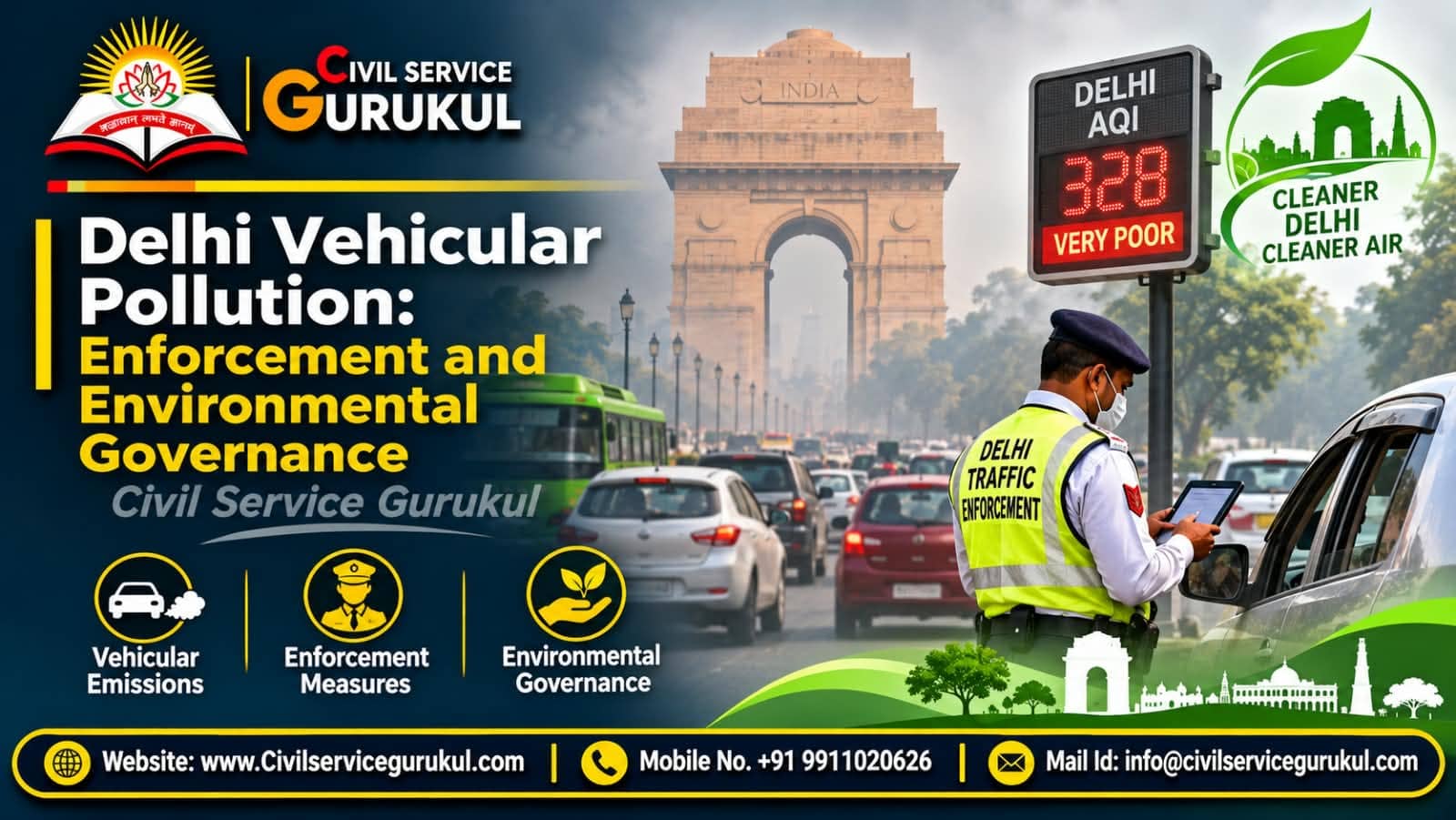
Delhi Vehicular Pollution Crisis 2026: Supreme Court Intervention, BS-VI Emission Norms and the Future of Environmental Governance in India
Delhi's recurring air pollution crisis represents a complex challenge involving transportation, public health, urban planning, regulatory enforcement and cooperative federalism. Recent judicial interventions and revised vehicle-emission regulations highlight the urgent need to move beyond seasonal restrictions towards sustainable, technology-enabled environmental governance.
Why in the News?
The Supreme Court of India has intensified its examination of vehicular pollution in Delhi and the National Capital Region during November 2026.
In its order dated 6 November 2026, the Court sought detailed responses from the Delhi government, Municipal Corporation of Delhi, Delhi Traffic Police and the governments of Haryana, Uttar Pradesh and Rajasthan regarding vehicle-emission enforcement.
The Court examined concerns involving emission standards, Pollution Under Control certification, older vehicles, interstate vehicular movement and regulatory accountability.
During the hearing on 23 November 2026, the Supreme Court reportedly expressed support for a transition towards BS-VI-compliant vehicles in Delhi.
The development comes alongside revised PUC certification provisions announced by the Ministry of Road Transport and Highways and technology-enabled enforcement measures introduced by the Commission for Air Quality Management.
Judicial observations favouring cleaner vehicles should not be interpreted as an immediately operative blanket prohibition on every vehicle below BS-VI standards. The actual restrictions depend on applicable written court orders, statutory directions, notifications and exemptions.
UPSC CSE Syllabus Relevance
| UPSC Paper | Relevant Syllabus Topics |
|---|---|
| Prelims GS Paper I | Environmental ecology, pollution, general science, government schemes and current affairs |
| Mains GS Paper I | Urbanization, geographical factors and urban environmental challenges |
| Mains GS Paper II | Government policies, judicial intervention, cooperative federalism and governance |
| Mains GS Paper III | Environmental pollution, conservation, sustainable development, infrastructure and clean technology |
| Mains GS Paper IV | Environmental ethics, public accountability, intergenerational equity and administrative responsibility |
| Essay Paper | Development versus sustainability, environmental justice and the right to clean air |
What Is Vehicular Pollution?
Vehicular pollution refers to the release of harmful gases, particulate matter and other pollutants associated with the operation and movement of motor vehicles.
Conventional petrol and diesel vehicles produce emissions through the combustion of fossil fuels. Vehicles also contribute to non-exhaust emissions through tyre wear, brake wear and the resuspension of road dust.
Vehicular emissions become particularly significant in densely populated urban areas where high traffic volumes, congestion and limited atmospheric dispersion increase exposure to pollutants.
Major Sources of Vehicular Pollution
- Combustion of petrol and diesel.
- Incomplete fuel combustion.
- Operation of poorly maintained vehicles.
- Traffic congestion and prolonged engine idling.
- Heavy commercial vehicle movement.
- Evaporative emissions from fuel systems.
- Tyre and brake wear.
- Resuspension of particulate matter from road surfaces.
Vehicular pollution cannot be addressed entirely by replacing combustion-engine vehicles with electric vehicles. Electric vehicles eliminate tailpipe emissions but continue to generate certain non-exhaust emissions, including tyre wear and road dust resuspension.
Why Does Delhi Experience Severe Air Pollution?
1. High Vehicular Density
Delhi and its adjoining urban centres experience substantial movement of private cars, motorcycles, buses, commercial vehicles and freight transport.
A growing dependence on motorized transportation increases the potential emission burden.
2. Traffic Congestion
Congestion increases travel time, fuel consumption and emissions from conventional vehicles, particularly when engines operate inefficiently during frequent stopping and acceleration.
3. Temperature Inversion
During winter, colder air near the ground may become trapped beneath a warmer atmospheric layer.
This condition restricts vertical mixing and allows pollutants to accumulate near the surface.
4. Low Wind Speed
Weak winds reduce the horizontal dispersion of pollutants, resulting in higher concentrations near emission sources.
5. Reduced Atmospheric Mixing Height
Winter meteorological conditions can reduce the depth of the atmospheric layer within which pollutants disperse.
The same quantity of emissions may consequently produce higher ground-level pollutant concentrations.
6. Regional Agricultural Residue Burning
Seasonal crop residue burning in adjoining agricultural regions may contribute to Delhi's pollution burden depending on wind direction, atmospheric conditions and the intensity of burning.
7. Construction and Road Dust
Construction activities, demolition, unpaved surfaces and road dust generate significant particulate pollution.
8. Industrial and Other Combustion Sources
Industrial processes, electricity generation, waste burning and other combustion activities contribute to the region's overall pollution load.
9. Regional Geography and Airshed Characteristics
Delhi is located within the Indo-Gangetic Plain, where regional atmospheric processes allow pollution to accumulate and move across administrative boundaries.
Delhi's pollution crisis is a multi-source and regional environmental problem. Vehicular emissions are an important contributor, but their percentage contribution varies according to season, location, meteorology and the methodology used in source-apportionment studies.
Major Pollutants Associated with Vehicular Emissions
| Pollutant | Major Source or Formation Process | Potential Impact |
|---|---|---|
| Carbon Monoxide (CO) | Incomplete combustion of carbon-containing fuels | Reduces oxygen transport in the bloodstream |
| Nitrogen Oxides (NOx) | High-temperature combustion | Respiratory irritation, ozone formation and secondary particulate pollution |
| Particulate Matter (PM2.5) | Combustion and secondary atmospheric processes | Respiratory and cardiovascular health impacts |
| Particulate Matter (PM10) | Road dust, mechanical wear and combustion | Respiratory irritation and reduced air quality |
| Volatile Organic Compounds (VOCs) | Fuel evaporation and incomplete combustion | Formation of ground-level ozone and secondary pollutants |
| Carbon Dioxide (CO2) | Combustion of fossil fuels | Climate change and global warming |
| Sulphur Dioxide (SO2) | Combustion of sulphur-containing fuels | Respiratory impacts and formation of secondary particles |
| Ground-Level Ozone (O3) | Photochemical reactions involving nitrogen oxides and VOCs | Respiratory irritation and damage to vegetation |
Primary Pollutants vs Secondary Pollutants
| Primary Pollutants | Secondary Pollutants |
|---|---|
| Released directly from pollution sources | Formed through chemical reactions in the atmosphere |
| Carbon monoxide, nitric oxide and directly emitted particulate matter | Ground-level ozone, secondary nitrates and sulphates |
| Controlled primarily through source-level emission reduction | Controlled through reduction of precursor emissions and regional management |
Difference Between PM2.5 and PM10
| Particular | PM2.5 | PM10 |
|---|---|---|
| Particle Size | Nominal aerodynamic diameter of 2.5 micrometres or less | Nominal aerodynamic diameter of 10 micrometres or less |
| Common Sources | Combustion and secondary atmospheric particles | Dust, mechanical wear and combustion |
| Respiratory Penetration | Can penetrate deep into the lungs | Can enter the respiratory system |
| Health Concerns | Cardiovascular and respiratory disease risks | Respiratory and other health impacts |
PM2.5 is included within the broader PM10 particle-size category. Fine particles can penetrate deep into the lungs, and some particles or their constituents may enter the bloodstream.
What Is the Air Quality Index?
The Air Quality Index, commonly known as AQI, is a numerical communication tool used to express ambient air quality and associated health concerns.
India's National Air Quality Index was launched in 2014 and is supported by the Central Pollution Control Board and associated monitoring agencies.
Eight Pollutants Considered in India's National AQI
- Particulate Matter PM10.
- Particulate Matter PM2.5.
- Nitrogen Dioxide (NO2).
- Sulphur Dioxide (SO2).
- Carbon Monoxide (CO).
- Ozone (O3).
- Ammonia (NH3).
- Lead (Pb).
| AQI Range | Air Quality Category |
|---|---|
| 0–50 | Good |
| 51–100 | Satisfactory |
| 101–200 | Moderate |
| 201–300 | Poor |
| 301–400 | Very Poor |
| 401–500 | Severe |
Carbon dioxide is a major greenhouse gas, but it is not one of the eight pollutants used in India's National Air Quality Index.
AQI is also different from the actual mass concentration of a pollutant, which may be expressed in micrograms per cubic metre.
Understanding Bharat Stage Emission Standards
Bharat Stage emission standards are regulatory norms prescribing limits on specified air pollutants emitted by motor vehicles.
These standards are broadly aligned with European vehicle-emission frameworks, with adaptations relevant to Indian regulatory requirements.
India transitioned directly from Bharat Stage IV to Bharat Stage VI emission standards for new vehicles nationwide on 1 April 2020, skipping Bharat Stage V.
BS-IV vs BS-VI Emission Standards
| Particulars | BS-IV | BS-VI |
|---|---|---|
| Fuel Sulphur Limit | 50 parts per million | 10 parts per million |
| Emission Limits | Earlier regulatory standards | More stringent standards for specified pollutants |
| Emission Control Technology | Earlier-generation systems | More advanced emission control systems, depending on vehicle category |
| Particulate Emission Control | Less stringent limits for several vehicle categories | Improved particulate emission requirements |
| Monitoring | Applicable earlier diagnostic requirements | More advanced diagnostic and compliance requirements |
Important Emission Control Technologies
- Diesel Particulate Filter: Captures particulate matter from diesel exhaust.
- Selective Catalytic Reduction: Reduces nitrogen oxide emissions through catalytic treatment.
- Exhaust Gas Recirculation: Helps reduce nitrogen oxide formation by modifying combustion conditions.
- Catalytic Converter: Converts certain harmful exhaust pollutants into less harmful substances.
- On-Board Diagnostics: Monitors selected vehicle systems and identifies certain emission-related malfunctions.
The use of these technologies varies according to vehicle category, fuel type and applicable emission requirements.
BS-VI Phase II
India introduced additional BS-VI Phase II requirements from April 2023, including Real Driving Emissions requirements for applicable vehicle categories.
The objective is to improve the relationship between vehicle-emission performance under laboratory testing and actual driving conditions.
Bharat Stage standards regulate vehicle-emission performance under prescribed testing conditions. They are not equivalent to ambient air quality standards, which regulate or assess pollution levels in the surrounding atmosphere.
New PUC Certificate Validity Rules 2026
The Ministry of Road Transport and Highways notified the Central Motor Vehicles (Sixteenth Amendment) Rules, 2026 through G.S.R. 991(E), dated 13 November 2026.
The amendment revises Rule 115 of the Central Motor Vehicles Rules, 1989 and introduces differentiated PUC certificate validity periods based on emission standards, vehicle category and age.
The Ministry announced the revised framework on 19 November 2026.
Revised PUC Validity Periods
| Vehicle Category | Age from First Registration | PUC Certificate Validity |
|---|---|---|
| BS-I, BS-II and BS-III vehicles | All applicable ages | 3 months |
| BS-IV vehicles | All applicable ages | 6 months |
| BS-VI non-transport vehicles | Up to 6 years | 3 years |
| BS-VI non-transport vehicles | Above 6 years and up to 10 years | 1 year |
| BS-VI non-transport vehicles | Above 10 years | 6 months |
| BS-VI transport vehicles | Up to 6 years | 2 years |
| BS-VI transport vehicles | Above 6 years and up to 10 years | 1 year |
| BS-VI transport vehicles | Above 10 years | 6 months |
Transitional Provisions
For certificates issued before commencement of the amendment, the revised validity periods apply upon their first renewal after commencement.
Where renewal is obtained within the ten days preceding expiry, the renewed certificate takes effect from the existing certificate's expiry date.
Where renewal occurs after expiry, the renewed certificate takes effect from the renewal date.
A valid PUC certificate does not automatically authorize operation of a vehicle that is separately prohibited under applicable age-based restrictions, vehicle-entry rules, court orders or GRAP measures.
No PUCC, No Fuel: Technology-Enabled Enforcement
The Commission for Air Quality Management issued Direction No. 101 dated 15 May 2026 to strengthen enforcement of pollution certification requirements across the National Capital Region.
The direction prescribes denial of fuel to vehicles lacking a valid Pollution Under Control Certificate at NCR fuel stations from 1 October 2026, subject to specified exceptions.
Exceptional circumstances may include medical emergencies, disaster response, law and order duties and other situations authorized by the relevant governments.
How the Enforcement Mechanism Works
Automatic Number Plate Recognition cameras or other approved systems identify the vehicle registration number.
Vehicle registration and pollution certificate information is checked through integrated databases such as VAHAN and PUCC records.
The system determines whether the vehicle has the required valid certificate.
Fuel station operators and relevant authorities implement applicable restrictions, taking account of authorized exceptions and verification requirements.
Enforcement authorities review compliance records, system reliability, violations and corrective measures.
Benefits of Technology-Enabled Enforcement
- Improved detection of expired pollution certificates.
- Reduced dependence on random manual inspections.
- Greater consistency in regulatory monitoring.
- Better coordination across NCR jurisdictions.
- Potential reduction in discretionary enforcement.
- Improved availability of compliance data.
Potential Implementation Challenges
- Incorrect number plate recognition.
- Outdated or inconsistent vehicle databases.
- Fraudulent or unreliable pollution certificates.
- Technical failures at fuel stations.
- Digital privacy and data protection concerns.
- Need for accessible grievance redressal.
- Uneven implementation across different jurisdictions.
Supreme Court Intervention in Delhi Vehicular Pollution
The Supreme Court's November 2026 proceedings emphasize the need for coordinated environmental action across Delhi-NCR.
The order dated 6 November 2026 directed concerned authorities to provide detailed information on the regulatory and enforcement framework governing vehicular emissions.
Major Areas of Judicial Examination
- Regulation of commercial and non-commercial vehicles entering and operating in Delhi-NCR.
- Identification of vehicles that do not meet emission requirements.
- Enforcement of valid pollution certification.
- Action against over-age and otherwise non-compliant vehicles.
- Details of inspections, challans and restrictions imposed.
- Coordination between Delhi and neighbouring states.
- Time-bound plans for strengthening pollution enforcement.
The Court's subsequent hearing on 23 November 2026 reportedly included observations favouring a transition towards BS-VI-compliant vehicles.
Such observations indicate the direction of judicial concern, but the precise regulatory effect must be determined from the applicable written orders.
Judicial intervention in air pollution reflects the importance of constitutional environmental rights and executive accountability. However, sustainable pollution control requires effective administrative institutions, scientific planning and consistent enforcement rather than exclusive dependence on judicial supervision.
Commission for Air Quality Management (CAQM)
The Commission for Air Quality Management in National Capital Region and Adjoining Areas is a statutory body established under the CAQM Act, 2021.
Its purpose is to improve coordination, research, monitoring and resolution of air pollution-related problems affecting Delhi-NCR and relevant adjoining areas.
| Particulars | Details |
|---|---|
| Full Form | Commission for Air Quality Management |
| Legal Basis | CAQM Act, 2021 |
| Nature | Statutory body |
| Geographical Scope | National Capital Region and relevant adjoining areas |
| Associated Union Ministry | Ministry of Environment, Forest and Climate Change |
| Major Function | Coordinated regional air quality management |
| Section 12 | Powers and functions, including issuance of statutory directions |
| Important Enforcement Tool | Graded Response Action Plan |
Major Functions of CAQM
- Coordinating pollution control measures across jurisdictions.
- Issuing directions for air quality improvement.
- Monitoring compliance with environmental requirements.
- Examining major pollution sources.
- Promoting scientific research and technological interventions.
- Coordinating emergency pollution-control measures.
- Reviewing implementation by concerned government agencies.
CAQM is a statutory institution, not a constitutional body. Its mandate is specifically associated with air quality management in NCR and adjoining areas.
What Is the Graded Response Action Plan?
The Graded Response Action Plan, commonly abbreviated as GRAP, is a framework of progressively stronger air pollution control measures for Delhi-NCR.
Its implementation depends on air quality conditions, forecasts and decisions of the competent authorities.
The CAQM revised the GRAP schedule on 29 September 2026.
Four Stages of GRAP
| GRAP Stage | Delhi AQI Range | Category | Illustrative Measures |
|---|---|---|---|
| Stage I | 201–300 | Poor | Dust control, waste-burning restrictions and basic pollution enforcement |
| Stage II | 301–400 | Very Poor | Enhanced pollution monitoring, traffic management and strengthened public transport measures |
| Stage III | 401–450 | Severe | Additional restrictions on specified construction activities and vehicle categories |
| Stage IV | Above 450 | Severe Plus | More stringent emergency measures and transport restrictions, subject to applicable orders |
The competent authority may invoke higher-stage measures in advance based on forecast conditions.
On 6 November 2026, Stage III was invoked in Delhi-NCR. It was subsequently revoked on 17 November 2026 following an improvement in air quality and forecast conditions.
The active GRAP stage is dynamic and must be checked against the latest CAQM orders.
India's National AQI contains six air quality categories, whereas GRAP uses four stages of progressively stronger pollution-control interventions. These two classifications are related but not identical.
End-of-Life Vehicles and Vehicle Scrappage Policy
End-of-life vehicles are vehicles subject to retirement or disposal under applicable legal and regulatory requirements.
Delhi-NCR has historically applied age-related restrictions involving diesel vehicles exceeding ten years and petrol vehicles exceeding fifteen years.
However, subsequent judicial directions and regulatory amendments have affected the enforcement of these restrictions, including distinctions involving vehicle-emission categories.
Consequently, the applicable age, emission standard, registration status and latest written orders must be examined before determining whether a particular vehicle can legally operate.
Objectives of Vehicle Scrappage
- Reduce emissions from unsuitable and highly polluting vehicles.
- Improve road safety and vehicle fitness.
- Encourage cleaner vehicle technologies.
- Promote recycling and material recovery.
- Reduce unsafe disposal of automobile components.
- Support a circular economy in the automotive sector.
India's national vehicle scrappage framework emphasizes vehicle fitness and organized recycling. It should not be confused with every location-specific restriction applicable in Delhi-NCR.
Constitutional and Legal Framework for Environmental Governance
Article 21: Right to Life
Through constitutional interpretation, the Supreme Court has recognized that the right to life includes important environmental protections associated with healthy living conditions.
Protection against serious air pollution is therefore connected with fundamental rights and public health.
Article 48A: Protection of Environment
Article 48A is a Directive Principle of State Policy requiring the State to endeavour to protect and improve the environment and safeguard forests and wildlife.
Article 51A(g): Fundamental Duty
Citizens have a fundamental duty to protect and improve the natural environment and show compassion for living creatures.
Article 47: Public Health
Article 47 identifies improvement of public health as one of the primary duties of the State.
| Legislation | Major Relevance |
|---|---|
| Air (Prevention and Control of Pollution) Act, 1981 | Prevention, control and abatement of air pollution |
| Environment (Protection) Act, 1986 | Broad environmental protection and regulatory powers |
| Motor Vehicles Act, 1988 | Motor vehicle regulation and associated compliance requirements |
| Central Motor Vehicles Rules, 1989 | Vehicle-emission standards and pollution certification requirements |
| National Green Tribunal Act, 2010 | Specialized adjudication of specified environmental disputes |
| CAQM Act, 2021 | Regional air quality coordination and regulatory enforcement |
Important Environmental Principles for UPSC
1. Polluter Pays Principle
The costs of preventing and remedying pollution should appropriately be borne by those responsible for causing it.
2. Precautionary Principle
A lack of complete scientific certainty should not automatically justify postponing proportionate measures against serious environmental risks.
3. Sustainable Development
Development should balance economic progress, environmental protection and social welfare.
4. Intergenerational Equity
Present generations have responsibilities towards preserving environmental resources and healthy living conditions for future generations.
5. Environmental Justice
The costs and benefits of environmental policies should be distributed fairly, with particular attention to vulnerable communities and unequal exposure to pollution.
6. Public Trust Doctrine
Public authorities have responsibilities concerning the protection and responsible management of natural resources held for public benefit.
Important Environmental Judgments
| Judgment | Environmental Significance |
|---|---|
| M.C. Mehta v. Union of India | Series of important environmental proceedings, including vehicular pollution and cleaner public transport |
| Subhash Kumar v. State of Bihar, 1991 | Recognized the relevance of pollution-free water and air to Article 21 |
| Vellore Citizens Welfare Forum v. Union of India, 1996 | Recognition of sustainable development, precautionary principle and polluter pays principle |
| M.C. Mehta v. Kamal Nath, 1997 | Public trust doctrine in environmental protection |
| M.K. Ranjitsinh v. Union of India, 2024 | Recognition of constitutional protections against adverse effects of climate change under Articles 14 and 21 |
Health, Economic and Social Impacts of Vehicular Pollution
Public Health Impacts
- Increased risk of respiratory illnesses.
- Aggravation of asthma and existing respiratory conditions.
- Cardiovascular health impacts.
- Greater health risks among children and older persons.
- Increased exposure-related risks for outdoor workers.
- Potential adverse effects of long-term pollution exposure.
Economic Impacts
- Higher healthcare expenditure.
- Loss of working days and productivity.
- Disruption of transportation and commercial activities.
- Additional expenditure on pollution control infrastructure.
- Economic costs associated with reduced quality of life.
- Transition costs for vehicle owners and transport operators.
Social Impacts
- Unequal exposure among different socio-economic groups.
- Disproportionate effects on traffic police and outdoor workers.
- Disruption of educational activities during severe pollution episodes.
- Reduced accessibility of outdoor public spaces.
- Greater financial pressure on low-income households.
A low-income household may contribute relatively little to private vehicular emissions while experiencing substantial pollution exposure. Environmental governance must therefore combine emission reduction with equitable access to clean transportation and public healthcare.
Major Government Initiatives for Air Pollution Control
1. National Clean Air Programme
The National Clean Air Programme was launched by the Ministry of Environment, Forest and Climate Change in January 2019.
Its revised target framework envisaged reducing PM10 concentrations by up to 40 percent or achieving the applicable annual national air quality standard by FY 2025-26, using FY 2017-18 as the comparison baseline.
Government reporting in 2026 indicated that 108 of the 130 cities covered under the programme recorded reductions in annual PM10 concentrations during FY 2025-26 compared with FY 2017-18. Of these, 26 cities achieved reductions exceeding 40 percent.
These reported improvements do not establish that all participating cities have achieved safe air quality or met every programme objective.
2. Bharat Stage VI Norms
The nationwide transition to BS-VI emission standards strengthens source-level regulation of emissions from new vehicles.
3. PM E-DRIVE Scheme
The PM Electric Drive Revolution in Innovative Vehicle Enhancement scheme supports electric mobility, charging infrastructure and eligible cleaner transportation technologies.
4. PM-eBus Sewa
The initiative promotes the expansion of electric bus services and aims to strengthen urban public transportation.
5. Vehicle Scrappage Framework
Organized vehicle fitness testing, retirement and recycling can support modernization of the vehicle fleet and cleaner transportation.
6. Metro Rail Development
Expansion of reliable mass rapid transit systems can reduce dependence on private motor vehicles, particularly when combined with accessible last-mile connectivity.
7. National Air Quality Monitoring Programme
The monitoring network supports assessment of ambient pollution levels and provides information for environmental regulation and policy evaluation.
8. Cleaner Commercial Vehicle Transition
CAQM announced Direction No. 102 in August 2026 concerning phased transition towards cleaner light goods vehicles.
The prescribed framework envisages restrictions on new registration of specified conventional-fuel N1 light goods vehicles in Delhi from January 2027 and in identified high vehicle density districts from July 2027, subject to the direction's detailed provisions and subsequent amendments.
Institutional Framework for Air Pollution Governance
| Institution | Major Responsibility |
|---|---|
| MoEFCC | National environmental policy and regulatory framework |
| CAQM | Regional coordination and air quality directions |
| CPCB | Pollution monitoring, technical guidance and national coordination |
| Delhi Pollution Control Committee | Applicable environmental monitoring and enforcement in Delhi |
| State Pollution Control Boards | Pollution regulation and monitoring within relevant states |
| MoRTH | National motor vehicle standards and related rules |
| Transport Departments | Vehicle registration, certification and applicable enforcement |
| Traffic Police | Traffic management and applicable vehicle compliance enforcement |
| Municipal Bodies | Road dust, waste management and local environmental infrastructure |
| India Meteorological Department | Weather forecasts and meteorological information |
| Indian Institute of Tropical Meteorology | Atmospheric research and air quality forecasting support |
| Supreme Court and National Green Tribunal | Judicial and specialized environmental adjudication within their respective jurisdictions |
Electric Vehicles and Sustainable Urban Mobility
Electric vehicles can reduce urban tailpipe emissions and contribute to lower fossil fuel dependence.
However, the broader environmental benefits of electric mobility depend on electricity generation, battery production, vehicle utilization and end-of-life recycling.
Advantages of Electric Vehicles
- No tailpipe emissions during electric operation.
- Potential reduction in urban nitrogen oxide emissions.
- Lower dependence on petroleum fuels.
- Reduced engine-related noise.
- Potential improvement in energy efficiency.
Challenges of Electric Mobility
- High initial acquisition costs for certain vehicle categories.
- Availability of charging infrastructure.
- Battery material supply and recycling requirements.
- Dependence on electricity generation sources.
- Continued non-exhaust emissions.
- Need for accessible financing and equitable adoption.
Replacing every conventional private car with an electric car would not independently solve traffic congestion, inefficient land use or road dust pollution. Sustainable urban mobility requires cleaner vehicles alongside reliable public transportation, walking infrastructure and cycling facilities.
Climate Change vs Local Air Pollution
| Particular | Local Air Pollution | Climate Change |
|---|---|---|
| Primary Concern | Harmful concentrations of pollutants affecting health and ecosystems | Long-term changes in the climate system |
| Major Indicators | PM2.5, PM10, NO2, ozone and AQI | Greenhouse gas concentrations and temperature trends |
| Geographical Impact | Local and regional, with transboundary movement | Global with regional variations |
| Common Solutions | Cleaner fuels, emission controls and reduced combustion | Decarbonization, energy efficiency and renewable energy |
Some measures, such as cleaner public transport and reduced fossil fuel consumption, can produce both air quality and climate benefits.
Major Challenges in Delhi's Environmental Governance
1. Fragmented Institutional Responsibilities
Multiple agencies are responsible for different aspects of air pollution management. Without clear coordination, implementation gaps and overlapping responsibilities may arise.
2. Interstate Coordination
Air pollution and vehicular movement extend beyond Delhi's administrative boundaries.
Effective control therefore requires coordination among Delhi, Haryana, Uttar Pradesh, Rajasthan and other relevant regional authorities.
3. Weak Compliance Monitoring
Regulatory requirements may produce limited improvements if inspections, certification processes and corrective action remain inconsistent.
4. Reliability of PUC Testing
Effective pollution certification requires calibrated equipment, reliable testing procedures, competent personnel and controls against fraudulent certification.
5. Seasonal Policy Dependence
Emergency restrictions during winter may reduce immediate risks, but year-round emission management is necessary for sustained air quality improvement.
6. Socio-Economic Costs
Rapid restrictions on older vehicles can impose transition costs on small businesses, low-income households and commercial transport operators.
7. Inadequate Public Transport Alternatives
Private vehicle restrictions may be difficult to implement equitably unless reliable, affordable and accessible alternatives are available.
8. Data and Technology Limitations
Automated enforcement depends on reliable databases, system interoperability, accurate vehicle identification and appropriate exception-handling mechanisms.
9. Variable Source Contributions
Pollution source contributions change according to season, meteorology and human activities. Policy priorities must therefore be informed by regularly updated scientific assessments.
10. Public Participation
Environmental regulations are more effective when citizens understand the reasons for restrictions, available alternatives and their responsibilities.
Way Forward: Towards Sustainable Environmental Governance
1. Adopt an Airshed-Based Approach
Air pollution management should be organized around shared atmospheric regions rather than relying exclusively on individual municipal or state boundaries.
2. Strengthen Pollution Certification Integrity
Authorities should improve PUC testing quality through equipment calibration, digital records, periodic audits and action against fraudulent certification.
3. Expand Public Transportation
Delhi-NCR should strengthen affordable bus services, metro integration, suburban transport and reliable last-mile connectivity.
4. Accelerate Cleaner Commercial Transport
Targeted financing, scrappage support and phased transition policies can help transport operators adopt cleaner and compliant vehicles.
5. Promote Transit-Oriented Development
Urban development should encourage compact, mixed-use neighbourhoods with convenient access to public transportation.
6. Improve Walking and Cycling Infrastructure
Safe footpaths, pedestrian crossings and cycling networks can reduce dependence on motor vehicles for shorter journeys.
7. Use Technology Responsibly
Automated enforcement systems should incorporate database accuracy, privacy protection, human review and accessible grievance-redressal mechanisms.
8. Strengthen Year-Round Pollution Management
Environmental policy should address emissions throughout the year rather than relying only on emergency winter restrictions.
9. Protect Vulnerable Communities
Public policies should prioritize children, older persons, outdoor workers and communities experiencing disproportionate pollution exposure.
10. Establish Outcome-Based Accountability
Government agencies should be evaluated using measurable emission reductions, air quality improvements, testing integrity and enforcement effectiveness.
11. Improve Regional Freight Management
Coordinated freight movement, logistics planning and cleaner goods transport can help reduce congestion and commercial vehicle emissions.
12. Promote Environmental Awareness
Citizen awareness campaigns should encourage vehicle maintenance, timely pollution certification, shared mobility and responsible transportation choices.
Clean Fuels + Reliable Vehicle Testing + Public Transportation + Regional Coordination + Scientific Monitoring + Environmental Justice = Sustainable Urban Air Quality Management.
UPSC Prelims 2027: Important Facts for Revision
- CAQM is a statutory body established under the CAQM Act, 2021.
- CAQM's mandate covers NCR and relevant adjoining areas.
- Section 12 of the CAQM Act provides important regulatory powers.
- GRAP stands for Graded Response Action Plan.
- GRAP consists of four progressively stronger stages.
- India's National AQI consists of six categories.
- India's National AQI considers eight pollutants.
- Carbon dioxide is not included among the eight National AQI pollutants.
- Ground-level ozone is generally a secondary pollutant.
- Carbon monoxide can arise from incomplete fuel combustion.
- PM2.5 particles can penetrate deep into the respiratory system.
- Temperature inversion can restrict vertical atmospheric mixing.
- India skipped BS-V and transitioned directly from BS-IV to BS-VI.
- Nationwide BS-VI standards for new vehicles became applicable from 1 April 2020.
- BS-VI petrol and diesel fuel sulphur limits are 10 ppm.
- Additional BS-VI Phase II requirements became applicable from April 2023.
- PUC stands for Pollution Under Control.
- ANPR stands for Automatic Number Plate Recognition.
- CAQM Direction No. 101 concerns technology-enabled PUC enforcement.
- The November 2026 PUC amendment introduces differentiated validity periods.
- National Clean Air Programme was launched in January 2019.
- Article 48A concerns environmental protection by the State.
- Article 51A(g) concerns the environmental duties of citizens.
- Article 21 has been judicially interpreted to include important environmental protections.
- Electric vehicles eliminate tailpipe emissions but not every form of vehicular pollution.
UPSC Prelims Practice Questions
Question 1
With reference to the Commission for Air Quality Management, consider the following statements:
1. It is a statutory body.
2. Its mandate relates to the National Capital Region and adjoining areas.
3. It was established through a constitutional amendment.
Which of the statements given above are correct?
(a) 1 only
(b) 1 and 2 only
(c) 2 and 3 only
(d) 1, 2 and 3
View Answer and Explanation
Correct Answer: (b) 1 and 2 only
CAQM is a statutory institution governed by the CAQM Act, 2021. It is not a constitutional body.
Question 2
Which of the following pollutants are included in India's National Air Quality Index?
1. Ozone
2. Carbon monoxide
3. Ammonia
4. Carbon dioxide
Select the correct answer using the code given below:
(a) 1 and 2 only
(b) 2 and 4 only
(c) 1, 2 and 3 only
(d) 1, 2, 3 and 4
View Answer and Explanation
Correct Answer: (c) 1, 2 and 3 only
Ozone, carbon monoxide and ammonia are included in India's National AQI. Carbon dioxide is an important greenhouse gas but is not included among the eight AQI pollutants.
Question 3
Consider the following statements regarding Bharat Stage emission standards:
1. India transitioned directly from BS-IV to BS-VI emission standards.
2. BS-VI fuel has a lower prescribed sulphur limit than BS-IV fuel.
3. BS-VI standards became applicable nationwide for new vehicles from April 2020.
Which of the statements given above are correct?
(a) 1 only
(b) 1 and 2 only
(c) 2 and 3 only
(d) 1, 2 and 3
View Answer and Explanation
Correct Answer: (d) 1, 2 and 3
All three statements are correct. India skipped BS-V and adopted BS-VI nationwide for new vehicles from 1 April 2020. The fuel sulphur limit was reduced from 50 ppm to 10 ppm.
Question 4
Temperature inversion contributes to severe air pollution because it:
(a) Increases vertical dispersion of pollutants
(b) Restricts vertical mixing of atmospheric air
(c) Eliminates secondary pollutant formation
(d) Converts all particulate matter into harmless gases
View Answer and Explanation
Correct Answer: (b)
Temperature inversion can trap cooler air near the surface beneath warmer air, restricting vertical mixing and increasing ground-level pollutant concentrations.
Question 5
Consider the following pairs with reference to the Graded Response Action Plan:
| GRAP Stage | AQI Range |
|---|---|
| 1. Stage I | 201–300 |
| 2. Stage II | 301–400 |
| 3. Stage III | 401–450 |
| 4. Stage IV | Above 450 |
How many of the above pairs are correctly matched?
(a) Only one
(b) Only two
(c) Only three
(d) All four
View Answer and Explanation
Correct Answer: (d) All four
All four pairs correspond to the prescribed AQI ranges associated with GRAP stages. Actual invocation may also consider forecast conditions.
Question 6
Under the revised November 2026 PUC validity framework, the validity period for a certificate issued or renewed for an eligible BS-VI non-transport vehicle within six years of first registration is:
(a) Three months
(b) Six months
(c) Two years
(d) Three years
View Answer and Explanation
Correct Answer: (d) Three years
The revised framework provides three-year validity for applicable BS-VI non-transport vehicles up to six years old, subject to transitional and other applicable requirements.
Question 7
With reference to electric vehicles, consider the following statements:
1. Electric vehicles eliminate tailpipe emissions during electric operation.
2. Electric vehicles completely eliminate tyre wear and road dust pollution.
3. Their life-cycle environmental impact depends partly on electricity generation and battery production.
Which of the statements given above are correct?
(a) 1 and 2 only
(b) 1 and 3 only
(c) 2 and 3 only
(d) 1, 2 and 3
View Answer and Explanation
Correct Answer: (b) 1 and 3 only
Electric vehicles have no tailpipe emissions during electric operation, but non-exhaust emissions remain. Their life-cycle impacts depend on several factors, including energy sources and battery production.
Question 8
Which Article of the Constitution of India specifically refers to the fundamental duty of citizens to protect and improve the natural environment?
(a) Article 21
(b) Article 48A
(c) Article 51A(g)
(d) Article 51A(h)
View Answer and Explanation
Correct Answer: (c) Article 51A(g)
Article 51A(g) establishes the environmental duty of citizens. Article 48A is a Directive Principle concerning environmental protection by the State.
Question 9
Which of the following is generally a secondary air pollutant formed through atmospheric photochemical reactions?
(a) Carbon monoxide
(b) Ground-level ozone
(c) Directly emitted carbon dioxide
(d) Directly emitted road dust
View Answer and Explanation
Correct Answer: (b) Ground-level ozone
Ground-level ozone forms through photochemical reactions involving precursor pollutants, particularly nitrogen oxides and volatile organic compounds.
Question 10
With reference to environmental governance in Delhi-NCR, consider the following statements:
1. Air pollution may move across administrative boundaries.
2. An airshed-based approach can improve regional pollution management.
3. Seasonal emergency restrictions alone are sufficient to ensure sustainable air quality throughout the year.
Which of the statements given above are correct?
(a) 1 only
(b) 1 and 2 only
(c) 2 and 3 only
(d) 1, 2 and 3
View Answer and Explanation
Correct Answer: (b) 1 and 2 only
Air pollution is transboundary and benefits from regional coordination. Seasonal emergency measures must be complemented by year-round structural reforms.
UPSC Mains Practice Questions
Question 1 – GS Paper III
Delhi's recurring air pollution crisis reflects a failure of environmental governance rather than merely a shortage of pollution-control technologies. Critically examine with reference to vehicular emissions.
Marks: 15 | Word Limit: 250 words
Question 2 – GS Paper II
Discuss the role of cooperative federalism and judicial intervention in addressing the transboundary nature of air pollution in Delhi-NCR.
Marks: 15 | Word Limit: 250 words
Question 3 – GS Paper III
Explain the significance and limitations of Bharat Stage VI emission norms and Pollution Under Control certification in reducing vehicular pollution in India.
Marks: 10 | Word Limit: 150 words
Question 4 – GS Paper IV
Environmental protection and economic livelihood may appear to be competing objectives in the enforcement of vehicle pollution restrictions. Discuss the ethical principles that should guide public administrators.
Marks: 15 | Word Limit: 250 words
Question 5 – GS Paper III
Electric mobility is necessary but not sufficient for sustainable urban transportation. Examine the statement in the context of India's growing urban air pollution challenges.
Marks: 15 | Word Limit: 250 words
UPSC Mains Model Answer
Question
Delhi's recurring air pollution crisis reflects a failure of environmental governance rather than merely a shortage of pollution-control technologies. Critically examine with reference to vehicular emissions.
GS Paper III | 15 Marks | 250 Words
Introduction
Delhi-NCR's recurring air pollution crisis demonstrates the interaction of vehicular emissions, adverse meteorological conditions and administrative weaknesses. The Supreme Court's November 2026 intervention highlights the importance of regulatory enforcement and institutional accountability.
Governance Challenges
- Institutional fragmentation: Multiple agencies operate across different administrative jurisdictions.
- Weak enforcement: Pollution certification and vehicle-emission requirements may not be consistently implemented.
- Seasonal approach: Emergency restrictions frequently receive greater attention than year-round emission reduction.
- Transport inadequacies: Limited public transport accessibility encourages private vehicle dependence.
- Environmental inequality: Restrictive measures may impose disproportionate costs on vulnerable households and small transport operators.
Role of Technology
BS-VI emission standards, automated number plate recognition, electric mobility and improved air quality monitoring offer important technological solutions. However, their effectiveness depends on maintenance, reliable data, coordinated enforcement and public participation.
Way Forward
India should adopt airshed-based environmental governance, strengthen CAQM-led regional coordination, improve PUC testing integrity and expand affordable public transportation.
Outcome-based monitoring, phased cleaner vehicle transitions and appropriate support for economically vulnerable groups can improve regulatory effectiveness and fairness.
Conclusion
The right to clean air, grounded in constitutional environmental protections, requires sustained administrative action. Delhi's pollution crisis must therefore be addressed through a combination of scientific innovation, cooperative federalism, environmental justice and accountable governance.
UPSC GS Paper IV: Ethics Case Study
Case Study: Clean Air, Livelihood and Regulatory Enforcement
You are a senior transport administrator in Delhi-NCR during a severe air pollution episode.
The government has directed strict enforcement of applicable pollution certification and vehicle-emission restrictions.
During implementation, you discover that several low-income commercial vehicle operators depend on older vehicles for their livelihoods.
Some operators possess expired pollution certificates, while others allege that automated enforcement systems have incorrectly classified their vehicles.
Environmental organizations demand immediate strict action, while transport associations request temporary relaxation.
You are also informed that a small number of testing centres may have issued unreliable pollution certificates.
Questions
- Identify the stakeholders involved in the situation.
- What ethical dilemmas arise?
- What alternatives are available to you?
- What course of action would you adopt to balance environmental protection and social justice?
View Model Case Study Solution
Stakeholders
- Residents of Delhi-NCR.
- Children, older persons and vulnerable patients.
- Commercial vehicle operators.
- Transport employees and their families.
- Environmental organizations.
- Government departments and enforcement agencies.
- Fuel station operators.
- Authorized pollution testing centres.
Ethical Dilemmas
- Public health versus immediate livelihood concerns.
- Strict enforcement versus proportionality.
- Automated efficiency versus procedural fairness.
- Environmental responsibility versus economic vulnerability.
- Institutional accountability versus administrative convenience.
Available Alternatives
Option 1: Enforce every automated restriction without reviewing disputed vehicle classifications.
Although administratively efficient, this could create unfair outcomes where technology or database errors exist.
Option 2: Suspend enforcement for economically vulnerable vehicle operators without legal authorization.
This could provide immediate livelihood relief but undermine statutory requirements and public health protection.
Option 3: Enforce applicable law consistently while providing human review of disputed cases, authorized emergency exceptions, reliable testing facilities and appropriate transition support.
Recommended Course of Action
I would adopt the third option. Strict action should continue against established violations while genuine technical errors are reviewed through a transparent grievance mechanism.
Testing centres should be audited, and appropriate proceedings initiated wherever fraudulent certification is established.
I would coordinate with relevant authorities to improve affordable pollution testing, cleaner vehicle financing and legally permissible transition assistance for vulnerable operators.
Ethical Justification
The approach balances environmental protection, legality, compassion, fairness, transparency, proportionality and administrative accountability.
Important Keywords for UPSC Mains Answer Writing
Airshed-Based Governance | Environmental Justice | Cooperative Federalism | Polluter Pays Principle | Precautionary Principle | Intergenerational Equity | Sustainable Urban Mobility | Regulatory Accountability | Source Apportionment | Public Health Governance | Technology-Enabled Enforcement | Environmental Federalism | Green Transportation | Circular Economy | Transit-Oriented Development | Climate Co-Benefits | Emission Reduction | Evidence-Based Policymaking | Right to Clean Air | Environmental Sustainability
Essay Paper: Important Themes
- The right to breathe clean air is fundamental to human dignity.
- Economic development cannot remain sustainable without environmental responsibility.
- Technology can strengthen governance but cannot replace accountability.
- Environmental justice is an essential component of social justice.
- Urban development must prioritize people rather than private vehicles.
Frequently Asked Questions
1. Why is Delhi vehicular pollution in the news?
The Supreme Court examined vehicular emission enforcement during November 2026, emphasizing stronger regulatory measures, interstate coordination and cleaner vehicle technologies.
2. What is vehicular pollution?
Vehicular pollution refers to harmful emissions associated with motor vehicle operation, including exhaust gases, particulate matter, tyre wear and road dust resuspension.
3. What is CAQM?
CAQM is the Commission for Air Quality Management, a statutory institution responsible for coordinated air quality management in NCR and adjoining areas.
4. What is GRAP?
GRAP stands for Graded Response Action Plan. It provides progressively stronger pollution-control measures based on air quality conditions and forecasts.
5. How many stages are there in GRAP?
GRAP consists of four stages corresponding broadly to Poor, Very Poor, Severe and Severe Plus air quality conditions.
6. What is the difference between BS-IV and BS-VI?
BS-VI prescribes more stringent emission requirements than BS-IV for relevant vehicle categories and uses fuel with a lower sulphur limit.
7. When did India introduce BS-VI standards nationwide?
BS-VI emission standards became applicable nationwide for new vehicles from 1 April 2020.
8. What is a PUC certificate?
A Pollution Under Control Certificate records compliance with prescribed in-use vehicle-emission testing requirements.
9. What is the revised PUC validity for BS-IV vehicles?
The November 2026 amendment prescribes six-month validity for applicable BS-IV vehicle pollution certificates.
10. What is the revised PUC validity for newer BS-VI private vehicles?
Eligible BS-VI non-transport vehicles within six years of first registration are covered by the revised three-year certificate validity provision, subject to applicable transitional rules.
11. What does No PUCC, No Fuel mean?
It refers to the regulatory restriction on dispensing fuel to vehicles lacking valid pollution certification, subject to applicable legal requirements and authorized exceptions.
12. What is temperature inversion?
Temperature inversion occurs when a warmer atmospheric layer lies above cooler air near the surface, potentially restricting pollutant dispersion.
13. Is carbon dioxide included in India's National AQI?
No. Carbon dioxide is a greenhouse gas but is not one of the eight pollutants used in India's National AQI.
14. Can electric vehicles completely eliminate vehicular pollution?
No. Electric vehicles eliminate tailpipe emissions during electric operation, but non-exhaust pollution and life-cycle environmental impacts remain relevant.
15. Which constitutional provisions relate to environmental protection?
Articles 21, 48A, 51A(g) and 47 are important constitutional provisions relevant to environmental protection and public health.
16. What is the National Clean Air Programme?
NCAP is a Government of India initiative launched in January 2019 to strengthen air quality management and reduce particulate pollution in targeted cities.
17. What is an airshed-based approach?
It is a pollution-management approach that considers the shared atmospheric region through which pollutants move, rather than limiting action to administrative boundaries.
18. Why is vehicular pollution important for UPSC 2027?
The topic integrates environmental science, public health, government schemes, constitutional rights, judicial intervention, cooperative federalism, urban planning and administrative ethics.
Conclusion
Delhi's recurring vehicular pollution crisis demonstrates that environmental challenges require more than technological solutions and temporary regulatory restrictions.
The Supreme Court's intervention, revised pollution certification rules, Bharat Stage VI norms and CAQM-led enforcement represent important elements of India's evolving environmental governance framework.
However, lasting improvements require coordinated regional action, reliable scientific monitoring, cleaner public transportation, transparent regulatory enforcement and equitable transition policies.
The right to clean air should be understood as an essential component of public health, human dignity and sustainable development.
India must move towards an environmental governance model that prevents pollution throughout the year rather than responding only when air quality reaches crisis levels.
Prepare for UPSC CSE 2027 with Civil Service Gurukul
Strengthen your preparation through syllabus-oriented current affairs, conceptual clarity, systematic revision, Prelims MCQs and analytical Mains answer writing.
Our Academic Focus:
UPSC Prelims | UPSC Mains | Current Affairs | Environment and Ecology | Indian Geography | Indian Polity | Indian Economy | Science and Technology | International Relations | Ethics | Essay Writing | Test Series | Mains Answer Writing | Mentorship
Explore Our Courses Contact Our Academic Team WhatsApp for Guidance Email UsThis article has been prepared for educational purposes and UPSC Civil Services Examination preparation. It reflects information reviewed as of 24 November 2026.
Vehicular restrictions, GRAP stages and enforcement requirements may change through subsequent court orders, statutory directions and government notifications. Reported judicial observations should not be interpreted as independently enforceable blanket prohibitions.
The practice questions, model answers and hypothetical ethics case study are independently prepared educational material and are not official UPSC previous-year questions.
Prepare with Mentors Who Cleared the Exam
Get personalized study plans, evaluated answer models, and test series access.