Mumbai–Ahmedabad Bullet Train: High-Speed Rail and UPSC 2027
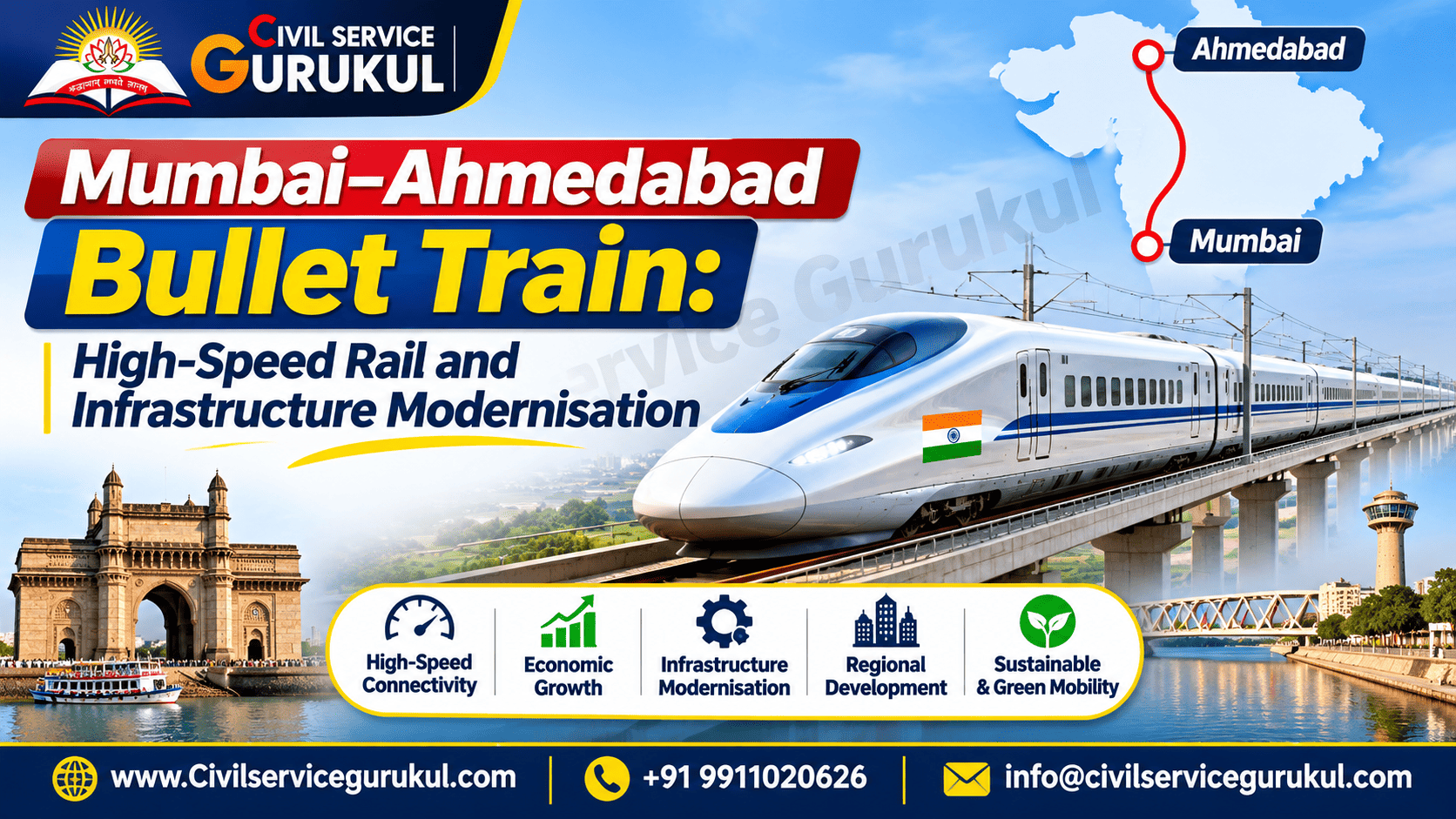
India’s Bullet Train Revolution: Mumbai–Ahmedabad High-Speed Rail and the Road Towards World-Class Infrastructure
A comprehensive analysis of India's first dedicated high-speed railway corridor, Japanese Shinkansen technology, infrastructure modernisation, economic development and sustainable mobility for UPSC Civil Services Examination 2027.
Published: | Civil Service Gurukul Editorial Team
The Mumbai–Ahmedabad High-Speed Rail Project marks India's transition towards advanced intercity passenger transport infrastructure. The project combines Japanese railway expertise with growing Indian engineering and manufacturing capabilities.
On 20 November 2026, overhead electrical systems along the Surat–Bilimora section were successfully energised, bringing the corridor closer to subsequent testing and commissioning.
Beyond reducing journey times, the project offers opportunities for regional economic integration, technology transfer, skilled employment and modernisation of India's railway ecosystem. However, its success will depend on affordability, financial sustainability, safety and effective integration with existing transport networks.
UPSC Syllabus Mapping
| UPSC Paper | Relevant Syllabus Area |
|---|---|
| GS Paper I | Urbanisation, geographical distribution of economic activities and regional development. |
| GS Paper II | India–Japan relations, bilateral agreements, government policies and international cooperation. |
| GS Paper III | Infrastructure, railways, investment models, Indian economy, technology and sustainable development. |
| GS Paper IV | Public expenditure, environmental ethics, accountability and inclusive development. |
| Essay Paper | Infrastructure-led growth, technological self-reliance and sustainable urban mobility. |
| Prelims | High-speed rail technology, geographical locations, government institutions and transport infrastructure. |
1. Why Is the Mumbai–Ahmedabad Bullet Train in the News?
India's first dedicated high-speed rail corridor achieved an important electrical infrastructure milestone on 20 November 2026.
The Overhead Equipment system along the approximately 50-km Surat–Bilimora section was successfully energised. The development covers both directions of the elevated railway alignment and enables further technical testing.
Key November 2026 Developments
- Successful energisation of overhead railway equipment.
- Progress towards electrical and operational testing.
- Development of traction substations and monitoring infrastructure.
- Advancement of civil engineering and railway systems integration.
The electrification milestone was officially reported by the Ministry of Railways through the Press Information Bureau on 21 November 2026.
Energisation of railway infrastructure does not mean commercial passenger services have commenced. Testing, safety validation, certification and other commissioning requirements must be completed before regular operations begin.
2. What Is High-Speed Rail?
High-speed rail refers to railway systems specifically designed or upgraded to support significantly faster passenger services than conventional railway networks.
Internationally, newly constructed high-speed rail infrastructure commonly supports speeds of at least 250 km/h, while suitably upgraded existing railway lines may be associated with speeds of approximately 200 km/h or above.
Important Characteristics of Dedicated High-Speed Rail
- Specially designed railway alignment.
- Advanced train control and signalling systems.
- High-capacity electrical traction infrastructure.
- Precision-engineered railway tracks.
- Separation from conflicting road and rail traffic.
- Advanced emergency management systems.
- Aerodynamically designed rolling stock.
- Continuous infrastructure and equipment monitoring.
3. Mumbai–Ahmedabad High-Speed Rail Project: Complete Overview
The Mumbai–Ahmedabad High-Speed Rail Project, commonly abbreviated as MAHSR, is India's first dedicated bullet train corridor.
| Particular | Project Details |
|---|---|
| Project Name | Mumbai–Ahmedabad High-Speed Rail Project |
| Abbreviation | MAHSR |
| Implementing Organisation | National High Speed Rail Corporation Limited (NHSRCL) |
| Administrative Ministry | Ministry of Railways |
| Corridor Length | Approximately 508 km |
| Geographical Coverage | Maharashtra, Gujarat and Dadra and Nagar Haveli |
| Number of Stations | 12 |
| Design Speed | 350 km/h |
| Planned Maximum Operating Speed | 320 km/h |
| Track Gauge | Standard Gauge – 1,435 mm |
| Technology | Japanese Shinkansen-based high-speed railway systems |
| Planned Limited-Stop Journey Time | Approximately 1 hour and 58 minutes |
| Major International Funding Partner | Japan International Cooperation Agency (JICA) |
| November 2026 Status | Under construction and progressing towards testing |
Implementation Schedule
A government factsheet issued in July 2026 identified August 2027 as the expected commencement of the initial passenger service, covering the Surat–Vapi section.
This is an announced target rather than a confirmed operational launch. Construction, rolling stock availability, system integration and statutory safety approvals may influence the actual commencement date.
4. Mumbai–Ahmedabad Bullet Train Route and Station Mapping
The corridor links important industrial, commercial and urban centres across western India.
Station Sequence: Mumbai to Sabarmati
State-Wise Distribution of Stations
| State | Stations | Total |
|---|---|---|
| Maharashtra | Mumbai, Thane, Virar and Boisar | 4 |
| Gujarat | Vapi, Bilimora, Surat, Bharuch, Vadodara, Anand, Ahmedabad and Sabarmati | 8 |
Important Geographical Features
- Western coastal plains of India.
- Thane Creek and adjoining coastal ecosystems.
- Industrial regions of southern Gujarat.
- Narmada, Tapi, Mahi and Sabarmati river systems.
- Major metropolitan and commercial centres.
Maharashtra has four planned stations, while Gujarat has eight. Dadra and Nagar Haveli is part of the alignment's geographical coverage but does not have a separately listed station.
5. Japanese Shinkansen Technology and Its Significance
Shinkansen is Japan's high-speed railway system. Its development established an important international benchmark in dedicated high-speed passenger railway engineering.
Japan introduced its first Shinkansen service in 1964 between Tokyo and Osaka.
Major Technological Features
What Is Ballastless Slab Track Technology?
Traditional railway tracks commonly rely on crushed stone ballast to support sleepers. Ballastless track systems instead use engineered concrete structures to support railway tracks.
| Conventional Ballasted Track | Ballastless Slab Track |
|---|---|
| Uses crushed stone ballast. | Uses engineered concrete support structures. |
| Requires periodic ballast maintenance. | Reduces routine maintenance associated with ballast. |
| Generally lower initial construction costs. | Generally higher initial construction costs. |
| Widely used across conventional railway networks. | Suitable for high-speed lines, tunnels and viaducts. |
| Alignment may require more frequent adjustment. | Designed to maintain precise alignment. |
The Mumbai–Ahmedabad corridor introduces Japanese J-Slab ballastless track technology into India's high-speed railway infrastructure.
6. Advanced Electrification: Understanding the 2 × 25 kV System
High-speed railway operations require reliable delivery of substantial electrical power. The Mumbai–Ahmedabad corridor uses an autotransformer-based 2 × 25 kV traction electrification arrangement.
This system improves long-distance power transmission efficiency and helps manage voltage drops along the railway alignment.
Conceptual Power Supply Flowchart
Important Technical Terms
| Technical Term | Meaning |
|---|---|
| OHE | Overhead Equipment supplying electrical energy to trains. |
| Traction Substation | Facility receiving and transforming electrical power for railway operations. |
| Pantograph | Equipment mounted on a train to collect current from overhead contact wires. |
| Autotransformer | Electrical equipment supporting efficient traction power distribution. |
| Rolling Stock | Railway vehicles, including trainsets and coaches. |
The designation 2 × 25 kV refers to the traction supply arrangement. It does not mean the train's pantograph directly receives 50 kV relative to the rail.
7. India's First Undersea Railway Tunnel
One of the most complex engineering components of the bullet train project is the approximately 21-km tunnel between Bandra Kurla Complex and Shilphata in Maharashtra.
This includes an approximately 7-km undersea section beneath Thane Creek.
Major Tunnel Construction Technologies
| Technology | Explanation |
|---|---|
| Tunnel Boring Machine (TBM) | Mechanised underground excavation equipment used to construct circular tunnels. |
| New Austrian Tunnelling Method (NATM) | Tunnelling approach using geological assessment, controlled excavation and adaptable support systems informed by ground behaviour. |
Engineering Challenges
- Complex underground geological conditions.
- Management of groundwater pressure.
- Protection of nearby infrastructure.
- Construction beneath sensitive coastal environments.
- Ventilation and emergency evacuation arrangements.
- Structural durability and long-term maintenance.
8. India–Japan Cooperation and Strategic Significance
The bullet train project represents an important component of the India–Japan Special Strategic and Global Partnership.
Japanese cooperation extends beyond financing to technical assistance, engineering practices, training and institutional capacity building.
Major Dimensions of India–Japan Cooperation
- Infrastructure financing and development assistance.
- Transfer of specialised high-speed railway knowledge.
- Training of Indian engineers and railway professionals.
- Industrial and technological cooperation.
- Development of indigenous manufacturing capabilities.
- Strengthening bilateral economic relations.
- Promotion of quality infrastructure development.
Importance for India's Foreign Policy
Cooperation with Japan contributes to India's broader strategy of diversifying technology partnerships and mobilising long-term investment for infrastructure development.
India and Japan also cooperate through the Quadrilateral Security Dialogue, commonly known as the Quad, alongside Australia and the United States.
9. Financing the Mumbai–Ahmedabad Bullet Train Project
High-speed railway projects involve substantial initial expenditure on land, viaducts, tunnels, stations, rolling stock, electrical systems and specialised railway infrastructure.
Japanese Official Development Assistance, channelled through the Japan International Cooperation Agency, forms the principal external financing arrangement for MAHSR.
| Financing Particular | Details |
|---|---|
| Major Funding Partner | Japan through JICA |
| Funding Instrument | Official Development Assistance Loan |
| Japanese Financing Share | Approximately 81% of the original project financing framework |
| Loan Tenure | 50 years |
| Moratorium | 15 years |
What Is Official Development Assistance?
Official Development Assistance refers to development-oriented financial assistance provided through eligible official institutions. It may include concessional loans or grants intended to support economic development and welfare.
Financial Considerations
- Long-term debt repayment obligations.
- Foreign exchange exposure.
- Construction cost escalation.
- Future passenger demand and fare revenue.
- Operating and maintenance expenditure.
- Potential commercial development around stations.
10. Economic Importance of High-Speed Rail in India
A. Reduction in Travel Time
Faster intercity connectivity can reduce the time required for business meetings, tourism, professional travel and regional interaction.
B. Infrastructure Multiplier Effect
Investment in railway construction generates demand for engineering services, steel, cement, electrical equipment, machinery and skilled labour.
C. Regional Economic Integration
Improved connectivity between metropolitan centres and intermediate cities can enlarge accessible labour markets, encourage investment and promote business interaction.
D. Employment Generation
Construction and operation can create employment opportunities in civil engineering, electrical systems, manufacturing, operations and maintenance.
E. Industrial Modernisation
High-speed rail projects require advanced manufacturing, precision engineering, quality assurance and sophisticated project management capabilities.
Infrastructure-Led Economic Development
The magnitude of economic benefits depends on ridership, affordability, project efficiency, complementary infrastructure and regional development policies.
11. Transit-Oriented Development and Multimodal Connectivity
Transit-Oriented Development, or TOD, encourages compact and accessible urban development around public transport facilities.
High-speed railway stations may become important economic centres when integrated with existing railways, metro systems, buses, pedestrian networks and commercial facilities.
Potential Benefits of Station-Area Development
- Better access to employment opportunities.
- Development of commercial and residential areas.
- Improved public transport integration.
- Reduction in dependence on private vehicles.
- Enhanced pedestrian accessibility.
- Potential generation of non-fare revenue.
Connection with PM Gati Shakti
The PM Gati Shakti National Master Plan promotes coordinated infrastructure planning and multimodal connectivity.
Integrating high-speed railway stations with other transportation networks is consistent with the broader objectives of coordinated infrastructure development.
12. Make in India, Atmanirbhar Bharat and Technology Transfer
A major long-term opportunity arising from the bullet train project is the development of an indigenous high-speed railway ecosystem.
India can use international cooperation to strengthen its domestic ability to manufacture, operate and maintain specialised railway systems.
Potential Areas of Indigenous Capability Development
- Railway rolling stock manufacturing.
- Advanced traction equipment.
- Track construction machinery.
- Signalling and communication systems.
- Precision engineering components.
- Tunnel and viaduct construction technologies.
- Software and railway monitoring systems.
- Technical training and quality certification.
Indigenous High-Speed Train Development
Indian Railways is also supporting domestic high-speed train development through collaboration involving Integral Coach Factory and BEML.
The announced indigenous trainset programme includes trains with a design speed of 280 km/h. This represents a separate manufacturing specification from the 350 km/h design standard of the MAHSR corridor.
13. Bullet Train vs Vande Bharat Express
| Particular | MAHSR Bullet Train | Vande Bharat Express |
|---|---|---|
| Railway Category | Dedicated high-speed rail. | Semi-high-speed passenger train service. |
| Design Speed | MAHSR corridor designed for 350 km/h. | Conventional Vande Bharat chair-car trainsets designed for up to 180 km/h. |
| Operating Speed | Corridor planned for operation up to 320 km/h. | Depends on train specification, route and permitted track speed. |
| Track Gauge | Standard gauge – 1,435 mm. | Indian broad gauge – 1,676 mm. |
| Railway Infrastructure | Dedicated high-speed corridor. | Generally operates on existing railway infrastructure. |
| Technology | Japanese high-speed railway engineering framework. | Indigenously developed trainset platform. |
| Primary Objective | Very fast intercity connectivity on dedicated lines. | Modern, efficient passenger services across existing routes. |
14. Environmental Significance of High-Speed Rail
Electric high-speed rail can contribute to lower-emission intercity transport, particularly when passenger occupancy is high and electricity generation becomes increasingly renewable.
Potential Environmental Benefits
- Reduced dependence on private road transport.
- Potential substitution of some short-distance air journeys.
- Greater utilisation of electric transportation.
- Potential reduction in operational emissions per passenger.
- Opportunities for compact urban development.
Environmental Challenges
- Embodied emissions from steel and cement production.
- Land acquisition and habitat disturbance.
- Potential impact on mangrove and coastal ecosystems.
- Construction-related dust and noise.
- Electricity demand and associated generation emissions.
- Ecological risks associated with major infrastructure works.
Environmental assessments should consider the complete life cycle of the infrastructure, rather than only emissions generated during train operations.
Relevant Sustainable Development Goals
| SDG | Relevance |
|---|---|
| SDG 8 | Decent Work and Economic Growth. |
| SDG 9 | Industry, Innovation and Infrastructure. |
| SDG 11 | Sustainable Cities and Communities. |
| SDG 13 | Climate Action. |
15. Major Challenges Facing India's High-Speed Rail Development
Opportunity Cost of Public Infrastructure Investment
Public funds devoted to major high-speed railway projects must be evaluated alongside competing requirements such as conventional railway modernisation, passenger safety, rural connectivity and urban public transportation.
The appropriate policy approach is not necessarily to choose between conventional railways and high-speed rail, but to allocate resources according to demonstrated economic and social needs.
16. India's Future High-Speed Railway Network
The Mumbai–Ahmedabad corridor is intended to provide engineering and institutional experience that can support future high-speed railway development.
A July 2026 government factsheet identified seven additional high-speed rail corridors covering nearly 4,000 kilometres.
| Serial Number | Identified Future Corridor |
|---|---|
| 1 | Delhi–Varanasi |
| 2 | Varanasi–Patna–Siliguri |
| 3 | Chennai–Bengaluru |
| 4 | Bengaluru–Hyderabad |
| 5 | Chennai–Hyderabad |
| 6 | Mumbai–Pune |
| 7 | Pune–Hyderabad |
Importance of Standardisation
Standard engineering designs, maintenance procedures and technical specifications may help reduce duplication, improve manufacturing efficiency and facilitate future railway expansion.
17. Way Forward: Building a Sustainable High-Speed Rail Ecosystem
Civil Service Gurukul proposes an original RAIL framework for UPSC Mains answer writing.
| Framework | Recommended Approach |
|---|---|
| R – Responsible Investment | Undertake realistic demand forecasting, cost-benefit analysis and transparent financial monitoring. |
| A – Accessibility and Affordability | Promote inclusive access, multimodal connectivity and appropriate fare policies. |
| I – Indigenous Innovation | Strengthen domestic manufacturing, technical research and specialised workforce development. |
| L – Long-Term Sustainability | Ensure environmental protection, safety, maintenance and lifecycle planning. |
Additional Policy Recommendations
- Strengthen transparent project appraisal mechanisms.
- Promote effective rehabilitation and compensation.
- Improve integration with existing railway and metro networks.
- Establish robust safety certification mechanisms.
- Encourage domestic research and development.
- Ensure continuous environmental monitoring.
- Promote renewable electricity procurement where feasible.
- Develop skilled technical and operational personnel.
- Balance high-speed rail investment with conventional railway requirements.
- Conduct periodic evaluations of passenger demand and economic outcomes.
18. UPSC GS Paper IV Ethics Case Study
Case Study: Development Versus Displacement
You are a senior district administrator responsible for coordinating land acquisition for a proposed high-speed railway corridor.
The project is expected to improve regional connectivity and generate economic opportunities. However, local farmers are concerned about loss of agricultural land and livelihood security. Environmental groups have also raised concerns about sensitive habitats along the proposed route.
Questions:- Identify the ethical issues involved.
- Identify the major stakeholders.
- Examine the conflict between development and social justice.
- Suggest an appropriate administrative course of action.
Reveal Model Solution
Ethical Issues
- Public interest versus individual property interests.
- Economic development versus environmental protection.
- Fair compensation and rehabilitation.
- Transparency and administrative accountability.
- Intergenerational equity.
Stakeholders
Farmers, local communities, railway authorities, government agencies, environmental organisations, future passengers and taxpayers.
Recommended Course of Action
Conduct meaningful stakeholder consultations, ensure lawful and fair compensation, evaluate reasonable alignment alternatives, establish effective grievance redressal mechanisms and implement environmental safeguards.
The administration should pursue infrastructure development while protecting dignity, livelihood security and legitimate community rights.
Ethical Values
Justice, empathy, integrity, transparency, accountability, public interest and sustainability.
19. UPSC Prelims 2027 Practice MCQs
The following are original examination-oriented practice questions for UPSC preparation.
With reference to the Mumbai–Ahmedabad High-Speed Rail Project, consider the following statements:
- The corridor has an approximate length of 508 km.
- Its planned maximum operating speed is 320 km/h.
- It uses Indian broad-gauge railway tracks.
Which of the statements given above are correct?
A. 1 only
B. 1 and 2 only
C. 2 and 3 only
D. 1, 2 and 3
Reveal Answer and Explanation
Correct Answer: B
Statements 1 and 2 are correct. Statement 3 is incorrect because the corridor uses standard gauge of 1,435 mm.
MCQ Trap: Standard gauge is different from Indian broad gauge.
The November 2026 electrification milestone of the Mumbai–Ahmedabad Bullet Train Project was associated with which section?
A. Mumbai–Thane
B. Ahmedabad–Sabarmati
C. Surat–Bilimora
D. Vadodara–Anand
Reveal Answer and Explanation
Correct Answer: C
The overhead railway equipment along the Surat–Bilimora section was energised on 20 November 2026.
Which of the following organisations is responsible for implementing the Mumbai–Ahmedabad High-Speed Rail Project?
A. National Highways Authority of India
B. National High Speed Rail Corporation Limited
C. Dedicated Freight Corridor Corporation of India Limited
D. Airports Authority of India
Reveal Answer and Explanation
Correct Answer: B
NHSRCL is the implementing organisation for the Mumbai–Ahmedabad High-Speed Rail Project.
India's bullet train undersea railway tunnel is being constructed beneath:
A. Palk Strait
B. Gulf of Kutch
C. Chilika Lake
D. Thane Creek
Reveal Answer and Explanation
Correct Answer: D
The undersea tunnel component lies beneath Thane Creek in Maharashtra.
MCQ Trigger: Thane Creek – Undersea Railway Tunnel.
Consider the following statements regarding Japanese cooperation in India's bullet train project:
- Japan provides technical and financial assistance.
- JICA is associated with project financing.
- The project is implemented by the Quad.
Which of the statements given above are correct?
A. 1 only
B. 1 and 2 only
C. 2 and 3 only
D. 1, 2 and 3
Reveal Answer and Explanation
Correct Answer: B
Japan provides bilateral technical and financial assistance, including financing through JICA. The project is not implemented by the Quad.
Which of the following are associated with high-speed railway infrastructure?
- Ballastless slab tracks.
- Advanced train control systems.
- High-capacity electrical traction.
- Precision-engineered railway alignment.
Select the correct answer:
A. 1 and 2 only
B. 2 and 3 only
C. 1, 3 and 4 only
D. 1, 2, 3 and 4
Reveal Answer and Explanation
Correct Answer: D
All four are important technologies or engineering features associated with modern high-speed railway infrastructure.
Consider the following pairs:
- Boisar – Maharashtra
- Bilimora – Gujarat
- Vapi – Rajasthan
- Sabarmati – Gujarat
How many of the above pairs are correctly matched?
A. Only one
B. Only two
C. Only three
D. All four
Reveal Answer and Explanation
Correct Answer: C
Pairs 1, 2 and 4 are correct. Vapi is located in Gujarat, not Rajasthan.
A pantograph in an electric railway system primarily performs which function?
A. Collects electricity from overhead contact wires.
B. Controls railway ticket prices.
C. Excavates underground railway tunnels.
D. Measures passenger occupancy.
Reveal Answer and Explanation
Correct Answer: A
A pantograph collects electrical current from the overhead contact system and supplies it to the train's electrical equipment.
Transit-Oriented Development is primarily associated with:
A. Increasing dependence on private vehicles.
B. Developing accessible and compact urban areas around public transport facilities.
C. Expanding offshore petroleum extraction.
D. Promoting exclusively rural agricultural infrastructure.
Reveal Answer and Explanation
Correct Answer: B
Transit-Oriented Development seeks to integrate land use and public transportation through accessible, compact and connected urban development.
Which of the following statements best describes the difference between high-speed rail corridor design speed and operating speed?
A. Both terms always refer to the same speed.
B. Operating speed must always exceed design speed.
C. Design speed is an engineering parameter, while operating speed is determined by permitted operational conditions.
D. Design speed refers exclusively to conventional freight trains.
Reveal Answer and Explanation
Correct Answer: C
Design speed represents an infrastructure or equipment engineering parameter. Actual operating speed depends on technical compatibility, safety approvals and operational restrictions.
20. UPSC Mains Practice Questions
Examine the potential role of high-speed railway corridors in transforming urbanisation and regional development patterns in India.
15 Marks | 250 Words
Discuss the significance of the Mumbai–Ahmedabad High-Speed Rail Project in strengthening India–Japan bilateral relations.
15 Marks | 250 Words
Examine the economic and technological significance of high-speed rail development in India. Discuss its major implementation challenges.
15 Marks | 250 Words
Can high-speed rail contribute to sustainable transportation in India? Critically examine its environmental benefits and limitations.
15 Marks | 250 Words
Public infrastructure development must balance economic efficiency with social justice. Discuss in the context of high-speed railway projects.
10 Marks | 150 Words
21. UPSC Mains Model Answer
Discuss the significance of the Mumbai–Ahmedabad Bullet Train Project for India's infrastructure modernisation. Examine the challenges and suggest a suitable way forward.
15 Marks | Approximately 250 Words
Introduction
The 508-km Mumbai–Ahmedabad High-Speed Rail Project represents India's entry into dedicated high-speed railway transportation. Developed with Japanese cooperation, it offers opportunities for infrastructure modernisation, technology transfer and regional economic integration.
Significance
- Economic Growth: Infrastructure investment generates industrial demand, employment and productivity opportunities.
- Regional Connectivity: Reduced journey times can facilitate business, tourism and labour mobility.
- Technology Transfer: Advanced railway systems strengthen indigenous engineering and manufacturing capabilities.
- International Relations: The project reinforces India–Japan strategic and economic cooperation.
- Sustainable Mobility: Electric rail can provide an alternative to road and short-distance air travel.
Major Challenges
- High capital expenditure and financing requirements.
- Land acquisition and rehabilitation concerns.
- Environmental risks in sensitive ecosystems.
- Passenger affordability and financial viability.
- Dependence on specialised technologies.
- Competing investment requirements of conventional railways.
Way Forward
- Ensure transparent cost-benefit analysis.
- Promote indigenous manufacturing and technology transfer.
- Strengthen multimodal station connectivity.
- Protect affected communities and ecosystems.
- Develop realistic fare and ridership strategies.
- Maintain robust operational safety standards.
Conclusion
High-speed rail should form part of an integrated national transport strategy rather than remain an isolated infrastructure achievement. By combining technological innovation with financial prudence, environmental responsibility and inclusive accessibility, India can transform railway modernisation into a catalyst for sustainable development.
22. Quick Revision Notes for UPSC Prelims 2027
| Keyword | Exam-Oriented Fact |
|---|---|
| MAHSR | Mumbai–Ahmedabad High-Speed Rail. |
| NHSRCL | National High Speed Rail Corporation Limited. |
| Corridor Length | Approximately 508 km. |
| Number of Stations | 12. |
| Maharashtra Stations | 4. |
| Gujarat Stations | 8. |
| Corridor Design Speed | 350 km/h. |
| Planned Maximum Operating Speed | 320 km/h. |
| Track Gauge | Standard gauge – 1,435 mm. |
| Shinkansen | Japanese high-speed railway system. |
| JICA | Japan International Cooperation Agency. |
| ODA | Official Development Assistance. |
| Loan Tenure | 50 years. |
| Loan Moratorium | 15 years. |
| Total BKC–Shilphata Tunnel | Approximately 21 km. |
| Undersea Tunnel Component | Approximately 7 km beneath Thane Creek. |
| OHE | Overhead Equipment. |
| Traction System | 2 × 25 kV. |
| November 2026 Milestone | Surat–Bilimora section energisation on 20 November. |
| J-Slab | Japanese ballastless slab track technology. |
| TBM | Tunnel Boring Machine. |
| NATM | New Austrian Tunnelling Method. |
| TOD | Transit-Oriented Development. |
| Initial Service Target | August 2027, subject to project readiness and approvals. |
23. UPSC Essay Value Addition
Important Essay Topics
- Infrastructure as the foundation of national development.
- Technology transfer and India's journey towards self-reliance.
- Economic development versus environmental sustainability.
- Modern transportation and the transformation of urban India.
- India–Japan partnership in the twenty-first century.
- Inclusive infrastructure for Viksit Bharat 2047.
24. Frequently Asked Questions
What is the Mumbai–Ahmedabad Bullet Train Project?
It is India's first dedicated high-speed railway corridor, connecting Mumbai and Ahmedabad through approximately 508 kilometres of specialised railway infrastructure.
What is the maximum speed of India's bullet train corridor?
The Mumbai–Ahmedabad corridor has a design speed of 350 km/h and a planned maximum operating speed of 320 km/h.
How many stations are planned along the Mumbai–Ahmedabad corridor?
Twelve stations are planned, including four in Maharashtra and eight in Gujarat.
Which country is assisting India with the bullet train project?
Japan provides technical and financial cooperation, including development financing through JICA.
Where is India's first undersea railway tunnel being constructed?
The approximately seven-kilometre undersea component is being constructed beneath Thane Creek in Maharashtra.
What was the bullet train project's November 2026 milestone?
The overhead railway electrical system along the Surat–Bilimora section was successfully energised on 20 November 2026.
When will India's first bullet train start operating?
A government announcement identified August 2027 as the expected commencement of initial services. The actual launch remains subject to construction, testing and safety approvals.
What is the difference between Vande Bharat and the Bullet Train?
Vande Bharat is a modern semi-high-speed train service generally operating on existing broad-gauge railway lines. The Mumbai–Ahmedabad Bullet Train uses dedicated standard-gauge high-speed railway infrastructure.
Is high-speed rail environmentally sustainable?
High-speed electric rail may offer environmental benefits depending on passenger occupancy, electricity sources, construction emissions and ecological impacts across the project lifecycle.
Why is the Mumbai–Ahmedabad Bullet Train important for UPSC?
The topic connects infrastructure development, Indian economy, India–Japan relations, railway technology, environmental sustainability, urbanisation and public policy.
25. Conclusion
The Mumbai–Ahmedabad High-Speed Rail Project is an important milestone in India's infrastructure modernisation journey.
Its long-term significance extends beyond the introduction of faster passenger trains. The project can contribute to specialised industrial development, technological learning, regional connectivity and international cooperation.
However, successful railway modernisation requires financial discipline, environmental responsibility, inclusive accessibility and continuous attention to passenger safety.
India's vision of Viksit Bharat 2047 must therefore be supported by transportation infrastructure that is technologically advanced, economically viable, socially inclusive and environmentally sustainable.
Prepare Smarter. Think Deeper. Become a Civil Servant.
Civil Service Gurukul provides concept-oriented, examination-focused and analytical learning resources for civil service aspirants.
Explore Our UPSC Learning Resources
Daily Current Affairs |
UPSC Prelims 2027 Test Series |
General Studies Notes |
Mains Answer Writing |
Indian Economy |
Geography MCQs |
Science and Technology |
Ethics Case Studies |
Essay Preparation |
Personalised Mentorship
Website:
www.civilservicegurukul.com
Mobile:
+91 99110 20626
Email:
info@civilservicegurukul.com
Prepare with Mentors Who Cleared the Exam
Get personalized study plans, evaluated answer models, and test series access.