
India’s Oil and Gas Production: Energy Security and Exploration
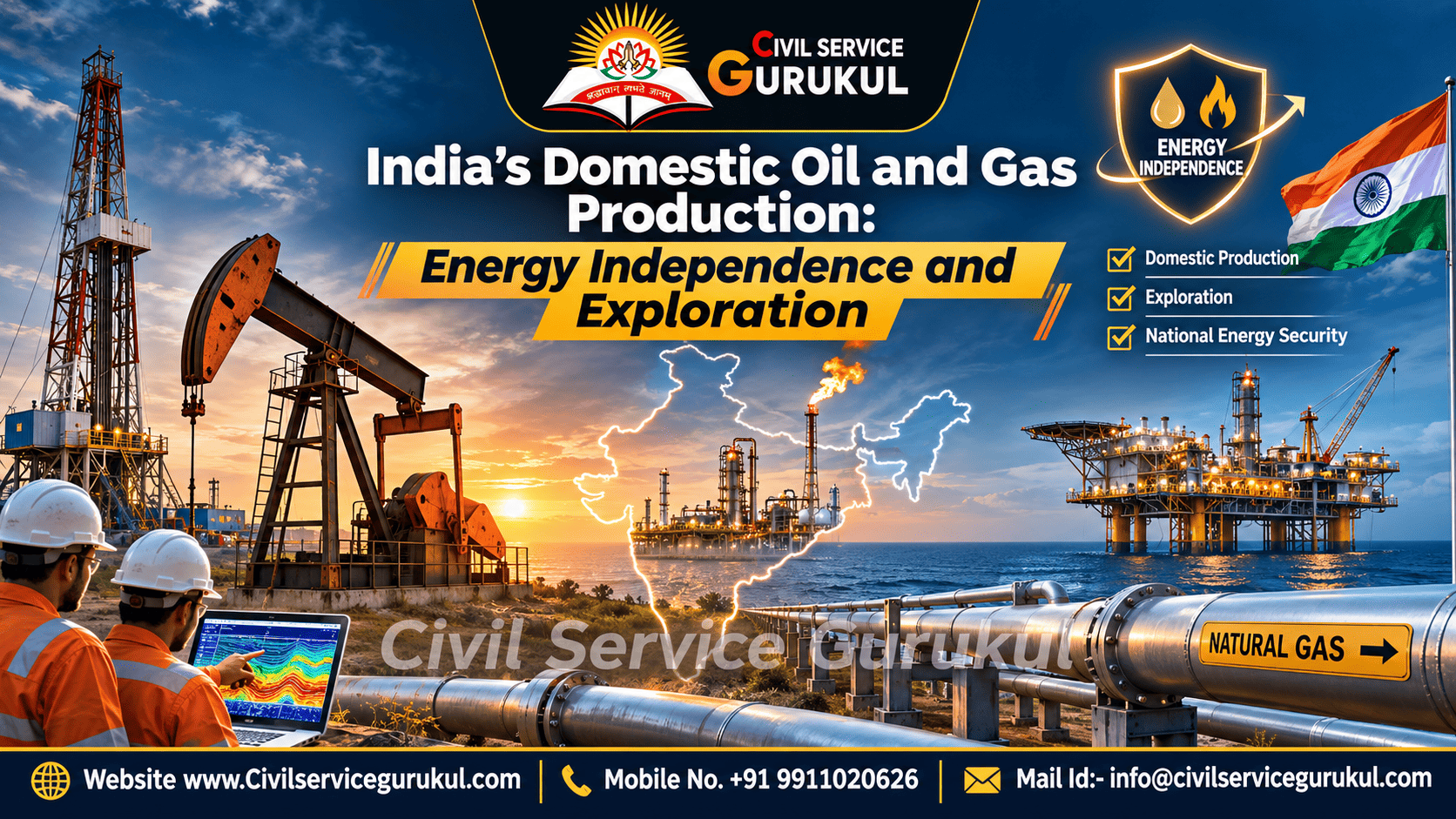
India’s Quest for Energy Independence: Domestic Oil and Gas Production, Hydrocarbon Exploration and the Future of Energy Security
A comprehensive analysis of India's petroleum resources, import dependence, offshore exploration, government policies and sustainable energy transition for UPSC Civil Services Examination 2027.
Published: | Civil Service Gurukul Editorial Team
India's economic development requires a reliable, affordable and secure supply of energy. However, substantial dependence on imported crude oil exposes the country to international price volatility, geopolitical disruptions and foreign exchange pressures.
Expanding domestic hydrocarbon production, modernising exploration policies, improving offshore capabilities and accelerating the transition towards cleaner energy are essential components of India's long-term energy strategy.
The National Offshore Exploration Scheme, Samudra Manthan, approved in July 2026, represents a major policy intervention to strengthen domestic exploration capabilities.
UPSC Syllabus Mapping
| UPSC Paper | Relevant Syllabus Area |
|---|---|
| GS Paper I | Distribution of key natural resources, Indian geography and mineral resources. |
| GS Paper II | Government policies, international relations, energy diplomacy and strategic partnerships. |
| GS Paper III | Indian economy, infrastructure, energy, investment, environmental conservation and technological development. |
| GS Paper IV | Intergenerational equity, environmental ethics, corporate responsibility and sustainable development. |
| Essay Paper | Energy independence, economic sovereignty, resource security and sustainable development. |
| Prelims | Sedimentary basins, oil fields, government schemes, petroleum reserves and international organisations. |
1. Why Is India's Domestic Oil and Gas Production in the News?
India has intensified efforts to strengthen domestic energy production amid rising demand, international supply risks and continued dependence on imported hydrocarbons.
On 31 July 2026, the Union Cabinet approved Samudra Manthan, a major offshore exploration initiative with an approved financial outlay of ₹84,084 crore through FY 2030-31.
Earlier, on 25 July 2026, drilling commenced at an appraisal well in the Mahanadi Offshore Basin, highlighting the growing importance of India's eastern offshore resources.
Major Reasons for Renewed Policy Attention
- High dependence on imported crude oil.
- Declining production from mature oil fields.
- Increasing domestic energy consumption.
- Geopolitical uncertainty in major oil-producing regions.
- Volatility in international crude oil prices.
- Growing opportunities in deepwater exploration.
- Need for greater technological self-reliance.
- Long-term objectives of Atmanirbhar Bharat.
2. What Is Energy Security?
Energy security refers to the ability of a country to maintain an uninterrupted and affordable supply of energy while managing economic, geopolitical and environmental risks.
Four Dimensions of Energy Security
Energy Security vs Energy Independence
| Energy Security | Energy Independence |
|---|---|
| Reliable and affordable energy availability. | Greater ability to meet energy requirements domestically. |
| May include diversified international imports. | Focuses on reducing external dependence. |
| Emphasises resilience against supply disruptions. | Emphasises domestic production and substitution. |
| Requires supply diversification and storage. | Requires production, efficiency and alternative energy. |
3. Current Status of India's Domestic Oil and Gas Production
India remains one of the world's largest consumers of petroleum. However, its domestic production satisfies only a limited portion of national crude oil requirements.
India's Crude Oil Production and Import Dependence
| Financial Year | Domestic Crude Oil Production | Import Dependence |
|---|---|---|
| 2021-22 | 29.7 MMT | 85.5% |
| 2022-23 | 29.2 MMT | 87.4% |
| 2023-24 | 29.4 MMT | 87.8% |
| 2024-25 | 28.7 MMT | 88.3% |
| 2025-26 (Provisional) | 28.0 MMT | 88.7% |
Data attribution: Petroleum Planning and Analysis Cell figures reported in a parliamentary reply, July 2026. Figures may be revised subsequently.
Visual Analysis: India's Crude Oil Import Dependence
2021-22 — 85.5%
2022-23 — 87.4%
2023-24 — 87.8%
2024-25 — 88.3%
2025-26 — 88.7% (Provisional)
Natural Gas Production
India produced approximately 34.78 billion cubic metres of natural gas in FY 2025-26, according to reported petroleum ministry data.
Imported LNG meets a substantial portion of domestic natural gas requirements, particularly in fertiliser production, industrial consumption and city gas distribution.
- MMT: Million Metric Tonnes.
- BCM: Billion Cubic Metres.
- MMSCM: Million Metric Standard Cubic Metres.
- MMTOE: Million Metric Tonnes of Oil Equivalent.
4. What Are Hydrocarbons?
Hydrocarbons are chemical compounds containing hydrogen and carbon. Petroleum and natural gas are important naturally occurring hydrocarbon resources.
Conventional petroleum accumulations generally develop when buried organic material undergoes transformation over geological time and the resulting hydrocarbons migrate into suitable reservoirs.
Major Types of Hydrocarbon Resources
| Resource | Characteristics |
|---|---|
| Crude Oil | Liquid hydrocarbon mixture refined into petroleum products. |
| Natural Gas | Gaseous hydrocarbon mixture consisting primarily of methane. |
| Shale Gas | Natural gas trapped within low-permeability shale formations. |
| Tight Gas | Gas found in reservoirs with low permeability. |
| Coal Bed Methane (CBM) | Methane associated with underground coal seams. |
| Gas Hydrates | Ice-like crystalline structures containing trapped gas molecules. |
Essential Elements of a Conventional Petroleum System
- Source Rock: Rock containing organic matter capable of generating hydrocarbons.
- Reservoir Rock: Porous and permeable formation that can store hydrocarbons.
- Cap Rock: Relatively impermeable layer that restricts further migration.
- Trap: Geological arrangement capable of accumulating hydrocarbons.
- Migration: Movement of hydrocarbons from source rock towards reservoirs.
- Timing: Appropriate geological sequence for generation, migration and trapping.
5. Major Oil and Natural Gas Producing Regions in India
India has 26 sedimentary basins covering approximately 3.36 million square kilometres, including onshore and offshore geological regions.
These basins differ substantially in geological characteristics, exploration maturity and commercial production potential.
Seven Category-I Sedimentary Basins
Category-I basins are associated with established commercial hydrocarbon production.
| Sedimentary Basin | Geographical Location | Importance |
|---|---|---|
| Mumbai Offshore Basin | Arabian Sea, western offshore India | Major offshore crude oil and natural gas production. |
| Assam Shelf Basin | Assam, northeastern India | Established onshore petroleum production. |
| Assam-Arakan Fold Belt | Northeastern India | Geologically complex hydrocarbon-bearing region. |
| Cambay Basin | Gujarat | Important onshore oil and natural gas fields. |
| Rajasthan Basin | Western Rajasthan | Large onshore crude oil discoveries. |
| Krishna-Godavari Basin | Andhra Pradesh and adjoining offshore Bay of Bengal | Major natural gas and offshore petroleum resources. |
| Cauvery Basin | Tamil Nadu, Puducherry and adjoining offshore areas | Oil and natural gas production and exploration. |
Important Emerging Exploration Regions
- Mahanadi Basin.
- Andaman-Nicobar Basin.
- Kutch Basin.
- Saurashtra Basin.
- Vindhyan Basin.
Important Oil Fields for UPSC Map-Based Questions
| Oil Field or Region | State or Geographical Location |
|---|---|
| Digboi | Assam |
| Naharkatiya | Assam |
| Moran | Assam |
| Ankleshwar | Gujarat |
| Kalol | Gujarat |
| Mangala Oil Field | Barmer region, Rajasthan |
| Mumbai High | Arabian Sea |
| Heera Oil Field | Western Offshore |
| KG-D6 Block | Krishna-Godavari Offshore Basin |
| Narimanam | Tamil Nadu |
Western India: Rajasthan, Cambay and Mumbai Offshore.
Eastern India: Krishna-Godavari, Mahanadi and Cauvery.
Northeastern India: Assam Shelf and Assam-Arakan Fold Belt.
6. How Does Oil and Gas Exploration Take Place?
Hydrocarbon exploration is a scientific, technological and capital-intensive process. It involves identifying potential geological structures and determining whether hydrocarbons can be commercially extracted.
Exploratory Well vs Appraisal Well vs Development Well
| Type of Well | Purpose |
|---|---|
| Exploratory Well | Determines whether a potential geological structure contains hydrocarbons. |
| Appraisal Well | Evaluates the size, characteristics and commercial potential of a discovery. |
| Development Well | Supports extraction from a commercially developed field. |
Resources vs Reserves
Hydrocarbon resources represent estimated quantities that may exist within geological formations.
Reserves are discovered quantities assessed as commercially recoverable under defined technical and economic conditions.
Upstream, Midstream and Downstream Sectors
| Segment | Major Activities |
|---|---|
| Upstream | Exploration, drilling and extraction. |
| Midstream | Transportation, storage and related infrastructure. |
| Downstream | Refining, processing, distribution and marketing. |
7. Major Oil and Gas Companies and Institutions in India
| Organisation | Major Role |
|---|---|
| Oil and Natural Gas Corporation (ONGC) | Major upstream oil and natural gas exploration and production company. |
| Oil India Limited (OIL) | Oil and gas exploration, production and associated activities. |
| Indian Oil Corporation Limited (IOCL) | Refining, petroleum product distribution and marketing. |
| Gas Authority of India Limited (GAIL) | Natural gas transmission, marketing and petrochemical activities. |
| Reliance Industries Limited | Private-sector refining, petrochemicals and hydrocarbon production. |
| Cairn Oil & Gas, Vedanta | Private-sector hydrocarbon exploration and production. |
| Directorate General of Hydrocarbons (DGH) | Technical support, monitoring and administration of upstream petroleum activities. |
| Petroleum Planning and Analysis Cell (PPAC) | Petroleum-sector statistics, economic analysis and policy support. |
| Petroleum and Natural Gas Regulatory Board (PNGRB) | Regulation of specified petroleum and natural gas activities, excluding crude oil and natural gas production. |
| Indian Strategic Petroleum Reserves Limited (ISPRL) | Development and management of strategic crude oil storage infrastructure. |
8. Major Government Policies to Increase Domestic Oil and Gas Production
A. New Exploration Licensing Policy (NELP)
NELP introduced a competitive framework for awarding exploration blocks and encouraging investment in the petroleum sector.
B. Hydrocarbon Exploration and Licensing Policy (HELP), 2016
HELP replaced the earlier licensing approach with a more flexible framework for developing conventional and unconventional hydrocarbons.
Important Features
- Uniform licensing framework for different hydrocarbon resources.
- Revenue-sharing contractual model.
- Open acreage-based exploration opportunities.
- Greater marketing and pricing flexibility, subject to applicable conditions.
- Measures to attract investment in offshore and frontier basins.
NELP vs HELP
| Particular | NELP | HELP |
|---|---|---|
| Contract Model | Production-sharing framework. | Revenue-sharing framework. |
| Licensing Approach | Earlier resource-specific arrangements. | Uniform hydrocarbon licensing. |
| Exploration Blocks | Government-defined bidding blocks. | Greater flexibility through open acreage. |
| Cost Recovery | Contractual cost-recovery mechanism. | Revenue sharing without conventional cost recovery. |
C. Open Acreage Licensing Programme (OALP)
OALP allows exploration companies to identify and propose areas of interest instead of depending exclusively on predefined exploration blocks offered by the government.
D. Discovered Small Field Policy (DSF), 2015
The policy facilitates commercial development of previously discovered hydrocarbon fields that have remained undeveloped or underutilised.
E. National Data Repository (NDR)
The National Data Repository provides access to geological, geophysical and exploration-related information, supporting informed investment decisions.
F. National Seismic Programme
The programme strengthens geological knowledge through seismic surveys, particularly in areas where exploration-related data has been limited.
G. Mission Anveshan
Mission Anveshan supports improved assessment of selected onshore sedimentary basins through systematic seismic data collection.
H. Oilfields (Regulation and Development) Amendment Act, 2025
The 2025 amendment modernises the legislative framework for petroleum operations and seeks to improve regulatory predictability, investment confidence and operational flexibility.
I. Petroleum and Natural Gas Rules, 2025
These rules support implementation of the revised statutory framework and administration of petroleum leases.
9. Samudra Manthan: National Offshore Exploration Scheme 2026
The Union Cabinet approved Samudra Manthan on 31 July 2026 as a Central Sector Scheme under the Ministry of Petroleum and Natural Gas.
The initiative focuses on improving India's ability to investigate and develop offshore hydrocarbon resources through coordinated public investment and industry participation.
| Particular | Details |
|---|---|
| Scheme Name | Samudra Manthan – National Offshore Exploration Scheme |
| Approval Date | 31 July 2026 |
| Implementing Ministry | Ministry of Petroleum and Natural Gas |
| Scheme Type | Central Sector Scheme |
| Approved Outlay | ₹84,084 crore |
| Implementation Period | Up to FY 2030-31 |
| Primary Objective | Accelerate offshore hydrocarbon exploration and strengthen domestic capabilities. |
Major Components
- Advanced offshore geological and seismic investigations.
- Financial support for high-risk exploratory drilling.
- Shared infrastructure for developing offshore discoveries.
- Domestic oilfield equipment and engineering capabilities.
- Digital monitoring and specialised workforce development.
Expected Outcomes
| Indicator | Announced Objective or Estimate |
|---|---|
| Annual Domestic Oil and Gas Production | Increase from approximately 62 MMTOE to 80 MMTOE. |
| Hydrocarbon Resource Base | Increase from approximately 1.6 billion TOE to 2.2 billion TOE. |
| Potential Reserve Accretion | More than 600 MMTOE. |
| Potential Annual Crude Oil Import Savings | Approximately ₹1 lakh crore. |
Why Offshore Exploration Is Important
India's offshore regions offer opportunities for new petroleum discoveries. However, deepwater operations involve greater geological uncertainty, sophisticated technology and substantial financial commitments.
Government-supported exploration can help address early-stage investment barriers, although every project must independently demonstrate commercial and environmental viability.
10. Mahanadi Basin and India's Eastern Offshore Opportunity
The Mahanadi Basin extends across parts of eastern India and adjoining offshore regions of the Bay of Bengal.
The commencement of appraisal drilling in the offshore basin on 25 July 2026 represents an important step in evaluating its hydrocarbon potential.
Strategic Importance of the Mahanadi Basin
- Diversification of India's domestic petroleum production regions.
- Development of deepwater exploration capabilities.
- Potential expansion of eastern offshore infrastructure.
- Opportunities for investment and technological innovation.
- Possible long-term contribution to energy security.
Andaman-Nicobar Basin
The Andaman-Nicobar region is another frontier exploration area. Its complex geological setting requires detailed scientific investigation and carefully planned offshore activities.
Exploration in this region must also consider marine biodiversity, sensitive ecosystems and the interests of local communities.
- Mumbai High – Arabian Sea.
- Krishna-Godavari Basin – Bay of Bengal.
- Mahanadi Basin – Eastern India and adjoining offshore region.
- Andaman Basin – Andaman Sea and surrounding offshore areas.
11. Major Challenges in India's Domestic Oil and Gas Production
Additional Structural Challenges
- Limited commercial success in frontier basins.
- Insufficient exploration data in certain regions.
- Volatility in international petroleum prices.
- Competition for global exploration investment.
- Dependence on imported specialised oilfield equipment.
- Infrastructure limitations in newly discovered fields.
- Growing domestic demand despite production improvements.
- Risk of stranded fossil fuel assets during energy transition.
Enhanced Oil Recovery (EOR)
Enhanced Oil Recovery refers to specialised techniques used to improve the recovery of oil remaining in reservoirs.
Thermal, chemical and gas-injection methods may improve extraction from suitable mature fields, depending on reservoir characteristics and economic feasibility.
12. Economic and Strategic Importance of Domestic Oil Production
A. Current Account Deficit
Higher domestic output can reduce the requirement for imported petroleum, other factors remaining unchanged. This may support India's external account stability.
B. Foreign Exchange Conservation
Lower import requirements can reduce foreign currency expenditure and vulnerability to international financial pressures.
C. Inflation Management
Greater supply resilience may help reduce exposure to international energy price shocks, although domestically produced oil can still be linked to international market prices.
D. Industrial Development
Domestic petroleum and natural gas support fertilisers, petrochemicals, transportation, manufacturing and other industrial activities.
E. Employment Generation
Exploration, engineering, equipment manufacturing, transportation and associated services can create skilled employment opportunities.
F. Strategic Autonomy
A diversified domestic and international energy portfolio gives India greater flexibility during geopolitical disruptions.
Economic Impact of High Crude Oil Import Dependence
The magnitude of these effects depends on exchange rates, domestic taxation, international contracts, government policies and market conditions.
13. Geopolitics of India's Energy Security
India imports petroleum from multiple regions, including West Asia, Russia, Africa and other global suppliers.
Political instability, maritime disruptions and international sanctions may influence the price and availability of imported energy.
Important Maritime Chokepoints for UPSC
| Chokepoint | Connects | Strategic Importance |
|---|---|---|
| Strait of Hormuz | Persian Gulf and Gulf of Oman | Critical route for Gulf petroleum and LNG exports. |
| Bab-el-Mandeb Strait | Red Sea and Gulf of Aden | Connects major maritime routes towards the Suez Canal. |
| Suez Canal | Mediterranean Sea and Red Sea | Important shipping route between Europe and Asia. |
| Strait of Malacca | Andaman Sea and South China Sea via the Singapore Strait | Major energy and commercial shipping corridor towards East Asia. |
Role of Energy Diplomacy
- Diversification of oil and gas suppliers.
- Long-term purchase agreements.
- International upstream investments.
- Strategic partnerships with producing countries.
- Cooperation on shipping and maritime security.
- Participation in international energy dialogues.
OPEC vs OPEC+
The Organization of the Petroleum Exporting Countries (OPEC) coordinates petroleum policies among its member countries.
OPEC+ refers to broader production cooperation between OPEC members and participating non-OPEC oil-producing countries.
14. Strategic Petroleum Reserves of India
Strategic Petroleum Reserves are emergency crude oil stocks designed to improve a country's ability to respond to major supply disruptions.
India's Phase-I strategic crude oil storage infrastructure has a combined designed capacity of 5.33 MMT.
| Strategic Reserve | State | Designed Capacity |
|---|---|---|
| Visakhapatnam | Andhra Pradesh | 1.33 MMT |
| Mangaluru | Karnataka | 1.50 MMT |
| Padur | Karnataka | 2.50 MMT |
| Total | 5.33 MMT | |
Importance of Strategic Petroleum Reserves
- Emergency protection against supply disruptions.
- Improved national energy resilience.
- Support during geopolitical emergencies.
- Additional flexibility in managing petroleum supplies.
15. Environmental Concerns Associated with Oil and Gas Exploration
While domestic hydrocarbon production can strengthen energy security, it may also create significant environmental risks.
| Environmental Concern | Potential Impact |
|---|---|
| Oil Spills | Marine pollution, damage to fisheries and coastal ecosystems. |
| Methane Leakage | Contribution to greenhouse gas emissions. |
| Gas Flaring | Resource wastage and atmospheric emissions. |
| Offshore Seismic Surveys | Potential disturbance to marine fauna. |
| Onshore Drilling | Land disturbance and risks to soil and water quality. |
| Habitat Fragmentation | Possible biodiversity loss in sensitive regions. |
| Climate Change | Long-term emissions associated with fossil fuel production and consumption. |
Measures for Environmentally Responsible Exploration
- Environmental impact assessment where applicable.
- Strict operational and industrial safety standards.
- Oil spill preparedness and emergency response.
- Methane leak detection and repair programmes.
- Reduction of routine gas flaring.
- Protection of marine and terrestrial biodiversity.
- Meaningful consultation with affected communities.
- Responsible decommissioning of abandoned infrastructure.
16. Energy Independence and India's Clean Energy Transition
India cannot depend exclusively on increasing domestic fossil fuel production to achieve long-term energy independence.
Reducing petroleum demand through efficiency, electrification and renewable energy is equally important.
| Initiative | Contribution to Energy Security |
|---|---|
| National Green Hydrogen Mission | Promotes low-emission hydrogen production and industrial decarbonisation. |
| Ethanol Blended Petrol Programme | Substitutes part of conventional petrol demand with ethanol. |
| SATAT Initiative | Promotes compressed biogas production and utilisation. |
| Electric Mobility | Can reduce petroleum consumption in road transportation. |
| National Solar Mission | Supports expansion of domestic renewable electricity generation. |
| Energy Efficiency Programmes | Reduce overall energy requirements through efficient consumption. |
| Natural Gas Infrastructure | Facilitates diversified fuel use in industries and urban areas. |
Natural Gas as a Transition Fuel
Natural gas generally produces less carbon dioxide than coal per unit of energy during combustion.
However, its overall environmental performance also depends on methane leakage, transportation, processing and the complete life-cycle emissions.
India has articulated an objective of increasing the share of natural gas in its primary energy mix to 15% by 2030. This remains a policy target rather than a share already achieved.
India's Energy Independence Vision
The national vision of energy independence by 2047 requires a combination of secure domestic resources, clean energy innovation, diversified supplies and efficient consumption.
17. Way Forward: India's Roadmap Towards Energy Self-Reliance
Civil Service Gurukul proposes an original ENERGY framework for UPSC Mains answer writing.
| Framework | Recommended Approach |
|---|---|
| E – Exploration | Strengthen scientific assessment and commercial development of prospective basins. |
| N – New Technologies | Promote indigenous offshore equipment, seismic analysis and enhanced recovery. |
| E – Efficiency | Reduce petroleum demand through efficient transport and industrial operations. |
| R – Renewable Energy | Accelerate solar, wind, green hydrogen and sustainable bioenergy. |
| G – Global Partnerships | Diversify suppliers, strengthen energy diplomacy and attract technology investment. |
| Y – Yield Optimisation | Improve resource recovery while maintaining environmental and safety standards. |
Additional Policy Recommendations
- Maintain predictable and transparent regulatory arrangements.
- Accelerate commercially viable offshore discoveries.
- Strengthen research and development in upstream technologies.
- Encourage responsible public-private partnerships.
- Improve geological data quality and availability.
- Expand strategic petroleum storage where justified.
- Strengthen environmental monitoring and enforcement.
- Promote circular economy practices and resource efficiency.
- Develop a skilled workforce for emerging energy technologies.
- Align petroleum investment with India's climate commitments.
18. UPSC Prelims 2027 Practice MCQs
The following are original examination-oriented practice questions with detailed explanations.
With reference to Samudra Manthan, consider the following statements:
- It is a Central Sector Scheme.
- It operates under the Ministry of Petroleum and Natural Gas.
- Its primary objective is offshore hydrocarbon exploration.
Which of the statements given above are correct?
A. 1 only
B. 1 and 2 only
C. 2 and 3 only
D. 1, 2 and 3
Reveal Answer and Explanation
Correct Answer: D
All three statements are correct. Samudra Manthan was approved in July 2026 with a financial outlay of ₹84,084 crore.
MCQ Trigger: Samudra Manthan – Offshore Hydrocarbon Exploration.
Which of the following are features of the Hydrocarbon Exploration and Licensing Policy?
- Uniform licensing for hydrocarbons.
- Revenue-sharing contractual framework.
- Open acreage-based exploration opportunities.
Select the correct answer:
A. 1 and 2 only
B. 2 and 3 only
C. 1 and 3 only
D. 1, 2 and 3
Reveal Answer and Explanation
Correct Answer: D
HELP was introduced in 2016. All three features form part of the reformed exploration framework.
MCQ Trap: HELP uses revenue sharing rather than the earlier production-sharing model.
Consider the following pairs:
- Mumbai High – Arabian Sea
- Krishna-Godavari Basin – Bay of Bengal
- Mangala Oil Field – Rajasthan
- Digboi – Gujarat
How many of the above pairs are correctly matched?
A. Only one
B. Only two
C. Only three
D. All four
Reveal Answer and Explanation
Correct Answer: C
The first three pairs are correctly matched. Digboi is located in Assam, not Gujarat.
MCQ Trigger: Digboi – Assam – Petroleum History.
Which of the following locations are associated with India's Phase-I Strategic Petroleum Reserves?
- Visakhapatnam
- Mangaluru
- Padur
- Mumbai High
Select the correct answer:
A. 1 and 2 only
B. 1, 2 and 3 only
C. 2, 3 and 4 only
D. 1, 2, 3 and 4
Reveal Answer and Explanation
Correct Answer: B
India's Phase-I strategic crude oil storage facilities are located at Visakhapatnam, Mangaluru and Padur. Mumbai High is an offshore production region.
An appraisal well is primarily drilled to:
A. Transport crude oil to a refinery.
B. Evaluate the characteristics and potential of an existing hydrocarbon discovery.
C. Store strategic petroleum reserves.
D. Refine natural gas into petroleum products.
Reveal Answer and Explanation
Correct Answer: B
Appraisal drilling evaluates a discovery before commercial development decisions are finalised.
Which of the following activities belong primarily to the upstream petroleum sector?
- Geological exploration
- Exploratory drilling
- Crude oil extraction
- Retail marketing of petrol
Select the correct answer:
A. 1 and 2 only
B. 1, 2 and 3 only
C. 3 and 4 only
D. 1, 2, 3 and 4
Reveal Answer and Explanation
Correct Answer: B
Exploration, drilling and extraction are upstream activities. Retail marketing is a downstream activity.
The Strait of Hormuz connects which of the following?
A. Red Sea and Mediterranean Sea
B. Persian Gulf and Gulf of Oman
C. Red Sea and Gulf of Aden
D. Black Sea and Sea of Marmara
Reveal Answer and Explanation
Correct Answer: B
The Strait of Hormuz connects the Persian Gulf with the Gulf of Oman and provides a major maritime route for petroleum exports.
Consider the following statements:
- India is a member of OPEC.
- India has 26 sedimentary basins.
- Coal Bed Methane is associated with coal seams.
Which of the statements given above are correct?
A. 1 only
B. 2 and 3 only
C. 1 and 3 only
D. 1, 2 and 3
Reveal Answer and Explanation
Correct Answer: B
India is not an OPEC member. Statements 2 and 3 are correct.
With reference to hydrocarbon resources, consider the following statements:
- All hydrocarbon discoveries automatically become commercially recoverable reserves.
- Reservoir rocks generally require suitable storage and flow characteristics.
- Cap rocks help restrict hydrocarbon migration.
Which of the statements given above are correct?
A. 1 and 2 only
B. 2 and 3 only
C. 1 and 3 only
D. 1, 2 and 3
Reveal Answer and Explanation
Correct Answer: B
Commercial reserves must satisfy relevant technical and economic conditions. A discovery alone does not establish commercial recoverability.
Which of the following measures can contribute to reducing India's external petroleum dependence?
- Domestic hydrocarbon exploration.
- Electric mobility.
- Energy efficiency.
- Sustainable ethanol blending.
Select the correct answer:
A. 1 and 2 only
B. 2 and 3 only
C. 1, 3 and 4 only
D. 1, 2, 3 and 4
Reveal Answer and Explanation
Correct Answer: D
A combination of supply expansion, fuel substitution and demand management can contribute to lower petroleum dependence.
19. UPSC Mains Practice Questions
Examine the geographical distribution of petroleum resources in India and explain the significance of offshore sedimentary basins for future exploration.
15 Marks | 250 Words
Discuss the relationship between India's petroleum import dependence, energy diplomacy and strategic autonomy.
15 Marks | 250 Words
Despite significant policy reforms, India continues to depend heavily on imported crude oil. Examine the challenges and suggest measures to improve domestic energy security.
15 Marks | 250 Words
Domestic hydrocarbon exploration and clean energy transition need not be mutually exclusive. Critically examine this statement in the context of India's development requirements.
15 Marks | 250 Words
Discuss the ethical responsibilities of governments and corporations undertaking petroleum exploration in environmentally sensitive regions.
10 Marks | 150 Words
20. UPSC Mains Model Answer
Examine the significance of increasing domestic oil and gas production for India's energy security. Discuss the challenges and suggest a sustainable way forward.
15 Marks | Approximately 250 Words
Introduction
India's rapidly growing economy requires reliable and affordable energy supplies. With crude oil import dependence reaching approximately 88.7% in FY 2025-26, strengthening domestic energy production has become an economic and strategic priority.
Significance of Domestic Production
- Economic Stability: Reduces exposure to petroleum import expenditure and foreign exchange pressures.
- Strategic Autonomy: Improves resilience against geopolitical disruptions.
- Industrial Development: Supports petrochemicals, fertilisers, manufacturing and employment.
- Technological Advancement: Encourages indigenous exploration and offshore capabilities.
Major Challenges
- Depletion of mature petroleum fields.
- High capital requirements and geological uncertainty.
- Long project development periods.
- Technological dependence in deepwater exploration.
- Environmental risks and climate-related concerns.
Government Initiatives
HELP, OALP, the Discovered Small Field Policy, the 2025 petroleum-sector legislative reforms and the ₹84,084 crore Samudra Manthan scheme seek to strengthen domestic exploration and production.
Way Forward
- Accelerate commercially viable hydrocarbon development.
- Promote enhanced recovery from mature fields.
- Strengthen indigenous exploration technology.
- Ensure strict environmental safeguards.
- Diversify international energy supplies.
- Expand renewable energy, electric mobility and green hydrogen.
- Improve energy efficiency across economic sectors.
Conclusion
India's long-term energy security requires a balanced approach combining responsible domestic hydrocarbon production, diversified imports and accelerated clean energy transition. Energy self-reliance must strengthen economic sovereignty while remaining consistent with environmental sustainability.
21. Quick Revision Notes for UPSC Prelims 2027
| Keyword | Exam-Oriented Fact |
|---|---|
| Crude Oil Import Dependence | 88.7% in FY 2025-26 (Provisional). |
| Domestic Crude Oil Production | 28 MMT in FY 2025-26 (Provisional). |
| Gross Natural Gas Production | Approximately 34.78 BCM in FY 2025-26. |
| Sedimentary Basins | 26 in India. |
| Category-I Basins | Seven commercially producing basins. |
| HELP | Hydrocarbon Exploration and Licensing Policy, 2016. |
| OALP | Open Acreage Licensing Programme. |
| DSF Policy | Commercial development of previously discovered fields. |
| Samudra Manthan | National Offshore Exploration Scheme approved on 31 July 2026. |
| Scheme Outlay | ₹84,084 crore through FY 2030-31. |
| Samudra Manthan Production Objective | Approximately 80 MMTOE annually, subject to exploration success. |
| Mumbai High | Offshore petroleum field in the Arabian Sea. |
| KG Basin | Eastern petroleum and natural gas region. |
| Digboi | Historical petroleum region in Assam. |
| Mangala Oil Field | Rajasthan. |
| Strategic Petroleum Reserves | Visakhapatnam, Mangaluru and Padur. |
| Phase-I SPR Capacity | 5.33 MMT. |
| CBM | Coal Bed Methane. |
| Appraisal Well | Evaluates an existing hydrocarbon discovery. |
| Natural Gas Share Target | 15% of primary energy mix by 2030. |
| Energy Independence Vision | 2047. |
| Strait of Hormuz | Persian Gulf and Gulf of Oman. |
| OPEC | India is not a member. |
22. UPSC Essay Value Addition
Important Essay Topics
- Energy independence and India's economic sovereignty.
- Development and environmental sustainability.
- Natural resources as instruments of national power.
- Technology and self-reliance in modern India.
- Energy transition and intergenerational justice.
- Atmanirbhar Bharat and the future of energy security.
23. Frequently Asked Questions
What is India's crude oil import dependence?
According to provisional FY 2025-26 figures reported in Parliament, India's crude oil import dependence was approximately 88.7%.
How much crude oil does India produce domestically?
India produced approximately 28 million metric tonnes of crude oil in FY 2025-26, according to provisional figures.
What is the Samudra Manthan Scheme?
Samudra Manthan is the National Offshore Exploration Scheme approved on 31 July 2026 to strengthen offshore hydrocarbon exploration and associated domestic capabilities.
What is the approved budget of Samudra Manthan?
The scheme has an approved financial outlay of ₹84,084 crore for implementation through FY 2030-31.
How many sedimentary basins are there in India?
India has 26 sedimentary basins, covering approximately 3.36 million square kilometres.
What is the difference between HELP and OALP?
HELP is the broader hydrocarbon exploration and licensing policy framework, while OALP provides an open acreage-based mechanism for identifying and offering exploration blocks.
Where are India's strategic petroleum reserves located?
India's Phase-I strategic petroleum reserves are located at Visakhapatnam in Andhra Pradesh and Mangaluru and Padur in Karnataka.
What is India's target for the share of natural gas in its primary energy mix?
India aims to increase the share of natural gas in its primary energy mix to 15% by 2030.
Why is domestic petroleum production important for India?
Domestic production can reduce external supply vulnerabilities, support industrial development and conserve foreign exchange, subject to production costs and overall energy demand.
Why is India's oil and gas production important for UPSC?
The topic connects Indian geography, natural resources, economic development, energy diplomacy, government policies, infrastructure, environmental sustainability and national security.
24. Conclusion
India's pursuit of energy independence is one of the most important strategic challenges of the twenty-first century.
Domestic petroleum production, offshore exploration and technological innovation can help India reduce its exposure to international supply shocks. However, increasing hydrocarbon production alone cannot guarantee long-term energy independence.
A comprehensive strategy combining responsible resource development, energy efficiency, renewable energy, strategic storage and international cooperation is necessary.
India's vision of Viksit Bharat 2047 must therefore be supported by an energy system that is economically resilient, technologically advanced, environmentally responsible and socially inclusive.
Prepare Smarter. Think Deeper. Become a Civil Servant.
Civil Service Gurukul provides concept-oriented, examination-focused and analytical learning resources for civil service aspirants.
Explore Our UPSC Learning Resources
Daily Current Affairs |
UPSC Prelims 2027 Test Series |
General Studies Notes |
Mains Answer Writing |
Geography MCQs |
Indian Economy |
Ethics Case Studies |
Essay Preparation |
Personalised Mentorship
Website:
www.civilservicegurukul.com
Mobile:
+91 99110 20626
Email:
info@civilservicegurukul.com
Prepare with Mentors Who Cleared the Exam
Get personalized study plans, evaluated answer models, and test series access.