
Salt Marshes and Coastal Protection: UPSC 2026
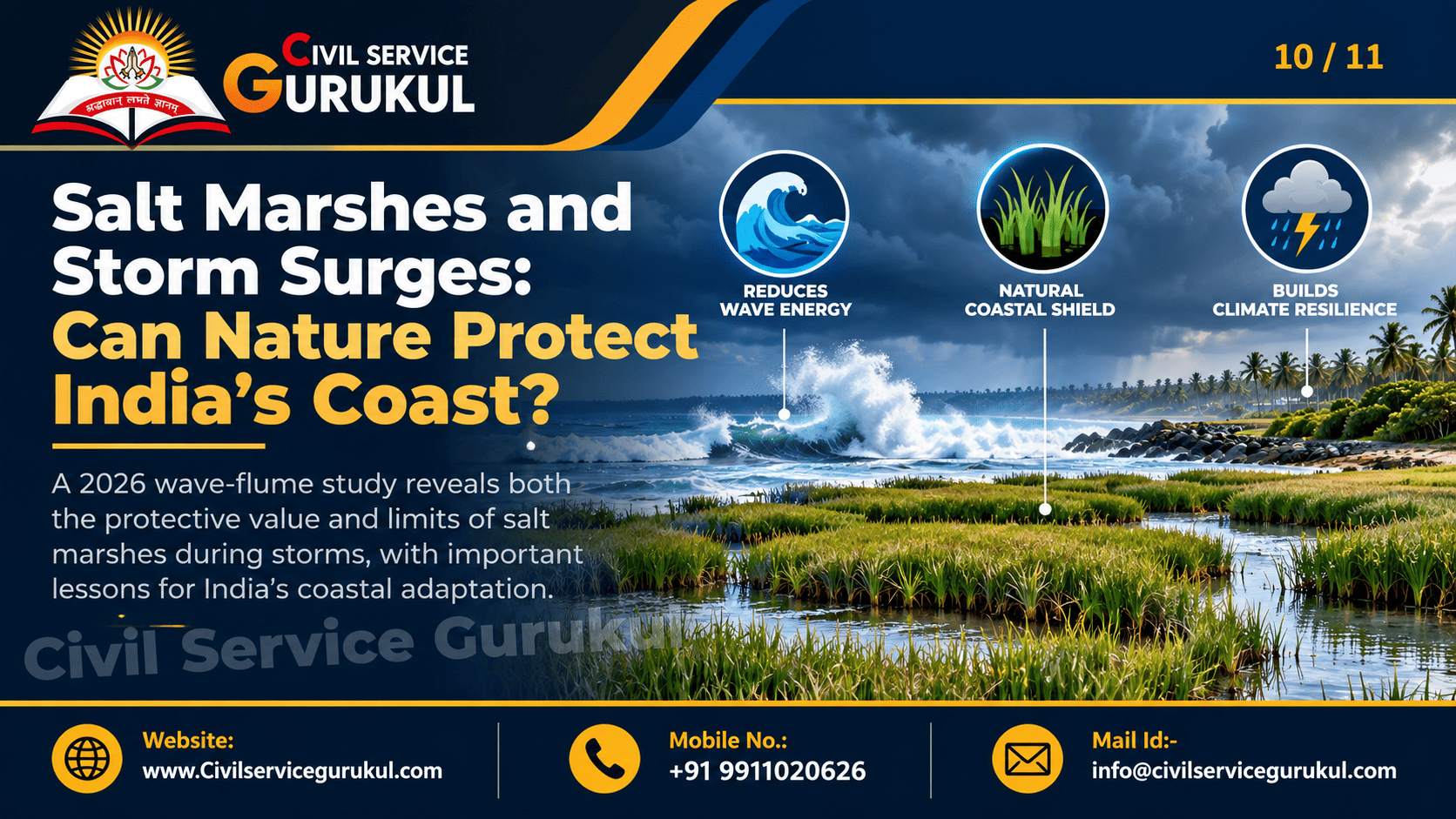
Can Salt Marshes Protect India's Coastline? New 2026 Study Reveals Their Role in Cyclone Defence and Climate Resilience
Understanding wave attenuation, coastal wetlands, blue carbon and nature-based disaster risk reduction for UPSC Prelims and Mains.
A 2026 experimental study of coastal salt marshes highlights their potential to reduce wave energy while revealing important limitations during powerful storms. Researchers observed that marsh sediment could remain relatively stable even when vegetation suffered substantial damage. The findings have implications for India's cyclone preparedness, wetland conservation and climate adaptation.
Why Are Salt Marshes in the News?
A study reported as published in Nature on 21 October 2026 examined the ability of coastal salt marshes to withstand powerful waves.
The research explored a central question in coastal climate adaptation: under which conditions can natural wetlands reduce wave energy, and when do their protective limits become significant?
This question is especially relevant for coastal communities exposed to cyclones, storm surges, saline intrusion and rising sea levels.
What Are Salt Marshes?
Salt marshes are coastal tidal wetlands dominated by salt-tolerant grasses and other low-growing vegetation.
They generally occur along sheltered coastlines and estuaries where tidal water periodically inundates the land.
Important Characteristics
- Regular influence of tidal water
- Salt-tolerant vegetation
- Sediment accumulation and retention
- Habitat for coastal biodiversity
- Potential reduction in incoming wave energy
- Storage of coastal blue carbon
What Did the 2026 Salt-Marsh Experiment Find?
The study described in the supplied report used a large experimental wave flume containing a transplanted 306-square-metre salt marsh.
Researchers exposed the marsh to waves reaching approximately two metres in height.
Over a period of about 21 hours, the marsh surface reportedly lost only around seven millimetres of sediment.
However, the vegetation experienced substantial damage.
Relative stability of marsh sediment does not necessarily mean that the vegetation responsible for reducing wave energy remains intact.
| Parameter | Reported Observation |
|---|---|
| Experimental habitat | Salt marsh |
| Marsh area | 306 square metres |
| Wave height | Up to approximately 2 m |
| Exposure duration | Approximately 21 hours |
| Surface sediment loss | Approximately 7 mm |
| Vegetation response | Substantial damage |
How Do Salt Marshes Reduce Wave Energy?
Vegetation Friction
Dense vegetation creates resistance as water moves through the marsh. This resistance can dissipate part of the incoming wave energy.
Sediment Retention
Marsh vegetation can help trap sediment and stabilise the wetland surface.
Reduced Wave Height
Wave attenuation may be stronger under smaller-wave and moderate-energy coastal conditions.
The supplied report describes conditional research estimates of wave reductions exceeding 10% in some settings and reaching around 50% in lower-energy settings.
These figures should not be treated as guaranteed protection for every coastline or cyclone.
Ecological and Economic Importance of Salt Marshes
Coastal Protection
Salt marshes may complement engineered coastal defences by dissipating part of incoming wave energy.
Blue Carbon Storage
Coastal wetlands can store carbon in vegetation and sediments. This stored carbon is commonly discussed under the concept of blue carbon.
Biodiversity Support
Salt marsh habitats support fish, invertebrates and other coastal organisms.
Sediment Stability
Sediment accumulation can contribute to maintaining wetland elevation, depending on local environmental conditions.
Why Is This Study Important for India?
India's coastal communities face multiple environmental hazards, including cyclones, storm surges, saline intrusion and sea-level rise.
Salt marsh conservation could form part of a broader strategy involving mangrove restoration, dune protection, early warning systems and evacuation planning.
The suitability of marsh restoration depends on local tidal conditions, sediment availability, coastline exposure, land ownership and community livelihoods.
Nature-based coastal protection should be location-specific. A wetland effective in a sheltered estuary may provide limited protection on a highly exposed coastline.
Limitations of Salt Marshes During Extreme Storms
Salt marshes cannot be assumed to eliminate flooding risk during severe cyclones.
Strong waves can damage vegetation, potentially weakening its ability to dissipate energy.
Wetlands may also face pressures from coastal development, port expansion, aquaculture and habitat fragmentation.
For this reason, natural wetlands should be viewed as complementary to engineering and disaster preparedness measures, rather than a universal replacement.
Way Forward: Building Climate-Resilient Indian Coastlines
- Map coastal vulnerability and wetland elevation before restoration.
- Assess vegetation health and sediment supply.
- Monitor marsh condition after major storms.
- Combine ecological restoration with appropriate engineered defences.
- Maintain early warning and evacuation systems.
- Involve fishing communities and local governments.
- Account for residual risk through planning and insurance.
UPSC Prelims 2027: Practice MCQ
Question: With reference to the 2026 salt-marsh wave experiment, which statement is most appropriate?
(a) Salt marshes completely prevent flooding in all cyclones.
(b) Marsh soil can remain relatively stable even when vegetation is damaged.
(c) Salt marshes occur only in freshwater lakes.
(d) Wave reduction is independent of storm intensity.
The experiment reported modest sediment loss despite substantial vegetation damage. It demonstrates that marsh stability and vegetation condition are different indicators of coastal protection.
UPSC Mains GS Paper III: Answer Writing Practice
Question: Explain the potential and limitations of ecosystem-based coastal protection in India. (150 words)
Suggested Answer Framework
Introduction: Define ecosystem-based coastal protection and explain the role of tidal wetlands.
Body: Discuss wave attenuation, sediment retention, blue carbon and biodiversity benefits. Explain the limitations of natural protection during severe storms.
Way Forward: Recommend site-specific restoration, hybrid coastal defences, community involvement and post-storm monitoring.
Conclusion: Nature-based solutions can strengthen coastal resilience when combined with scientific planning and disaster preparedness.
Frequently Asked Questions
What is a salt marsh?
A salt marsh is a tidal coastal wetland dominated by salt-tolerant grasses and other low-growing vegetation.
Are salt marshes and mangroves the same?
No. Salt marshes are generally herbaceous wetlands, while mangroves consist of woody, salt-tolerant coastal vegetation.
What is wave attenuation?
Wave attenuation refers to a reduction in wave energy or height as waves travel through an environment.
Can salt marshes replace seawalls?
Not universally. Their protective contribution depends on local conditions, and they may need to complement engineered defences.
What is blue carbon?
Blue carbon refers to carbon stored in coastal and marine ecosystems.
Why is this topic important for UPSC?
It connects physical geography, ecology, biodiversity, climate adaptation and disaster-risk reduction.
Civil Service Gurukul: Key Takeaway
Salt marshes can contribute to coastal protection, but their effectiveness depends on local ecological conditions and storm intensity. Sustainable adaptation requires a combination of natural ecosystems, engineered protection and disaster preparedness.
Important SEO Topics
Prepare for UPSC with Civil Service Gurukul
Explore current affairs, Prelims practice questions, Mains answer writing and syllabus-oriented study resources with Civil Service Gurukul.
Website: www.civilservicegurukul.com
Mobile: +91 9911020626
Email: info@civilservicegurukul.com
Editorial note: This independent educational article is based on the supplied study summary. Experimental measurements are presented as reported, not as universal predictions of coastal protection. UPSC questions are original practice material and are not official UPSC examination questions.
Prepare with Mentors Who Cleared the Exam
Get personalized study plans, evaluated answer models, and test series access.