
India's Care Economy 2026: UPSC GS1, GS2 & GS3
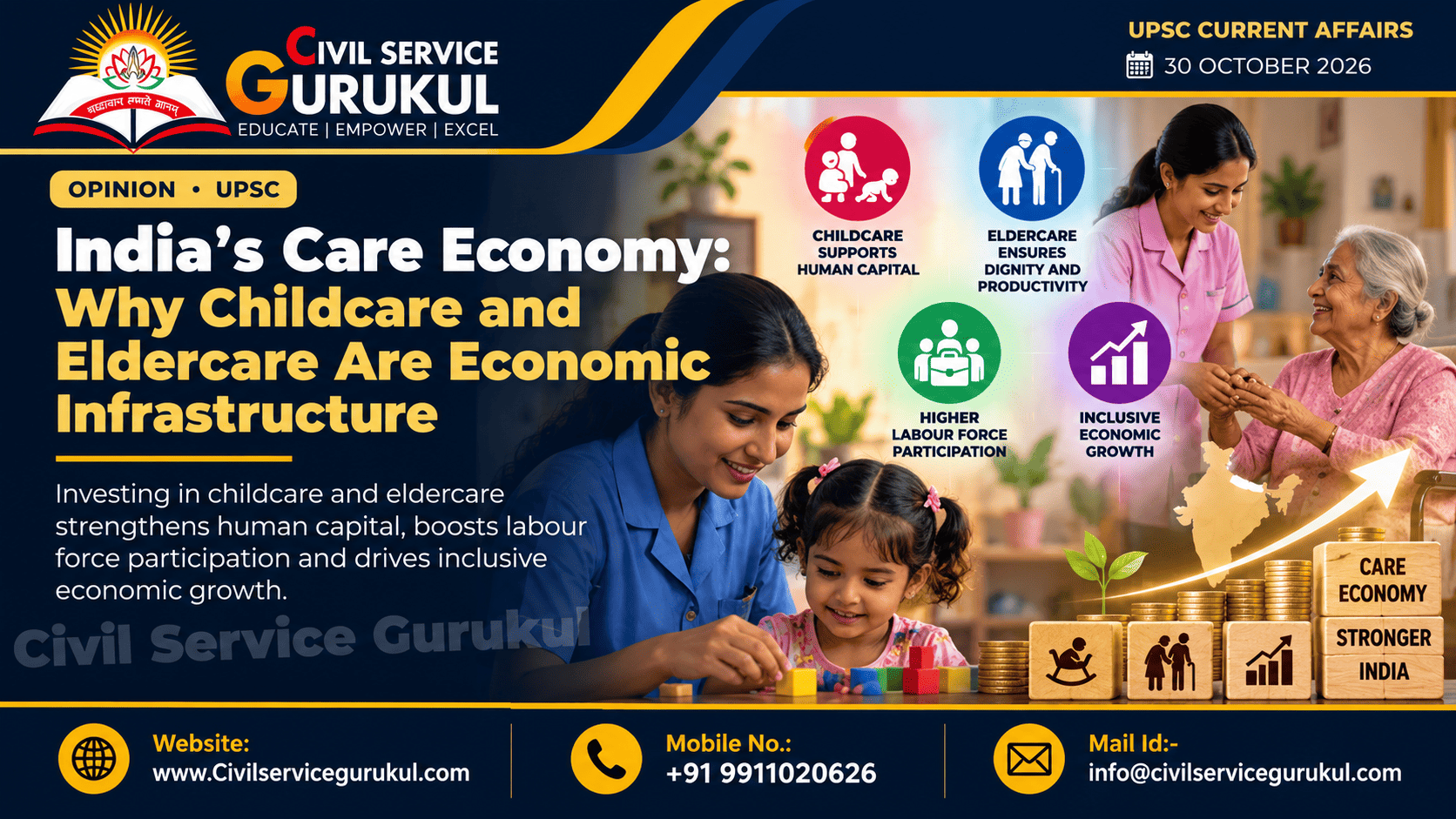
India's Care Economy 2026: Why Childcare, Eldercare and Unpaid Work Matter for Inclusive Growth
Understanding care as economic infrastructure: women's employment, ageing, disability support, the value of unpaid work and the future of India's social protection system.
India's care economy comprises paid and unpaid activities that support children, older persons, persons with disabilities and individuals requiring assistance due to illness.
Although essential to human well-being and economic productivity, caregiving often remains undervalued in conventional economic and infrastructure discussions.
A stronger system of childcare, eldercare and disability support could improve women's labour-market participation, create dignified employment and strengthen inclusive development.
GS Paper I: Role of women, population ageing, family structures and social change.
GS Paper II: Social justice, welfare programmes, vulnerable groups and service delivery.
GS Paper III: Employment, human capital, inclusive growth and productivity.
GS Paper IV: Ethics of care, compassion, dignity and public responsibility.
Why Is India's Care Economy in the News?
A policy discussion dated 29 October 2026 highlighted the need to treat care services as essential economic and social infrastructure rather than as a fragmented welfare activity.
The discussion emphasised childcare, eldercare, disability support and the working conditions of caregivers.
Changes in household structures, population ageing and unequal distribution of unpaid work have increased the importance of organised care services.
Can India build an integrated care system that protects vulnerable people, improves women's economic opportunities and ensures dignified working conditions for professional caregivers?
What Is the Care Economy?
The care economy includes activities and services that maintain the health, safety, development and daily well-being of individuals.
It covers both paid professional services and unpaid caregiving within households.
Paid Care Work
- Childcare and crèche services.
- Professional nursing and home caregiving.
- Support services for older persons.
- Assistance for persons with disabilities.
- Community-based care services.
Unpaid Care Work
- Supervising and caring for children.
- Supporting dependent family members.
- Assisting elderly relatives.
- Providing unpaid care during illness.
- Supporting persons requiring daily assistance.
Household domestic work and direct caregiving may overlap, but they are not identical categories in time-use measurement.
Why Is Unpaid Care Work Important?
Unpaid care work enables households and the wider economy to function.
Parents and other family members may provide services that would otherwise require paid childcare, nursing or personal assistance.
However, unpaid caregiving is often not captured as paid production in conventional national income measures.
Gender Dimension
Women frequently undertake a disproportionate share of unpaid caregiving responsibilities.
This can restrict their ability to pursue paid employment, education, entrepreneurship or career advancement.
The issue is therefore closely connected with gender equality, economic opportunity and household decision-making.
Time Use Survey 2024: Understanding the Evidence
Time Use Surveys record how people allocate time across different activities, including paid work, unpaid domestic services, caregiving, learning and leisure.
The supplied October 2026 material reports that approximately 41% of women aged 15–59 participated in unpaid caregiving activities, with around 140 minutes spent daily among participants.
These are participation-based figures. They should not be interpreted as the average caregiving time of every woman in the age group.
Always distinguish between the participation rate in an activity and the average time spent by those who participate.
The cited figures should be checked against the relevant official Time Use Survey tables before being used as precise statistical evidence.
Why Care Is Economic Infrastructure
Supporting Labour-Force Participation
Affordable and accessible care services may enable more people, particularly women, to enter or remain in paid employment.
Improving Human Capital
Quality early-childhood care can support children's development, while appropriate eldercare and disability support can improve health, autonomy and well-being.
Creating Employment
Expansion of care services can create jobs in childcare, community care, nursing and related support activities.
These jobs must be accompanied by adequate wages, training, workplace safety and social protection.
Reducing Household Stress
Reliable services can reduce the physical, emotional and financial pressure on family caregivers.
Supporting Inclusive Growth
Care infrastructure can improve the participation of individuals who might otherwise be excluded from employment and social life.
Childcare Infrastructure in India
Childcare services include early-childhood support, supervision, nutrition, care facilities and age-appropriate development activities.
Accessible childcare can be especially important for households in which parents or guardians undertake paid employment.
What Makes Childcare Effective?
- Affordable and accessible facilities.
- Trained and adequately supported staff.
- Child safety and hygiene standards.
- Developmentally appropriate activities.
- Suitable operating hours.
- Monitoring of service quality.
- Inclusion of children with disabilities.
Childcare should be evaluated not merely by the number of facilities established, but also by the safety, development and well-being of the children served.
Eldercare, Ageing and Disability Support
As the population ages, demand for assistance with daily living, health management, mobility and social participation can increase.
A comprehensive care economy must therefore extend beyond childcare.
Key Eldercare Priorities
- Community-based day-care facilities.
- Accessible home-care services.
- Support for family caregivers.
- Safe and dignified living conditions.
- Protection against neglect and abuse.
- Coordination with healthcare providers.
Disability-Inclusive Care
Care policies should also consider accessibility, independent living, reasonable accommodation and the rights and preferences of persons with disabilities.
Effective support should promote autonomy and dignity, rather than treating individuals only as passive recipients of assistance.
Indian Policy Initiatives Relevant to the Care Economy
| Initiative | Broad Area | Care Economy Relevance |
|---|---|---|
| Anganwadi Services | Early childhood and nutrition | Support for children and eligible beneficiaries through community-level services. |
| Palna | Crèche services | Institutional childcare support for eligible households. |
| Eldercare Programmes | Older persons | Welfare and support for ageing-related needs. |
| Disability Support Initiatives | Persons with disabilities | Accessibility, support services and social inclusion. |
These initiatives operate through different institutional and administrative arrangements.
An important policy challenge is improving coordination without ignoring the distinct needs of different beneficiary groups.
Major Challenges Facing India's Care Economy
Fragmented Service Delivery
Care programmes may differ in eligibility, financing, quality standards and administrative responsibility.
Unequal Access
Affordable care facilities may not be equally accessible across rural and urban areas or income groups.
Gendered Responsibility
Policies may unintentionally reinforce the expectation that women should remain the primary caregivers.
Workforce Vulnerability
Care workers may face inadequate remuneration, limited training, occupational risks and insufficient grievance mechanisms.
Quality Assurance
The expansion of facilities must be matched by effective supervision, safety standards and measurable outcomes.
Financing Constraints
Sustainable care services require predictable funding, rather than reliance on short-term initiatives alone.
Way Forward: Building an Integrated Care Economy
- Prepare district-level maps of childcare, eldercare and disability-support needs.
- Expand accessible crèches and community day-care services.
- Establish appropriate quality and safety standards for care facilities.
- Develop professional training and skill-certification pathways.
- Improve wages, workplace safety and social protection for care workers.
- Promote shared caregiving through parental leave and flexible work arrangements.
- Improve coordination between ministries, States and local institutions.
- Measure outcomes through user satisfaction, well-being and service quality.
- Ensure that care policies respect autonomy, inclusion and human dignity.
A sustainable approach must combine public investment, appropriate regulation, community participation and professional care standards.
UPSC Prelims Practice Questions
Question 1
Which survey is particularly suited to measuring the time spent on unpaid caregiving?
(a) Economic Census
(b) Time Use Survey
(c) Census of Manufacturing
(d) Wholesale Price Index
The Time Use Survey records the allocation of time across paid and unpaid activities, including caregiving.
Question 2
Consider the following statements:
- The care economy includes both paid and unpaid caregiving.
- Childcare services can help reduce barriers to women's participation in paid employment.
Which of the statements given above is/are correct?
(a) 1 only
(b) 2 only
(c) Both 1 and 2
(d) Neither 1 nor 2
Both statements are correct. The care economy covers paid and unpaid services, and accessible childcare can support labour-market participation.
Question 3
Which of the following best reflects an integrated care economy approach?
(a) Restricting all care responsibilities to households
(b) Providing only institutional eldercare
(c) Coordinating childcare, eldercare, disability support and caregiver protection
(d) Measuring success only through the number of facilities opened
An integrated approach addresses different care needs while considering access, service quality and caregiver welfare.
Question 4
Which of the following is a potential economic benefit of affordable childcare?
(a) Automatic elimination of unemployment
(b) Greater opportunity for caregivers to participate in paid work
(c) Elimination of all household responsibilities
(d) Guaranteed increase in wages across all sectors
Affordable childcare may reduce caregiving-related constraints on participation in paid employment. It does not guarantee the other outcomes.
UPSC Mains GS Paper II and III Practice
Question: "Treating care as economic infrastructure is essential for inclusive growth." Discuss with reference to women's employment, population ageing and social justice in India. (250 words)
Suggested Answer Framework
Introduction: Define the care economy and explain its contribution to human well-being and economic activity.
Gender Dimension: Discuss unequal unpaid care responsibilities and their relationship with labour-market participation.
Economic Dimension: Explain how childcare and professional care services can support productivity, employment and human capital.
Social Justice: Highlight the needs of older persons, children and persons with disabilities.
Challenges: Discuss fragmentation, financing, unequal access and poor working conditions.
Way Forward: Recommend integrated planning, quality standards, workforce protection and shared caregiving.
Conclusion: Care infrastructure should be recognised as a foundation of inclusive economic development and human dignity.
Frequently Asked Questions
What is the care economy?
The care economy includes paid and unpaid activities that support children, older persons, persons with disabilities and others requiring care.
Is all care work unpaid?
No. Care work includes paid professional services as well as unpaid household caregiving.
Why is childcare linked to women's employment?
Accessible childcare can reduce the time and financial constraints that prevent some women from participating in paid employment.
What is the Time Use Survey?
It measures how people allocate their time among paid work, unpaid activities, caregiving and other daily tasks.
Why is eldercare important for India's development?
Population ageing increases the importance of accessible support for older persons and their caregivers.
Which UPSC papers cover the care economy?
The topic is relevant to GS I Society, GS II Social Justice, GS III Employment and GS IV Ethics.
Key Takeaway for UPSC Aspirants
Care is not merely a private household responsibility or a peripheral welfare concern. It supports economic participation, human development, social inclusion and dignity.
India's long-term policy challenge is to build accessible, high-quality care services while recognising and protecting both paid and unpaid caregivers.
SEO Keywords and Tags
Prepare for UPSC with Civil Service Gurukul
Build conceptual clarity in Indian society, social justice, government policies, women's empowerment, economic development and current affairs through examination-focused learning.
Website: www.civilservicegurukul.com
Mobile: +91 9911020626
Email: info@civilservicegurukul.com
Prepare with Mentors Who Cleared the Exam
Get personalized study plans, evaluated answer models, and test series access.