
Matarbari Port & India–Japan Act East Policy: UPSC 2026
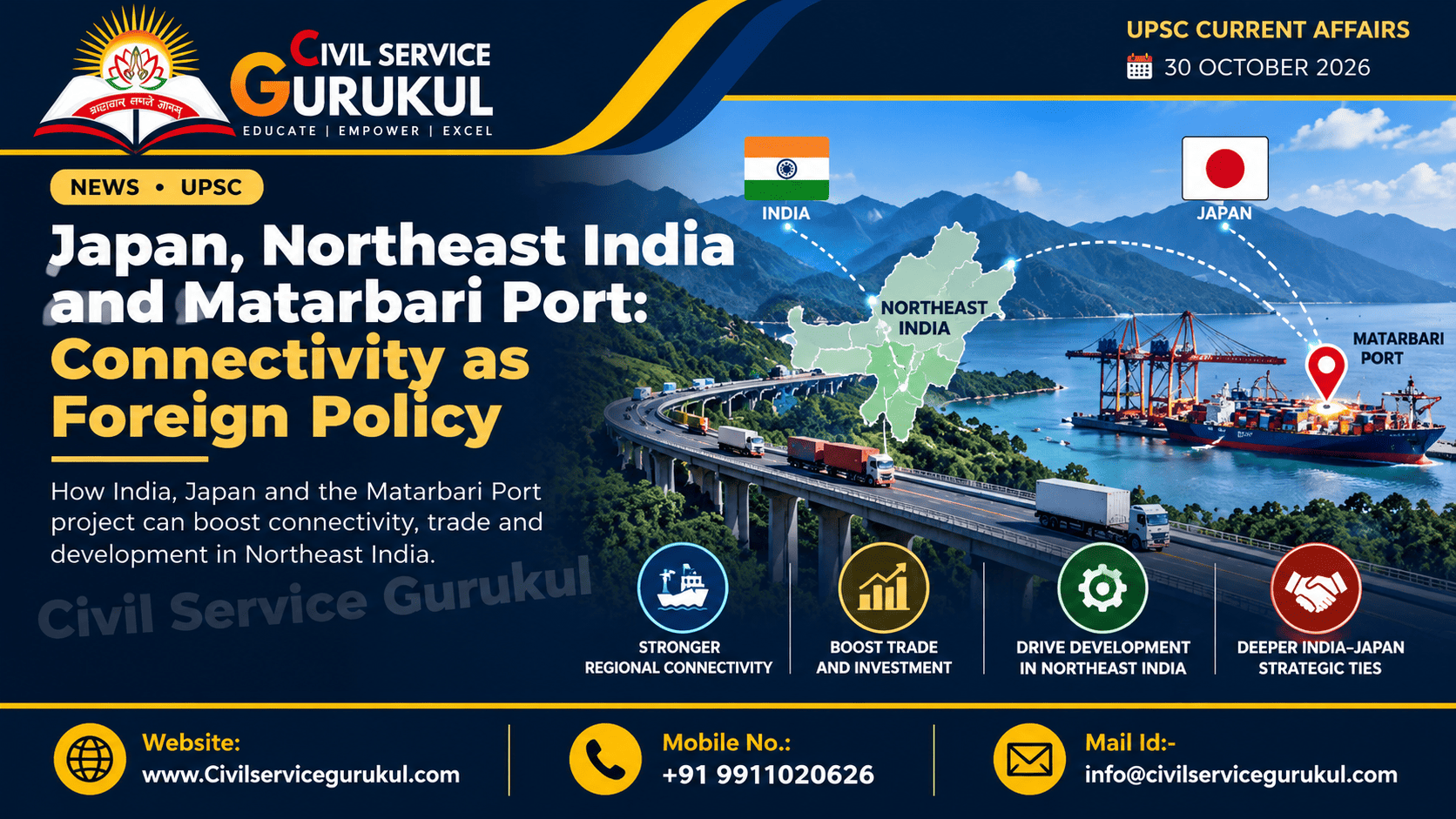
Japan–India Connectivity Strategy 2026: How Matarbari Port Could Transform Northeast India's Economic Future
Understand how Japan-supported infrastructure cooperation, Bangladesh's Matarbari deep-sea port and India's Act East Policy could reshape trade, logistics and regional development across the Bay of Bengal.
India's northeastern region occupies a strategically important position between the Indian subcontinent and Southeast Asia. However, geographical constraints and infrastructure gaps have historically complicated its economic integration.
Japan-supported infrastructure development in Northeast India, combined with the Matarbari deep-sea port project in Bangladesh, offers a potential opportunity to improve maritime access, strengthen logistics networks and develop regional value chains.
The opportunity is significant, but the commercial success of such connectivity depends on cross-border agreements, efficient customs systems, last-mile transport infrastructure and cooperation among India, Japan and Bangladesh.
GS Paper I: Indian geography, transport networks, regional geography and the strategic significance of Northeast India.
GS Paper II: India–Japan relations, India–Bangladesh relations, bilateral cooperation and India's neighbourhood policy.
GS Paper III: Infrastructure, economic development, trade logistics, investment and regional connectivity.
Prelims: Matarbari Port, Siliguri Corridor, Act East Forum, JICA and Bay of Bengal geography.
Why Is Matarbari Port and Northeast Connectivity in the News?
Reporting highlighted on 29 October 2026 discussed India's intention to strengthen development links between Japan and northeastern States, against the background of Japan–Bangladesh cooperation around the Matarbari deep-sea port.
The broader policy discussion concerns how maritime infrastructure in Bangladesh and transport development in Northeast India could complement each other.
A more integrated regional transport network could create additional opportunities for trade, investment and industrial activity.
Matarbari is a port project located in Bangladesh. A potential logistics corridor linking it with Northeast India should not be described as a fully operational cross-border route without evidence of the necessary agreements and infrastructure.
Why Is Northeast India's Geography Strategically Important?
Northeast India shares international borders with several neighbouring countries and lies close to important economic routes connecting South Asia with Southeast Asia.
Its location provides significant strategic potential, but connectivity to the rest of India has long depended heavily on the narrow Siliguri Corridor.
The Siliguri Corridor
The Siliguri Corridor, often described as the "Chicken's Neck", is a narrow land connection between mainland India and the northeastern region.
Its strategic importance arises from the concentration of transport connections through a geographically constrained area.
Why Alternative Routes Matter
- They may improve transport resilience.
- They could reduce dependence on a limited number of logistics routes.
- They may provide additional access to maritime trade.
- They can support regional manufacturing and distribution.
- They may strengthen cross-border economic cooperation.
However, an alternative route is useful only when infrastructure, permissions and commercial operations function together.
India–Japan Act East Forum: Background and Significance
The India–Japan Act East Forum was inaugurated in December 2017.
It provides a bilateral platform for coordinating cooperation focused on India's northeastern region.
The Forum connects India's regional development priorities with Japan's experience in infrastructure, technology and development cooperation.
Important Areas of Cooperation
- Roads and transport infrastructure.
- Water and sanitation projects.
- Energy and power infrastructure.
- Investment and industrial development.
- Skills and human-resource development.
- Regional connectivity.
Role of JICA
The Japan International Cooperation Agency, commonly known as JICA, is an important institution in Japan's development cooperation framework.
Japanese development assistance has supported various infrastructure and development projects in India.
Such cooperation can help address financing, technology and capacity constraints, although project outcomes depend on implementation quality.
What Is the Matarbari Deep-Sea Port Project?
Matarbari is located on the southeastern coast of Bangladesh.
The port is being developed as part of a broader maritime and industrial infrastructure initiative with Japanese support.
Its strategic relevance lies in the possibility of strengthening Bangladesh's maritime logistics capacity and supporting regional trade networks.
Why Is a Deep-Sea Port Important?
Deep-sea port infrastructure can support larger ocean-going vessels, subject to the port's design, navigational conditions and operational capabilities.
Efficient maritime terminals may help improve cargo handling, trade connectivity and industrial supply chains.
Potential Relevance to Northeast India
A viable connection between Northeast India and Matarbari could provide an additional maritime gateway for businesses in the region.
However, this outcome would require appropriate transport links, customs arrangements, security cooperation and commercially workable cargo services.
How Could the India–Bangladesh–Japan Connectivity Model Work?
The proposed regional connectivity concept can be understood as the integration of maritime facilities, cross-border transport, industrial activity and logistics services.
| Component | Potential Function |
|---|---|
| Matarbari Port | Maritime cargo gateway in Bangladesh. |
| Bangladesh Transport Network | Movement of goods between port facilities and border connections. |
| Northeast Indian Roads and Railways | Last-mile and regional cargo distribution. |
| Customs and Border Systems | Legal clearance, cargo processing and transit administration. |
| Industrial and Logistics Facilities | Storage, processing, manufacturing and distribution. |
| Skills and Human Capital | Workforce development for emerging economic activity. |
From Infrastructure to Economic Corridors
A road or port does not automatically create an economic corridor.
For an effective corridor, businesses must be able to move goods reliably and at competitive costs.
This requires predictable border procedures, adequate cargo volumes, well-maintained infrastructure and commercially viable services.
Potential Economic and Strategic Benefits
Lower Logistics Costs
Improved route options could reduce transport costs for some goods and destinations.
The actual benefit would depend on distance, border delays, handling charges and shipping services.
Access to Global Supply Chains
Reliable maritime access could make it easier for regional producers to connect with international markets.
This may support industrial diversification and new investment.
Regional Industrial Development
Better connectivity may encourage investment in logistics, processing, warehousing and manufacturing.
These opportunities would be stronger where reliable electricity, skills and business infrastructure are available.
Tourism and Services
Transport improvements may also support tourism and service-sector activity, provided travel arrangements and supporting facilities are suitable.
Strategic Cooperation
Connectivity projects can strengthen diplomatic cooperation by creating shared economic interests.
For India, Japan and Bangladesh, successful collaboration would require mutually beneficial arrangements and respect for national sovereignty.
Major Challenges in Regional Connectivity
Cross-Border Coordination
Transit arrangements depend on the decisions and cooperation of the countries involved.
Customs procedures, transport permits, security rules and operational agreements must be aligned.
Political and Diplomatic Uncertainty
Regional projects may be affected by changing political priorities or diplomatic conditions.
Long-term cooperation requires predictable institutional arrangements.
Infrastructure Gaps
Ports need efficient connections to roads, railways, logistics hubs and border facilities.
Weak last-mile infrastructure can reduce the value of major investments.
Environmental and Social Concerns
Large infrastructure projects can affect coastal ecosystems, land use, communities and local livelihoods.
Environmental and social assessments are therefore essential.
Unequal Distribution of Benefits
Economic gains may be concentrated in a few transport hubs or districts.
Inclusive planning should consider smaller enterprises, workers and communities located away from major corridors.
Commercial Viability
Even well-built infrastructure may be underused without sufficient cargo demand and competitive logistics services.
Connectivity should be evaluated through actual economic outcomes, not only the construction of physical infrastructure.
Cargo movement, transport costs, travel times, investment and jobs are more meaningful indicators of success.
Way Forward: Making Connectivity Economically Meaningful
- Strengthen coordinated planning among India, Japan and Bangladesh.
- Develop reliable last-mile road and railway links.
- Improve customs digitisation and cross-border cargo processing.
- Establish clear and predictable transit arrangements.
- Integrate infrastructure planning with industrial development.
- Undertake robust environmental and social impact assessments.
- Involve northeastern State governments, local traders and affected communities.
- Promote skills development linked to realistic employment opportunities.
- Measure actual cargo flows, cost reductions, investment and job creation.
Regional connectivity will deliver sustainable benefits only when physical infrastructure is matched by institutional cooperation and productive economic activity.
UPSC Prelims Practice Questions
Question 1
Matarbari deep-sea port is located in which country?
(a) India
(b) Myanmar
(c) Bangladesh
(d) Thailand
Matarbari is located on Bangladesh's southeastern coast. It is a maritime and industrial infrastructure project supported by Japan.
Question 2
The India–Japan Act East Forum was inaugurated in:
(a) 2005
(b) 2010
(c) 2017
(d) 2023
The India–Japan Act East Forum was inaugurated in December 2017 to support cooperation focused on India's northeastern region.
Question 3
The Siliguri Corridor is strategically important because it:
(a) Connects India directly to Sri Lanka
(b) Links Northeast India with the rest of India
(c) Is India's largest seaport
(d) Connects the Arabian Sea to the Bay of Bengal
The Siliguri Corridor provides a narrow land connection between Northeast India and the rest of the country.
Question 4
Which of the following is essential for a cross-border economic corridor to function?
(a) Construction of roads alone
(b) A seaport without customs arrangements
(c) Infrastructure, agreements and functioning logistics
(d) Industrial investment without transport connectivity
An effective economic corridor requires physical infrastructure, cross-border permissions, customs arrangements and reliable logistics operations.
UPSC Mains GS Paper II Practice
Question: Assess the geopolitical and developmental significance of Japan-supported connectivity initiatives in Northeast India, with reference to Bangladesh's Matarbari deep-sea port. (250 words)
Suggested Answer Framework
Introduction: Explain the strategic location of Northeast India and the importance of regional connectivity.
Geographical Context: Discuss the Siliguri Corridor and potential alternative maritime access through Bangladesh.
Diplomatic Dimension: Explain the India–Japan Act East Forum and the importance of cooperation with Bangladesh.
Developmental Benefits: Evaluate trade, logistics, investment, industrialisation and employment potential.
Challenges: Discuss sovereignty, border procedures, environmental impacts and project viability.
Conclusion: Emphasise practical regional cooperation, inclusive development and measurable economic outcomes.
Frequently Asked Questions
Where is Matarbari Port located?
Matarbari is located in southeastern Bangladesh, along the Bay of Bengal.
What is the India–Japan Act East Forum?
It is a bilateral cooperation mechanism inaugurated in 2017 to support development and connectivity in Northeast India.
Why is Matarbari important for Northeast India?
It could potentially provide an additional maritime trade gateway, subject to cross-border agreements and operational infrastructure.
What is JICA?
JICA stands for Japan International Cooperation Agency, an important institution in Japan's international development cooperation.
Is the proposed Matarbari–Northeast corridor already operational?
The uploaded article describes a potential connectivity opportunity, not an automatically operational corridor. Its functioning would depend on agreements, infrastructure and logistics arrangements.
Why is this topic relevant for UPSC?
It connects Indian geography, Act East Policy, India–Japan relations, India–Bangladesh cooperation, infrastructure and regional economic development.
Key Takeaway for UPSC Aspirants
Matarbari Port illustrates how maritime infrastructure can influence regional economic and diplomatic relationships.
For Northeast India, the strategic opportunity lies not merely in reaching a port, but in creating reliable, inclusive and commercially viable cross-border economic networks.
SEO Keywords and Tags
Prepare for UPSC with Civil Service Gurukul
Build conceptual clarity in international relations, Indian geography, economic development, government policies and UPSC current affairs.
Website: www.civilservicegurukul.com
Mobile: +91 9911020626
Email: info@civilservicegurukul.com
Editorial Note: This original educational article is based on the uploaded October 2026 current-affairs material. The reported policy developments have not been independently verified against the latest official announcements. Potential future corridors are discussed as possibilities, not completed arrangements. The practice questions are original educational exercises, not official UPSC questions.
Prepare with Mentors Who Cleared the Exam
Get personalized study plans, evaluated answer models, and test series access.