
Poverty Measurement in India: UPSC 2026 Analysis
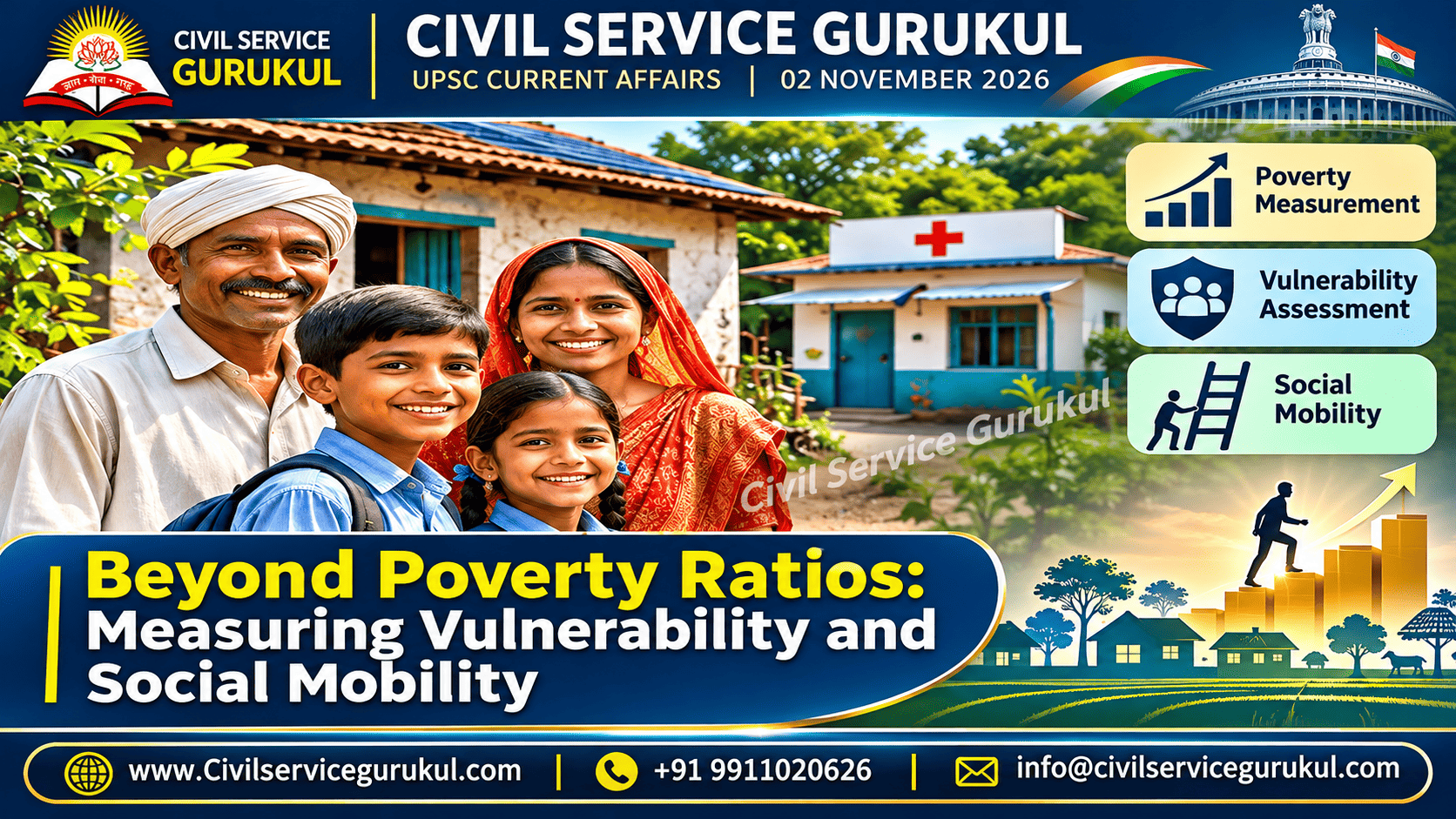
Poverty Measurement in India: Beyond Poverty Ratios, Understanding Vulnerability and Social Mobility
An in-depth UPSC Prelims and Mains analysis of monetary poverty, multidimensional deprivation, economic vulnerability, purchasing power parity, social mobility and inclusive growth.
Poverty measurement is essential for understanding material deprivation and evaluating development policies.
However, a single poverty ratio cannot fully capture access to education, healthcare, nutrition, secure employment or essential services.
Households may move above a monetary poverty threshold yet remain vulnerable to illness, job loss, crop failure or rising living costs.
A comprehensive poverty assessment should therefore combine monetary indicators with multidimensional deprivation, economic vulnerability and social mobility.
1. Why Poverty Measurement Matters
Poverty measurement helps policymakers identify deprivation, allocate resources and assess progress in social and economic development.
Poverty ratios provide useful summary information, but they do not fully explain the circumstances of individual households.
Two households with similar consumption levels may experience very different living conditions.
For example, one household may have access to reliable healthcare and education, while another may face high medical expenses and poor public services.
Poverty reduction should be assessed alongside vulnerability, service access and resilience to economic shocks.
2. Monetary Poverty: Income and Consumption
Monetary poverty is commonly assessed by comparing income or consumption with a selected poverty threshold.
A poverty line helps classify whether a household falls below a defined minimum standard of material resources.
Poverty Headcount Ratio
The poverty headcount ratio measures the proportion of the population below a selected poverty line.
Headcount Ratio = Population Below Poverty Line ÷ Total Population × 100
Illustrative Example
Suppose a hypothetical survey covers 1,000 individuals, of whom 150 fall below the selected poverty threshold.
The headcount ratio would be 15%.
This illustration does not represent an actual Indian poverty estimate.
3. Why Credible Poverty Estimates Can Differ
National and international poverty estimates may use different methodologies.
Differences may arise from the poverty threshold selected, survey design, reference period, price adjustments and purchasing power parity.
Purchasing Power Parity
Purchasing power parity, or PPP, is used to compare purchasing power across economies while accounting for differences in price levels.
Survey Methodology
Differences in survey sampling, questionnaire design and measurement of household consumption can affect estimates.
Two credible poverty estimates may differ without either being fabricated or necessarily incorrect.
The methodology must be examined before comparing their results.
4. Multidimensional Poverty: Beyond Income and Consumption
Multidimensional poverty recognises that deprivation can occur across several aspects of life.
A household may have income above a poverty line but still face inadequate healthcare, poor nutrition, limited educational opportunities or deficient living conditions.
Important Dimensions
- Health and nutrition.
- Education and learning.
- Housing conditions.
- Access to essential services.
- Basic living standards.
Multidimensional indicators complement monetary poverty measurement by capturing different forms of deprivation.
| Dimension | Possible Indicator | Policy Relevance |
|---|---|---|
| Health | Health access and outcomes | Public healthcare planning |
| Education | Schooling and learning outcomes | Education policy |
| Living Standards | Housing and essential services | Infrastructure and welfare |
| Employment | Job security and work quality | Labour and livelihood policy |
5. Economic Vulnerability: Why Poverty Reduction May Be Fragile
Economic vulnerability refers to the risk that a household's living conditions may deteriorate after an adverse event.
A household slightly above a poverty threshold may still face a high risk of falling back into poverty.
Common Economic Shocks
- Serious illness.
- Unexpected healthcare expenses.
- Loss of employment.
- Crop failure.
- Income disruption.
- Sharp increases in living costs.
A narrow focus on current poverty status may overlook these risks.
Sustainable poverty reduction requires not only raising living standards, but also strengthening households' capacity to withstand shocks.
6. Social Mobility: Moving Beyond Temporary Poverty Exit
Social mobility concerns changes in a person's or household's socioeconomic position over time or across generations.
A meaningful development strategy should examine whether people can access opportunities that support lasting improvement in their circumstances.
Important Enablers
- Quality education.
- Affordable healthcare.
- Skills and employment opportunities.
- Secure livelihoods.
- Access to essential services.
- Effective social protection.
A decline in monetary poverty does not by itself establish strong social mobility.
7. Urban Rent and Regional Price Differences
Living costs vary across regions and settlement types.
Urban households may face substantial housing, transport and other essential expenses.
Regional price differences can complicate direct comparisons of nominal income or consumption.
Why This Matters
A household with the same nominal income may have different purchasing power depending on local living costs.
Therefore, price adjustments and survey methodology are important when interpreting poverty estimates.
8. Indicators Beyond Poverty Ratios
A broader development assessment can track monetary resources alongside service access and household resilience.
| Indicator | What It Helps Assess |
|---|---|
| Household Consumption | Material living standards. |
| Nutrition | Food and nutritional deprivation. |
| Learning Outcomes | Quality of educational achievement. |
| Health Expenses | Financial pressure from medical needs. |
| Employment Quality | Security and sustainability of livelihoods. |
| Social Protection | Support available during economic shocks. |
No single indicator captures every dimension of household welfare.
A balanced measurement framework can provide a more complete policy picture.
9. Challenges in Poverty Measurement
Methodological Differences
Different poverty thresholds and survey methods may produce different estimates.
Survey Limitations
Sampling, questionnaire design and measurement errors can affect statistical reliability.
Price Variation
Regional and urban-rural price differences can complicate welfare comparisons.
Dynamic Vulnerability
Household welfare can change after illness, job loss or other shocks.
Incomplete Welfare Picture
A monetary poverty ratio does not directly capture all service and opportunity deprivations.
10. Way Forward: A Comprehensive Poverty Assessment Framework
- Combine Indicators: Assess monetary poverty alongside multidimensional deprivation.
- Measure Vulnerability: Examine household exposure to economic shocks.
- Track Social Mobility: Evaluate opportunities for long-term socioeconomic improvement.
- Strengthen Surveys: Improve data quality and methodological transparency.
- Recognise Regional Costs: Consider relevant price differences in welfare comparisons.
- Publish Limitations: Explain uncertainty ranges and survey constraints.
- Monitor Service Access: Track healthcare, education, nutrition and essential infrastructure.
- Improve Social Protection: Strengthen household resilience to adverse events.
11. UPSC Prelims: Quick Revision Notes
- Poverty lines provide a monetary threshold for assessing deprivation.
- The headcount ratio measures the share of people below a poverty line.
- Purchasing power parity accounts for differences in price levels across economies.
- Survey methodology influences poverty estimates.
- National and international poverty series may differ.
- Multidimensional poverty includes non-monetary deprivation.
- Economic vulnerability concerns exposure to future shocks.
- Social mobility concerns changes in socioeconomic position.
- Regional price differences affect welfare comparisons.
- Transparent uncertainty reporting improves statistical interpretation.
12. UPSC Prelims Practice MCQs
Why can two credible poverty estimates differ?
- They may use different thresholds and methods.
- One must necessarily be fabricated.
- Population size never matters.
- All countries use identical surveys.
View Answer and Explanation
Correct Answer: A. Poverty estimates can differ because of poverty thresholds, PPP adjustments, survey methods and reference periods.
The poverty headcount ratio primarily measures:
- Average household wealth.
- Proportion of people below a poverty threshold.
- Employment growth.
- Inflation rate.
View Answer and Explanation
Correct Answer: B. The headcount ratio measures the proportion of the population below the selected poverty line.
Which of the following best describes economic vulnerability?
- Only current income.
- Only household wealth.
- Risk of welfare deterioration after adverse shocks.
- Only urban poverty.
View Answer and Explanation
Correct Answer: C. Economic vulnerability concerns the risk that household welfare may deteriorate following illness, job loss or other shocks.
Which of the following may be included in a broader multidimensional assessment of deprivation?
- Health
- Education
- Living standards
- All of the above
View Answer and Explanation
Correct Answer: D. Multidimensional assessment can consider health, education and living standards.
Purchasing power parity is especially useful for:
- Comparing purchasing power across economies.
- Determining election results.
- Calculating literacy rates directly.
- Measuring rainfall.
View Answer and Explanation
Correct Answer: A. PPP supports international comparisons by accounting for differences in price levels.
13. UPSC Mains: Model Answer Writing
"Monetary poverty estimates should be complemented by multidimensional indicators of deprivation and economic vulnerability." Discuss.
Word Limit: 250 words
Model Answer
Introduction: Monetary poverty measurement helps identify individuals or households below a selected income or consumption threshold. However, it cannot fully capture the multiple dimensions of human welfare.
Limitations: A single poverty ratio does not directly measure access to healthcare, education, nutrition or secure employment.
Households just above a poverty threshold may remain vulnerable to illness, crop failure, job loss and rising living costs.
Differences in PPP conversion, survey design and poverty thresholds can also affect comparability.
Need for Broader Measurement: Multidimensional indicators can capture deprivation in health, education and living standards.
Vulnerability assessment helps identify households at risk of falling back into poverty, while social mobility indicators support evaluation of long-term opportunity.
Way Forward: India should track consumption alongside nutrition, learning outcomes, health expenses, employment quality and social protection.
Statistical reports should transparently disclose uncertainty ranges and survey limitations.
Conclusion: Sustainable poverty reduction requires not only improving current material living standards, but also strengthening resilience and enabling lasting socioeconomic mobility.
GS Paper IV: Ethics Case Study
A district official is asked to report poverty reduction performance.
The available data show a decline in the monetary poverty ratio, but many households remain vulnerable to health expenses and insecure employment.
Question: How should the official present the findings ethically?
- Report the measured poverty ratio accurately.
- Disclose methodological limitations.
- Explain remaining economic vulnerability.
- Avoid overstating policy outcomes.
- Recommend complementary welfare indicators.
- Support transparent, evidence-based policymaking.
14. Frequently Asked Questions
What is poverty measurement?
Poverty measurement assesses deprivation using selected monetary or non-monetary indicators.
What is the poverty headcount ratio?
It is the proportion of the population below a selected poverty line.
What is multidimensional poverty?
It considers deprivation across multiple dimensions, such as health, education and living standards.
Why do national and international poverty estimates differ?
They may use different thresholds, survey methodologies and price adjustments.
What is economic vulnerability?
It is the risk that a household's welfare may deteriorate after adverse economic or social shocks.
Why is social mobility important?
Social mobility helps assess whether people can achieve lasting improvements in socioeconomic position.
Conclusion: Poverty Reduction Must Mean More Than Crossing a Statistical Threshold
Poverty ratios remain important tools for economic analysis and public policy.
However, sustainable development requires attention to economic vulnerability, essential services, human capabilities and social mobility.
A comprehensive poverty assessment should measure not only how many people are currently poor, but also how securely households can maintain and improve their living standards.
SEO Keywords and Tags
Prepare UPSC with Civil Service Gurukul
Strengthen your UPSC preparation with comprehensive Indian Economy, Social Justice, Indian Society, Current Affairs, Prelims practice and Mains answer-writing resources.
Website: www.civilservicegurukul.com
Mobile: +91 9911020626
Email: info@civilservicegurukul.com
Editorial Disclaimer: This article is an independent UPSC educational analysis based on the supplied study material. Illustrative calculations are hypothetical. The article does not claim to provide a newly verified official poverty ratio or time-sensitive statistical estimate. Candidates should check the latest official data, methodologies and survey publications before quoting numerical findings in examinations.
Prepare with Mentors Who Cleared the Exam
Get personalized study plans, evaluated answer models, and test series access.