
Chola Bronzes: Heritage Protection & UPSC Notes
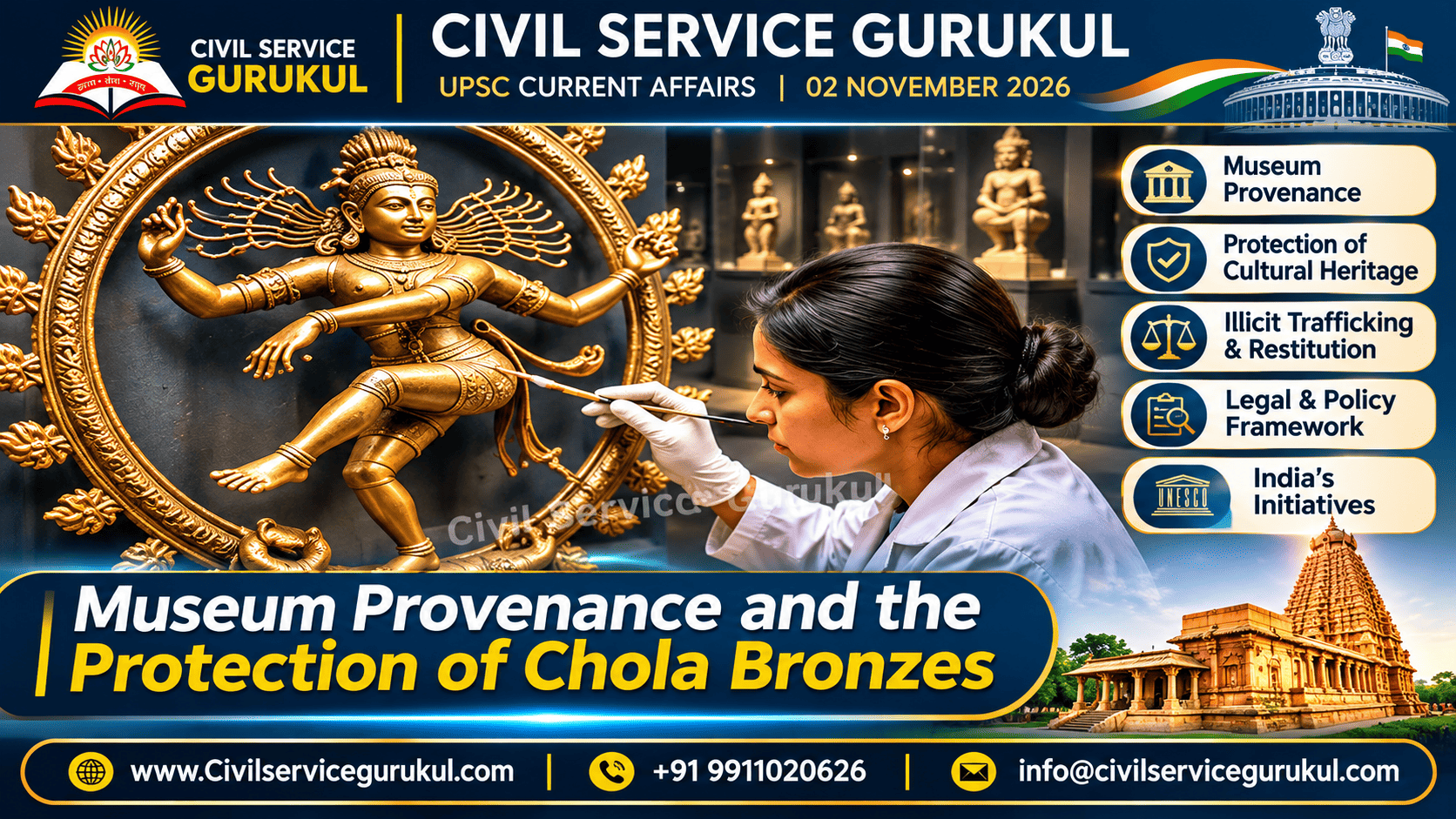
Chola Bronze Sculptures: Provenance, Heritage Protection and Museum Governance in India
An in-depth UPSC Prelims and Mains analysis of South Indian bronze sculpture, archaeological context, the Antiquities and Art Treasures Act, 1972, scientific conservation, ethical acquisition and community participation.
South Indian bronze sculpture is an important source for understanding artistic traditions, devotional practices and historical craft networks.
Chola bronzes hold significance as cultural objects and historical evidence.
Their protection requires more than recovering valuable artefacts.
Documented provenance, preservation of archaeological context, scientific conservation, transparent museum acquisition standards and community participation are essential.
Unverified ownership claims and illicit antiquities trade create legal and ethical risks.
1. Why Chola Bronze Sculptures Matter
South Indian bronze sculpture is an important part of India's artistic and cultural heritage.
Such sculptures provide evidence about historical craft traditions, religious practices and artistic networks.
Their significance extends beyond visual beauty or market value.
They also carry information about the communities, institutions and historical settings with which they were associated.
Cultural heritage should be assessed not only through the value of individual objects, but also through their historical context and public significance.
2. Historical and Cultural Significance
Chola bronze sculptures are associated with the rich artistic traditions of South India.
They offer insights into devotional practices, technical craftsmanship and historical patronage networks.
Important Dimensions
- Artistic traditions.
- Religious and devotional practices.
- Historical craft networks.
- Material culture.
- Regional cultural identity.
Their study can contribute to a broader understanding of India's cultural history.
3. What Is Archaeological Provenance?
Provenance refers to the documented history of an artefact's origin, ownership, custody or movement.
For heritage objects, provenance documentation helps establish where an object came from and how it entered a collection.
Why Provenance Matters
- Supports historical research.
- Helps assess ownership claims.
- Improves museum transparency.
- Supports investigation of illicit trade.
- Strengthens public trust.
An object may be physically preserved while its provenance remains uncertain.
Preservation of the object and documentation of its history are related but separate responsibilities.
4. Why Archaeological Context Must Be Preserved
An artefact's archaeological context includes its location and relationship with surrounding materials and excavation layers.
This context may provide important evidence about chronology and historical associations.
When an artefact is removed without adequate documentation, valuable information may be lost.
Information That May Be Lost
- Original find location.
- Excavation layer.
- Association with nearby objects.
- Relevant chronological evidence.
- Historical site relationships.
The scientific value of an archaeological find depends not only on the object, but also on the evidence preserved around it.
5. Legal and Institutional Framework
Antiquities and Art Treasures Act, 1972
The Antiquities and Art Treasures Act, 1972 regulates specified antiquities and art treasures.
Its relevance includes the legal management and protection of cultural objects.
Archaeological Survey of India
The Archaeological Survey of India plays an important role in archaeological and heritage administration within its legal mandate.
State Archaeology Departments
State archaeology departments also perform functions within their respective legal and administrative responsibilities.
| Institution / Law | Relevance |
|---|---|
| Antiquities and Art Treasures Act, 1972 | Legal regulation of specified antiquities. |
| Archaeological Survey of India | Archaeological and heritage responsibilities within its mandate. |
| State Archaeology Departments | State-level archaeological responsibilities. |
| Museums | Documentation, custody, conservation and ethical acquisition practices. |
6. Scientific Conservation of Bronze Artefacts
Scientific conservation aims to protect heritage objects from avoidable damage and deterioration.
Conservation should be undertaken by appropriately trained specialists.
Important Principles
- Careful documentation before intervention.
- Assessment of the object's condition.
- Appropriate handling and storage.
- Specialist-led conservation.
- Maintenance of treatment records.
Untrained cleaning, polishing or restoration may damage important physical evidence.
The immediate priority after a discovery should be to protect and document the object and its original context, rather than to improve its appearance for display.
7. Illicit Antiquities Trade and Ownership Risks
Cultural objects may face risks from unlawful removal, unverified ownership claims and illicit trade.
Incomplete documentation can make it difficult to establish an object's history and lawful custody.
Major Governance Risks
- Loss of archaeological context.
- Unverified ownership claims.
- Incomplete acquisition records.
- Unauthorised movement of artefacts.
- Reduced public confidence.
Transparent documentation and appropriate legal review can help address these risks.
8. Transparent Museum Governance
Museums have responsibilities that extend beyond displaying cultural objects.
They should maintain accurate records of acquisition, custody, condition and conservation.
Recommended Museum Governance Practices
- Transparent acquisition standards.
- Documented provenance review.
- Tamper-evident inventories.
- Regular collection audits.
- Conservation records.
- Appropriate handling of ownership disputes.
A well-managed museum protects both the physical object and the credibility of its documented history.
9. Role of Local Communities
Local communities may possess important knowledge about heritage sites, traditional practices and the cultural significance of objects.
Community participation can strengthen heritage protection and public awareness.
Potential Benefits
- Improved local awareness.
- Greater public trust.
- Better recognition of cultural significance.
- Support for responsible heritage stewardship.
- Improved communication between institutions and communities.
Consultation should be meaningful and respectful of relevant legal and institutional responsibilities.
10. GS Paper IV: Ethics and Accountability
Cultural heritage governance raises ethical questions about integrity, fairness, accountability and public trust.
| Ethical Principle | Administrative Application |
|---|---|
| Integrity | Accurate records and honest provenance reporting. |
| Accountability | Documented custody and acquisition decisions. |
| Transparency | Clear disclosure of known provenance and uncertainty. |
| Fairness | Responsible consideration of competing claims. |
| Public Trust | Professional conservation and responsible stewardship. |
Ethical Case Study
A museum receives an offer to acquire a valuable bronze sculpture.
The seller cannot provide a reliable record of the object's origin or ownership history.
The ethical response is to conduct appropriate provenance review, seek legal and specialist advice, document uncertainty and avoid an unsupported acquisition decision.
11. Way Forward: Responsible Heritage Governance
- Document Find Context: Record precise location and associated archaeological evidence.
- Scientific Conservation: Use trained specialists for handling and treatment.
- Tamper-Evident Inventories: Maintain reliable collection records.
- Provenance Review: Assess documented origin and custody history.
- Community Consultation: Engage relevant local stakeholders.
- Transparent Acquisition: Apply clear museum standards.
- Institutional Coordination: Strengthen cooperation among responsible heritage authorities.
- Accountable Decisions: Record reasons, uncertainties and relevant legal considerations.
12. UPSC Prelims: Quick Revision Notes
- Chola bronze sculptures are associated with South Indian artistic traditions.
- They provide evidence of devotional practices and craft networks.
- Provenance concerns an object's documented origin and custody history.
- Archaeological context includes location and association with excavation layers.
- Loss of context can reduce historical information.
- The Antiquities and Art Treasures Act, 1972 regulates specified antiquities.
- ASI has archaeological and heritage responsibilities within its mandate.
- State archaeology departments also have relevant responsibilities.
- Scientific conservation requires trained specialists.
- Transparent museum acquisition standards strengthen accountability.
13. UPSC Prelims Practice MCQs
Which of the following is most important immediately after an archaeological find?
- Documenting its original context.
- Polishing it for display.
- Selling it to a private collector.
- Discarding nearby material.
View Answer and Explanation
Correct Answer: A. Documenting the original context helps preserve information about chronology, excavation layers and associated objects.
The Antiquities and Art Treasures Act was enacted in which year?
- 1950
- 1962
- 1972
- 1991
View Answer and Explanation
Correct Answer: C. The Antiquities and Art Treasures Act, 1972 regulates specified antiquities and art treasures.
In heritage management, provenance primarily refers to:
- The market price of an object.
- The documented origin and custody history of an object.
- The weight of an artefact.
- The colour of a museum display.
View Answer and Explanation
Correct Answer: B. Provenance concerns an object's documented origin, ownership, custody or movement history.
Which institution has archaeological and heritage responsibilities within its legal mandate?
- Archaeological Survey of India.
- Election Commission of India.
- Reserve Bank of India.
- Central Electricity Authority.
View Answer and Explanation
Correct Answer: A. The Archaeological Survey of India plays a major role in archaeological and heritage administration.
Which of the following is a recommended practice in museum governance?
- Ignoring ownership documentation.
- Removing excavation records.
- Maintaining tamper-evident inventories.
- Accepting all objects without review.
View Answer and Explanation
Correct Answer: C. Tamper-evident inventories support collection accountability and responsible heritage management.
14. UPSC Mains: Model Answer Writing
"Scientific conservation and documented provenance are as important as recovering ancient objects." Assess the role of provenance and community participation in cultural-heritage governance.
Word Limit: 250 words
Model Answer
Introduction: Cultural heritage objects provide evidence about historical societies, artistic traditions and community practices. Their protection requires preserving both the physical artefact and its documented context.
Importance of Provenance: Provenance records help establish an object's origin, ownership and custody history.
They support historical research, museum accountability and responsible assessment of ownership claims.
Archaeological Context: An artefact removed without adequate documentation may lose information about chronology and associated materials.
Community Participation: Local communities can contribute knowledge about cultural significance and support heritage stewardship.
Meaningful consultation can improve public trust and institutional responsiveness.
Challenges: Illicit antiquities trade, unverified ownership claims, incomplete inventories and inadequate conservation practices create risks.
Way Forward: Heritage authorities should document find contexts, use trained conservators, maintain tamper-evident inventories, apply transparent museum acquisition standards and consult local communities.
Conclusion: Effective cultural heritage governance protects not only valuable objects but also the historical evidence, community significance and public trust associated with them.
GS Paper IV: Ethics Case Study
A district official learns that a historically important bronze sculpture has been recovered, but its excavation context was not properly recorded.
Several parties make competing ownership claims.
Question: What ethical and administrative steps should the official take?
- Secure the artefact according to applicable law.
- Preserve remaining contextual evidence.
- Arrange specialist conservation.
- Document competing claims objectively.
- Consult relevant archaeological authorities.
- Maintain transparent custody records.
- Communicate uncertainty responsibly.
15. Frequently Asked Questions
What are Chola bronze sculptures?
They are bronze sculptures associated with South Indian artistic and devotional traditions, particularly the Chola cultural milieu.
What is provenance in archaeology?
Provenance is the documented history of an object's origin, ownership, custody or movement.
Why is excavation context important?
It helps researchers understand an artefact's chronology and relationship with associated materials.
Which law regulates specified antiquities in India?
The Antiquities and Art Treasures Act, 1972.
What is the role of ASI?
The Archaeological Survey of India performs archaeological and heritage functions within its legal mandate.
Why is this topic important for UPSC?
It connects Indian art and culture, heritage conservation, governance, legal regulation and administrative ethics.
Conclusion: Protecting Heritage Means Preserving Objects and Their Stories
Chola bronzes are important sources of India's artistic and historical heritage.
Responsible protection requires scientific conservation, documented provenance, transparent institutions and community participation.
A recovered artefact is most valuable to public knowledge when its history, context and custody are also preserved.
SEO Keywords and Tags
Prepare UPSC with Civil Service Gurukul
Strengthen your UPSC preparation with comprehensive Indian Art and Culture, History, Governance, Ethics, Current Affairs, Prelims practice and Mains answer-writing resources.
Website: www.civilservicegurukul.com
Mobile: +91 9911020626
Email: info@civilservicegurukul.com
Editorial Disclaimer: This article is an independent UPSC educational analysis based on the supplied study material. It does not independently verify a specific 2026 excavation, recovery, repatriation, ownership dispute or museum acquisition. Candidates should consult current official archaeological records and applicable legal provisions before quoting time-sensitive claims in examinations.
Prepare with Mentors Who Cleared the Exam
Get personalized study plans, evaluated answer models, and test series access.