Electoral Roll Objections & Form 7 – UPSC 2026
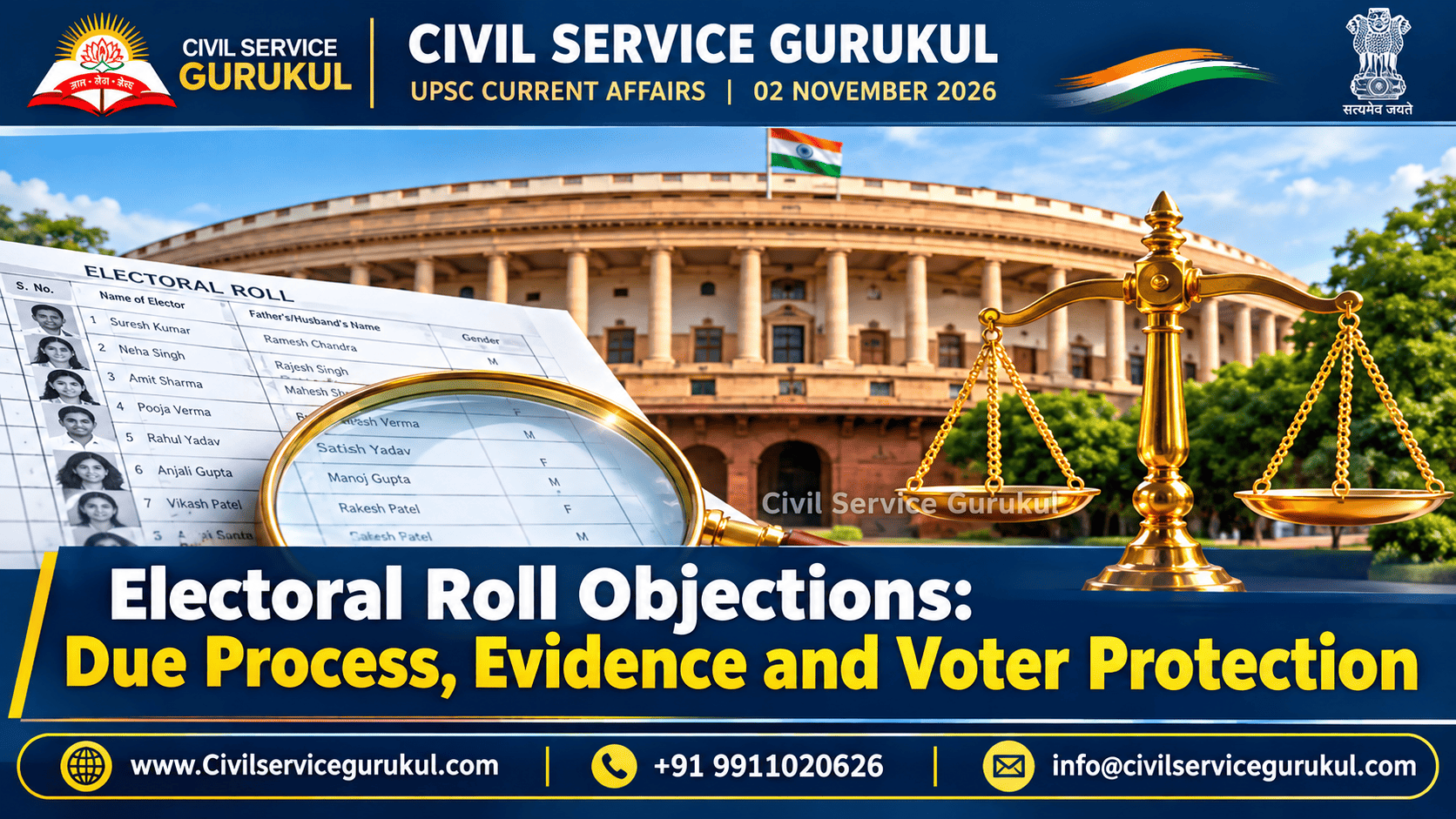
Electoral Roll Objections and Form 7: Due Process, Voter Protection and Democratic Accountability
A comprehensive UPSC Prelims and Mains analysis of electoral roll revision, Form 7 objections, constitutional safeguards, procedural fairness, citizen rights and the Election Commission's role.
Electoral rolls are the foundation of representative democracy. They determine which eligible citizens are registered to vote in a constituency.
Form 7 provides a prescribed mechanism for objections to electoral roll inclusion and requests for deletion of existing entries.
However, an objection must not automatically result in the removal of an eligible voter.
Procedural fairness, documentary verification, appropriate notice, hearing opportunities and review mechanisms are essential safeguards.
For UPSC aspirants, the topic connects constitutional democracy, electoral administration, citizen rights, administrative ethics and public accountability.
1. Why Electoral Roll Objections Matter
Electoral rolls identify the citizens registered to vote in an electoral constituency.
Accurate rolls help protect electoral integrity by reducing ineligible, duplicate or outdated entries.
At the same time, incorrect deletion may prevent an eligible citizen from exercising the franchise.
Therefore, the electoral registration system must balance two objectives:
- Maintaining accurate electoral rolls.
- Protecting eligible voters from wrongful exclusion.
Electoral roll accuracy and voter protection are complementary democratic objectives.
An effective system must pursue both through transparent and fair procedures.
2. Constitutional Framework of Elections in India
Article 324: Election Commission of India
Article 324 vests the superintendence, direction and control of electoral roll preparation and specified elections in the Election Commission of India.
Article 325: One General Electoral Roll
Article 325 provides for one general electoral roll for each territorial constituency and prohibits exclusion on specified grounds such as religion, race, caste or sex.
Article 326: Adult Suffrage
Article 326 establishes adult suffrage for Lok Sabha and State Legislative Assembly elections, subject to constitutional and statutory conditions.
The voting age is 18 years.
The right to vote in Indian elections is generally treated as a statutory right governed by election law, while adult suffrage has a constitutional foundation under Article 326.
3. Legal Framework for Electoral Registration
Two major legal instruments govern electoral registration:
- Representation of the People Act, 1950.
- Registration of Electors Rules, 1960.
Representation of the People Act, 1950
The Act provides the statutory framework for electoral rolls, registration qualifications, disqualifications and relevant procedures.
Registration of Electors Rules, 1960
These Rules prescribe procedural requirements for electoral registration, claims, objections and related applications.
| Instrument | Relevance |
|---|---|
| Article 324 | Election Commission's constitutional authority. |
| Article 325 | General electoral roll and non-discrimination. |
| Article 326 | Adult suffrage for specified elections. |
| RPA, 1950 | Electoral registration framework. |
| Registration of Electors Rules, 1960 | Procedures and prescribed forms. |
4. What Is Form 7 in Electoral Roll Revision?
Form 7 is a prescribed application used to object to inclusion of a person's name in an electoral roll or to request deletion of an existing entry, as applicable.
The application must be considered through the prescribed electoral registration process.
Possible Grounds Requiring Verification
- Death of the registered elector.
- Duplicate registration.
- Shifting of ordinary residence.
- Other applicable statutory grounds.
The existence of an objection does not itself prove that the concerned elector is ineligible.
An allegation is not equivalent to proof.
Deletion decisions must be based on lawful, case-specific verification and the applicable procedural safeguards.
5. Due Process: How Voter Protection Should Operate
Procedural fairness requires an administrative authority to act within legal powers and provide meaningful opportunities for affected individuals to respond.
Important Safeguards
- Receipt and recording of the objection.
- Verification of relevant information.
- Notice where required under applicable procedure.
- Opportunity to respond or be heard, as prescribed.
- Reasoned decision based on available evidence.
- Maintenance of an appropriate audit trail.
- Availability of statutory review or appeal mechanisms.
The exact procedural requirements depend on the applicable statutory provision, rules and stage of electoral roll revision.
Principles of Natural Justice
Two important principles are:
- Audi alteram partem: Hear the other side.
- Nemo judex in causa sua: No one should be a judge in their own cause.
These principles support fair administrative decision-making, subject to the applicable legal framework.
6. Major Challenges in Electoral Roll Objection Processes
A. Wrongful Deletion
Incorrect verification may exclude an eligible elector.
B. Duplicate Entries
Duplicate registrations can affect roll accuracy, but apparent duplication requires careful identity verification.
C. Migration
Population mobility can complicate ordinary-residence assessments.
D. Digital Exclusion
Citizens with limited digital access may face difficulty tracking notices or applications.
E. Mass Objections
Large numbers of objections can create administrative pressure and raise concerns about inadequate individual scrutiny.
F. Vulnerable Groups
Persons with disabilities, migrants, older persons and low-connectivity households may require accessible assistance.
Technology can support verification, but automated flags should not replace lawful case-specific administrative judgment.
7. GS Paper IV: Ethics and Governance Perspective
Electoral roll administration involves the exercise of public authority over an important democratic process.
Therefore, ethical standards are essential.
| Ethical Value | Administrative Application |
|---|---|
| Integrity | Impartial verification of objections. |
| Accountability | Documented decisions and review. |
| Fairness | Equal treatment of eligible electors. |
| Transparency | Clear communication of procedures. |
| Empathy | Accessible support for vulnerable citizens. |
| Responsibility | Correction of administrative errors. |
Ethical Dilemma
An electoral registration official may face pressure to process a large volume of objections quickly.
However, excessive speed without adequate verification may risk wrongful deletion.
The ethical response is to balance administrative efficiency with fairness, accuracy and citizen protection.
8. Way Forward: Improving Electoral Roll Integrity
- Evidence-Based Verification: Assess each objection through relevant records and lawful procedures.
- Accessible Notices: Ensure affected electors can understand and respond to communications.
- Reasoned Decisions: Record the basis for important administrative actions.
- Audit Trails: Maintain traceable records of verification and decisions.
- Grievance Redressal: Provide effective channels for correction and review.
- Inclusive Assistance: Support citizens with disabilities, migrants and digitally excluded households.
- Staff Training: Strengthen procedural knowledge and administrative ethics.
- Proportionate Technology Use: Use digital systems to assist, not replace, lawful human decision-making.
9. UPSC Prelims: Quick Revision Notes
- Article 324 concerns the Election Commission.
- Article 325 concerns general electoral rolls and non-discrimination.
- Article 326 establishes adult suffrage for specified elections.
- Voting age is 18 years.
- RPA, 1950 governs electoral registration.
- Registration of Electors Rules, 1960 prescribe relevant procedures.
- Form 7 concerns objections to inclusion and deletion requests.
- An objection is not automatically proof of ineligibility.
- Ordinary residence is important for electoral registration.
- Procedural fairness supports electoral legitimacy.
10. UPSC Prelims Practice MCQs
Which of the following is the primary purpose of Form 7 in electoral registration?
- To register a new political party.
- To object to inclusion or request deletion of an electoral-roll entry.
- To nominate an election candidate.
- To request a recount of votes.
View Answer and Explanation
Correct Answer: B. Form 7 is prescribed for objections to inclusion or requests for deletion under the electoral registration framework.
Which constitutional article vests superintendence, direction and control of electoral roll preparation in the Election Commission?
- Article 280
- Article 312
- Article 324
- Article 368
View Answer and Explanation
Correct Answer: C. Article 324 establishes the Election Commission's constitutional authority over specified electoral functions.
Consider the following statements:
- The Representation of the People Act, 1950 forms part of the electoral registration framework.
- Every Form 7 objection automatically results in deletion.
Which statement is correct?
- 1 only
- 2 only
- Both 1 and 2
- Neither 1 nor 2
View Answer and Explanation
Correct Answer: A. Statement 1 is correct. Statement 2 is incorrect because an objection must be examined under applicable legal procedures.
Which constitutional article provides for adult suffrage in Lok Sabha and State Assembly elections?
- Article 19
- Article 21
- Article 325
- Article 326
View Answer and Explanation
Correct Answer: D. Article 326 provides the constitutional basis for adult suffrage in the specified elections.
Which principle is most directly associated with the opportunity to be heard?
- Res judicata
- Audi alteram partem
- Doctrine of eclipse
- Separation of powers
View Answer and Explanation
Correct Answer: B. Audi alteram partem means hearing the other side and is an important principle of natural justice.
11. UPSC Mains: Model Answer Writing
"Procedural fairness in electoral roll revision is essential for democratic legitimacy." Discuss.
Word Limit: 250 words
Model Answer
Introduction: Electoral rolls form the operational foundation of representative democracy. Their accuracy protects electoral integrity, while fair revision procedures prevent wrongful exclusion of eligible voters.
Body: Article 324 establishes the Election Commission's constitutional authority, while the Representation of the People Act, 1950 and the Registration of Electors Rules, 1960 provide the legal framework for electoral registration.
Form 7 enables objections to inclusion and requests for deletion. Such mechanisms help address inaccurate entries, but unverified objections may also create exclusion risks.
Procedural fairness requires careful verification, appropriate notice, an opportunity to respond, reasoned decisions and effective review mechanisms under applicable law.
Additional assistance is important for migrants, persons with disabilities and digitally excluded citizens.
Transparent audit trails, trained electoral officials and proportionate use of technology can improve both accuracy and trust.
Conclusion: Electoral integrity is strengthened not merely by removing incorrect entries, but by ensuring that eligible citizens are not wrongfully excluded. Fair, evidence-based and citizen-centric procedures are therefore essential to democratic legitimacy.
GS Paper IV: Ethics Case Study
An Electoral Registration Officer receives a large number of objections against registered voters. There is administrative pressure to process them quickly, but supporting evidence is incomplete.
Questions: What ethical issues arise? What course of action should the officer adopt?
- Identify fairness, integrity and accountability concerns.
- Reject automatic deletion based only on allegations.
- Require lawful case-specific verification.
- Ensure prescribed notice and hearing safeguards.
- Maintain transparent decision records.
- Provide accessible correction and review channels.
12. Frequently Asked Questions
What is Form 7 in the Election Commission process?
Form 7 is used for objections to inclusion or requests for deletion of electoral-roll entries, subject to applicable rules.
Can a voter be deleted automatically after a Form 7 objection?
No. An objection does not itself establish ineligibility. The applicable legal procedure must be followed.
Which law governs electoral registration in India?
The Representation of the People Act, 1950 and the Registration of Electors Rules, 1960 form the principal statutory framework.
Which constitutional article relates to the Election Commission?
Article 324.
Why is this topic important for UPSC?
It connects Indian Polity, electoral reforms, governance, natural justice, administrative ethics and citizen rights.
What is the best way to prepare this topic for UPSC Mains?
Connect the constitutional framework with practical administrative challenges, ethical principles and specific institutional safeguards.
Conclusion: Electoral Integrity Must Protect Every Eligible Voter
Electoral roll revision is essential for maintaining accurate voter records.
However, accuracy cannot be pursued at the cost of procedural fairness or eligible citizens' participation.
The strongest electoral administration system combines evidence-based verification, transparency, accountability, accessible remedies and respect for democratic rights.
For UPSC aspirants, the central lesson is that good governance requires both administrative efficiency and constitutional values.
SEO Keywords and Tags
Prepare UPSC with Civil Service Gurukul
Strengthen your UPSC preparation with syllabus-oriented current affairs, Indian Polity, Governance, Prelims practice, Mains answer writing and conceptual analysis.
Website: www.civilservicegurukul.com
Mobile: +91 9911020626
Email: info@civilservicegurukul.com
Editorial Disclaimer: This article is an independent UPSC educational analysis based on the supplied study material, with additional constitutional and conceptual explanations. It does not claim that any particular electoral-roll deletion incident has been independently verified. Candidates should consult the latest Election Commission instructions, statutory provisions and official notifications before the examination.
Prepare with Mentors Who Cleared the Exam
Get personalized study plans, evaluated answer models, and test series access.