
India–Bangladesh Ganga Water Treaty 2026 | UPSC 2027
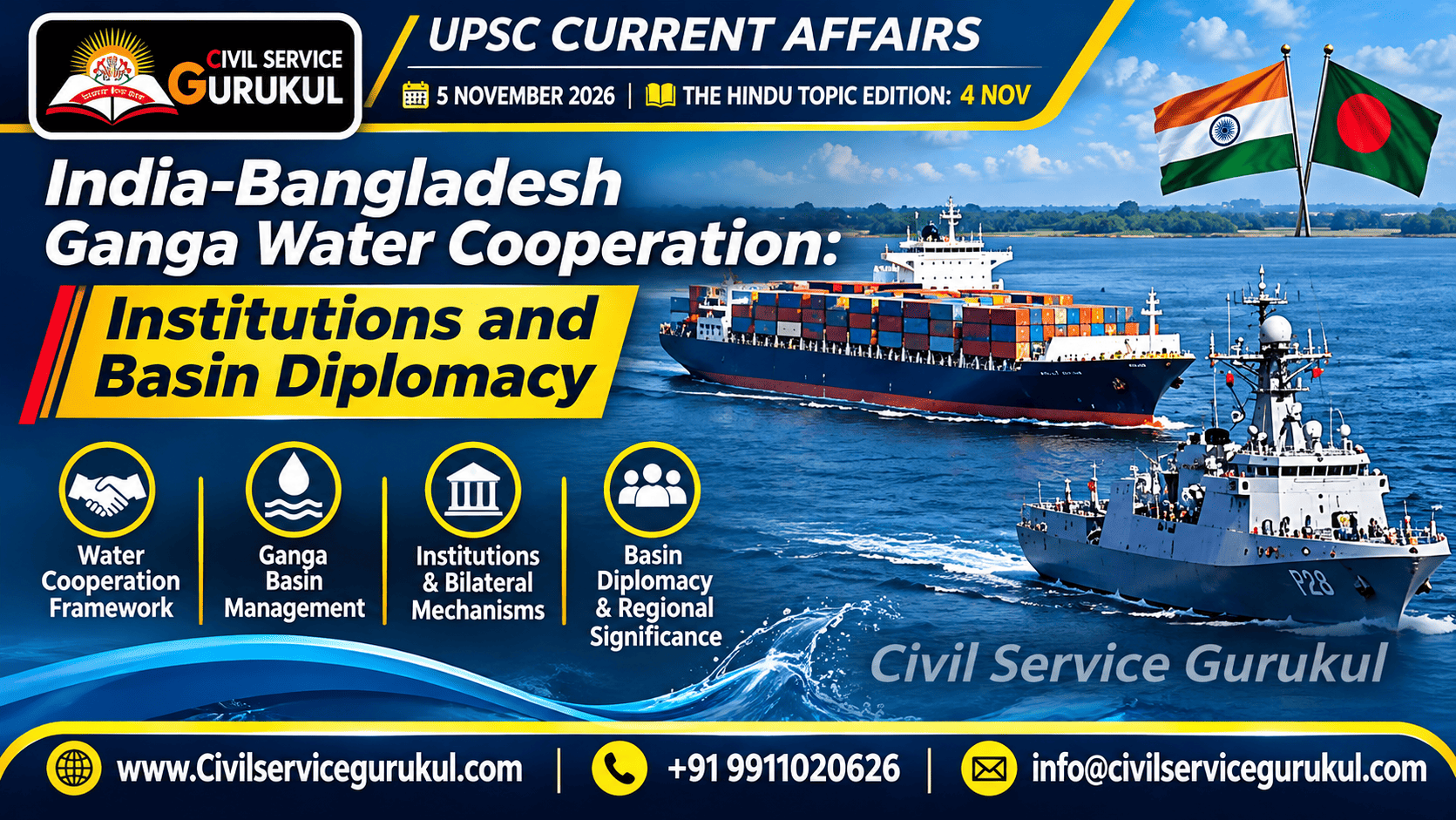
UPSC CURRENT AFFAIRS | INTERNATIONAL RELATIONS | GEOGRAPHY
India–Bangladesh Ganga Water Treaty 2026: Farakka Barrage, 1996 Agreement, Joint Rivers Commission and Water Diplomacy
Comprehensive UPSC Prelims and Mains analysis of transboundary river sharing, bilateral cooperation, water security and sustainable river-basin governance.
Published: 5 November 2026
1. Why Is the India–Bangladesh Ganga Water Treaty in News?
A current-affairs topic index dated 4 November 2026 highlighted India's statement concerning a structured mechanism for addressing issues relating to the Ganga Water Treaty.
The development draws attention to the institutional framework governing shared river waters between India and Bangladesh.
The 1996 Ganges Water Sharing Treaty was concluded for a thirty-year period, making 2026 an important year for discussions concerning future arrangements.
The exact status of renewal or subsequent negotiations should be verified through official statements.
2. Background of the Ganga Water Sharing Treaty
The Ganges Water Sharing Treaty was signed between India and Bangladesh in December 1996.
It established a framework for sharing dry-season Ganga waters at Farakka.
The agreement reflects the importance of cooperation over a river system that supports millions of people across national boundaries.
Its thirty-year term created a significant policy milestone in 2026.
3. Why Is Farakka Barrage Important?
Farakka Barrage is located on the Ganga in West Bengal.
It is an important structure in discussions concerning water distribution between India and Bangladesh.
The barrage is associated with the diversion of water through a feeder canal toward the Bhagirathi–Hooghly system.
Water availability at Farakka is therefore significant for dry-season sharing arrangements.
4. Ganga–Padma River System
The Ganga is one of South Asia's major river systems.
It originates in the Himalayan region and flows across northern India before entering Bangladesh.
In Bangladesh, the main Ganges channel is known as the Padma.
The Padma eventually joins the Jamuna, the main channel of the Brahmaputra in Bangladesh, before the combined system flows toward the Meghna and Bay of Bengal.
5. Major Features of the 1996 Treaty
The 1996 treaty established a framework for sharing available Ganges waters at Farakka during the dry season.
Its provisions include an allocation formula linked to water availability and institutional arrangements for implementation.
The treaty was designed for a thirty-year period.
The precise operation of its provisions depends on the treaty text and relevant hydrological observations.
6. Why Is the Dry Season Important?
River flows often vary significantly between monsoon and non-monsoon periods.
During the dry season, water demand may remain high while river discharge is comparatively limited.
This creates competition among uses such as:
- Agriculture and irrigation.
- Domestic water supply.
- Industrial activities.
- Navigation.
- Fisheries.
- Ecological flow requirements.
Dry-season allocation is therefore central to many transboundary water negotiations.
7. Joint Rivers Commission
The India–Bangladesh Joint Rivers Commission is an important bilateral institutional channel for discussions on shared water resources.
It supports technical dialogue and cooperation on common river-related issues.
Institutional mechanisms can help reduce misunderstandings by providing regular communication and technical exchange.
The specific responsibilities of treaty-related bodies should be distinguished from the broader functions of the Joint Rivers Commission.
8. Why Are Transboundary Rivers Politically Sensitive?
A transboundary river flows across or forms boundaries between countries.
Actions in one part of the river basin may affect water availability, sediment movement or ecological conditions elsewhere.
Political sensitivity can arise from:
- Different national development priorities.
- Seasonal water scarcity.
- Upstream and downstream dependencies.
- Uncertainty in hydrological data.
- Public concerns about water security.
- Ecological and livelihood impacts.
9. Water Security and India–Bangladesh Relations
Water cooperation is an important component of bilateral relations between India and Bangladesh.
Shared rivers connect agriculture, fisheries, transport, ecosystems and local livelihoods.
Constructive cooperation can strengthen regional trust and support sustainable development.
Disagreements over water availability may create political tension when institutional communication is inadequate.
10. Importance of Hydrological Data Sharing
Reliable hydrological data are essential for effective river management.
Important information may include:
- River discharge.
- Seasonal flow patterns.
- Rainfall and runoff.
- Flood forecasts.
- Sediment movement.
- Water demand and use.
Timely and transparent data exchange can improve planning and reduce uncertainty.
11. Environmental Concerns in the Ganga Basin
River-basin management must consider more than the volume of water allocated.
Environmental concerns include:
- Ecological flow requirements.
- Sediment transport.
- Riverbank erosion.
- Wetland health.
- Fish habitats.
- Water quality.
- Delta sustainability.
These issues illustrate the need for integrated river-basin management.
12. Climate Change and Transboundary Water Cooperation
Climate change may influence rainfall patterns, temperature, extreme weather and hydrological variability.
For shared river basins, such changes can increase uncertainty in water management.
Future cooperation may benefit from:
- Joint climate-risk assessments.
- Improved seasonal forecasting.
- Flood early warning.
- Drought preparedness.
- Flexible planning mechanisms.
- Protection of vulnerable livelihoods.
13. International Principles of Water Cooperation
International water governance often discusses principles such as equitable and reasonable utilisation, cooperation and prevention of significant harm.
These principles help frame debates about shared river management.
However, the legal obligations of particular countries depend on applicable treaties and international legal commitments.
UPSC answers should avoid assuming that every international water convention automatically binds India and Bangladesh.
14. Challenges in the Ganga Water Sharing Framework
Seasonal Water Variability
Dry-season flows may be limited relative to competing demands.
Data Quality
Incomplete or disputed information can undermine confidence.
Environmental Concerns
River health depends on flows, sediment and ecosystem conditions.
Livelihood Impacts
Farmers, fishers and river-dependent communities may be affected by water availability.
Institutional Coordination
Multiple agencies must coordinate technical and policy decisions.
15. Why River-Basin Governance Must Go Beyond Water Allocation
A bilateral water-sharing formula addresses an important part of cooperation.
However, sustainable river management also requires attention to water quality, sediment, ecosystems, flooding and local development.
| Traditional Allocation Approach | Integrated Basin Approach |
|---|---|
| Focus on dividing available water | Focus on water, ecology and livelihoods |
| Emphasis on specific flow measurements | Considers basin-wide hydrological conditions |
| Primarily bilateral allocation discussions | Broader technical and stakeholder coordination |
| Seasonal allocation priorities | Long-term resilience and sustainability |
16. Governance and Ethical Dimensions
Equity
Water management should consider the needs of affected communities.
Transparency
Reliable information supports public confidence.
Accountability
Institutions should monitor implementation and outcomes.
Cooperation
Dialogue can reduce the risk of political escalation.
Sustainability
Future generations also depend on healthy river ecosystems.
17. Way Forward: Strengthening India–Bangladesh Water Diplomacy
- Maintain regular bilateral technical dialogue.
- Strengthen joint hydrological observations.
- Improve timely data sharing.
- Enhance flood forecasting cooperation.
- Assess ecological flow requirements.
- Monitor sediment and riverbank changes.
- Consider local livelihood impacts.
- Promote climate-resilient river management.
- Use institutional mechanisms to resolve technical disagreements.
- Develop measurable indicators for cooperation outcomes.
18. UPSC Prelims Quick Revision
- The Ganges Water Sharing Treaty was signed in 1996.
- The treaty concerns dry-season Ganga flows at Farakka.
- It was concluded for a thirty-year period.
- Farakka Barrage is located in West Bengal.
- The Ganga's main channel in Bangladesh is called the Padma.
- The Jamuna is the main Brahmaputra channel in Bangladesh.
- The Joint Rivers Commission is an important bilateral institution.
- Transboundary river management involves upstream and downstream interests.
- Hydrological data sharing supports water diplomacy.
- Integrated basin management includes ecology, sediment and livelihoods.
19. UPSC Prelims Practice MCQs
Question 1
The Ganges Water Sharing Treaty between India and Bangladesh was signed in:
- 1972
- 1985
- 1996
- 2015
The treaty was signed in 1996.
Question 2
Farakka Barrage is located in:
- Bihar
- West Bengal
- Assam
- Odisha
Farakka Barrage is located in West Bengal.
Question 3
The Ganga is commonly known as which river in Bangladesh?
- Teesta
- Padma
- Subansiri
- Barak
The main Ganges channel is known as the Padma in Bangladesh.
Question 4
Which institution is associated with bilateral river cooperation between India and Bangladesh?
- Joint Rivers Commission
- Election Commission
- Finance Commission
- National Human Rights Commission
The Joint Rivers Commission supports bilateral cooperation on shared river matters.
Question 5
Which approach best supports sustainable transboundary river management?
- Ignoring downstream ecological impacts
- Using only short-term allocation data
- Combining water allocation, hydrological data and ecosystem considerations
- Eliminating all institutional communication
Integrated management considers water distribution, scientific information and environmental sustainability.
20. UPSC Mains Practice Questions
GS Paper I — Geography
Question: Explain the geographical significance of the Ganga–Brahmaputra–Meghna river system for South Asia. (150 words)
GS Paper II — International Relations
Question: Discuss the importance of the 1996 Ganges Water Sharing Treaty in India–Bangladesh relations. (250 words)
GS Paper III — Environment
Question: Why does sustainable transboundary river management require more than a water-sharing formula? (250 words)
21. Model UPSC Mains Answer
Question: Discuss why river-basin governance requires more than a bilateral allocation formula.
Introduction:
Transboundary rivers connect multiple countries through shared hydrological, ecological and economic systems. Water allocation is important, but sustainable governance requires a broader approach.
Body:
- Hydrological variability: Seasonal changes affect water availability.
- Ecology: Environmental flows sustain river ecosystems.
- Sediment: Sediment transport influences river morphology and delta systems.
- Livelihoods: Agriculture, fisheries and navigation depend on river conditions.
- Climate resilience: Floods and droughts require coordinated preparedness.
- Institutions: Regular dialogue and joint monitoring improve cooperation.
- Transparency: Shared data can strengthen trust and accountability.
Conclusion:
Effective river-basin governance should combine fair allocation, scientific cooperation, ecosystem protection and long-term regional trust.
22. Key Takeaways for UPSC Aspirants
- Remember the 1996 Ganges Water Sharing Treaty.
- Locate Farakka Barrage in West Bengal.
- Understand the Ganga–Padma–Jamuna–Meghna system.
- Revise the role of the Joint Rivers Commission.
- Connect river sharing with India–Bangladesh diplomacy.
- Explain dry-season scarcity and competing water demands.
- Include ecological flows, sediment and livelihoods in Mains answers.
- Distinguish the treaty's original thirty-year term from any unverified claim about its subsequent status.
Frequently Asked Questions
When was the India–Bangladesh Ganga Water Treaty signed?
The Ganges Water Sharing Treaty was signed in December 1996.
What is the purpose of the Ganga Water Treaty?
It establishes a framework for sharing dry-season Ganga waters at Farakka between India and Bangladesh.
Where is Farakka Barrage located?
Farakka Barrage is located in West Bengal, India.
What is the Joint Rivers Commission?
It is an important bilateral institution for technical dialogue and cooperation on shared rivers between India and Bangladesh.
What is the Ganga called in Bangladesh?
The main Ganges channel is known as the Padma in Bangladesh.
Has the 1996 treaty been renewed in 2026?
The uploaded headline does not establish the outcome of renewal discussions. The current legal and diplomatic status must be verified from official statements.
Why is the treaty important for UPSC 2027?
It connects international relations, physical geography, water security, environmental governance and regional cooperation.
Prepare for UPSC with Civil Service Gurukul
Strengthen your UPSC preparation with structured International Relations, Geography, Environment notes, Prelims MCQs and Mains answer-writing practice.
Visit Civil Service GurukulWebsite: www.civilservicegurukul.com
Mobile: +91 9911020626
Email: info@civilservicegurukul.com
Prepare with Mentors Who Cleared the Exam
Get personalized study plans, evaluated answer models, and test series access.