Oman Drone Strike 2026: Indian Ocean Security | UPSC 2027
UPSC CURRENT AFFAIRS | INTERNATIONAL RELATIONS | MARITIME SECURITY
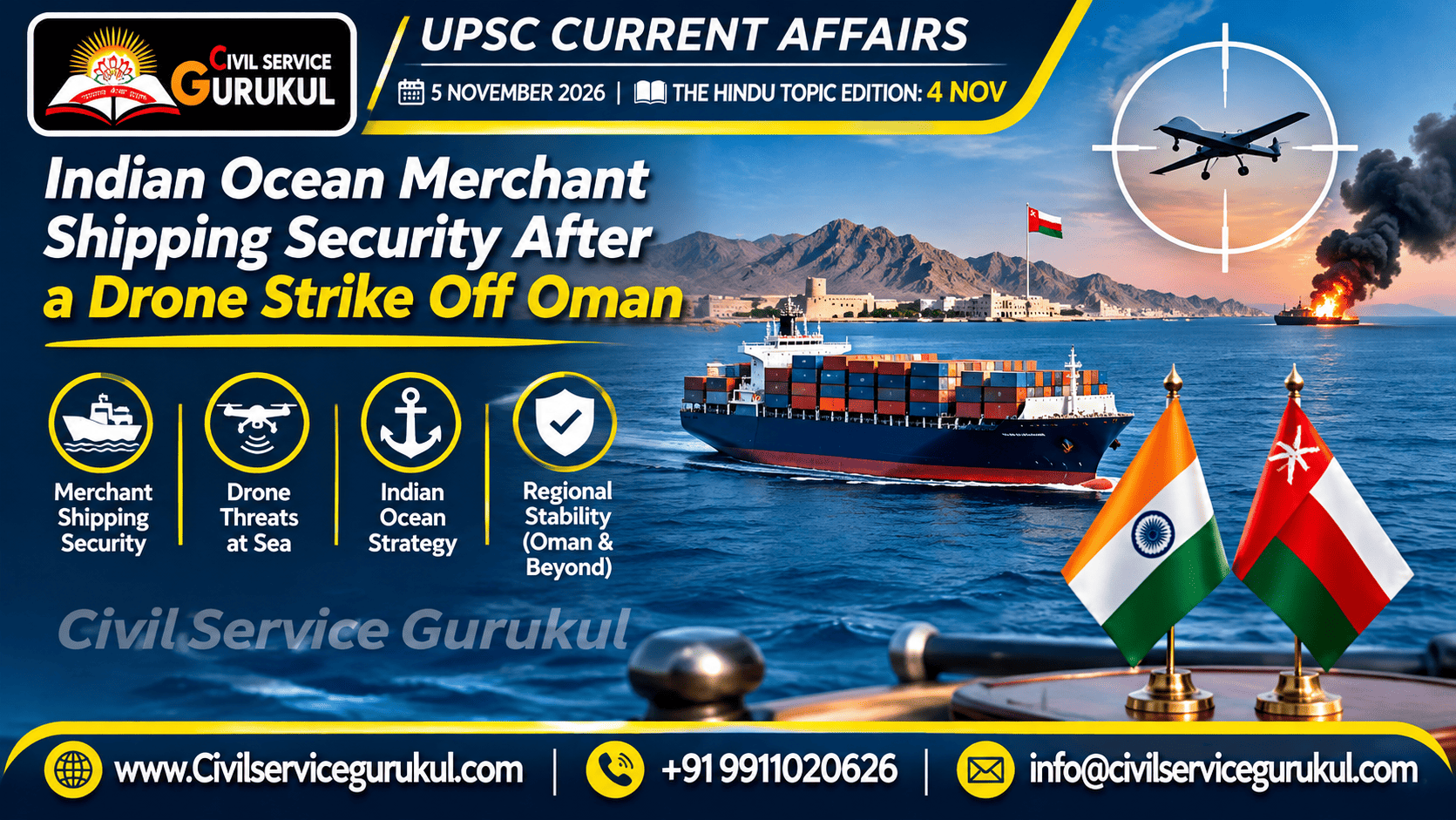
Drone Strike Near Oman 2026: Indian Seafarer Safety, Strait of Hormuz, Maritime Security and India's Indian Ocean Strategy
Comprehensive UPSC Prelims and Mains analysis of merchant shipping threats, sea-lane security, international maritime law, energy security and regional cooperation.
Published: 5 November 2026
1. Why Is Maritime Security Near Oman in News?
A current-affairs topic index dated 4 November 2026 highlighted a reported drone strike on a commercial vessel off Oman that resulted in the death of an Indian national.
The headline draws attention to the security challenges facing merchant shipping in the western Indian Ocean.
The exact identity of the vessel, its flag, the circumstances of the incident and responsibility for the attack require verification from reliable official information.
2. Strategic Importance of the Gulf of Oman
The Gulf of Oman connects the Arabian Sea with the approaches to the Strait of Hormuz.
It is an important maritime corridor for commercial vessels travelling between the Persian Gulf and wider international markets.
Security disruptions in this region may affect:
- Energy transportation.
- International shipping schedules.
- Marine insurance.
- Freight costs.
- Seafarer safety.
- Regional diplomatic relations.
3. Strait of Hormuz: Geography and Importance
The Strait of Hormuz is a strategically important waterway connecting the Persian Gulf with the Gulf of Oman.
It lies between Iran to the north and Oman to the south.
The strait is significant because substantial energy shipments move through this maritime passage.
4. Why Merchant Shipping Security Matters
Merchant vessels transport energy, food, raw materials, manufactured goods and other essential commodities.
Their safe movement is important for global economic stability.
Attacks on commercial ships can disrupt supply chains, increase operational risks and threaten multinational crews.
The impact may extend beyond the directly affected vessel.
5. Emerging Drone Threats to Commercial Shipping
Uncrewed systems, including aerial drones, have changed the nature of some maritime security threats.
Such technologies can create challenges for vessel detection, warning and defensive preparedness.
For policy analysis, it is important to distinguish the general capabilities of drone systems from the verified circumstances of a specific incident.
Responsibility for an attack should not be assumed without credible evidence.
6. Threats to Maritime Security
- Piracy and armed robbery at sea.
- Attacks using drones or other weapons.
- Maritime terrorism.
- Illegal trafficking.
- Cybersecurity threats to shipping systems.
- Disruption of navigation and communication.
- Regional military tensions.
Different threats require different legal, operational and diplomatic responses.
7. India's Strategic Interests in the Indian Ocean
India's geography gives it a major interest in the security of Indian Ocean sea lanes.
Maritime trade supports economic activity, energy imports and international connectivity.
India also has an important interest in the welfare of Indian nationals working on commercial ships.
A secure maritime environment therefore supports both economic and human security.
8. India's Energy Security and Sea Lanes
India depends on international maritime transport for a significant part of its energy trade.
Instability near major shipping routes can influence freight charges, insurance premiums and delivery schedules.
Such disruptions may create broader economic uncertainty.
Energy security therefore requires attention to both supply diversification and transport-route resilience.
9. UNCLOS and the Law of the Sea
The United Nations Convention on the Law of the Sea, commonly known as UNCLOS, provides an important international legal framework for maritime zones and ocean-related rights and responsibilities.
It addresses matters such as territorial seas, exclusive economic zones, navigation and other aspects of ocean governance.
The legal character of a particular incident depends on its location, circumstances and applicable rules.
10. International Maritime Organization
The International Maritime Organization, or IMO, is a specialized agency of the United Nations.
It develops international standards concerning shipping safety, security and prevention of marine pollution.
The IMO is central to the international regulatory framework for merchant shipping.
11. SOLAS and Maritime Safety
The International Convention for the Safety of Life at Sea, commonly called SOLAS, is an important international maritime safety convention.
It establishes requirements relating to the safety of merchant ships.
The International Ship and Port Facility Security Code, or ISPS Code, forms part of the international maritime security framework associated with SOLAS.
12. Protection of Indian Seafarers
Indian nationals work on commercial vessels operating across international waters.
Their safety requires coordination among shipping companies, flag states, coastal authorities and relevant Indian agencies.
In an emergency, important priorities include:
- Timely casualty information.
- Medical and rescue assistance.
- Communication with families.
- Consular coordination.
- Lawful investigation.
- Support for affected seafarers.
13. Role of the Indian Navy
The Indian Navy contributes to maritime security through surveillance, presence, coordination and other lawful operations.
Naval activities can support maritime-domain awareness and help respond to threats affecting shipping.
Operational responses depend on circumstances, legal authority and coordination with relevant states and agencies.
14. Maritime Domain Awareness
Maritime Domain Awareness, or MDA, means developing an understanding of activities, risks and conditions in the maritime environment.
It can draw upon information from:
- Coastal surveillance.
- Ship reporting systems.
- Radar and satellite information.
- Maritime traffic data.
- Inter-agency information sharing.
- International cooperation.
Improved MDA can support early warning and more effective response.
15. SAGAR and Regional Maritime Cooperation
SAGAR stands for Security and Growth for All in the Region.
It reflects India's emphasis on maritime cooperation and regional security.
Relevant priorities include cooperation with regional partners, capacity building, maritime safety and support for a stable Indian Ocean environment.
The approach highlights the importance of security cooperation alongside economic development.
16. Economic Impact of Attacks on Merchant Vessels
| Area | Potential Impact |
|---|---|
| Shipping | Route changes and delays |
| Insurance | Higher risk-related premiums |
| Energy | Uncertainty in transport and delivery |
| Trade | Supply-chain disruption |
| Seafarers | Physical danger and welfare concerns |
| Diplomacy | Need for international coordination |
17. International Cooperation and Maritime Security
Maritime threats often cross national boundaries.
Effective responses may require cooperation among:
- Coastal states.
- Flag states.
- Port authorities.
- Naval forces.
- Shipping companies.
- International maritime institutions.
- Consular authorities.
Such cooperation should be based on applicable international law and verified information.
18. Governance and Ethical Dimensions
Human Security
The protection of civilian seafarers should remain a central concern.
Accountability
Attacks should be investigated through lawful processes.
Transparency
Public communication should distinguish confirmed facts from allegations.
International Cooperation
States should support safe navigation and peaceful coordination.
Proportionality
Security responses should respect applicable legal standards and avoid unnecessary escalation.
19. Way Forward: Strengthening Indian Ocean Maritime Security
- Improve maritime-domain awareness.
- Strengthen shipping threat information sharing.
- Enhance emergency communication with merchant vessels.
- Support Indian seafarers and affected families.
- Coordinate with flag and coastal states.
- Promote lawful investigation of maritime incidents.
- Strengthen regional maritime cooperation.
- Improve preparedness for emerging technologies.
- Encourage de-escalation and diplomatic engagement.
- Support resilience of critical trade routes.
20. UPSC Prelims Quick Revision
- The Gulf of Oman connects the Arabian Sea with the Strait of Hormuz.
- The Strait of Hormuz connects the Persian Gulf and Gulf of Oman.
- UNCLOS is the United Nations Convention on the Law of the Sea.
- IMO is a UN specialized agency for international shipping.
- SOLAS concerns safety of life at sea.
- The ISPS Code is associated with maritime security under SOLAS.
- MDA stands for Maritime Domain Awareness.
- SAGAR stands for Security and Growth for All in the Region.
- Merchant shipping security is important for international trade and energy transport.
- Incident attribution requires reliable evidence.
21. UPSC Prelims Practice MCQs
Question 1
Which international organization develops standards for shipping safety and security?
- WHO
- IMO
- UNESCO
- FAO
The International Maritime Organization is the relevant UN specialized agency.
Question 2
The Strait of Hormuz connects:
- Red Sea and Mediterranean Sea
- Persian Gulf and Gulf of Oman
- Black Sea and Caspian Sea
- Bay of Bengal and Andaman Sea
The Strait of Hormuz connects the Persian Gulf with the Gulf of Oman.
Question 3
UNCLOS is primarily associated with:
- International aviation law
- International maritime law
- International taxation
- International monetary policy
UNCLOS provides an important legal framework for ocean governance.
Question 4
SAGAR stands for:
- Security and Growth for All in the Region
- Strategic Alliance for Global Agricultural Reform
- South Asian Governance and Research
- Security Agreement for Global Air Routes
SAGAR means Security and Growth for All in the Region.
Question 5
Which approach best supports merchant shipping security?
- Ignoring information sharing
- Assuming responsibility without evidence
- Combining surveillance, seafarer protection and lawful cooperation
- Eliminating emergency communication
Effective maritime security requires awareness, cooperation and protection of civilian crews.
22. UPSC Mains Practice Questions
GS Paper II — International Relations
Question: Discuss the importance of maritime cooperation in protecting India's interests in the western Indian Ocean. (250 words)
GS Paper III — Security
Question: Examine the emerging security challenges posed by drones and other asymmetric threats to merchant shipping. (250 words)
GS Paper III — Economy
Question: Explain how disruptions to major maritime routes may affect India's energy security and international trade. (150 words)
23. Model UPSC Mains Answer
Question: Assess India's priorities in protecting seafarers and trade routes in the western Indian Ocean.
Introduction:
The western Indian Ocean is vital for commercial shipping, energy transportation and regional connectivity. Threats to merchant vessels can affect both economic security and the safety of seafarers.
Body:
- Maritime awareness: Strengthen monitoring and timely threat information.
- Seafarer safety: Improve rescue coordination, medical support and consular assistance.
- Naval coordination: Support lawful maritime security operations and regional cooperation.
- International law: Respect applicable UNCLOS and maritime safety frameworks.
- Energy resilience: Prepare for transport disruption and supply-chain uncertainty.
- Diplomacy: Encourage cooperation and de-escalation among relevant states.
- Accountability: Support credible investigations based on verified evidence.
Conclusion:
India's maritime strategy should integrate security, economic resilience, seafarer welfare and international cooperation to protect critical sea lanes.
24. Key Takeaways for UPSC Aspirants
- Locate the Gulf of Oman and Strait of Hormuz on a map.
- Understand the importance of merchant shipping for India's economy.
- Revise UNCLOS, IMO, SOLAS and ISPS Code.
- Connect maritime security with India's energy security.
- Understand Maritime Domain Awareness and SAGAR.
- Discuss emerging drone threats without assuming incident-specific facts.
- Highlight seafarer protection and consular coordination.
- Use international law, diplomacy and regional cooperation in Mains answers.
Frequently Asked Questions
Why is the Gulf of Oman strategically important?
It connects the Arabian Sea with the approaches to the Strait of Hormuz and is important for international shipping and energy transportation.
What is the Strait of Hormuz?
It is a strategic waterway connecting the Persian Gulf with the Gulf of Oman.
What is the International Maritime Organization?
IMO is a UN specialized agency responsible for international shipping safety, security and marine pollution standards.
What is UNCLOS?
UNCLOS is the United Nations Convention on the Law of the Sea, which provides a major framework for ocean governance.
What does SAGAR mean?
SAGAR stands for Security and Growth for All in the Region.
Who carried out the reported drone strike near Oman?
The uploaded headline does not establish responsibility. Attribution requires credible investigation and verified information.
Why is the incident relevant for UPSC 2027?
It connects international relations, geography, maritime security, energy security, international law and governance.
Prepare for UPSC with Civil Service Gurukul
Strengthen your UPSC preparation with structured International Relations, Security, Geography, Current Affairs, Prelims MCQs and Mains answer-writing practice.
Visit Civil Service GurukulWebsite: www.civilservicegurukul.com
Mobile: +91 9911020626
Email: info@civilservicegurukul.com
Prepare with Mentors Who Cleared the Exam
Get personalized study plans, evaluated answer models, and test series access.