
Unified Urban Planning in India: Challenges & Reforms | UPSC 2027
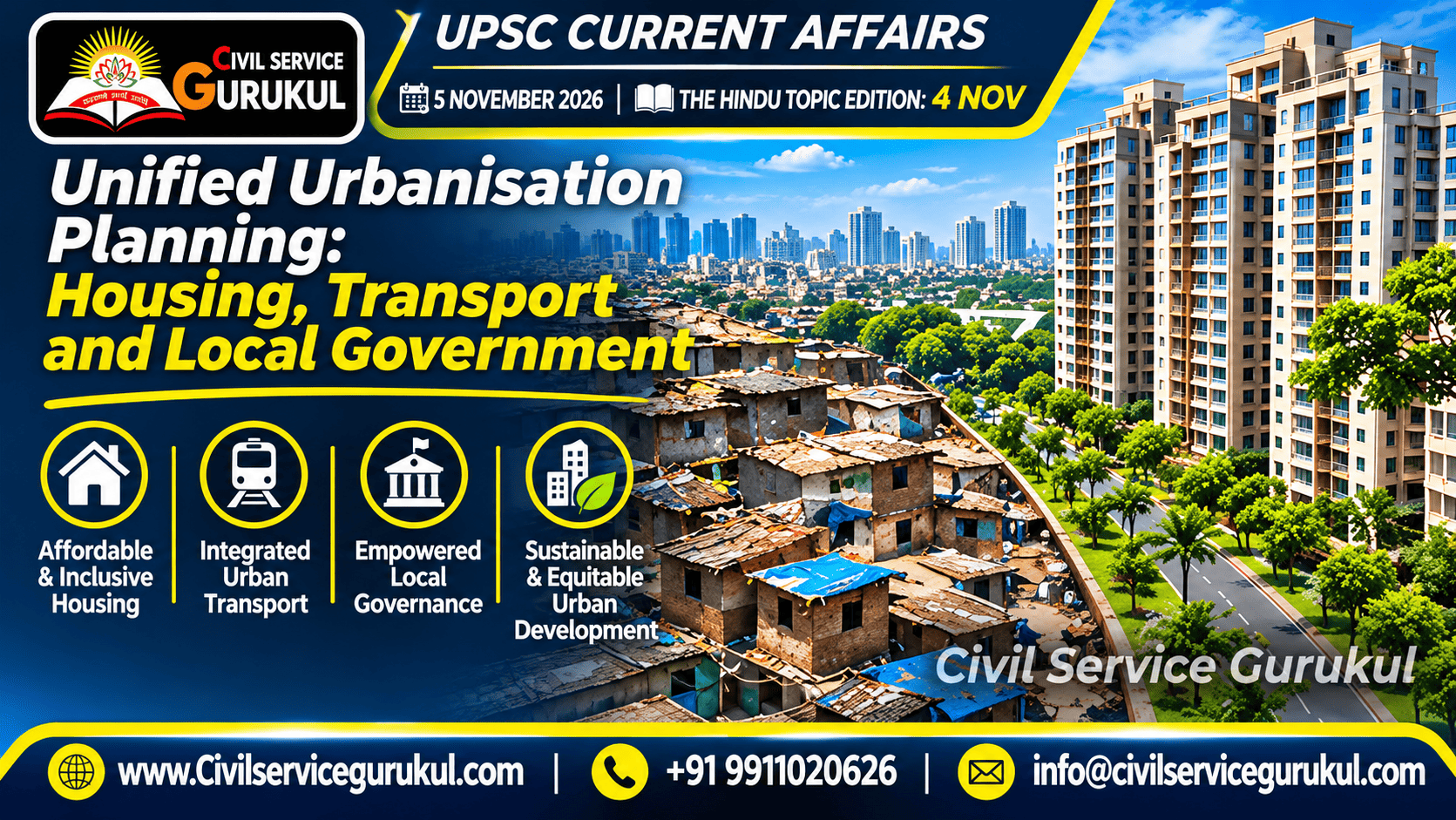
UPSC CURRENT AFFAIRS | URBANISATION | GOVERNANCE | GEOGRAPHY
India's Urbanisation Challenge 2026: Why Unified Planning of Housing, Transport and Local Government Is Essential
Comprehensive UPSC Prelims and Mains analysis of integrated city planning, municipal governance, affordable housing, urban mobility, climate resilience and institutional reforms.
Published: 5 November 2026
1. Why Is Unified Urbanisation Planning in News?
A current-affairs topic index dated 4 November 2026 highlighted the need for a unified urbanisation plan in India.
The issue draws attention to fragmented planning of housing, transport, drainage, land use and municipal services across expanding urban regions.
Indian cities increasingly extend beyond traditional municipal boundaries through commuting networks, industrial corridors, peri-urban development and shared environmental systems.
2. What Is Unified Urban Planning?
Unified urban planning is an approach that coordinates land use, housing, transport, water, sanitation, drainage, environmental management and public services within a common planning framework.
Its objective is to ensure that infrastructure decisions are spatially connected, financially feasible and aligned with the needs of residents.
Unified planning does not necessarily mean placing every decision under a single authority.
Instead, it requires effective coordination among responsible institutions, clear accountability and meaningful public participation.
3. Why Is Urban Planning Fragmented in India?
Urban governance involves municipal bodies, development authorities, transport agencies, water utilities, state departments and other institutions.
These agencies may operate under different laws, budgets, geographical jurisdictions and planning timelines.
Fragmentation can result in:
- Housing projects disconnected from employment centres.
- Road development without adequate public transport.
- Drainage systems that ignore watershed boundaries.
- Peripheral settlements without basic services.
- Duplicated infrastructure expenditure.
- Weak coordination between land use and mobility.
4. Urbanisation and Peri-Urban Development
Peri-urban areas are transition zones between predominantly urban and rural landscapes.
They may experience rapid land conversion, changing livelihoods, increased commuting and rising demand for infrastructure.
Such areas often fall between different administrative arrangements, making coordinated planning particularly important.
Effective urban planning must therefore consider the wider functional urban region rather than only the legally defined municipal boundary.
5. The 74th Constitutional Amendment Act, 1992
The 74th Constitutional Amendment Act, 1992 introduced a constitutional framework for urban local self-government through Part IXA of the Constitution.
It provides for municipalities and includes provisions relating to their composition, elections, planning and other institutional matters.
However, the actual assignment of functions and powers depends substantially on state legislation.
Therefore, constitutional recognition does not automatically ensure complete administrative or financial autonomy for municipalities.
6. Twelfth Schedule of the Constitution
The Twelfth Schedule lists 18 matters associated with municipal functions.
Important subjects include:
- Urban planning, including town planning.
- Regulation of land use and construction of buildings.
- Planning for economic and social development.
- Roads and bridges.
- Water supply.
- Public health, sanitation and solid waste management.
- Urban forestry and environmental protection.
- Slum improvement and upgrading.
- Urban poverty alleviation.
- Provision of urban amenities and facilities.
7. Metropolitan Planning Committees
Article 243ZE provides for Metropolitan Planning Committees to prepare a draft development plan for the metropolitan area as a whole.
This framework recognizes the need to coordinate development across multiple municipalities and other local areas.
Metropolitan planning is especially important where housing markets, transport systems and infrastructure networks extend across administrative boundaries.
The actual institutional effectiveness of these committees depends on state-level implementation and their practical relationship with other planning agencies.
8. District Planning Committees
Article 243ZD provides for District Planning Committees to consolidate plans prepared by Panchayats and municipalities and prepare a draft development plan for the district as a whole.
This framework is relevant where rural and urban development needs intersect.
District-level coordination can support integrated planning of roads, water resources, land use and public services.
| District Planning Committee | Metropolitan Planning Committee |
|---|---|
| Article 243ZD | Article 243ZE |
| District-level planning framework | Metropolitan-area planning framework |
| Consolidates Panchayat and municipal plans | Prepares a draft development plan for the metropolitan area |
| Supports rural–urban coordination | Supports metropolitan coordination |
9. Integrating Land Use and Urban Transport
Land use and transport are closely connected.
Housing locations influence commuting patterns, while transport infrastructure shapes urban expansion and land values.
When affordable housing is developed far from employment centres without reliable transport, residents may face higher travel costs and reduced access to opportunities.
Integrated planning seeks to coordinate:
- Residential development.
- Employment centres.
- Public transport corridors.
- Walking and cycling infrastructure.
- Public services.
- Land-use regulations.
10. Transit-Oriented Development
Transit-Oriented Development, or TOD, is a planning approach that encourages compact, mixed-use and accessible development around public transport corridors or stations.
Its potential benefits include improved accessibility, reduced dependence on private vehicles and more efficient use of urban land.
However, TOD requires attention to affordability, pedestrian safety, public amenities and the risk of displacement.
Transport infrastructure alone cannot guarantee inclusive urban development.
11. Affordable Housing and Urban Inclusion
Affordable housing is not simply the construction of low-cost residential units.
Its effectiveness also depends on access to employment, transport, water, sanitation, schools and healthcare.
Housing located far from jobs may create additional economic burdens for residents.
Urban policy should therefore assess affordability in terms of both housing costs and the wider cost of accessing essential opportunities.
12. Urban Flooding and Watershed-Based Planning
Urban flooding can be aggravated by inadequate drainage, loss of natural water bodies, construction in vulnerable areas and changes in land cover.
Drainage systems often cross municipal boundaries and must be considered at an appropriate watershed scale.
Integrated planning can support:
- Protection of natural drainage channels.
- Improved stormwater management.
- Risk-sensitive land-use planning.
- Coordination across local jurisdictions.
- Protection of wetlands and water bodies.
- Climate-resilient infrastructure design.
13. Climate-Resilient Urban Development
Indian cities face risks associated with extreme rainfall, heat stress, water scarcity and other climate-related challenges.
Climate resilience requires urban planning to account for environmental risks before major infrastructure and land-use decisions are made.
Possible measures include:
- Urban green spaces.
- Heat-resilient public infrastructure.
- Improved drainage.
- Protection of floodplains.
- Water-sensitive urban design.
- Risk-informed development controls.
14. Municipal Finance and Urban Governance
Urban local bodies require adequate financial resources to provide and maintain public services.
Municipal financing may involve own-source revenues, intergovernmental transfers, grants and other legally available financing mechanisms.
Weak fiscal capacity can limit the effectiveness of even well-designed urban plans.
Stronger financial management, transparent budgeting and reliable service delivery are important for urban governance.
15. Why Municipal Empowerment Matters
Urban planning is more effective when institutions have clear responsibilities, adequate staff, financial capacity and accountability mechanisms.
Municipal bodies are important because they are directly connected to local public services and resident needs.
However, large metropolitan regions also require coordination across multiple local bodies and state-level agencies.
The challenge is to combine local democratic accountability with regional planning capacity.
16. Urban Planning and Open Spatial Data
Spatial data can help planners understand population distribution, land use, transport networks, drainage systems and infrastructure gaps.
Open and interoperable planning data can improve coordination among agencies.
Relevant applications include:
- Mapping public transport accessibility.
- Identifying underserved settlements.
- Monitoring land-use change.
- Assessing flood exposure.
- Planning public facilities.
- Tracking infrastructure implementation.
Data use should also respect applicable privacy, security and governance requirements.
17. Major Urban Development Initiatives
Smart Cities Mission
The Smart Cities Mission was launched to promote urban improvements through area-based development and other interventions.
AMRUT
The Atal Mission for Rejuvenation and Urban Transformation focuses on urban service infrastructure and related improvements.
Pradhan Mantri Awas Yojana – Urban
PMAY-Urban is associated with housing support for eligible urban households.
These initiatives should be understood within the wider challenge of institutional coordination and local governance.
Specific scheme phases, current funding and implementation outcomes should be checked against official records.
18. Fragmented Planning vs Unified Planning
| Fragmented Planning | Unified Planning |
|---|---|
| Separate sectoral decisions | Coordinated land use and infrastructure decisions |
| Housing disconnected from jobs | Housing linked with employment and mobility |
| Drainage planned within narrow jurisdictions | Watershed-scale drainage coordination |
| Limited information sharing | Interoperable spatial data |
| Infrastructure measured mainly by construction | Infrastructure assessed through accessibility and service outcomes |
| Unclear institutional responsibility | Defined roles and accountability |
19. Challenges to Unified Urban Planning
Institutional Overlap
Multiple agencies may exercise authority over related urban functions.
Weak Local Capacity
Municipalities may face shortages of specialized planning staff and financial resources.
Rapid Peri-Urban Growth
Urban expansion may outpace the extension of formal services.
Data Fragmentation
Agencies may use incompatible information systems and planning boundaries.
Social Inequality
Planning decisions may overlook informal settlements and vulnerable groups.
Climate Risks
Infrastructure may be planned without adequate consideration of flood and heat exposure.
20. Way Forward: A Unified Urbanisation Strategy
- Coordinate housing, land use and transport planning.
- Strengthen metropolitan and district-level planning arrangements.
- Clarify responsibilities among urban institutions.
- Improve municipal financial capacity.
- Develop interoperable spatial planning systems.
- Integrate watershed-scale drainage planning.
- Protect environmentally sensitive urban areas.
- Promote affordable housing near jobs and public transport.
- Ensure meaningful public consultation.
- Measure access to services rather than construction alone.
- Publish transparent implementation indicators.
- Conduct periodic independent evaluations.
21. UPSC Prelims Quick Revision
- The 74th Constitutional Amendment Act, 1992 concerns urban local self-government.
- Part IXA of the Constitution deals with municipalities.
- The Twelfth Schedule lists 18 municipal matters.
- Article 243ZD provides for District Planning Committees.
- Article 243ZE provides for Metropolitan Planning Committees.
- Transit-Oriented Development links land use with public transport.
- Peri-urban areas are transition zones between urban and rural areas.
- Urban flooding requires coordination beyond municipal boundaries.
- Municipal finance is essential for service delivery.
- Integrated planning requires coordination without eliminating local democratic accountability.
22. UPSC Prelims Practice MCQs
Question 1
The Twelfth Schedule of the Indian Constitution is associated with:
- Panchayat functions
- Municipal functions
- Union List subjects
- Emergency provisions
The Twelfth Schedule lists 18 matters associated with municipalities.
Question 2
Which Article provides for Metropolitan Planning Committees?
- Article 243ZD
- Article 243ZE
- Article 280
- Article 324
Article 243ZE provides for Metropolitan Planning Committees.
Question 3
Transit-Oriented Development primarily seeks to:
- Separate all housing from public transport
- Promote compact and accessible development around transit
- Eliminate pedestrian infrastructure
- Restrict all mixed-use development
TOD encourages coordinated land use and transport planning.
Question 4
Which statement best describes peri-urban areas?
- Only the central business districts of cities
- Transition zones between urban and rural landscapes
- Areas located exclusively inside national parks
- Regions without any interaction with cities
Peri-urban areas are transition zones experiencing rural–urban interactions and land-use change.
Question 5
Which approach is most consistent with unified urban planning?
- Planning drainage without considering watershed boundaries
- Locating affordable housing without assessing transport access
- Coordinating land use, housing, transport and municipal services
- Eliminating public consultation
Unified planning integrates interconnected urban functions and institutional responsibilities.
23. UPSC Mains Practice Questions
GS Paper I — Urbanisation
Question: Explain how fragmented urban planning contributes to housing inequality, congestion and environmental vulnerability in Indian cities. (250 words)
GS Paper II — Governance
Question: Discuss the institutional reforms needed for integrated and inclusive urban planning in India. (250 words)
GS Paper III — Infrastructure
Question: Examine the role of transit-oriented development and climate-resilient infrastructure in sustainable urbanisation. (150 words)
24. Model UPSC Mains Answer
Question: Discuss the institutional reforms needed for integrated and inclusive urban planning in India.
Introduction:
Rapid urban expansion increasingly crosses municipal boundaries, while housing, transport, drainage and land use are often planned by separate agencies. This creates a need for integrated urban governance.
Body:
- Planning institutions: Strengthen District and Metropolitan Planning Committees under Articles 243ZD and 243ZE.
- Municipal empowerment: Improve the functional, financial and administrative capacity of urban local bodies.
- Integrated land use: Coordinate housing locations with employment centres and public transport.
- Environmental planning: Adopt watershed-based drainage and climate-risk assessment.
- Data systems: Develop interoperable spatial information and transparent planning records.
- Social inclusion: Prioritize access to safe housing, services and mobility for underserved communities.
- Accountability: Assign clear institutional responsibilities and evaluate measurable service outcomes.
Conclusion:
Integrated urbanisation requires coordination across institutions while preserving local democracy. Its success should be measured through improved accessibility, resilience, affordability and quality of life.
25. Key Takeaways for UPSC Aspirants
- Define unified urban planning clearly.
- Explain the problems of fragmented urban governance.
- Revise the 74th Constitutional Amendment.
- Remember the 18 matters in the Twelfth Schedule.
- Distinguish Articles 243ZD and 243ZE.
- Connect housing with jobs and transport accessibility.
- Understand peri-urban development and urban flooding.
- Explain the importance of municipal finance.
- Include climate resilience and public participation in Mains answers.
- Measure urban development through service outcomes, not only infrastructure construction.
Frequently Asked Questions
What is unified urban planning?
It is an approach that coordinates land use, housing, transport, environmental management and municipal services within a common planning framework.
Why does India need unified urban planning?
Urban regions cross administrative boundaries, while fragmented institutions can create gaps in housing, transport, drainage and public services.
What is the 74th Constitutional Amendment?
It introduced a constitutional framework for urban local self-government through Part IXA of the Constitution.
What is the Twelfth Schedule?
It lists 18 matters associated with municipal functions, including urban planning, water supply, roads and sanitation.
What is a Metropolitan Planning Committee?
Under Article 243ZE, it prepares a draft development plan for the metropolitan area as a whole.
What is Transit-Oriented Development?
It promotes compact, accessible and mixed-use development around public transport corridors or stations.
Why is this topic important for UPSC 2027?
It connects urbanisation, constitutional governance, infrastructure, sustainable development, public finance and environmental management.
Prepare for UPSC with Civil Service Gurukul
Strengthen your UPSC preparation with structured Geography, Indian Polity, Governance, Economy, Environment, Current Affairs, Prelims MCQs and Mains answer-writing practice.
Visit Civil Service GurukulWebsite: www.civilservicegurukul.com
Mobile: +91 9911020626
Email: info@civilservicegurukul.com
Prepare with Mentors Who Cleared the Exam
Get personalized study plans, evaluated answer models, and test series access.