Aadhaar vs Citizenship Proof: Voter Verification | UPSC 2027
UPSC CURRENT AFFAIRS | INDIAN POLITY | CONSTITUTIONAL LAW
Aadhaar Is Not Proof of Citizenship: Delhi Voter Verification, ECI Rules, Constitutional Rights and Electoral Reforms
Complete UPSC Prelims and Mains analysis of identity, citizenship, voter eligibility, electoral verification and democratic safeguards.
Published: 5 November 2026
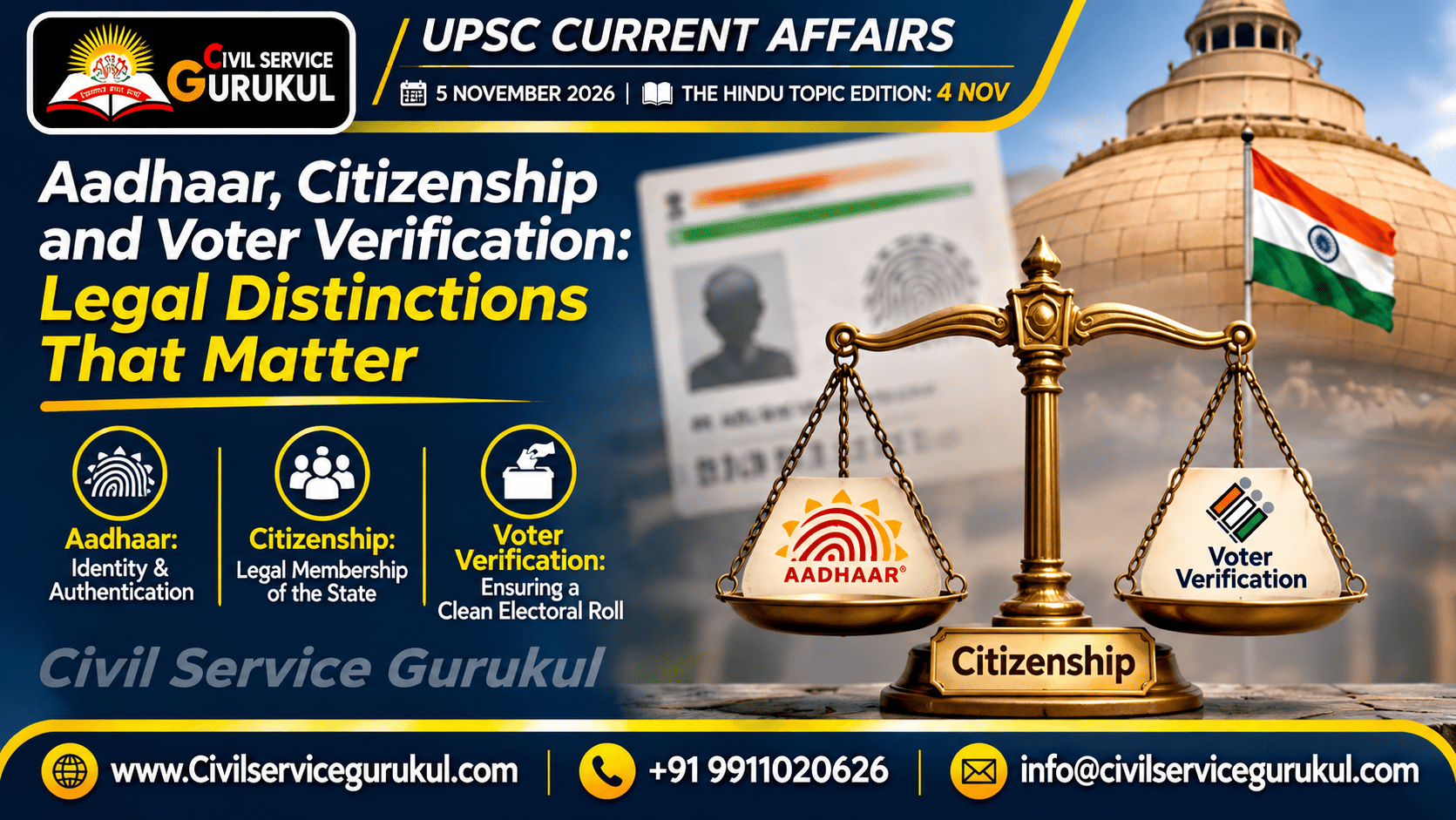
1. Why Is Aadhaar and Voter Verification in News?
A current-affairs topic index dated 4 November 2026 highlighted a report concerning Delhi Booth Level Officers and citizenship-related verification of voters.
The headline indicated that Aadhaar alone was considered insufficient for establishing citizenship during the reported verification exercise.
The complete official instruction, including the documents accepted and the scope of verification, requires confirmation from the relevant authorities.
The issue raises important questions about identity, citizenship, voter eligibility, privacy and administrative fairness.
2. What Is Aadhaar?
Aadhaar is a unique identification number issued by the Unique Identification Authority of India under the applicable statutory framework.
Aadhaar is based on identity information and biometric or demographic data collected through prescribed enrolment procedures.
It can support identity verification in legally permitted contexts.
However, Aadhaar does not independently establish Indian citizenship.
3. Aadhaar and Citizenship: Key Differences
| Feature | Aadhaar | Citizenship |
|---|---|---|
| Basic Meaning | Statutory identification number | Legal membership of the Indian state |
| Governing Framework | Aadhaar Act, 2016 | Constitution and Citizenship Act, 1955 |
| Issuing or Determining Authority | UIDAI issues Aadhaar numbers | Citizenship status is determined under applicable law |
| Citizenship Proof | Not independently conclusive | Requires legally relevant evidence and determination |
| Electoral Eligibility | Does not automatically establish eligibility | Indian citizenship is a necessary electoral qualification |
4. Constitutional Framework of Citizenship
Part II of the Indian Constitution contains provisions relating to citizenship at the commencement of the Constitution.
Articles 5 to 11 address different citizenship-related questions.
Article 11
Article 11 empowers Parliament to make laws concerning the acquisition and termination of citizenship and other citizenship matters.
The Citizenship Act, 1955 provides an important statutory framework for citizenship in India.
5. Citizenship Act, 1955
The Citizenship Act, 1955 governs important aspects of Indian citizenship.
It includes provisions relating to citizenship by:
- Birth.
- Descent.
- Registration.
- Naturalisation.
- Incorporation of territory.
The applicable requirements depend on statutory provisions, amendments and individual circumstances.
6. Article 326 and Electoral Eligibility
Article 326 provides for elections to the Lok Sabha and State Legislative Assemblies on the basis of adult suffrage.
Eligible citizens aged 18 years or above may qualify for electoral registration, subject to constitutional and statutory conditions.
Citizenship is therefore a fundamental qualification for registration as an elector.
Possession of Aadhaar alone does not establish all the requirements for voter eligibility.
7. Role of the Election Commission of India
The Election Commission of India is a constitutional body established under Article 324.
It exercises constitutional responsibilities relating to the conduct and supervision of specified elections.
Electoral roll preparation and revision operate within the relevant statutory and regulatory framework.
Election authorities must balance electoral accuracy with protection of eligible voters from unjustified exclusion.
8. What Is Electoral Roll Verification?
Electoral roll verification involves checking information relevant to electoral registration.
It may involve confirming:
- Eligibility under electoral law.
- Relevant residence information.
- Accuracy of electoral records.
- Potential duplicate entries.
- Information required by applicable registration procedures.
The precise documents and procedures depend on the governing rules and valid official directions.
9. Booth Level Officers and Electoral Verification
Booth Level Officers, commonly called BLOs, assist electoral administration at the local level.
They may perform assigned verification and voter assistance functions.
However, BLOs operate within the applicable administrative framework.
Their assigned tasks should not be confused with the statutory decision-making powers of Electoral Registration Officers.
10. Why Aadhaar Alone Cannot Establish Citizenship
Aadhaar enrolment and citizenship determination serve different legal purposes.
The Aadhaar framework is linked to identity and residency-based eligibility, rather than an independent legal determination of nationality.
Therefore, possession of an Aadhaar number cannot by itself establish that a person is an Indian citizen.
Similarly, absence of Aadhaar should not automatically be treated as proof that a person is not an Indian citizen.
11. Challenges in Citizenship-Related Voter Verification
Documentation Gaps
Some eligible citizens may have incomplete or inconsistent records.
Migration
Mobile workers may face difficulties maintaining updated documents.
Gender-Related Barriers
Women may face documentation challenges linked to residence changes or record inconsistencies.
Digital Divide
Online-only processes can create barriers for citizens with limited digital access.
Administrative Capacity
Verification processes require trained personnel, consistent instructions and accessible remedies.
12. Right to Privacy and Personal Data Protection
The Supreme Court recognized privacy as a fundamental right in Justice K.S. Puttaswamy (Retd.) v. Union of India (2017).
Voter verification may involve the collection and processing of personal information.
Such processes should respect applicable legal requirements and principles of necessity, proportionality and data security.
Important Safeguards
- Collect only legally necessary information.
- Provide clear purposes for data collection.
- Restrict unauthorized access.
- Protect sensitive records.
- Ensure appropriate grievance mechanisms.
13. Electoral Integrity vs Democratic Inclusion
Electoral integrity requires that electoral rolls contain legally eligible voters.
Democratic inclusion requires that eligible citizens have a fair opportunity to register and participate.
These objectives need not be contradictory.
A well-designed verification system can protect electoral accuracy while avoiding unnecessary exclusion.
| Electoral Integrity | Democratic Inclusion |
|---|---|
| Prevent improper registration | Protect eligible voters from exclusion |
| Maintain accurate records | Provide accessible correction mechanisms |
| Use lawful verification | Ensure fair and consistent procedures |
| Support public confidence | Strengthen democratic participation |
14. Governance and Ethical Dimensions
Rule of Law
Verification must follow applicable legal authority and valid instructions.
Fairness
Comparable cases should receive consistent treatment.
Transparency
Citizens should understand the requirements and available remedies.
Accountability
Officials should be answerable for decisions and procedural failures.
Empathy
Administrative systems should recognize barriers faced by vulnerable groups.
15. Way Forward: Rights-Based Voter Verification
- Publish clear, legally grounded documentation requirements.
- Allow legally recognized alternative evidence.
- Train Booth Level Officers and registration staff.
- Ensure transparent verification procedures.
- Provide accessible offline assistance.
- Protect personal data and privacy.
- Communicate reasons for adverse decisions.
- Preserve statutory review and appeal routes.
- Monitor exclusion risks among vulnerable groups.
- Conduct regular administrative evaluation.
The central objective should be accurate electoral records without unjustified exclusion of eligible citizens.
16. UPSC Prelims Quick Revision
- Aadhaar is not by itself proof of Indian citizenship.
- UIDAI issues Aadhaar numbers.
- The Aadhaar Act was enacted in 2016.
- Part II of the Constitution addresses citizenship at commencement.
- Article 11 empowers Parliament to legislate on citizenship.
- The Citizenship Act was enacted in 1955.
- Article 324 concerns the Election Commission.
- Article 326 concerns adult suffrage for Lok Sabha and State Assembly elections.
- The minimum voting age is 18 years, subject to applicable qualifications.
- Electoral registration is governed by applicable electoral laws and rules.
- The Supreme Court recognized privacy as a fundamental right in the Puttaswamy judgment of 2017.
17. UPSC Prelims Practice MCQs
Question 1
Which statement about Aadhaar is correct?
- Aadhaar conclusively proves Indian citizenship.
- Aadhaar is not by itself proof of citizenship.
- Every Aadhaar holder is automatically a registered voter.
- Aadhaar replaces the Citizenship Act.
Aadhaar serves an identity-related purpose and does not independently establish Indian citizenship.
Question 2
Which constitutional article empowers Parliament to legislate on citizenship?
- Article 11
- Article 32
- Article 110
- Article 280
Article 11 empowers Parliament to make laws concerning citizenship matters.
Question 3
Which article provides for adult suffrage in Lok Sabha and State Assembly elections?
- Article 19
- Article 21
- Article 326
- Article 368
Article 326 concerns adult suffrage for the specified elections.
Question 4
The Supreme Court recognized privacy as a fundamental right in:
- Kesavananda Bharati case
- Justice K.S. Puttaswamy case
- Minerva Mills case
- Indra Sawhney case
The 2017 Puttaswamy judgment recognized privacy as a fundamental right.
Question 5
Which principle best supports lawful voter verification?
- Automatic exclusion of all persons without Aadhaar
- Verification without any review mechanism
- Legally grounded verification with procedural safeguards
- Unrestricted collection of personal data
Verification should follow applicable law and protect procedural fairness and privacy.
18. UPSC Mains Practice Questions
GS Paper II — Constitutional Governance
Question: Distinguish between Aadhaar-based identity verification and citizenship determination in India. (150 words)
GS Paper II — Electoral Reforms
Question: Examine the challenges of maintaining electoral roll accuracy while protecting the voting rights of eligible citizens. (250 words)
GS Paper IV — Ethics
Question: Discuss the ethical importance of fairness, privacy and accountability in voter verification. (150 words)
19. Model UPSC Mains Answer
Question: Examine the due-process safeguards needed in voter identity verification.
Introduction:
Voter verification is important for maintaining accurate electoral rolls, but it must operate within constitutional and statutory safeguards.
Body:
- Legal authority: Verification requirements must follow applicable law.
- Clear documentation: Citizens should receive understandable instructions.
- Alternative evidence: Legally recognized documents should be considered.
- Procedural fairness: Adverse decisions should be reasoned and reviewable.
- Privacy: Personal data collection should be necessary and proportionate.
- Accessibility: Vulnerable groups should receive appropriate assistance.
- Accountability: Authorities should monitor errors and exclusion risks.
Conclusion:
A credible verification system must protect electoral integrity while ensuring fairness, transparency, privacy and democratic inclusion.
20. Key Takeaways for UPSC Aspirants
- Do not confuse Aadhaar with proof of citizenship.
- Revise Articles 11, 324 and 326.
- Understand the Citizenship Act, 1955.
- Differentiate identity verification from citizenship determination.
- Recognize the role of Booth Level Officers and Electoral Registration Officers.
- Connect electoral roll verification with democratic inclusion.
- Use the Puttaswamy judgment for privacy-related analysis.
- Discuss lawful verification, procedural fairness and accessible remedies.
- Verify the exact Delhi verification instructions before treating them as an established nationwide rule.
Frequently Asked Questions
Is Aadhaar proof of Indian citizenship?
No. Aadhaar does not by itself establish Indian citizenship.
Can an Aadhaar holder automatically vote in India?
No. Electoral participation requires satisfaction of applicable legal qualifications and inclusion in the relevant electoral roll.
Which law governs Indian citizenship?
The Citizenship Act, 1955, together with relevant constitutional provisions and amendments, provides the central legal framework.
What is Article 326?
Article 326 provides for adult suffrage in elections to the Lok Sabha and State Legislative Assemblies.
What is the role of a Booth Level Officer?
A BLO supports electoral administration and assigned local verification activities under applicable instructions.
Does the reported Delhi instruction apply automatically throughout India?
The headline alone does not establish nationwide application. The relevant official direction and its scope must be verified.
Why is this topic important for UPSC 2027?
It connects Indian Polity, constitutional law, electoral governance, citizenship, privacy and ethics.
Prepare for UPSC with Civil Service Gurukul
Strengthen your UPSC preparation with structured Indian Polity notes, current affairs, constitutional analysis, Prelims MCQs and Mains answer writing.
Visit Civil Service GurukulWebsite: www.civilservicegurukul.com
Mobile: +91 9911020626
Email: info@civilservicegurukul.com
Prepare with Mentors Who Cleared the Exam
Get personalized study plans, evaluated answer models, and test series access.