
AI Ethics and Religious Traditions: UPSC 2026
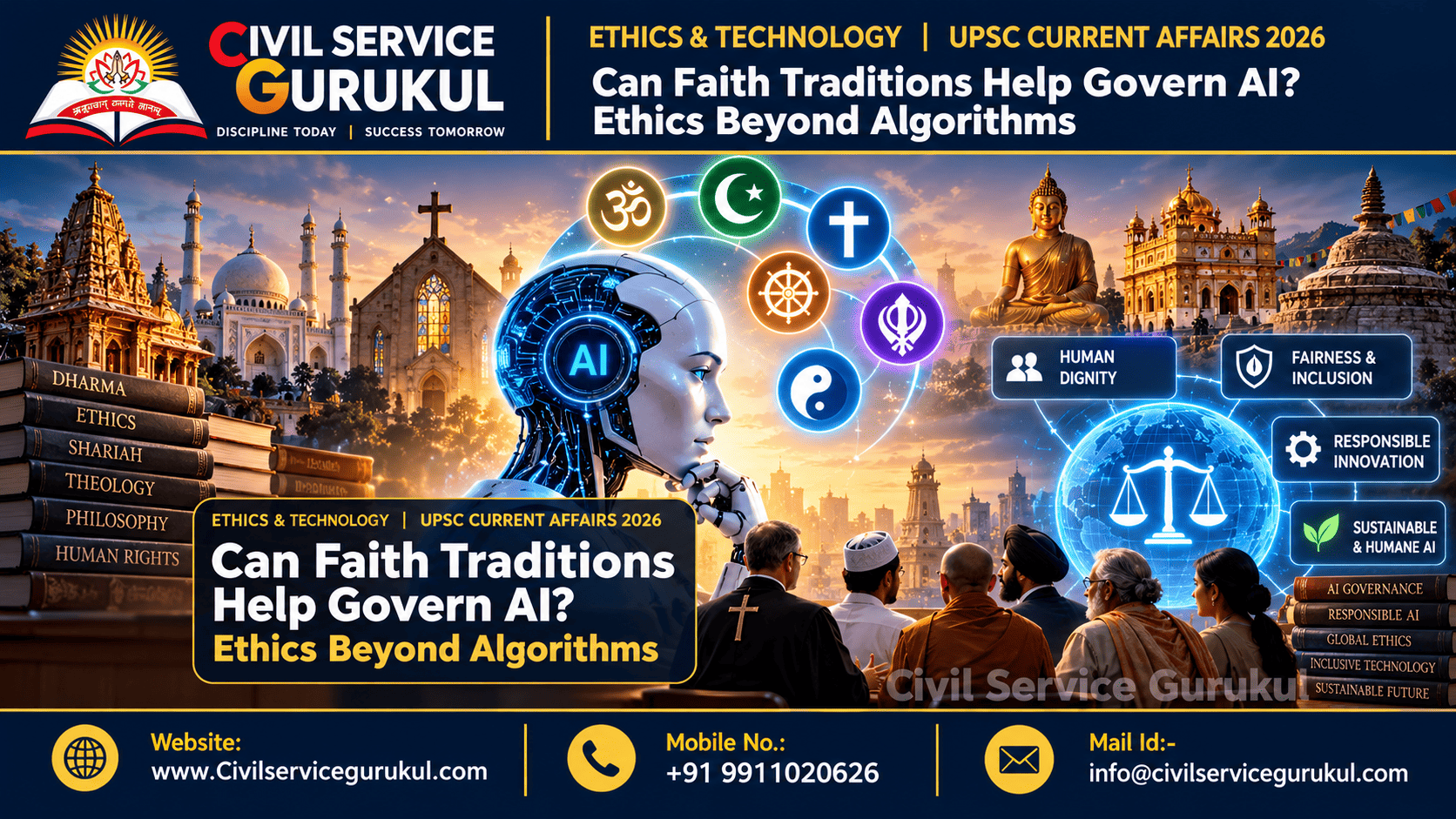
Can Religious and Ethical Traditions Shape AI Governance? Constitutional Morality, UNESCO Principles and UPSC Analysis 2026
How religious wisdom, philosophical ethics and constitutional principles can contribute to responsible artificial intelligence without compromising democratic accountability.
Artificial intelligence increasingly influences decisions affecting human dignity, equality, privacy and social relationships.
An October 2026 discussion about technology developers consulting religious communities has raised questions about the values that should guide AI systems.
Religious and philosophical traditions can offer insights into compassion, truthfulness, justice, stewardship and the limits of power.
However, democratic AI governance must protect people of different religious beliefs and those with no religious affiliation.
The central policy challenge is to combine inclusive ethical consultation with constitutional rights, technical evaluation and accountable oversight.
GS Paper II: Governance, accountability, rights and public institutions.
GS Paper III: Emerging technologies, artificial intelligence and technology-related risks.
GS Paper IV: Ethics, human values, integrity, impartiality and accountability.
Prelims: International frameworks, technology governance and basic AI concepts.
1. Why Is AI Ethics in the News?
Artificial intelligence can classify information, predict outcomes and generate text, images and other content at scale.
However, technical performance alone cannot resolve questions about fairness, dignity, responsibility or the acceptable use of power.
An October 2026 discussion about technology companies seeking ethical guidance from religious communities has brought attention to the wider question of who should influence the values embedded in AI systems.
This debate is especially important because AI applications can affect education, employment, healthcare, public services and social relationships.
2. How Religious and Philosophical Traditions Can Contribute to AI Ethics
Religious and philosophical traditions have long examined questions about human conduct, justice, responsibility and moral duty.
These traditions can help identify concerns that technical performance measures may overlook.
Potential ethical contributions
- Human dignity and respect.
- Compassion and care for vulnerable people.
- Truthfulness and avoidance of deception.
- Justice and fair treatment.
- Stewardship and responsible use of resources.
- Restraint in exercising power.
- Responsibility for foreseeable harm.
These contributions are most useful when considered alongside secular ethical perspectives, scientific evidence and constitutional safeguards.
3. UNESCO Recommendation on the Ethics of Artificial Intelligence, 2021
UNESCO adopted its Recommendation on the Ethics of Artificial Intelligence in November 2021.
The recommendation provides an international ethical framework for the development and use of AI.
Important principles
- Respect for human rights.
- Protection of human dignity.
- Fairness and non-discrimination.
- Transparency and explainability.
- Human oversight and responsibility.
- Accountability.
UNESCO's AI ethics recommendation is a soft-law international instrument.
It is not, by itself, a directly enforceable Indian statute.
4. Antiqua et Nova, 2025: Ethical Reflections on AI
The Vatican's 2025 note Antiqua et Nova discussed ethical questions arising from artificial intelligence.
The note addressed issues involving education, healthcare, employment, warfare, misinformation and human relationships.
Its relevance to AI governance lies in the broader debate over how technological development should respect human dignity and responsibility.
Such ethical reflections may contribute to public consultation, but they do not replace constitutional rights or democratically established legal obligations.
5. Religious Pluralism, Constitutional Morality and AI Governance
Plural societies contain people with different religious, philosophical and non-religious beliefs.
These groups may disagree on questions involving privacy, gender, speech and acceptable persuasion.
Giving one religious or philosophical authority final control over general-purpose AI systems could marginalise others.
Constitutional morality as a guiding framework
In India, constitutional morality offers a framework grounded in equality, liberty, dignity and freedom of conscience.
AI governance should therefore protect equal citizenship and individual rights rather than favouring one belief system.
Personal morality, professional ethics and public law are related but distinct.
A person's moral beliefs may influence ethical reflection, but public decisions must comply with constitutional and legal requirements.
6. Algorithmic Bias and Discrimination
Algorithmic bias occurs when an AI system produces systematically unfair outcomes.
Bias may emerge from training data, labels, optimisation objectives or the context in which a system is deployed.
Illustrative situations
- A recruitment system may disadvantage certain applicants.
- A loan-scoring model may unfairly affect historically disadvantaged groups.
- An educational system may provide unequal recommendations.
- A healthcare tool may perform differently across populations.
A system may appear technically efficient while producing socially harmful outcomes.
This illustrates why fairness cannot be assessed solely through accuracy.
7. What Is Ethics Washing in Artificial Intelligence?
Ethics washing refers to the practice of publicising ethical principles without implementing credible safeguards.
An organisation may publish statements about fairness and responsibility while failing to disclose evidence of bias, unsafe outputs or problematic data use.
How to prevent ethics washing
- Independent technical evaluation.
- Documented risk assessments.
- Transparent reporting.
- Red-teaming of AI systems.
- Complaint and appeal mechanisms.
- Meaningful human oversight.
- Remedies for affected individuals.
Ethical commitments become more meaningful when they are translated into measurable procedures and accountable institutions.
8. Human Oversight and Accountability in AI Decisions
Human oversight is particularly important when AI systems influence decisions affecting rights and opportunities.
Oversight should be meaningful rather than a ceremonial approval process.
Important safeguards
- Clear responsibility for consequential decisions.
- Appropriate explanation of AI-assisted outcomes.
- Human review where necessary.
- Independent oversight.
- Accessible complaint mechanisms.
- Effective remedies for affected persons.
Human responsibility should remain identifiable even when automated systems are involved.
9. Implications for AI Governance in India
India's governance framework must consider the opportunities and risks created by AI systems in diverse social settings.
Constitutional principles provide a foundation for evaluating how AI affects equality, liberty, dignity and freedom of conscience.
Important governance considerations
| Issue | Ethical Concern | Governance Response |
|---|---|---|
| Algorithmic Bias | Unfair treatment | Bias testing and review |
| Data Use | Privacy and consent | Appropriate legal safeguards |
| Automated Decisions | Weak accountability | Human oversight |
| Cultural Sensitivity | Exclusion of diverse perspectives | Inclusive consultation |
| Misleading AI Advice | False claims of authority | Disclosure and user protection |
| Ethics Washing | Unverified ethical claims | Independent evaluation |
The objective should be to support beneficial innovation while protecting fundamental rights and public trust.
10. Policy Priorities and the Way Forward
Effective AI governance requires both ethical reflection and practical institutional safeguards.
Recommended priorities
- Include diverse religious and secular perspectives in consultations.
- Ensure representation of minority communities and affected users.
- Translate ethical principles into measurable audits.
- Introduce proportionate risk assessment mechanisms.
- Require appropriate disclosure when people interact with AI systems.
- Strengthen complaint and appeal procedures.
- Maintain human responsibility for consequential decisions.
- Support independent oversight and technical evaluation.
The central principle is that ethical consultation should strengthen democratic governance rather than replace it.
11. UPSC Prelims Quick Revision Notes
- UNESCO AI Ethics Recommendation: Adopted in November 2021.
- Legal character: Soft-law international instrument.
- Antiqua et Nova: Vatican note published in 2025.
- Algorithmic bias: Systematic unfairness arising from data, design or deployment.
- Ethics washing: Ethical claims without credible implementation.
- Human oversight: Meaningful human responsibility and review.
- Constitutional morality: Respect for equality, liberty, dignity and freedom of conscience.
- Core UPSC theme: Ethical AI requires rights protection, transparency and accountability.
12. UPSC Prelims Practice MCQs
With reference to the UNESCO Recommendation on the Ethics of Artificial Intelligence, consider the following statements:
- It was adopted in November 2021.
- It emphasises human rights and human dignity.
- It is directly enforceable as an Indian statute.
Which statements are correct?
(a) 1 and 2 only
(b) 2 and 3 only
(c) 1 and 3 only
(d) 1, 2 and 3
The UNESCO recommendation was adopted in 2021 and emphasises rights-based AI governance. It is not itself a directly enforceable Indian law.
Which of the following best describes ethics washing?
(a) Developing AI without using training data.
(b) Publishing ethical commitments without credible implementation.
(c) Replacing human oversight with independent audits.
(d) Using artificial intelligence exclusively for education.
Ethics washing involves promoting ethical principles without implementing sufficient safeguards, evaluation or accountability.
Which approach best reconciles cultural consultation with democratic AI governance?
(a) Granting one religious authority control over all AI systems.
(b) Ignoring all ethical perspectives.
(c) Consulting diverse stakeholders while protecting constitutional rights.
(d) Allowing private companies to decide all rights-related questions without review.
Inclusive consultation can improve ethical understanding, but constitutional rights and accountable safeguards must remain central.
Algorithmic bias may arise from:
- Training data.
- Model objectives.
- Deployment context.
Select the correct answer:
(a) 1 only
(b) 1 and 2 only
(c) 2 and 3 only
(d) 1, 2 and 3
Algorithmic bias may emerge from data, model design and the conditions under which an AI system is used.
13. UPSC Mains Practice Questions
Question 1 — GS Paper IV
Can religious and philosophical traditions enrich AI ethics without undermining constitutional secularism? Examine. (150 words)
Suggested Answer Framework
Artificial intelligence creates ethical questions that technical optimisation alone cannot resolve.
Religious and philosophical traditions can contribute values such as compassion, dignity, truthfulness and restraint in the use of power.
However, plural societies contain different beliefs. Giving one tradition decisive authority over general-purpose AI could conflict with equality and freedom of conscience.
Constitutional morality provides a common framework grounded in rights and democratic accountability.
Therefore, AI governance should encourage inclusive consultation while requiring independent audits, transparency, human oversight and accessible remedies.
Question 2 — GS Paper III
Artificial intelligence cannot be governed by technical efficiency alone. Discuss the importance of ethics, human oversight and accountability in AI deployment. (250 words)
Answer Approach
- Introduce AI and the limits of technical optimisation.
- Explain risks involving bias, privacy and misinformation.
- Discuss human dignity and constitutional morality.
- Highlight UNESCO's ethics framework.
- Explain independent evaluation and human oversight.
- Conclude with rights-based, accountable AI governance.
14. Frequently Asked Questions
What is AI ethics?
AI ethics concerns the values and principles guiding the responsible development and use of artificial intelligence, including fairness, dignity, accountability and human rights.
Can religious traditions contribute to AI governance?
Yes. They can provide ethical perspectives, but democratic governance must remain inclusive and grounded in constitutional rights.
Is UNESCO's AI ethics recommendation legally binding in India?
No. It is an international soft-law recommendation and is not itself a directly enforceable Indian statute.
What is Antiqua et Nova?
It is a 2025 Vatican note discussing ethical questions relating to artificial intelligence.
What is algorithmic bias?
Algorithmic bias refers to systematically unfair outcomes that may result from training data, model design or deployment conditions.
What is ethics washing?
Ethics washing occurs when organisations promote ethical principles without implementing credible safeguards and accountability.
Why is AI ethics important for UPSC?
It connects GS Paper IV ethics with GS Paper III emerging technology and GS Paper II governance, rights and accountability.
15. Conclusion: Ethical AI Requires Plural Voices and Constitutional Accountability
The growing role of artificial intelligence has made ethical governance an important public-policy challenge.
Religious and philosophical traditions can enrich debates about compassion, justice, dignity and responsible use of technology.
However, such perspectives must operate within a democratic framework that protects equality, liberty and freedom of conscience.
The most effective approach combines inclusive consultation, scientific evaluation, independent oversight and meaningful remedies.
For UPSC aspirants, the central lesson is that ethical AI governance requires more than declarations of good intentions.
It requires accountable institutions capable of translating moral principles into practical safeguards.
Prepare for UPSC with Civil Service Gurukul
Strengthen your preparation for UPSC Prelims and Mains with concept-based current affairs, Ethics, Governance, Science and Technology, and answer-writing practice.
Website: www.civilservicegurukul.com
Mobile: +91 9911020626
Email: info@civilservicegurukul.com
Disclaimer: This article is intended for UPSC educational preparation. It is based on the supplied topic material and presents analytical discussion rather than legal advice. Legislative, judicial and regulatory developments should be checked against their latest authoritative versions before professional reliance.
Prepare with Mentors Who Cleared the Exam
Get personalized study plans, evaluated answer models, and test series access.