Right to Education 2026: Inclusive Education for UPSC
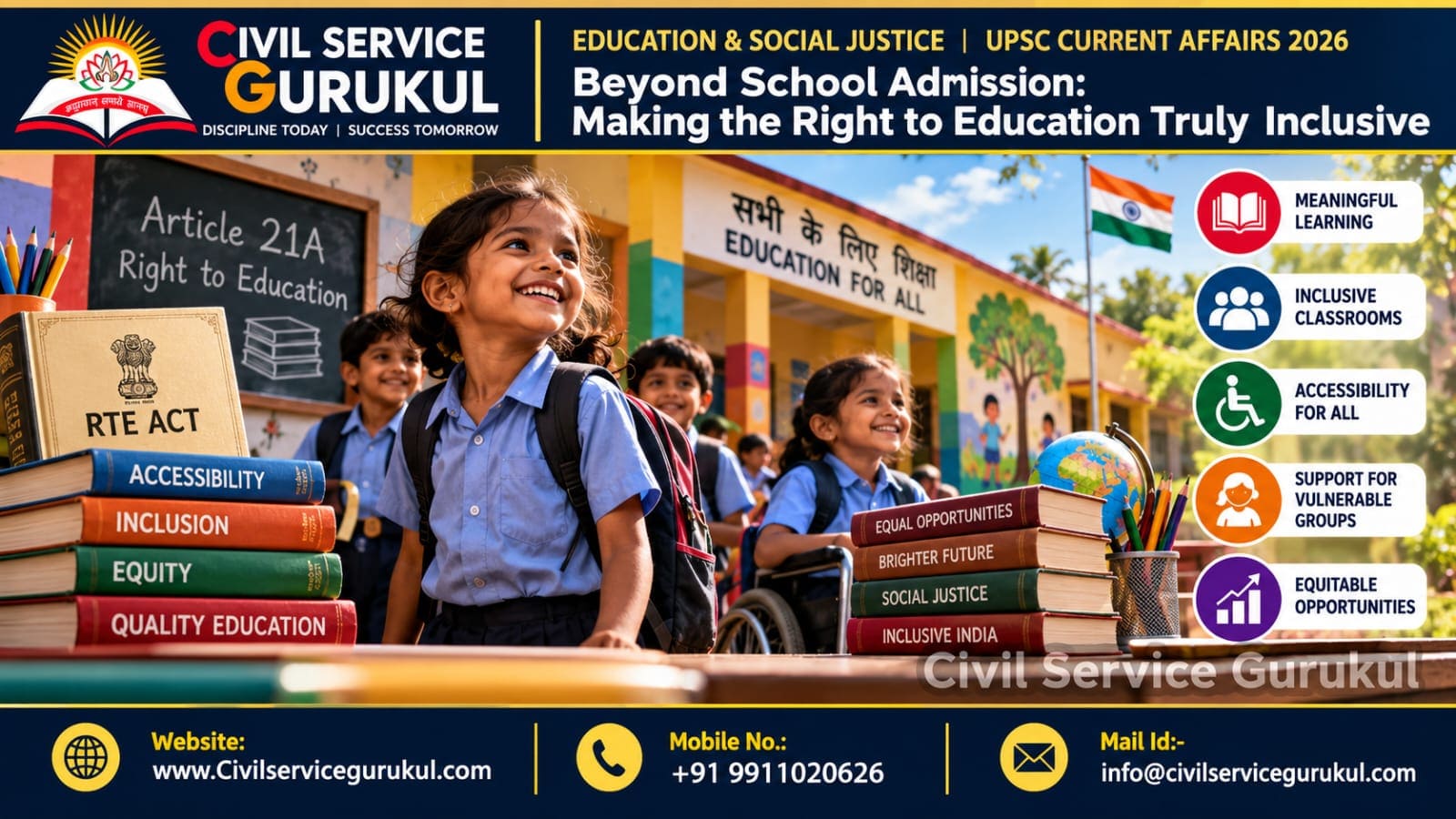
Right to Education in India 2026: Why Inclusive Classrooms Matter Beyond School Admission
Article 21A, the RTE Act, disability rights, accessible learning, teacher support and the constitutional promise of educational equity.
India's Right to Education framework guarantees free and compulsory elementary education for children aged six to fourteen.
However, admission to a school does not necessarily guarantee meaningful participation or learning.
Children with disabilities, migrant children, language minorities, first-generation learners and children from disadvantaged communities may face distinct barriers.
Inclusive education requires accessible infrastructure, appropriate teaching support, reasonable accommodation, protection from discrimination and effective accountability.
Prelims: Article 21A, RTE Act, disability rights, educational schemes and inclusive education.
GS Paper I: Social inclusion, inequality and vulnerable groups.
GS Paper II: Education, fundamental rights, welfare, governance and social justice.
GS Paper IV: Empathy, equity, dignity and administrative ethics.
1. Why Is Inclusive Education in the News?
An October 2026 discussion on the Right to Education highlights a critical distinction between formal school admission and meaningful educational inclusion.
A child may be enrolled in a school but still struggle to attend, participate or learn because of inaccessible infrastructure, language barriers or discrimination.
Therefore, the success of education policy must be measured through participation, dignity, retention and learning outcomes rather than admission figures alone.
2. Article 21A and the Right to Education Act, 2009
Article 21A of the Indian Constitution provides for free and compulsory education for children aged six to fourteen years in the manner determined by law.
The Right of Children to Free and Compulsory Education Act, 2009 provides the legislative framework for this constitutional guarantee.
Key features
- Free and compulsory elementary education.
- Responsibilities of governments and local authorities.
- Obligations relating to schools and admissions.
- Protection of children's educational rights.
- Framework for access and inclusion.
Article 21A concerns children aged six to fourteen. It does not itself establish a universal constitutional guarantee covering all higher education.
3. What Is Inclusive Education?
Inclusive education seeks to ensure that learners with different needs can access and participate meaningfully in education without discrimination.
It goes beyond placing students in the same physical classroom.
Core dimensions
- Physical accessibility.
- Accessible teaching materials.
- Appropriate instructional support.
- Respect for different learning needs.
- Protection from exclusion and bullying.
- Participation and learning outcomes.
Inclusion is a responsibility of the education system, not an act of charity.
4. Which Children Face Barriers to Inclusion?
Educational exclusion may affect different groups in different ways.
- Children with disabilities.
- Migrant children.
- Language minorities.
- First-generation learners.
- Children from economically disadvantaged households.
- Children facing caste or gender discrimination.
Uniform policies may fail to address these different barriers.
Meaningful equality therefore requires attention to the circumstances of each learner.
5. Physical, Digital and Communication Barriers
Inaccessible school buildings can prevent children from participating fully in education.
Common barriers
- Stairs without accessible alternatives.
- Inaccessible toilets.
- Unsuitable classroom layouts.
- Transport difficulties.
- Inaccessible digital learning materials.
- Communication barriers.
A ramp can improve physical entry, but it cannot replace accessible teaching methods, trained teachers or protection from discrimination.
6. Inclusive Pedagogy and Diverse Learning Needs
Children do not all learn in identical ways.
A single-language explanation, uniform textbook or inflexible assessment may disadvantage some learners.
Useful approaches
- Accessible textbooks and learning materials.
- Teacher training for diverse classrooms.
- Assistive technologies where appropriate.
- Flexible instructional approaches.
- Reasonable accommodation.
- Supportive classroom environments.
Universal design approaches can help reduce barriers for a wide range of learners.
7. Social Barriers: Caste, Gender, Language and Disability
Even physically accessible schools may remain socially exclusive.
Bullying, caste discrimination, gender stereotypes and negative assumptions about disability can undermine a child's participation.
Important institutional responses
- Anti-discrimination practices.
- Teacher sensitisation.
- Accessible grievance procedures.
- Parent and community engagement.
- Respectful classroom culture.
Inclusion must be understood as a social and institutional responsibility.
8. Rights of Persons with Disabilities Act, 2016
The Rights of Persons with Disabilities Act, 2016 provides a wider legal framework for disability rights.
Its provisions are relevant to accessibility, inclusion and reasonable accommodation in education.
What is reasonable accommodation?
Reasonable accommodation refers to necessary and appropriate modifications or adjustments, where required, that enable persons with disabilities to exercise rights on an equal basis with others.
Providing appropriate support is not inconsistent with the principle of equality.
9. Role of Samagra Shiksha in Inclusive Education
Samagra Shiksha is an important school-education programme that includes support for children with special needs.
Relevant support areas
- Assistive devices.
- Accessible learning materials.
- Teacher training.
- Educational support for children with special needs.
- Measures supporting participation.
Such interventions help translate formal educational rights into practical access.
10. Section 12(1)(c) of the RTE Act
Section 12(1)(c) of the RTE Act addresses admission obligations for specified categories of schools concerning children from weaker sections and disadvantaged groups.
The provision is important for understanding access to schooling within the RTE framework.
However, admission must be accompanied by supportive school environments to ensure meaningful inclusion.
11. Why Enrolment Data Alone Are Insufficient
School enrolment is an important indicator, but it does not capture the complete educational experience.
A child may be enrolled yet experience irregular attendance, limited participation or serious learning gaps.
Additional indicators
- Regular attendance.
- Retention across grades.
- Learning outcomes.
- Accessibility of school facilities.
- Availability of learning support.
- Protection from discrimination.
Education departments can improve accountability by monitoring these indicators while protecting children's privacy.
12. Equality of Opportunity vs Identical Treatment
| Basis | Identical Treatment | Substantive Inclusion |
|---|---|---|
| Approach | Same arrangements for everyone | Support according to barriers and needs |
| Learning Materials | One format only | Accessible formats where needed |
| Teaching | Uniform instructional approach | Appropriate differentiated support |
| Success Indicator | Admission alone | Participation, retention and learning |
Equal rights do not always require identical treatment.
Appropriate accommodations may be necessary to make a common right effective.
13. Policy Priorities and the Way Forward
- Conduct physical accessibility audits of schools.
- Improve digital and communication accessibility.
- Expand special-educator support.
- Provide teacher development for inclusive classrooms.
- Improve access to appropriate learning materials.
- Strengthen grievance redressal.
- Engage parents and local communities.
- Monitor attendance, retention and learning.
- Coordinate with health and child-protection services.
- Evaluate inclusion through outcomes, not admissions alone.
Educational success should be assessed through access, participation, dignity, learning and retention.
14. UPSC Prelims Quick Revision Notes
- Article 21A: Free and compulsory education for ages 6–14.
- RTE Act: Enacted in 2009.
- Section 12(1)(c): Admission obligations for specified school categories.
- RPwD Act: Rights of Persons with Disabilities Act, 2016.
- Samagra Shiksha: Includes support for children with special needs.
- Reasonable Accommodation: Appropriate adjustments to enable equal exercise of rights.
- Inclusive Education: Meaningful access, participation and learning.
- Key Governance Principle: Measure outcomes beyond enrolment.
15. UPSC Prelims Practice MCQs
With reference to Article 21A of the Indian Constitution, consider the following statements:
- It concerns free and compulsory education for children aged six to fourteen.
- It establishes a universal guarantee of free higher education.
- The RTE Act, 2009 provides a legislative framework for its implementation.
Which statements are correct?
(a) 1 only
(b) 1 and 3 only
(c) 2 and 3 only
(d) 1, 2 and 3
Statements 1 and 3 are correct. Article 21A concerns elementary education for children aged six to fourteen.
Which policy best advances substantive inclusion under the RTE framework?
(a) Counting admissions without measuring participation
(b) Providing accessible infrastructure, teaching support and grievance mechanisms
(c) Excluding students requiring accommodation
(d) Replacing all trained teachers with devices
Inclusion requires removing physical, instructional and social barriers.
Which of the following is most closely associated with reasonable accommodation?
(a) Refusing all individual adjustments
(b) Necessary and appropriate adjustments to enable equal exercise of rights
(c) Eliminating common educational objectives
(d) Restricting education to separate institutions
Reasonable accommodation helps address specific barriers faced by persons with disabilities.
Consider the following statements about inclusive education:
- Physical access alone guarantees meaningful inclusion.
- Teacher training can support inclusive classrooms.
- Learning and retention are important indicators of educational inclusion.
Which statements are correct?
(a) 1 only
(b) 1 and 2 only
(c) 2 and 3 only
(d) 1, 2 and 3
Physical access is important, but meaningful inclusion also requires appropriate teaching support, participation and learning.
16. UPSC Mains Practice Questions
Question 1 — GS Paper II
Why must implementation of the Right to Education move beyond enrolment indicators? Examine. (150 words)
Suggested Answer Framework
Article 21A and the RTE Act provide the constitutional and statutory framework for elementary education.
However, enrolment alone does not establish that children can participate or learn meaningfully.
Disability, language, economic disadvantage and social discrimination may create barriers.
Inclusive education requires accessible facilities, teacher support, reasonable accommodation and effective grievance redressal.
Governance indicators should therefore measure attendance, retention, participation and learning outcomes.
The objective is to transform formal school access into substantive educational equality.
Question 2 — GS Paper I
Examine how social and economic inequalities can undermine educational inclusion despite formal school admission. (150 words)
Answer Approach
- Explain formal access versus substantive inclusion.
- Discuss caste, gender, language and economic barriers.
- Examine disability-related barriers.
- Suggest school and community interventions.
- Conclude with dignity and equal opportunity.
Question 3 — GS Paper IV
Explain why empathy and reasonable accommodation are essential to ethical school administration. (150 words)
Answer Approach
- Define empathy in public administration.
- Discuss recognition of different learning needs.
- Explain reasonable accommodation.
- Highlight fairness and non-discrimination.
- Conclude with dignity-centred governance.
17. Frequently Asked Questions
What is Article 21A?
Article 21A provides for free and compulsory education for children aged six to fourteen in the manner determined by law.
What is the Right to Education Act, 2009?
The RTE Act provides the legislative framework for implementing the constitutional elementary-education guarantee.
Does the RTE Act cover all higher education?
No. Its core constitutional elementary-education guarantee concerns ages six to fourteen.
What is reasonable accommodation?
It refers to necessary and appropriate adjustments that enable persons with disabilities to exercise rights on an equal basis.
Is inclusive education limited to disability?
No. It also addresses social, linguistic, economic and other barriers to meaningful participation.
What role does Samagra Shiksha play?
Samagra Shiksha includes support for children with special needs, accessible materials, assistive devices and teacher training.
Why is this topic important for UPSC?
It connects fundamental rights, education governance, disability rights, social justice and administrative ethics.
18. Conclusion: From School Admission to Meaningful Learning
The Right to Education must be evaluated not merely through the number of children admitted to schools, but through their ability to participate and learn with dignity.
Accessible infrastructure, appropriate teaching support, reasonable accommodation, non-discrimination and effective accountability are essential.
For UPSC aspirants, the central lesson is that constitutional equality becomes meaningful only when public institutions remove barriers to its exercise.
Prepare for UPSC with Civil Service Gurukul
Strengthen your UPSC Prelims and Mains preparation with concept-based current affairs, Indian Polity, Education, Social Justice and Ethics.
Website: www.civilservicegurukul.com
Mobile: +91 9911020626
Email: info@civilservicegurukul.com
Educational analysis for UPSC preparation. Legislative, judicial and regulatory developments should be checked against their latest authoritative versions before professional reliance.
Prepare with Mentors Who Cleared the Exam
Get personalized study plans, evaluated answer models, and test series access.