
BNSS Section 15: Special Executive Magistrates UPSC 2026
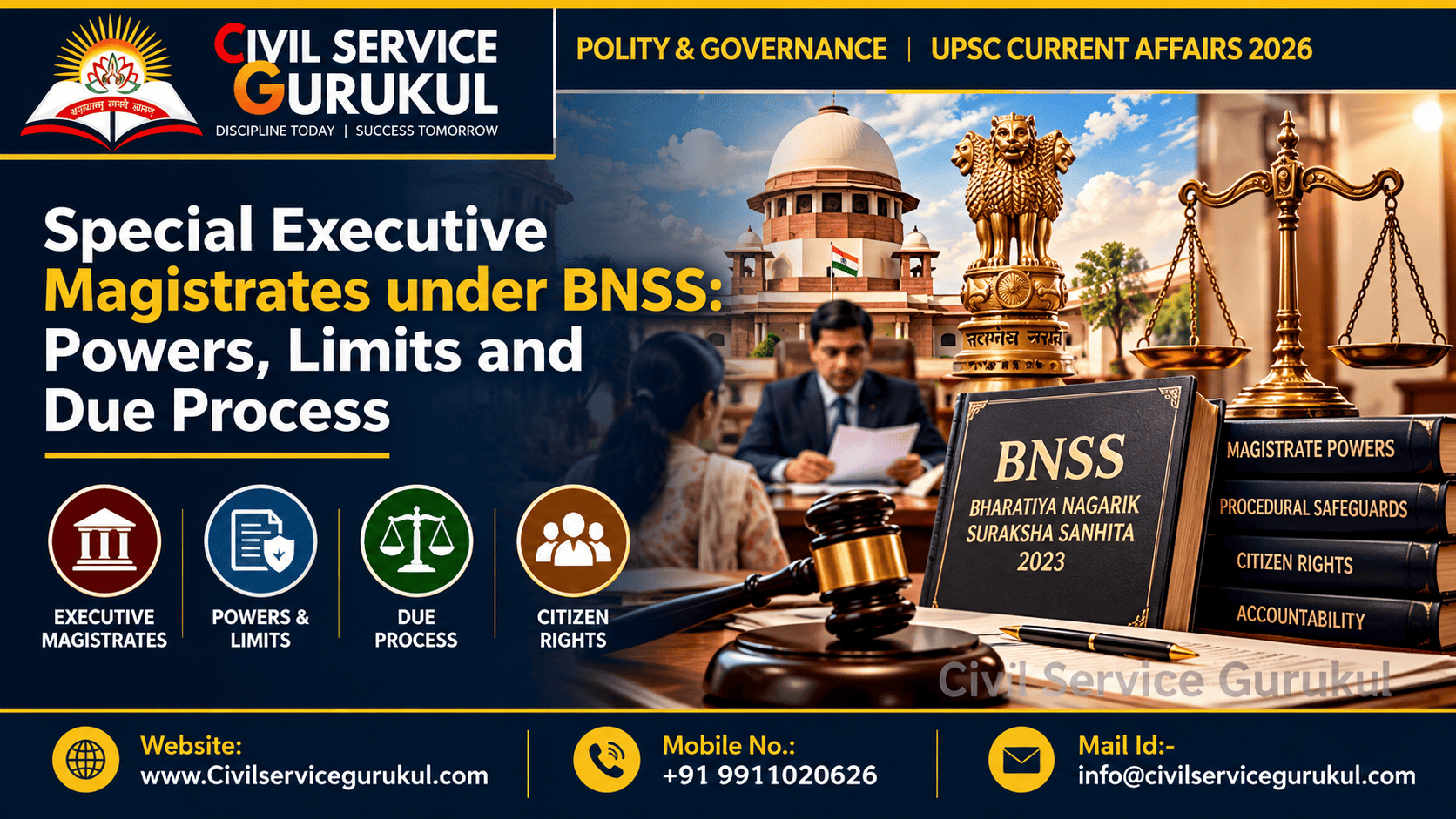
Special Executive Magistrates under BNSS Section 15: Appointment Powers, Legal Limits and Rule of Law Explained
A comprehensive UPSC analysis of executive magistracy, public-order administration, statutory powers, fundamental rights and judicial accountability.
Section 15 of the Bharatiya Nagarik Suraksha Sanhita, 2023 provides for the appointment of Special Executive Magistrates.
State Governments may make appointments for specified areas or functions, including eligible Executive Magistrates and police officers not below the rank of Superintendent of Police or equivalent.
These appointments do not automatically confer every power available to a District Magistrate.
Special Executive Magistrates exercise powers within the limits of the statute and the relevant appointment order.
Prelims: BNSS provisions, Executive Magistrates, Judicial Magistrates and appointment powers.
GS Paper II: Executive authority, rule of law, public order and fundamental rights.
GS Paper IV: Administrative ethics, impartiality, proportionality and accountability.
1. Why Are Special Executive Magistrates in the News?
The term magistrate is used for different functions within India's criminal-justice system.
Judicial Magistrates exercise judicial powers, while Executive Magistrates primarily perform preventive and administrative functions authorised by statute.
A 2026 discussion of Special Executive Magistrates highlights the importance of understanding the distinction between executive public-order powers and criminal trial jurisdiction.
This distinction is relevant to the rule of law, fundamental rights and accountable administration.
2. Bharatiya Nagarik Suraksha Sanhita, 2023
The Bharatiya Nagarik Suraksha Sanhita, 2023, commonly called BNSS, reorganised criminal procedure provisions previously contained in the Code of Criminal Procedure.
The BNSS came into force on 1 July 2024.
It provides the statutory framework for various criminal-procedure institutions and functions, including executive magistracy.
3. What Does BNSS Section 15 Provide?
Section 15 of the BNSS deals with Special Executive Magistrates.
It enables the State Government to make specified appointments and confer executive-magisterial powers in accordance with the law.
Important features
- Appointment by the State Government.
- Specified areas or particular functions.
- Eligible Executive Magistrates or qualifying police officers.
- Police rank threshold of Superintendent of Police or equivalent.
- Powers determined under the statutory framework.
An appointment as Special Executive Magistrate does not automatically confer all powers available to a District Magistrate.
The actual powers depend on the applicable law and the appointment order.
4. Appointment and Eligibility
The State Government is the appointing authority under Section 15.
The provision permits the appointment of qualifying Executive Magistrates and police officers meeting the specified minimum rank.
Can every police officer be appointed?
No.
For the police-officer category, the statutory threshold is not below the rank of Superintendent of Police or equivalent.
A qualifying rank alone does not automatically make an officer a Special Executive Magistrate.
A valid appointment by the State Government is necessary.
5. What Powers Can a Special Executive Magistrate Exercise?
The scope of authority depends on the statute and the powers conferred through the appointment.
The role may involve specified preventive or administrative public-order functions.
Key limitations
- Powers must have a legal basis.
- The appointment order defines the authorised scope.
- Executive powers are not unlimited.
- Constitutional protections continue to apply.
- Judicial remedies remain available under applicable law.
Executive authority cannot be treated as an unrestricted power to determine criminal guilt.
6. Executive Magistrate vs Judicial Magistrate
| Basis | Executive Magistrate | Judicial Magistrate |
|---|---|---|
| Principal Function | Preventive and administrative functions under statute | Judicial functions in criminal proceedings |
| Nature of Authority | Executive-magisterial powers | Judicial powers |
| Criminal Trials | No general judicial trial jurisdiction merely by executive appointment | Exercises criminal trial jurisdiction as provided by law |
| Accountability | Subject to statutory and constitutional controls | Subject to the applicable judicial framework |
The distinction helps preserve the separation between preventive administration and judicial adjudication.
7. BNSS Section 15 and the Earlier CrPC Provision
Section 15 of the BNSS broadly corresponds to Section 21 of the earlier Code of Criminal Procedure, 1973.
| Subject | Earlier CrPC | BNSS |
|---|---|---|
| Special Executive Magistrates | Section 21 | Section 15 |
| Executive Magistrates | Section 20 | Section 14 |
UPSC aspirants should distinguish the current BNSS section numbers from the earlier CrPC provisions.
8. Why Are Special Executive Appointments Useful?
Local administrations may require designated officers to handle particular preventive or public-order responsibilities.
Special appointments can help clarify responsibility in time-sensitive administrative situations.
Potential advantages
- Defined responsibility for specific functions.
- Administrative coordination.
- Timely preventive action within law.
- Clearer allocation of authorised duties.
However, administrative convenience must remain subordinate to legal limits and constitutional protections.
9. Constitutional Concerns and Possible Risks
Preventive public-order powers may affect individual liberty and other fundamental rights.
Their exercise therefore requires legal precision and accountability.
Potential concerns
- Arbitrary or excessive restrictions.
- Insufficiently reasoned orders.
- Conflict of interest.
- Unclear jurisdiction.
- Inadequate review of decisions.
A particular concern arises where policing responsibilities and preventive-magisterial authority are exercised by the same official.
Clear statutory boundaries and review mechanisms help reduce the risk of misuse.
10. Due Process, Proportionality and Judicial Review
The exercise of preventive authority must comply with the applicable legal framework.
Important safeguards
- Lawful appointment and jurisdiction.
- Reasoned administrative decisions.
- Proportionate use of authority.
- Proper documentation.
- Available review mechanisms.
- Respect for constitutional rights.
Administrative action should be based on legally relevant material rather than unsupported assumptions.
Executive-magistrate orders must not be presented as substitutes for judicial criminal trials.
11. Administrative Ethics and GS Paper IV
Special Executive Magistrates may face difficult situations involving public order and individual rights.
Ethical administration requires the exercise of authority with fairness, restraint and integrity.
Relevant ethical values
- Impartiality.
- Integrity.
- Objectivity.
- Accountability.
- Proportionality.
- Respect for human dignity.
An official facing a public-order concern should identify the legal basis for action, assess necessity, consider less restrictive options and record reasons for the decision.
12. Policy Priorities and the Way Forward
- Issue clear appointment orders.
- Specify jurisdiction and authorised functions.
- Define the applicable duration of appointment.
- Provide training on fundamental rights.
- Emphasise proportionality and reasoned decisions.
- Maintain auditable records of preventive action.
- Ensure appropriate review mechanisms.
- Preserve the distinction between executive and judicial functions.
Effective public-order administration requires both operational capability and constitutional accountability.
13. UPSC Prelims Quick Revision Notes
- BNSS: Bharatiya Nagarik Suraksha Sanhita, 2023.
- Commencement: 1 July 2024.
- Section 14: Executive Magistrates.
- Section 15: Special Executive Magistrates.
- Earlier CrPC provision: Section 21.
- Appointing authority: State Government.
- Police eligibility: Not below SP or equivalent rank.
- Authority: Limited by statute and appointment order.
- Key distinction: Executive Magistrates are not Judicial Magistrates.
- Core principle: Preventive powers remain subject to legal safeguards.
14. UPSC Prelims Practice MCQs
Under BNSS Section 15, which police officer may be appointed as a Special Executive Magistrate?
(a) Any police constable
(b) Any police inspector
(c) An officer not below Superintendent of Police or equivalent
(d) Only a retired High Court judge
The police-officer category under Section 15 requires the specified minimum rank of Superintendent of Police or equivalent.
Consider the following statements:
- BNSS Section 15 deals with Special Executive Magistrates.
- Every Superintendent of Police automatically becomes a Special Executive Magistrate.
- The State Government is the appointing authority.
Which statements are correct?
(a) 1 and 2 only
(b) 1 and 3 only
(c) 2 and 3 only
(d) 1, 2 and 3
Statements 1 and 3 are correct. A specific statutory appointment is necessary; qualifying rank alone is insufficient.
Which earlier CrPC provision broadly corresponds to BNSS Section 15?
(a) Section 21
(b) Section 41
(c) Section 144
(d) Section 167
CrPC Section 21 broadly corresponds to BNSS Section 15.
Which of the following statements best describes the role of a Special Executive Magistrate?
(a) The appointment automatically grants every District Magistrate power.
(b) The appointment creates general criminal trial jurisdiction.
(c) Powers are governed by the statute and appointment order.
(d) Executive orders are exempt from legal review.
The authority of a Special Executive Magistrate is limited by law and the applicable appointment order.
15. UPSC Mains Practice Questions
Question 1 — GS Paper II
Explain the constitutional safeguards needed when preventive public-order powers are exercised by Special Executive Magistrates. (150 words)
Suggested Answer Framework
Section 15 of the BNSS provides for the appointment of Special Executive Magistrates for specified areas or functions.
These appointments can support preventive public-order administration.
However, executive-magisterial authority must remain within statutory limits.
Safeguards include lawful appointment, clear jurisdiction, proportionality, reasoned orders, recordkeeping and access to review.
The separation between executive and judicial functions must also be respected.
Thus, preventive administration must combine effectiveness with constitutional accountability.
Question 2 — GS Paper IV
Discuss the ethical responsibilities of an official exercising preventive public-order powers. (150 words)
Answer Approach
- Identify the public-order objective.
- Explain legal authority and limitations.
- Discuss impartiality and integrity.
- Apply necessity and proportionality.
- Emphasise reasoned decisions and accountability.
16. Frequently Asked Questions
What is BNSS Section 15?
Section 15 of the Bharatiya Nagarik Suraksha Sanhita, 2023 deals with Special Executive Magistrates.
Who appoints Special Executive Magistrates?
The State Government makes appointments under the statutory framework.
Can every SP automatically become a Special Executive Magistrate?
No. A specific appointment by the State Government is necessary.
Can a Special Executive Magistrate try every criminal case?
No. Executive-magisterial authority does not confer general criminal trial jurisdiction.
Which CrPC section corresponds to BNSS Section 15?
CrPC Section 21 broadly corresponds to BNSS Section 15.
What is the difference between Executive and Judicial Magistrates?
Executive Magistrates primarily perform preventive and administrative functions, while Judicial Magistrates exercise judicial functions under law.
Why is this topic important for UPSC?
It connects criminal procedure, public-order governance, separation of powers, fundamental rights and administrative ethics.
17. Conclusion: Executive Authority Must Remain Accountable
Special Executive Magistrates can support preventive public-order administration when their functions are clearly defined.
However, executive powers must remain within statutory limits and respect constitutional safeguards.
Reasoned decisions, proportionality, proper documentation and review mechanisms are essential.
For UPSC aspirants, the central lesson is that effective administration and protection of fundamental rights must operate together.
Prepare for UPSC with Civil Service Gurukul
Strengthen your UPSC Prelims and Mains preparation with concept-based current affairs, Indian Polity, Governance, Constitutional Law and Ethics.
Website: www.civilservicegurukul.com
Mobile: +91 9911020626
Email: info@civilservicegurukul.com
Educational analysis for UPSC preparation. Legislative, judicial and regulatory developments should be checked against their latest authoritative versions before professional reliance.
Prepare with Mentors Who Cleared the Exam
Get personalized study plans, evaluated answer models, and test series access.