Daily Current Affairs & News Analysis
Our daily news analysis consists of two integral parts — Daily News Analysis and Important Editorials curated rigorously from The Hindu, The Indian Express, LiveMint, PIB, and Sansad TV debates. Content is mapped directly to UPSC CSE and State PCS syllabi.

Dancing Girl of Mohenjo-daro: UPSC Heritage Analysis 2026
The reported plan to relocate the iconic Dancing Girl bronze sculpture of Mohenjo-daro and the Nizam's jewels to the Yuge Yugeen Bharat Museum has renewed discussions about India's cultural heritage management. Beyond the display of historically significant artefacts, museum administration involves conservation science, provenance documentation, secure transportation, public accessibility and ethical stewardship. The Dancing Girl is among the most celebrated examples of bronze craftsmanship from the Indus Valley Civilisation. This Civil Service Gurukul analysis explores the historical significance of the sculpture, the challenges of relocating museum collections, the difference between provenance and ownership, the responsibilities of public museums and the relevance of heritage governance for UPSC Prelims and Mains.

Indian Students in US Universities 2026: UPSC Analysis
A November 2026 report indicating a decline in the number of Indian students at American universities has renewed debate about international education, student mobility and India's human-capital development. However, a fall in new admissions, total enrolment or student visa issuances represents different statistical developments and should not be interpreted interchangeably. Overseas education can provide access to advanced research, global networks and professional opportunities, but high costs, immigration uncertainty and unequal access may create challenges. The debate also extends beyond traditional brain drain to brain circulation, where knowledge, skills, investment and research networks move across borders. This Civil Service Gurukul analysis examines India–US education relations, the drivers of international student mobility, implications for Indian universities and research, policy options, UPSC Prelims MCQs and a Mains model answer.

COP31 Climate Negotiations 2026: UPSC Analysis
The COP31 climate negotiations in Türkiye have brought renewed attention to disagreements over climate finance, equity, emissions mitigation and the meaning of consensus in international environmental governance. A draft negotiating text discussed in November 2026 reportedly reflects divergent positions among participating countries, but a draft should not be confused with a formally adopted decision. For developing countries such as India, climate negotiations involve balancing development priorities, energy transition, adaptation needs and predictable international financial support. This Civil Service Gurukul analysis explains the UNFCCC framework, the Paris Agreement, common but differentiated responsibilities and respective capabilities (CBDR-RC), climate finance, loss and damage, negotiating procedures and India's strategic interests, along with UPSC Prelims questions and Mains answer-writing guidance.

Foreign Portfolio Investment in India: UPSC 2026
A reported revival in foreign portfolio investment in November 2026, accompanied by selling by domestic market participants, highlights the complex relationship between capital flows, stock market performance and financial stability. Foreign portfolio investors can provide liquidity and support market development, but their investments are often more readily reversible than greenfield foreign direct investment. Global interest rates, exchange-rate expectations, valuations and risk sentiment can influence these flows. A temporary market rebound therefore does not necessarily indicate durable investor confidence or stronger domestic productive capacity. This Civil Service Gurukul analysis examines FPI versus FDI, the role of domestic institutional investors, capital-flow volatility, regulatory institutions, macroeconomic risks and important UPSC Prelims–Mains questions.

WPI vs CPI Inflation October 2026: UPSC Analysis
India's October 2026 inflation data highlights an important divergence between wholesale and retail prices. According to the figures cited in the source article, Wholesale Price Index inflation reached 12.29%, compared with 11.39% in September, while Consumer Price Index inflation stood at 6.09%. The difference reflects the distinct coverage, weights and price transmission mechanisms of the two indices. Fuel and power, primary articles and manufactured products contributed to wholesale price pressures, raising questions about production costs, business margins, household purchasing power and monetary policy. This Civil Service Gurukul analysis explains WPI and CPI, the reasons for their divergence, implications for India's economy, inflation management strategies and important UPSC Prelims and Mains questions.
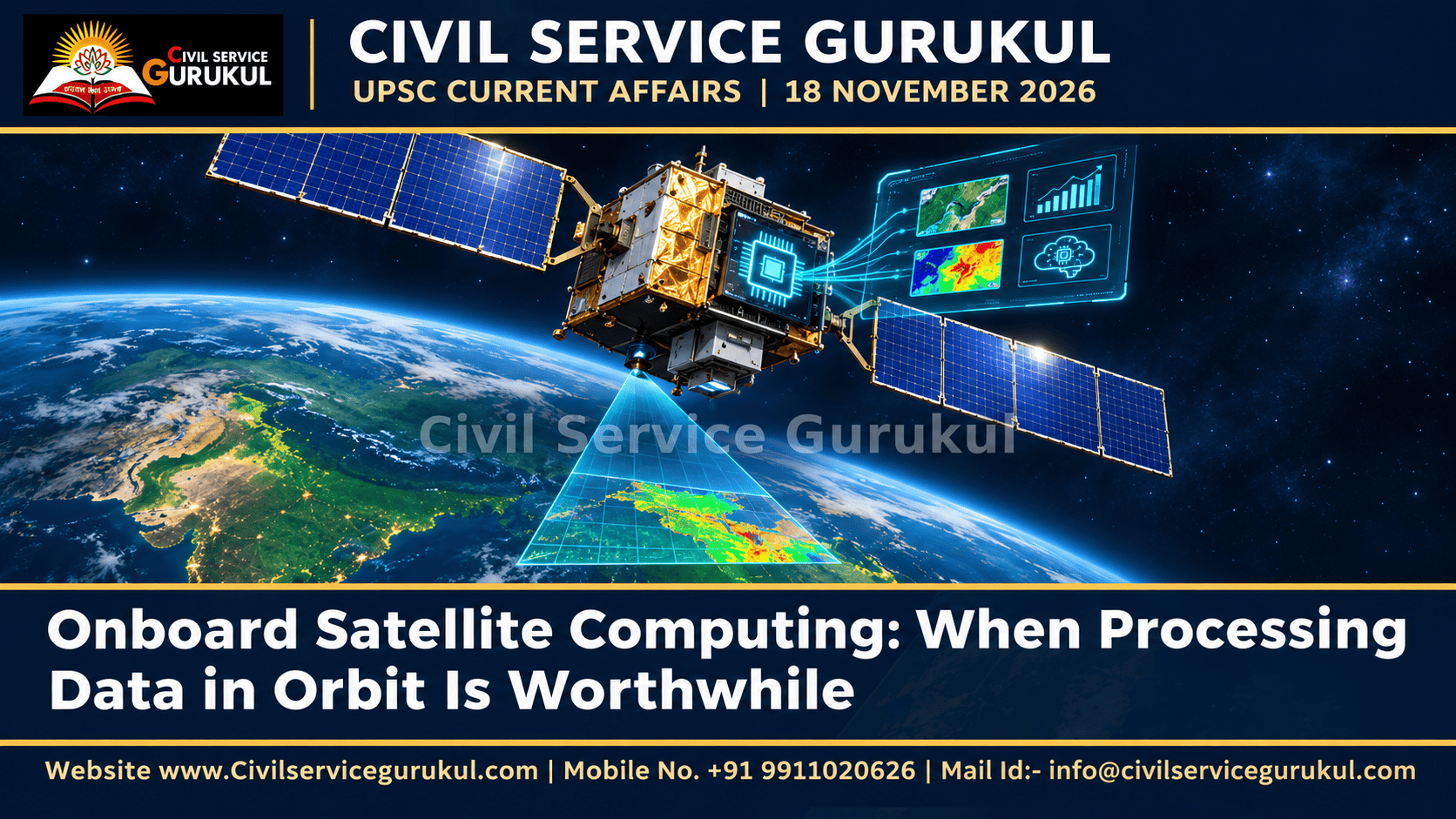
Onboard Satellite Computing: AI in Space UPSC 2026
Onboard satellite computing is emerging as an important approach to managing the enormous volume of data collected by Earth-observation satellites. Instead of transmitting every image and measurement to Earth for analysis, satellites equipped with suitable processors can filter, prioritise and analyse selected information directly in orbit. This can reduce unnecessary data transmission and improve the timeliness of applications such as disaster monitoring, environmental observation and maritime surveillance. However, onboard computing faces constraints involving power consumption, radiation, heat dissipation, processing capacity and algorithm reliability. This Civil Service Gurukul article explains satellite edge computing, its advantages over ground-based processing, relevance to India's space programme, technological challenges, ethical considerations and UPSC Prelims–Mains preparation.
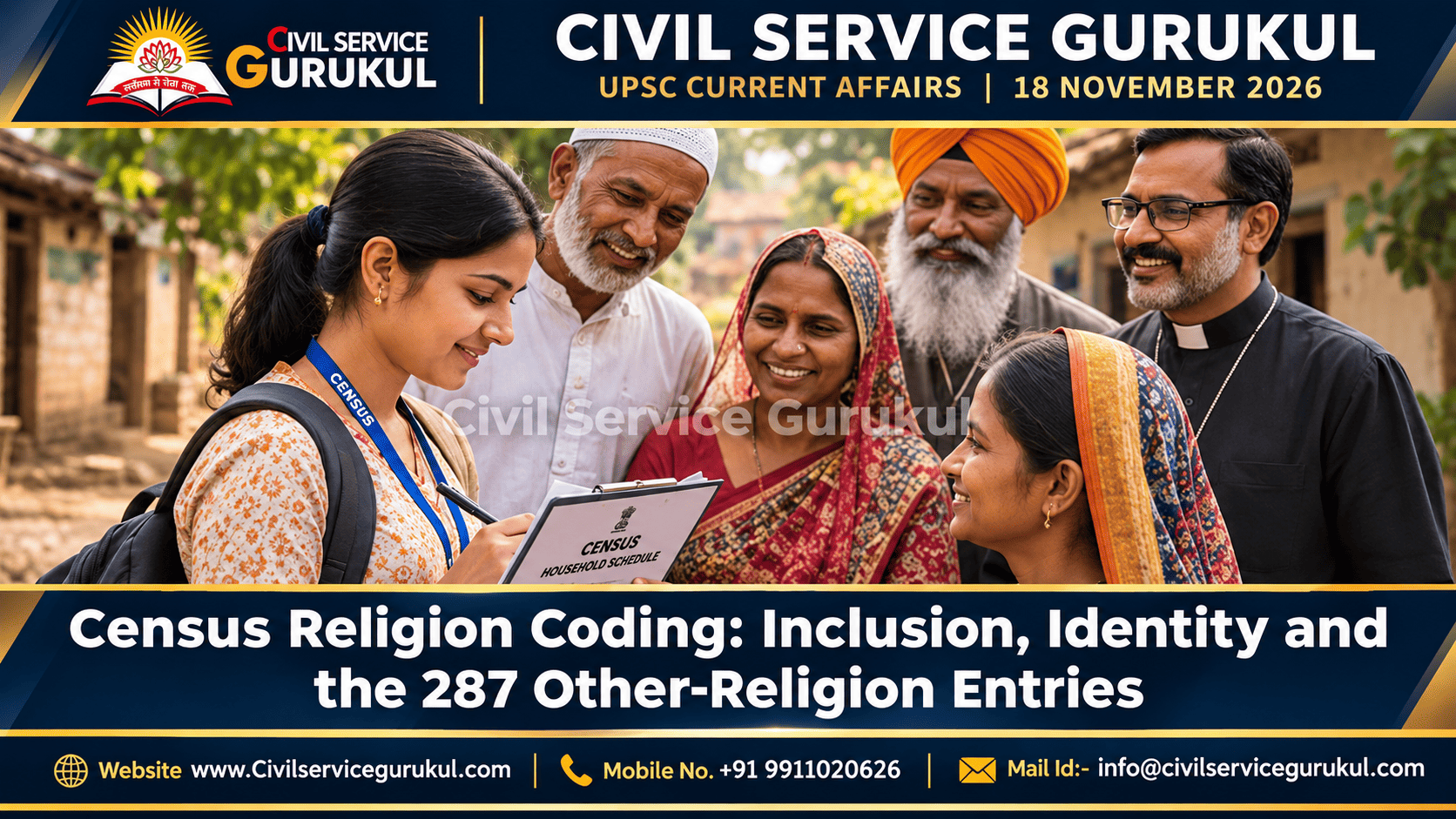
Census Religion Coding in India: UPSC 2026 Analysis
A November 2026 report concerning 287 “other” religion entries briefly appearing on a Census portal has renewed discussion about religious identity, statistical classification and the representation of smaller communities in India. The development raises important questions about self-identification, administrative coding, data reliability, minority visibility and the difference between provisional portal information and officially validated Census statistics. For UPSC aspirants, the issue connects directly with Indian Society, constitutional values, governance, ethics and social justice. This Civil Service Gurukul analysis examines the institutional context, opportunities and risks of religious enumeration, policy recommendations, Prelims practice questions and a structured GS Mains answer.