
Uniform Civil Code in India: Article 44, Gender Justice & UPSC Analysis
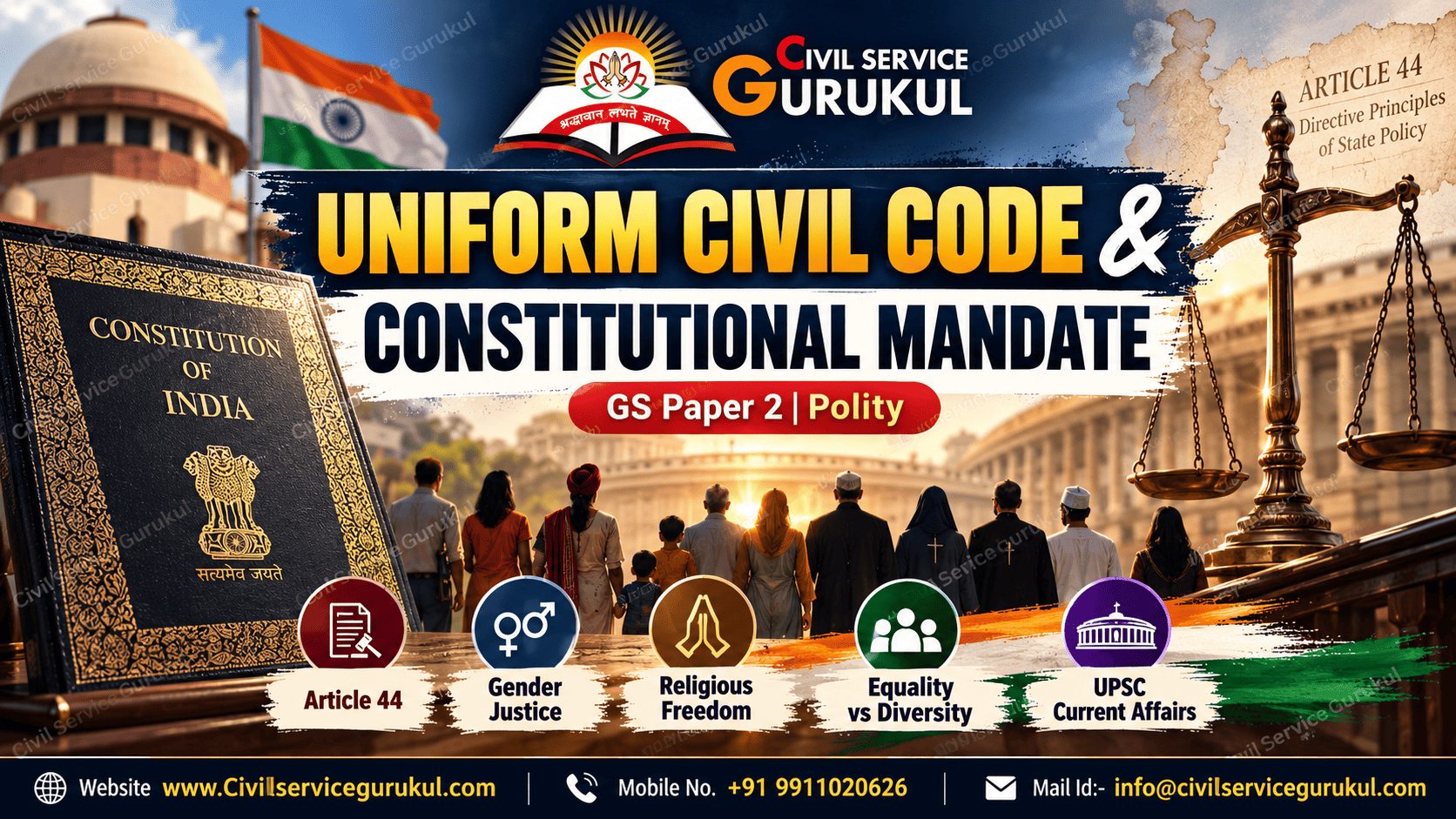
Uniform Civil Code in India: Can Article 44 Balance Gender Justice, Religious Freedom and Cultural Diversity?
The Uniform Civil Code debate lies at the intersection of equality, secularism, religious liberty and India's plural social structure. For UPSC aspirants, it is an important constitutional issue requiring a balanced understanding rather than a one-sided approach.
The Uniform Civil Code seeks a common framework of civil laws governing matters such as marriage, divorce, adoption, maintenance, succession and inheritance for all citizens irrespective of religion. Article 44 of the Constitution directs the State to endeavour to secure such a code, but the issue remains constitutionally sensitive because it must be reconciled with fundamental rights relating to equality, religious freedom and cultural diversity. For UPSC GS Paper 2, the central challenge is to examine whether India should pursue complete legal uniformity or prioritise gender-just reform within different personal-law systems.
GS Paper 2: Indian Constitution, Fundamental Rights, Directive Principles of State Policy, Social Justice, Governance.
Essay: Equality vs Diversity, Constitutional Morality, Women Empowerment, Secularism.
Prelims: Articles 14, 15, 25, 29 and 44; Fundamental Rights vs Directive Principles.
What Is a Uniform Civil Code?
A Uniform Civil Code, or UCC, refers to a common set of secular civil laws applicable to citizens in personal matters irrespective of religious identity.
It may cover areas such as:
- marriage;
- divorce;
- maintenance;
- adoption;
- guardianship;
- inheritance;
- succession.
At present, several personal matters in India continue to be governed by different laws and customs applicable to different religious communities.
Constitutional Basis: Article 44
The Constitution places the Uniform Civil Code within the Directive Principles of State Policy under Part IV. It requires the State to endeavour to secure a Uniform Civil Code for citizens throughout India.
Article 44 is therefore not directly enforceable by courts in the manner of a Fundamental Right.
However, Directive Principles remain fundamental to governance and guide the State in law-making and public policy.
Why Was UCC Placed in the Directive Principles?
The Constituent Assembly witnessed significant debate over the issue.
One view emphasised equality, particularly equal rights for women. Another stressed religious freedom and the right of communities to preserve their personal customs.
The constitutional compromise was to retain UCC as an objective of the State but not make it an immediately enforceable Fundamental Right.
Fundamental Rights Involved in the UCC Debate
| Article | Constitutional Principle | Relevance to UCC |
|---|---|---|
| Article 14 | Equality before law | Supports equal civil rights for citizens. |
| Article 15 | Prohibition of discrimination | Important for addressing gender discrimination in personal laws. |
| Article 21 | Life and personal liberty | Linked to dignity, autonomy and individual choice. |
| Article 25 | Freedom of conscience and religion | Raises questions regarding state intervention in religiously influenced personal practices. |
| Article 29 | Protection of cultural interests | Relevant to preservation of distinct cultural traditions. |
| Article 44 | Uniform Civil Code | Constitutional directive supporting common civil laws. |
Arguments in Favour of a Uniform Civil Code
1. Gender Justice
One of the strongest arguments for reform is the need to eliminate gender discrimination from personal laws.
A common framework could help ensure:
- equal inheritance rights;
- equal divorce rights;
- equal maintenance rights;
- monogamy;
- gender-neutral guardianship;
- equal treatment in succession.
2. Equality Before Law
Supporters argue that citizenship-based civil rights should not differ merely because citizens belong to different religions.
3. Strengthening Secularism
A secular civil code can be seen as separating civil legal rights from religious identity.
4. Simplifying the Legal System
Multiple personal-law systems can produce complex questions of jurisdiction, inheritance and inter-faith disputes.
A harmonised framework may reduce legal ambiguity.
5. Individual Rights Over Group Practices
Modern constitutionalism increasingly emphasises that community practices cannot automatically override the dignity and equality of individuals.
Arguments Against a Uniform Civil Code
1. Religious Freedom
Critics argue that certain personal laws are closely connected with religious belief and practice.
A compulsory secular code may therefore raise concerns under Article 25.
2. Cultural Diversity
India is a deeply plural society with diverse customs relating to marriage, family and inheritance.
Uniformity may be viewed as reducing legitimate cultural differences.
3. Fear of Majoritarianism
Minority groups may fear that the proposed "uniform" law could reflect the social norms of the numerically dominant community instead of creating a genuinely neutral framework.
4. Tribal Customs
Several tribal communities possess distinct customary systems.
Exemptions for Scheduled Tribes raise an important conceptual question: if exemptions are necessary to protect some customary systems, how should India define the degree of uniformity required from other communities?
5. Uniformity Does Not Automatically Mean Equality
A common law can still be unfair if its substantive provisions are not gender-just and rights-based.
The real constitutional objective should not be uniformity for its own sake. The stronger objective is: equality, dignity and justice within a framework respectful of India's pluralism.
How Can UCC Advance Women's Rights?
Supporters of reform argue that a gender-just civil framework can protect women through several mechanisms.
| Area | Possible Reform |
|---|---|
| Marriage | Common minimum age and legal registration requirements. |
| Polygamy | Uniform application of monogamy. |
| Inheritance | Equal rights for sons and daughters. |
| Divorce | Equal grounds and procedural safeguards. |
| Maintenance | Uniform statutory protection after marital breakdown. |
| Guardianship | Equal parental status of mother and father. |
Article 25 Is Not an Absolute Right
Freedom of religion is a Fundamental Right, but Article 25 itself makes religious freedom subject to:
- public order;
- morality;
- health;
- other Fundamental Rights.
This is important in constitutional analysis because a practice cannot automatically claim immunity from reform simply because it is connected with religion.
Uttarakhand and the State-Level UCC Debate
The operationalisation of a Uniform Civil Code in Uttarakhand has given the debate a new federal dimension.
It raises questions such as:
- Can different States develop different models of UCC?
- Should personal civil rights differ across State boundaries?
- How should tribal exemptions be handled?
- Should India ultimately move toward a nationally harmonised framework?
The UCC debate is now not only about religion and gender. It also involves issues of federalism and legislative harmonisation.
Law Commission's Alternative Approach
A significant alternative to immediate uniformity is reforming personal laws from within.
The 21st Law Commission argued that a UCC was neither necessary nor desirable at that stage and emphasised that diversity itself should not be treated as discrimination.
Instead, it supported reforms aimed at eliminating discriminatory provisions within different personal-law systems.
Equality Within Communities vs Uniformity Between Communities
This distinction is extremely important for UPSC Mains.
| Approach | Meaning |
|---|---|
| Uniformity Between Communities | One common personal law for every citizen. |
| Equality Within Communities | Different personal laws may continue, but discriminatory provisions are reformed. |
The second approach seeks gradual legal reform without requiring immediate complete uniformity.
Dr. B.R. Ambedkar and the Voluntary UCC Idea
During the Constituent Assembly debates, Dr. B.R. Ambedkar suggested that a future UCC could initially be made voluntary.
Under such an approach, citizens willing to be governed by a common code could opt into it.
This idea reflects an attempt to combine reform with social consent.
Constitutional Morality and Personal Law
The concept of constitutional morality requires laws and institutions to respect the fundamental values of the Constitution.
These include:
- human dignity;
- liberty;
- equality;
- non-discrimination;
- individual autonomy.
Accordingly, cultural or religious traditions may need reform where they result in serious discrimination or denial of dignity.
UCC and Secularism
There are two competing understandings of secularism in this debate.
Common Citizenship Approach
The State should apply identical civil rules to all citizens regardless of religion.
Pluralist Approach
Indian secularism allows different communities to preserve cultural and religious practices as long as constitutional rights are protected.
A balanced policy must reconcile these two interpretations.
UCC and India's Social Diversity
India's diversity is not limited to religion.
Personal practices also differ on the basis of:
- region;
- tribe;
- custom;
- language;
- community;
- local social traditions.
Therefore, drafting a truly uniform law requires extensive social and legal consultation.
What Should Be the Way Forward?
1. Put Gender Justice First
Any reform should guarantee equal rights in marriage, divorce, maintenance, guardianship and inheritance.
2. Conduct Wide Stakeholder Consultation
Consultations should involve:
- women's groups;
- religious organisations;
- tribal representatives;
- constitutional experts;
- civil society;
- State governments.
3. Reform Discriminatory Practices First
India can progressively eliminate provisions that clearly violate equality and dignity even before adopting complete uniformity.
4. Protect Legitimate Cultural Diversity
Cultural differences that do not violate constitutional rights need not necessarily be eliminated merely for the sake of formal uniformity.
5. Build Social Consensus
Durable social reform works best when supported by democratic consultation and trust rather than perceived coercion.
6. Create a Rights-Based Common Minimum Framework
A possible middle path is to define non-negotiable constitutional principles applicable to all personal laws while allowing limited diversity in non-discriminatory practices.
UPSC Prelims Quick Revision
- Article 44: Uniform Civil Code.
- Part IV: Directive Principles of State Policy.
- Article 14: Equality before law and equal protection of laws.
- Article 15: Prohibition of discrimination on specified grounds.
- Article 25: Freedom of conscience and free profession, practice and propagation of religion.
- Article 29: Protection of cultural and educational interests.
- Directive Principles are generally non-justiciable.
- Fundamental Rights are enforceable by constitutional courts.
UPSC Mains Answer Framework
Possible Question:“Can a Uniform Civil Code reconcile India's social diversity with the constitutional objective of individual equality? Discuss.”
Introduction:
Define UCC and mention Article 44.
Body Part I:
Explain arguments supporting UCC — equality, gender justice, secularism and legal simplification.
Body Part II:
Discuss concerns — religious freedom, cultural plurality, tribal customs and fears of majoritarianism.
Body Part III:
Mention Law Commission's approach of equality within communities and targeted reform.
Way Forward:
Gender justice + consultation + gradual reform + constitutional morality.
Conclusion:
The objective should be constitutional equality and dignity rather than mechanical uniformity.
Possible UPSC Mains Questions
- “To what extent can a Uniform Civil Code reconcile the competing claims of social diversity and individual equality in India?”
- “Article 44 must be interpreted in harmony with Articles 14, 25 and 29. Discuss.”
- “Gender justice rather than legal uniformity should be the guiding principle of personal-law reform in India. Examine.”
- “Uniformity and equality are not necessarily synonymous. Discuss in the context of the Uniform Civil Code.”
Frequently Asked Questions
Civil Service Gurukul Takeaway
For UPSC, the Uniform Civil Code should not be approached as a simple “for or against” issue.
A high-quality answer should balance four constitutional values:
- Equality
- Individual dignity
- Religious freedom
- Cultural diversity
The strongest conclusion is that India's personal-law reform must prioritise gender justice and constitutional morality while building social consensus and respecting legitimate diversity.
Conclusion
The Uniform Civil Code remains one of India's most complex constitutional questions because it brings two legitimate constitutional goals into conversation: individual equality and social diversity.
Article 44 provides a clear directive toward greater uniformity, but Articles 14, 25 and 29 require that any reform also protect equality, religious freedom and cultural rights.
Therefore, the future of personal-law reform is likely to depend not merely on whether India adopts one common code, but on whether every citizen can enjoy equal dignity and legal protection regardless of gender or community.
Prepare with Mentors Who Cleared the Exam
Get personalized study plans, evaluated answer models, and test series access.