
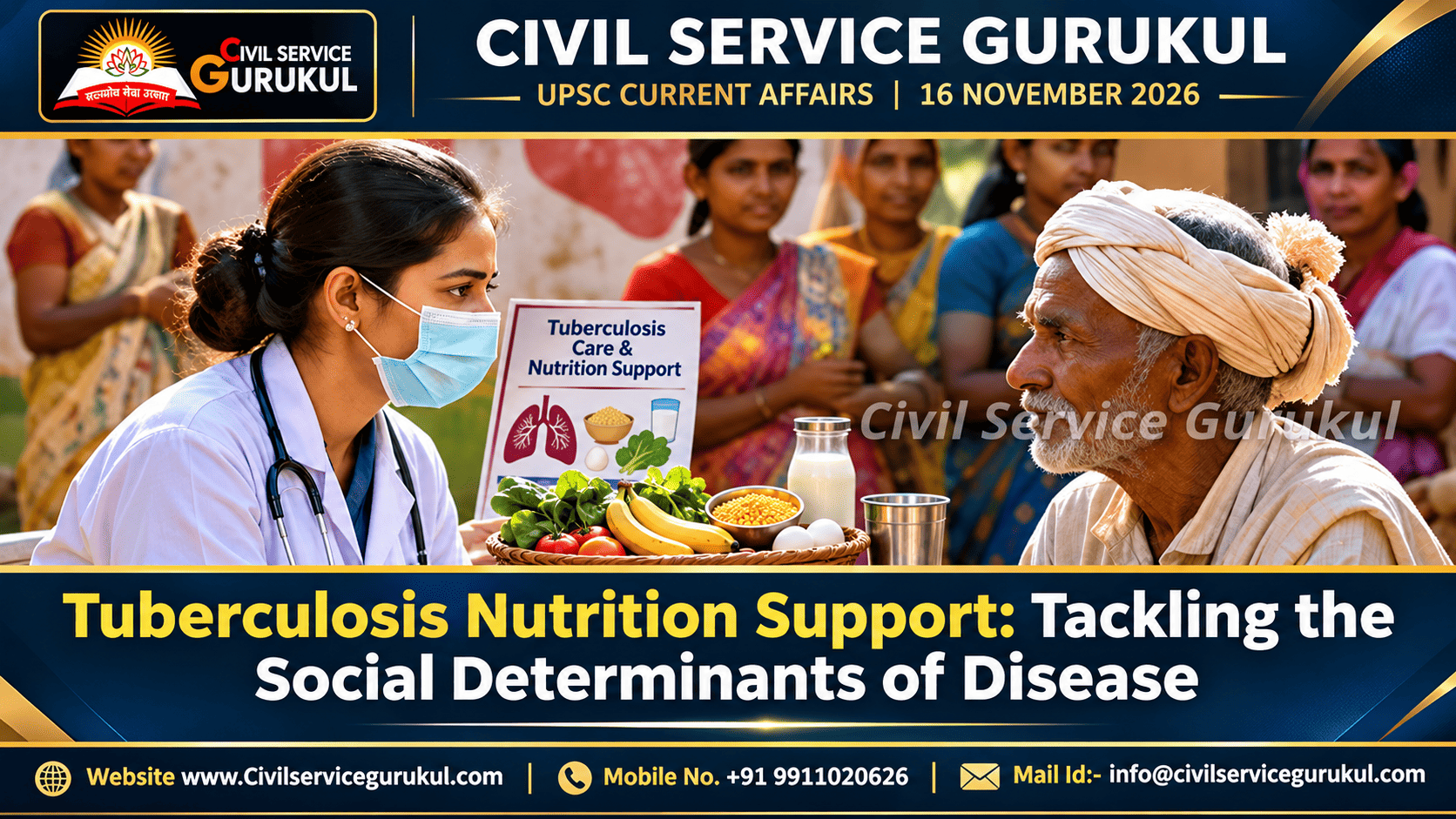
Why Is Tuberculosis Nutrition Support in the News?
Tuberculosis remains an important public health challenge requiring coordinated medical and social policy responses.
The supplied editorial refers to the WHO Global Tuberculosis Report 2026, reported as released on 12 November 2026, and a 14 November news index highlighting financing gaps.
The central policy question is whether health systems can address not only the infection itself but also the conditions that increase vulnerability and interrupt treatment.
Nutrition, housing, income security and stigma reduction are therefore important elements of a comprehensive TB response.
The supplied editorial identifies a WHO report release and financing concerns.
No specific TB incidence, mortality or funding figures are reproduced without independent verification of the underlying report.
UPSC Syllabus Relevance
| UPSC Paper | Relevant Syllabus Topics |
|---|---|
| GS Paper I | Poverty, social inequality, vulnerable groups and the social dimensions of health |
| GS Paper II | Health services, nutrition, social justice, government intervention and public welfare |
| GS Paper IV | Equity, dignity, compassion, accountability and ethical public service delivery |
| Prelims | Mycobacterium tuberculosis, bacterial infections, drug resistance, nutrition and public health |
What Is Tuberculosis?
Tuberculosis is an infectious disease caused by the bacterium Mycobacterium tuberculosis.
It most commonly affects the lungs, although other parts of the body can also be affected.
Pulmonary tuberculosis can spread through the air when a person with infectious disease releases bacteria into the air.
TB requires appropriate medical diagnosis and anti-tubercular treatment.
Understanding the Social Determinants of Tuberculosis
Social determinants of health refer to the conditions in which people are born, grow, live, work and age, along with broader social and economic systems influencing health.
These conditions can affect disease exposure, healthcare access, treatment continuity and recovery.
Major Social Determinants Relevant to TB
- Malnutrition and food insecurity.
- Poverty and income insecurity.
- Overcrowded or poorly ventilated housing.
- Limited access to healthcare.
- High out-of-pocket expenditure.
- Social stigma and discrimination.
- Employment insecurity during illness.
- Limited health awareness and support systems.
Addressing these factors is important because medical treatment alone cannot remove every condition that contributes to vulnerability.
Why Nutrition Matters in Tuberculosis Care
Adequate nutrition supports general health, physical functioning and recovery during illness.
Undernutrition is an important factor in tuberculosis vulnerability and may complicate recovery.
People receiving TB treatment may also experience economic hardship that makes it difficult to obtain adequate food.
Potential Benefits of Nutrition Support
- Improved access to adequate food.
- Reduced nutritional vulnerability.
- Support for patient well-being.
- Reduced financial pressure on affected households.
- Better conditions for continuing prescribed care.
Nutrition support should complement, not replace, appropriate medical treatment and clinical follow-up.
Nutrition support and anti-tubercular treatment serve different but complementary purposes.
Food assistance cannot substitute for prescribed TB medicines.
The Relationship Between Poverty and Tuberculosis
Poverty can influence tuberculosis risk through multiple interconnected pathways.
1. Food Insecurity
Low household income may reduce access to adequate and nutritious food.
2. Housing Conditions
Overcrowded and poorly ventilated living spaces can increase the risk of airborne disease transmission.
3. Delayed Healthcare
Financial and geographical barriers may delay diagnosis and treatment.
4. Income Loss
Illness may reduce the ability to work, creating further economic insecurity.
5. Treatment Expenses
Travel, lost wages and other indirect costs may create financial hardship.
Poverty and food insecurity → greater vulnerability to illness → healthcare and income-related costs → deeper financial insecurity.
This represents a possible reinforcing cycle rather than an inevitable outcome for every patient.
Why Housing Conditions Matter
Tuberculosis can spread through airborne particles in certain circumstances.
Overcrowding and inadequate ventilation may increase exposure risks.
Improving housing conditions and indoor air quality can therefore complement medical public health interventions.
Important Preventive Considerations
- Better ventilation in occupied spaces.
- Reduced overcrowding where feasible.
- Early identification of infectious cases.
- Appropriate infection prevention measures.
- Accessible information about transmission.
TB Treatment Adherence and Patient-Centred Care
Treatment adherence means following the prescribed treatment regimen as advised by qualified healthcare professionals.
Tuberculosis treatment may require medicines over an extended period, depending on the clinical diagnosis and treatment regimen.
Interruptions in treatment can complicate disease management and may contribute to poor outcomes.
Common Barriers to Treatment Continuity
- Travel and transport expenses.
- Loss of daily wages.
- Food insecurity.
- Medicine-related difficulties requiring clinical management.
- Social stigma.
- Weak follow-up arrangements.
- Fragmented healthcare services.
Patient-centred care seeks to reduce avoidable barriers while respecting individual needs and dignity.
Drug-Resistant Tuberculosis: Why It Matters
Drug-resistant tuberculosis occurs when the bacteria causing TB are resistant to one or more anti-tubercular medicines.
Drug resistance can make treatment more complex and may require specialised clinical management.
Resistance may arise through bacterial genetic changes and selection pressures.
Inadequate treatment or treatment interruption can contribute to the development or amplification of resistance, although drug-resistant TB can also be transmitted directly.
Drug-resistant TB is not a different viral infection.
It is tuberculosis caused by bacteria resistant to specified medicines.
Healthcare Financing and Out-of-Pocket Expenses
Healthcare expenses may include direct medical and non-medical costs as well as income losses.
Even where treatment services are available, patients may face transport expenses, lost wages and nutrition-related financial pressures.
Fragmented services may require repeated visits and increase the burden on households.
Policy Implications
- Reduce avoidable financial barriers.
- Improve access to local healthcare services.
- Coordinate clinical care with social support.
- Strengthen follow-up and referral systems.
- Monitor the actual burden on affected households.
Stigma and Social Exclusion in Tuberculosis
People affected by tuberculosis may experience fear, discrimination or social isolation.
Stigma can discourage individuals from seeking diagnosis, disclosing concerns or continuing care.
Public health communication should therefore promote accurate information, privacy and dignity.
Important Governance Measures
- Community awareness programmes.
- Confidential and respectful healthcare.
- Non-discriminatory public services.
- Supportive workplace practices.
- Accessible grievance mechanisms.
Integrating TB Care with Primary Healthcare
Primary healthcare can play an important role in early identification, referral, treatment support and patient follow-up.
Integration can reduce unnecessary fragmentation and improve continuity of services.
Elements of Integrated TB Care
- Accessible screening and diagnostic pathways.
- Timely referral and appropriate treatment.
- Nutrition assessment and support.
- Patient counselling and follow-up.
- Monitoring of treatment-related difficulties.
- Coordination with social welfare services.
- Protection of patient privacy and dignity.
Implementation should be adapted to local health system capacity and patient needs.
Public Health Governance: Measuring What Matters
A successful TB programme should not be evaluated only by the number of announcements or services offered.
It should also assess whether people receive timely, effective and equitable care.
| Policy Area | Potential Indicator | Why It Matters |
|---|---|---|
| Diagnosis | Timeliness of access to diagnostic services | Supports earlier care |
| Treatment | Treatment continuity and outcomes | Assesses effectiveness of care |
| Nutrition | Access to appropriate nutrition support | Addresses nutritional vulnerability |
| Financial protection | Patient-incurred expenses and income-related burden | Measures economic hardship |
| Equity | Differences across vulnerable groups | Identifies unequal access |
| Governance | Grievance resolution and follow-up quality | Strengthens accountability |
Ethical Dimensions of Tuberculosis Control
1. Human Dignity
People affected by TB should receive respectful and non-discriminatory care.
2. Equity
Health services should account for the needs of economically and socially vulnerable groups.
3. Compassion
Public institutions should recognise the social and economic difficulties faced during illness.
4. Accountability
Programme outcomes should be monitored through transparent and credible indicators.
5. Privacy
Patient information should be handled with appropriate confidentiality and safeguards.
Ethical public health governance requires balancing disease control with dignity, equity, compassion and accountability.
Way Forward: A Comprehensive TB Response
- Strengthen early diagnosis: Improve access to timely and appropriate testing.
- Ensure effective treatment: Provide medically appropriate care and follow-up.
- Integrate nutrition support: Address food insecurity alongside clinical treatment.
- Reduce financial hardship: Identify transport, income and other avoidable patient costs.
- Improve primary healthcare coordination: Link diagnosis, treatment, counselling and referrals.
- Address stigma: Promote accurate public communication and respectful care.
- Support vulnerable households: Coordinate health services with relevant social protection measures.
- Monitor drug resistance: Support appropriate diagnostic and clinical management systems.
- Improve accountability: Use measurable outcomes, transparent monitoring and accessible grievance mechanisms.
A sustainable tuberculosis response must integrate clinical treatment, nutrition security, social protection and accountable healthcare delivery.
UPSC Prelims Quick Revision
- Tuberculosis is caused by Mycobacterium tuberculosis.
- TB is bacterial, not viral.
- TB commonly affects the lungs but can affect other organs.
- Pulmonary TB may spread through the air.
- Drug-resistant TB involves resistance to specified anti-tubercular medicines.
- Nutrition support complements but does not replace medical treatment.
- Undernutrition is an important TB-related vulnerability.
- Housing, poverty, stigma and income security influence health outcomes.
- Treatment continuity and patient-centred follow-up are important.
Original UPSC Prelims Practice MCQs
Question 1: Tuberculosis Basics
Consider the following statements:
1. Tuberculosis is
caused by a bacterium.
2. Tuberculosis is
primarily treated
with antiviral medicines.
3. Tuberculosis may
affect organs other
than the lungs.
Which statements are correct?
(a) 1 and 2 only
(b) 1 and 3 only
(c) 2 and 3 only
(d) 1, 2 and 3
View Answer and Explanation
Correct Answer: (b) 1 and 3 only.
Statement 1 is correct because TB is caused by Mycobacterium tuberculosis.
Statement 2 is incorrect because TB is a bacterial disease requiring appropriate anti-tubercular medicines.
Statement 3 is correct.
Question 2: Nutrition and TB
Consider the following statements:
1. Undernutrition can
increase vulnerability
to tuberculosis.
2. Nutrition support
can completely replace
anti-tubercular treatment.
3. Food insecurity
may create additional
difficulties during
TB treatment.
Which statements are correct?
(a) 1 and 2 only
(b) 2 and 3 only
(c) 1 and 3 only
(d) 1, 2 and 3
View Answer and Explanation
Correct Answer: (c) 1 and 3 only.
Nutrition support is important, but it cannot replace prescribed medical treatment.
Question 3: Drug Resistance
Consider the following statements:
1. Drug-resistant TB
involves bacteria
resistant to
specified medicines.
2. Treatment interruption
can complicate
TB disease control.
3. Drug-resistant TB
is necessarily caused
by a virus.
Which statements are correct?
(a) 1 and 2 only
(b) 2 and 3 only
(c) 1 and 3 only
(d) 1, 2 and 3
View Answer and Explanation
Correct Answer: (a) 1 and 2 only.
Drug-resistant TB remains a bacterial infection, and treatment interruptions may complicate disease management.
Question 4: Social Determinants
Which of the following best represents a comprehensive tuberculosis control strategy?
(a) Focus only on medicines and ignore social conditions
(b) Replace clinical treatment with food assistance
(c) Integrate diagnosis, treatment, nutrition, social support and patient-centred follow-up
(d) Avoid monitoring treatment outcomes
View Answer and Explanation
Correct Answer: (c).
Effective TB control requires appropriate clinical care alongside support for relevant social and economic barriers.
UPSC Mains Practice Question
"Tuberculosis elimination is not merely a medical challenge but also a question of nutrition, poverty, housing and social justice." Discuss the importance of addressing social determinants in India's TB control strategy.
Suggested Answer-Writing Framework
Introduction: Define tuberculosis and explain the concept of social determinants of health.
Health Dimension: Discuss timely diagnosis, treatment and drug resistance.
Social Dimension: Explain malnutrition, poverty, housing, income insecurity and stigma.
Governance Dimension: Examine primary healthcare integration, financial protection and patient follow-up.
Way Forward: Recommend nutrition support, social protection, accessible healthcare and measurable monitoring.
Conclusion: Emphasise equitable, patient-centred and accountable public health policy.
Key Takeaways for UPSC Aspirants
- TB is caused by Mycobacterium tuberculosis.
- Drug resistance and treatment interruption can complicate control.
- Nutrition support is complementary to clinical treatment.
- Poverty and housing conditions influence vulnerability.
- Income insecurity can create barriers to treatment continuity.
- Stigma reduction is important for accessible and dignified care.
- Primary healthcare and social support should be coordinated.
- Public health success requires measurable and equitable outcomes.
Frequently Asked Questions
1. What causes tuberculosis?
Tuberculosis is caused by the bacterium Mycobacterium tuberculosis.
2. Why is nutrition important for TB patients?
Adequate nutrition supports general health and recovery, while food insecurity may create additional difficulties during treatment.
3. Can nutrition support replace TB medicines?
No. Nutrition support complements appropriate anti-tubercular treatment and medical follow-up.
4. What is drug-resistant tuberculosis?
Drug-resistant TB is tuberculosis caused by bacteria resistant to one or more anti-tubercular medicines.
5. What are the social determinants of TB?
Important factors include nutrition, poverty, housing, income security, healthcare access and social stigma.
6. Why is TB relevant for UPSC?
The topic connects public health, social justice, nutrition security, poverty and ethical governance.
Conclusion: TB Control Requires Health and Social Policy Integration
Tuberculosis control requires timely diagnosis and appropriate medical treatment, but social conditions also influence vulnerability and treatment outcomes.
Nutrition insecurity, poverty, inadequate housing, financial hardship and social stigma must therefore be considered in public health planning.
India's long-term strategy should integrate clinical care, nutritional support, social protection and accountable health system delivery.
The ultimate goal should be a patient-centred, equitable and sustainable response that improves health outcomes while protecting human dignity.
Prepare for UPSC Prelims & Mains with Civil Service Gurukul
Strengthen your understanding of Public Health, Social Justice, Governance and Current Affairs through conceptual learning, original MCQs and structured Mains answer-writing practice.
Visit Civil Service Gurukul Contact Our TeamEditorial Note
This is an original educational analysis based on the topic and context supplied in the uploaded editorial.
The supplied material mentions the WHO Global Tuberculosis Report 2026 and related financing concerns.
Specific disease burden or financing figures have not been included without independent verification.