
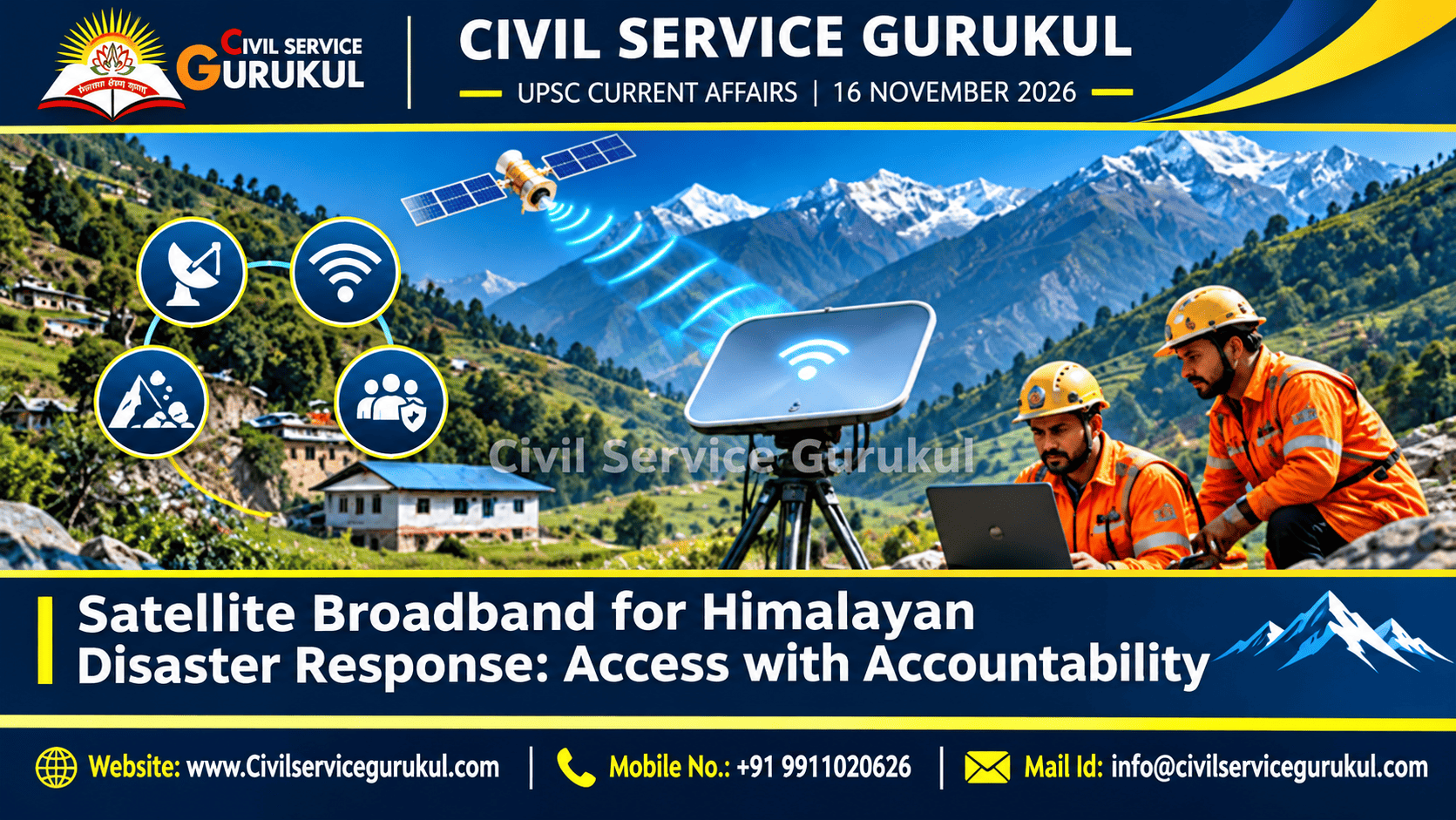
Why Is Satellite Broadband in the News?
Satellite broadband is increasingly discussed as a potential solution for improving connectivity in remote and disaster-prone regions.
In the Himalayan region, landslides, earthquakes, floods and severe weather may damage terrestrial communication infrastructure.
During emergencies, communication failures can delay warnings, rescue coordination, medical assistance and administrative decisions.
Satellite-based connectivity offers an alternative communication pathway, particularly where conventional networks are unavailable or severely disrupted.
The supplied editorial refers to a 14 November 2026 source index discussing sovereign controls over satellite connectivity.
It does not verify the enactment of a new satellite internet shutdown law.
This article therefore examines the broader technological, disaster management and governance implications without asserting an unverified legal development.
UPSC Syllabus Relevance
| UPSC Paper | Relevant Syllabus Topics |
|---|---|
| GS Paper I | Physical geography, Himalayan hazards, earthquakes, floods and landslides |
| GS Paper II | Governance, digital inclusion, public service delivery, accountability and legal safeguards |
| GS Paper III | Science and technology, space technology, disaster management, infrastructure and cybersecurity |
| Prelims | LEO satellites, GEO satellites, satellite communication, disaster management and digital infrastructure |
Why Is the Himalayan Region Vulnerable to Communication Disruptions?
The Himalayas are characterised by complex terrain, steep slopes, seismic activity and climatic variability.
Natural hazards can damage roads, electricity networks, telecommunication towers and fibre-optic cables.
Major Disaster Risks
- Landslides triggered by heavy rainfall or slope instability.
- Earthquakes affecting buildings and communication infrastructure.
- Flash floods and riverine flooding.
- Glacial lake outburst floods in vulnerable locations.
- Severe weather restricting physical access to affected settlements.
Remote settlements may experience additional difficulties because repair teams and emergency equipment cannot always reach them quickly.
What Is Satellite Broadband?
Satellite broadband provides internet connectivity using communication satellites and associated ground systems.
Unlike terrestrial networks, which primarily rely on cables and ground-based towers, satellite systems use space-based communication links.
A typical satellite communication arrangement includes user terminals, satellites, ground gateways and network management systems.
User terminal → satellite communication link → satellite or network gateway → wider communication network.
The exact architecture varies between satellite systems. Some networks may also use inter-satellite links.
LEO vs GEO Satellites: Important UPSC Concepts
Low-Earth-Orbit Satellites — LEO
LEO satellites operate relatively close to Earth compared with geostationary satellites.
They move relative to the Earth's surface and are often deployed in constellations to provide continuing coverage.
Geostationary Satellites — GEO
Geostationary satellites orbit above the equator at an altitude of approximately 35,786 kilometres.
They appear stationary relative to a point on the Earth's surface.
| Feature | LEO Satellites | GEO Satellites |
|---|---|---|
| Altitude | Relatively low orbital altitude | Approximately 35,786 km |
| Motion | Move relative to the ground | Appear stationary relative to Earth |
| Coverage | Individual satellites cover smaller areas | Individual satellites cover large geographical areas |
| Latency | Generally lower propagation delay | Generally higher propagation delay |
| Network Design | Often requires constellations | Can provide broad regional coverage from one orbital position |
How Satellite Internet Can Support Himalayan Disaster Response
1. Emergency Warning Communication
Satellite connectivity may help authorised agencies transmit emergency information when local terrestrial networks are disrupted.
2. Search and Rescue Coordination
Rescue teams may use satellite communication to exchange situation reports, coordinate resources and communicate with emergency control centres.
3. Telemedicine
Remote healthcare facilities may use satellite links to communicate with medical specialists, subject to available equipment and service capacity.
4. Administrative Coordination
District authorities, disaster management teams and relief agencies may use emergency connectivity to coordinate operations.
5. Relief Distribution
Communication links may assist with tracking relief requirements, supply deliveries and local needs.
6. Community Communication
Emergency access points may help affected communities contact authorities and obtain reliable information.
Why Satellite Connectivity Is Not Automatically Disaster-Proof
Satellite systems reduce some terrestrial network dependencies, but they are not independent of all ground infrastructure.
Key Operational Requirements
- Functioning user terminals.
- Reliable electricity or backup power.
- Suitable antenna installation and visibility.
- Operational gateways and supporting networks.
- Trained personnel for deployment and maintenance.
- Authorised access and service arrangements.
Equipment damage, power shortages, weather-related interference or network failures may still interrupt service.
Satellite connectivity is an additional layer of communication resilience, not a guarantee of uninterrupted service.
Reliable disaster response requires both technology and operational preparedness.
Satellite Broadband and Digital Inclusion
Remote Himalayan communities may face geographical and economic barriers to conventional connectivity.
Satellite broadband could help improve access to digital services where terrestrial networks are difficult to deploy.
Potential Applications
- Emergency healthcare communication.
- Distance education and digital learning.
- Administrative services.
- Weather and disaster information access.
- Connectivity for remote public institutions.
However, affordability, digital literacy, device availability and service reliability remain important challenges.
Satellite Communication and Sovereign Controls
Satellite communication raises governance questions relating to national security, lawful regulation, service continuity and user rights.
Governments may seek appropriate regulatory oversight of communication networks operating within their jurisdiction.
At the same time, restrictions affecting emergency connectivity may create serious public safety consequences.
Important Governance Principles
- Clear legal authority.
- Necessity and proportionality.
- Transparent procedures.
- Appropriate independent oversight.
- Protection of essential emergency services.
- Accessible grievance and review mechanisms.
Specific legal powers and procedures must be assessed under applicable Indian law and judicial standards.
No new satellite broadband shutdown law is claimed to have been enacted on the basis of the supplied editorial.
Balancing National Security and Disaster Connectivity
National security and public safety are important governmental responsibilities.
However, communication restrictions during disasters may affect rescue operations, healthcare coordination and public access to critical information.
A balanced governance framework should therefore consider the necessity, scope, duration and consequences of restrictions.
| Policy Objective | Potential Concern | Governance Safeguard |
|---|---|---|
| National security | Misuse of communication services | Lawful, targeted and proportionate controls |
| Disaster response | Loss of emergency connectivity | Continuity protocols for essential services |
| Digital inclusion | Unequal access and affordability | Accessible public service arrangements |
| Privacy | Exposure of sensitive information | Appropriate security and access controls |
| Accountability | Unclear decisions and limited review | Documented procedures and independent oversight |
Institutional Coordination in Disaster Management
Disaster communication planning requires coordination among multiple public institutions and operational agencies.
Important Stakeholders
- National and State Disaster Management Authorities.
- District disaster management administrations.
- Emergency response and rescue agencies.
- Telecommunication authorities and service providers.
- Healthcare and local government institutions.
- Community organisations and trained volunteers.
Clear operational responsibilities help reduce confusion during emergencies.
Communication protocols should be tested through regular preparedness exercises.
Challenges in Deploying Satellite Broadband in the Himalayas
| Challenge | Potential Impact | Suggested Response |
|---|---|---|
| Remote terrain | Difficulty transporting and installing terminals | Pre-positioned emergency equipment |
| Power disruptions | Loss of terminal operation | Backup power and tested energy arrangements |
| Limited trained personnel | Deployment delays | Regular technical training |
| Equipment costs | Restricted access | Risk-based public procurement planning |
| Network dependency | Service disruption | Redundant communication pathways |
| Regulatory uncertainty | Operational and legal challenges | Clear, lawful and accountable procedures |
Way Forward: Disaster-Resilient Satellite Communication
- Identify priority locations: Map vulnerable Himalayan settlements and critical public facilities.
- Pre-position equipment: Maintain suitable emergency terminals in strategically important locations.
- Ensure backup power: Provide tested battery, generator or other appropriate power arrangements.
- Train local operators: Build technical capacity among authorised responders.
- Integrate satellite and terrestrial systems: Develop layered communication networks rather than depending on a single technology.
- Conduct regular disaster drills: Test communication continuity under realistic emergency conditions.
- Protect essential communication: Design disaster-specific continuity protocols with appropriate legal safeguards.
- Strengthen independent review: Evaluate operational performance, service accessibility and governance decisions.
- Monitor measurable outcomes: Track restoration time, coverage reliability, equipment readiness and emergency response performance.
UPSC Prelims Quick Revision
- LEO satellites operate at lower altitudes than geostationary satellites.
- Geostationary satellites orbit approximately 35,786 km above the equator.
- LEO constellations can provide broadband coverage using multiple satellites.
- Satellite terminals require electricity and functioning service infrastructure.
- Satellite communication can support emergency response when terrestrial networks fail.
- Satellite connectivity does not eliminate all operational risks.
- Disaster communication requires coordination among multiple institutions.
- Emergency communication restrictions raise legal and public safety considerations.
Original UPSC Prelims Practice MCQs
Question 1: Satellite Orbits
Consider the following statements:
1. LEO satellites generally operate
at lower altitudes than
geostationary satellites.
2. Geostationary satellites
appear stationary relative
to the Earth's surface.
3. Every LEO satellite remains
stationary over one fixed
location on Earth.
Which statements are correct?
(a) 1 and 2 only
(b) 2 and 3 only
(c) 1 and 3 only
(d) 1, 2 and 3
View Answer and Explanation
Correct Answer: (a) 1 and 2 only.
Statement 1 is correct because LEO satellites operate at relatively low orbital altitudes.
Statement 2 is correct because geostationary satellites appear fixed relative to Earth.
Statement 3 is incorrect because LEO satellites move relative to the Earth's surface.
Question 2: Disaster Communication
Consider the following statements:
1. Satellite broadband
may support communication
when terrestrial networks fail.
2. Satellite terminals
can operate indefinitely
without any power supply.
3. Ground infrastructure
and network management
can affect satellite
service reliability.
Which statements are correct?
(a) 1 only
(b) 1 and 3 only
(c) 2 and 3 only
(d) 1, 2 and 3
View Answer and Explanation
Correct Answer: (b) 1 and 3 only.
Satellite connectivity may provide an alternative communication pathway.
However, terminals require power and functioning infrastructure.
Question 3: Governance
Which of the following is the most appropriate approach to emergency satellite communication?
(a) Depend entirely on one communication technology
(b) Ignore the need for trained operators
(c) Combine redundant networks, backup power, operational training and legal safeguards
(d) Assume all satellite services remain functional during every disaster
View Answer and Explanation
Correct Answer: (c).
Disaster communication resilience requires technological redundancy, operational preparedness and accountable governance.
Question 4: Himalayan Disaster Management
Consider the following statements:
1. Landslides may damage
terrestrial communication
infrastructure.
2. Backup power can improve
the operational readiness
of emergency communication
equipment.
3. Satellite communication
eliminates the need for
disaster preparedness exercises.
Which statements are correct?
(a) 1 and 2 only
(b) 2 and 3 only
(c) 1 and 3 only
(d) 1, 2 and 3
View Answer and Explanation
Correct Answer: (a) 1 and 2 only.
Infrastructure damage and power disruption are important operational risks during disasters.
Regular preparedness exercises remain necessary even when satellite communication is available.
UPSC Mains Practice Question
"Satellite broadband can strengthen disaster resilience in the Himalayan region, but technological access must be accompanied by institutional accountability." Critically examine.
Suggested Answer-Writing Framework
Introduction: Explain Himalayan disaster vulnerability and communication infrastructure challenges.
Technological Benefits: Discuss emergency warnings, rescue coordination, telemedicine and remote connectivity.
Operational Limitations: Explain power requirements, ground terminals, network dependencies and trained personnel.
Governance Dimension: Discuss national security, lawful regulation, essential service continuity and independent oversight.
Way Forward: Recommend layered communication, pre-positioned equipment, backup power, training and disaster-specific protocols.
Conclusion: Emphasise resilience, inclusion, accountability and protection of essential public services.
Key Takeaways for UPSC Aspirants
- Himalayan disasters can disrupt terrestrial communication networks.
- Satellite broadband may provide alternative emergency connectivity.
- LEO and GEO satellites differ in altitude and coverage characteristics.
- Satellite terminals require power and operational support.
- Technology alone cannot guarantee uninterrupted emergency communication.
- National security controls must be assessed alongside public safety needs.
- Disaster communication planning requires institutional coordination.
- Legal safeguards and independent review improve accountability.
Frequently Asked Questions
1. What is satellite broadband?
Satellite broadband provides internet connectivity through communication satellites and supporting ground systems.
2. Why is satellite internet important for Himalayan disasters?
It can provide an alternative communication pathway when terrestrial networks are damaged or unavailable.
3. What is the difference between LEO and GEO satellites?
LEO satellites operate at lower altitudes and move relative to Earth's surface. Geostationary satellites appear stationary over the equatorial region.
4. Can satellite internet operate without electricity?
No. User terminals and supporting equipment require a functioning power supply.
5. How can satellite communication support telemedicine?
It may help remote healthcare facilities communicate with specialists when suitable equipment and network services are available.
6. What governance safeguards are important?
Clear legal authority, necessity, proportionality, transparency, essential service continuity and independent oversight are important considerations.
Conclusion: Building Disaster-Resilient Communication in the Himalayas
Satellite broadband offers important opportunities to strengthen emergency communication in remote Himalayan regions.
However, reliable connectivity depends on ground terminals, electricity, trained personnel, network management and effective coordination.
India's long-term strategy should combine satellite and terrestrial systems with disaster preparedness, digital inclusion and accountable governance.
The objective must be not merely to expand connectivity, but to ensure that essential communication remains available when communities need it most.
Prepare for UPSC Prelims & Mains with Civil Service Gurukul
Strengthen your understanding of Disaster Management, Science & Technology, Governance and Geography through conceptual learning, original MCQs and structured Mains answer-writing practice.
Visit Civil Service Gurukul Contact Our TeamEditorial Note
This is an original educational analysis based on the topic and context supplied in the uploaded editorial.
The source refers to a 14 November 2026 discussion of sovereign controls over satellite connectivity.
It does not establish that a new satellite internet shutdown law was enacted.
The article therefore focuses on established technical concepts, disaster preparedness and governance principles.