
Public Accounts Committee & CAG Audit: UPSC 2026
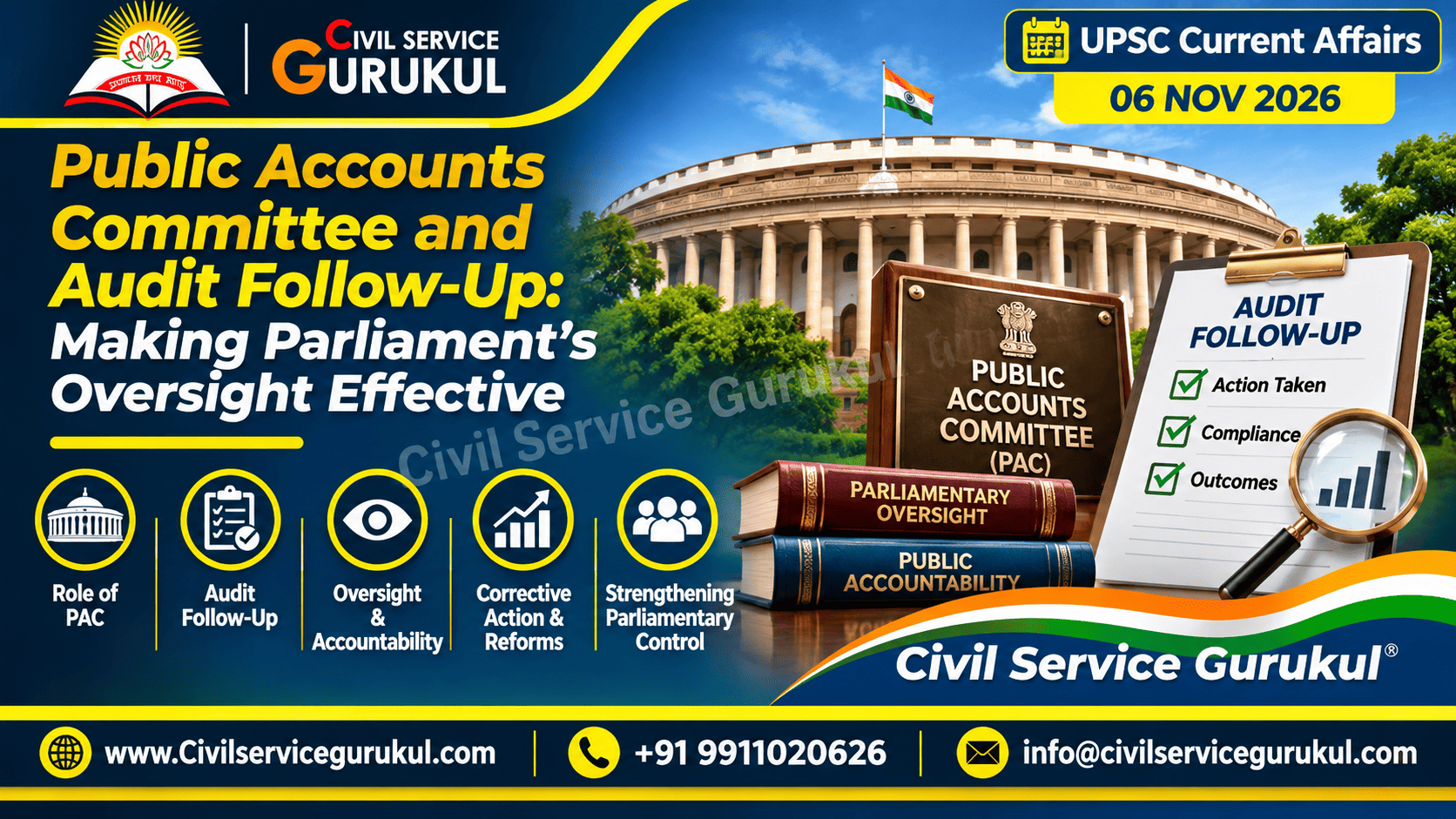
UPSC CIVIL SERVICES EXAMINATION | INDIAN POLITY | GOVERNANCE | PUBLIC ACCOUNTABILITY
Public Accounts Committee and CAG Audit: Why Parliamentary Oversight Must Go Beyond Audit Reports
An in-depth UPSC analysis of the Public Accounts Committee, CAG audit findings, parliamentary financial control, action-taken reports and accountable public expenditure.
Published: 6 November 2026 | Source Edition: 5 November 2026
UPSC Syllabus Relevance
| UPSC Paper | Relevant Areas |
|---|---|
| GS Paper II | Parliament, parliamentary committees, constitutional bodies, executive accountability and governance. |
| GS Paper IV | Integrity, transparency, accountability, objectivity and ethical public administration. |
| Prelims | Articles 148–151, CAG, PAC, audit reports and parliamentary oversight mechanisms. |
| Essay | Public trust, democratic accountability, transparency and good governance. |
Quick Revision: Important Concepts
1. Why Is Parliamentary Audit Follow-Up in the News?
A current-affairs source dated 5 November 2026 highlights a reported call by the Public Accounts Committee for stronger scrutiny of public expenditure and faster action on audit observations.
The issue raises a central question of democratic governance: how can Parliament ensure that public money is spent according to authorization and that weaknesses identified by auditors lead to meaningful corrective action?
Audit reports can identify irregularities, inefficiencies and weaknesses in public administration. However, their value depends on whether the executive responds effectively and whether implementation is subsequently verified.
Why It Matters for UPSC
- It concerns Parliament's financial oversight of the executive.
- It highlights the constitutional role of the CAG.
- It connects auditing with public expenditure management.
- It raises questions about transparency and institutional accountability.
- It is relevant to both GS Paper II and GS Paper IV.
2. What Is the Public Accounts Committee?
The Public Accounts Committee is a parliamentary financial committee that examines government accounts and relevant audit reports.
Its scrutiny helps Parliament assess whether public expenditure has been undertaken in accordance with legislative authorization and applicable financial requirements.
Major Functions
- Examine accounts relating to public expenditure.
- Review relevant CAG audit reports.
- Identify weaknesses in financial administration.
- Seek explanations from executive departments.
- Recommend corrective action.
- Follow up on departmental responses.
The PAC is a mechanism of legislative scrutiny. Executive departments remain responsible for implementing corrective measures.
3. Constitutional Position of the CAG
The Comptroller and Auditor General of India is a constitutional authority responsible for auditing government accounts and related matters within the applicable constitutional and statutory framework.
Important Constitutional Provisions
- Article 148: Establishes the office of the Comptroller and Auditor General of India.
- Article 149: Provides for the duties and powers of the CAG as prescribed by Parliament through law.
- Article 150: Concerns the form of accounts of the Union and States.
- Article 151: Deals with submission of audit reports relating to Union and State accounts.
4. How Do the CAG and PAC Work Together?
The CAG and PAC perform complementary roles in India's system of financial accountability.
↓
↓
↓
↓
The effectiveness of this process depends on whether audit findings are examined, responses are timely and corrective action is verifiable.
5. Why Audit Reports Alone Are Not Enough
An audit report may identify financial irregularities, procedural weaknesses or implementation deficiencies.
However, identifying a problem does not automatically correct it.
Why Follow-Up Is Essential
- Departments must explain audit observations.
- Corrective measures need clear responsibilities.
- Implementation should be time-bound where feasible.
- Repeat deficiencies require sustained scrutiny.
- Closure should be supported by evidence.
Without follow-up, the same administrative weaknesses may persist despite repeated audit observations.
6. What Are Action-Taken Reports?
Action-taken reports and related departmental responses document measures taken or proposed in response to parliamentary committee recommendations.
They help connect legislative scrutiny with executive implementation.
Important Elements
- Identification of the relevant recommendation.
- Explanation of the departmental response.
- Description of corrective action.
- Implementation status.
- Reasons for delay, where applicable.
- Supporting evidence of compliance.
Timely action-taken reporting can improve transparency and reduce the gap between recommendations and results.
7. Major Challenges in Parliamentary Financial Oversight
Backlog of Responses
Delayed action-taken notes can weaken timely legislative follow-up.
Recurring Audit Observations
Repeated deficiencies may indicate weaknesses in institutional learning or corrective implementation.
Complex Public Expenditure
Large programmes and procurement systems can involve multiple agencies and complicated financial arrangements.
Limited Performance Information
Incomplete or unreliable data can make it difficult to evaluate outcomes.
Weak Verification
A departmental claim that action has been taken may require independent confirmation.
8. Audit Objections Are Not Automatically Proof of Corruption
Audit findings may arise from procedural lapses, accounting issues, procurement weaknesses, inefficient spending or other deficiencies.
The existence of an audit objection should not automatically be interpreted as proof of corruption.
Why Careful Examination Matters
- Departments should be allowed to provide explanations.
- Relevant financial and procedural records must be examined.
- Findings should be assessed according to evidence.
- Different types of irregularities require different responses.
- Accountability should remain objective and proportionate.
9. Procurement Weaknesses and Public Expenditure
Government procurement involves the acquisition of goods, works and services using public resources.
Weak procurement systems can create risks of inefficiency, avoidable expenditure, delays and poor value for money.
Important Governance Concerns
- Inadequate planning.
- Weak documentation.
- Deficient contract management.
- Delayed project implementation.
- Unreliable performance reporting.
- Insufficient monitoring of outcomes.
Audit scrutiny can identify systemic weaknesses and support administrative improvements.
10. Parliamentary Oversight and Outcome-Oriented Governance
Public financial accountability should examine not only whether money was spent according to rules, but also whether public programmes achieved their intended purposes.
Important Evaluation Questions
- Was expenditure properly authorized?
- Were applicable procedures followed?
- Were project objectives achieved?
- Were resources used efficiently?
- Were delays and cost overruns explained?
- Were corrective recommendations implemented?
This approach connects financial scrutiny with public service delivery and citizen outcomes.
11. Cross-Party Scrutiny and Democratic Trust
Parliamentary committees can provide structured forums for examining complex administrative matters.
Evidence-based scrutiny across political differences may strengthen public confidence in legislative oversight.
Conditions for Effective Scrutiny
- Careful examination of audit evidence.
- Reasoned questioning of departments.
- Focus on institutional improvements.
- Transparent reporting of recommendations.
- Objective assessment of executive responses.
The credibility of oversight depends on evidence, fairness and sustained institutional follow-up.
12. Digital Tracking and Public Dashboards
Digital monitoring systems can help track audit observations and corrective measures.
Potential Features
- Identification of pending observations.
- Department-wise responsibility mapping.
- Recorded implementation deadlines.
- Status of action-taken responses.
- Tracking of repeat deficiencies.
- Evidence-based closure records.
Public dashboards may improve transparency where disclosure is legally appropriate and does not compromise protected information.
13. Risk-Based Prioritization of Audit Findings
Audit observations can differ in their financial significance, urgency and potential impact on public welfare.
A risk-based approach can help institutions prioritize serious or recurring deficiencies.
Possible Prioritization Criteria
- Magnitude of financial exposure.
- Potential impact on public services.
- Recurrence of the same weakness.
- Likelihood of continuing losses.
- Urgency of corrective action.
- Systemic implications across departments.
Such prioritization should remain transparent and should not be used to disregard smaller but legally significant irregularities.
14. Ethical Dimensions of Financial Accountability
Integrity
Public officials must handle public resources honestly and responsibly.
Transparency
Financial decisions and corrective measures should be appropriately documented and disclosed.
Objectivity
Audit findings and departmental explanations should be evaluated on evidence.
Accountability
Departments should explain their actions and demonstrate implementation of corrective measures.
Public Interest
Financial scrutiny should ultimately support better services and responsible use of public money.
15. Way Forward: Strengthening PAC and Audit Follow-Up
- Time-bound responses: Encourage timely action-taken reporting.
- Digital tracking: Monitor pending observations and implementation progress.
- Risk-based scrutiny: Prioritize serious and recurring deficiencies.
- Follow-up hearings: Review unresolved recommendations.
- Evidence-based closure: Verify that corrective action has occurred.
- Transparent reporting: Publish appropriate implementation information.
- Institutional learning: Use audit findings to improve financial systems.
- Outcome monitoring: Connect expenditure scrutiny with public service results.
16. UPSC Prelims Practice MCQs
Question 1
Which of the following is the constitutional audit authority of India?
- Comptroller and Auditor General
- Finance Commission
- Election Commission
- Union Public Service Commission
Correct Answer: A
Explanation: The Comptroller and Auditor General is the constitutional audit authority established under Article 148.
Question 2
Which constitutional article establishes the office of the CAG?
- Article 110
- Article 148
- Article 280
- Article 324
Correct Answer: B
Explanation: Article 148 provides for the Comptroller and Auditor General of India.
Question 3
Consider the following statements:
- The CAG audits government accounts within the applicable legal framework.
- The PAC examines relevant government accounts and audit reports.
- Executive departments are responsible for implementing corrective measures.
Which statements are correct?
- 1 only
- 1 and 2 only
- 2 and 3 only
- 1, 2 and 3
Correct Answer: D
Explanation: All three statements correctly describe complementary roles in financial accountability.
Question 4
Which of the following can strengthen audit follow-up?
- Time-bound action-taken reports
- Digital tracking of observations
- Follow-up examination of recurring deficiencies
- All of the above
Correct Answer: D
Explanation: These measures support transparency and implementation accountability.
Question 5
Which statement best reflects responsible treatment of audit objections?
- Every audit objection proves corruption.
- Audit objections should never be examined.
- Audit observations require evidence-based scrutiny and appropriate responses.
- Only financial amounts matter in audit assessment.
Correct Answer: C
Explanation: Audit observations may arise from different kinds of deficiencies and should be examined objectively.
17. UPSC Mains Practice Questions
Question 1 — GS Paper II | 150 Words | 10 Marks
Explain how the Public Accounts Committee contributes to parliamentary control over public expenditure.
Question 2 — GS Paper II | 250 Words | 15 Marks
Examine how effective audit follow-up can strengthen outcome-oriented public expenditure management in India.
Question 3 — GS Paper IV | 150 Words | 10 Marks
Discuss why objectivity, transparency and accountability are essential in responding to public audit findings.
18. UPSC Mains Model Answer
Question: Examine how effective audit follow-up can strengthen outcome-oriented public expenditure management in India. (250 words)
Introduction
Public financial accountability requires more than identifying expenditure irregularities. The CAG, PAC and executive departments perform complementary roles in ensuring that audit findings lead to corrective action.
Role of Audit Follow-Up
- Ensures departments respond to identified weaknesses.
- Improves transparency in public expenditure.
- Helps prevent recurrence of administrative deficiencies.
- Strengthens legislative scrutiny of executive action.
- Supports institutional learning and financial discipline.
Major Challenges
- Delayed action-taken reports.
- Recurring procurement and implementation weaknesses.
- Incomplete performance information.
- Insufficient verification of departmental responses.
- Complexity of large public programmes.
Way Forward
Time-bound departmental responses, digital tracking, risk-based prioritization, follow-up hearings and evidence-based closure can improve accountability. Public expenditure evaluation should consider both financial compliance and service-delivery outcomes.
Conclusion
The effectiveness of parliamentary oversight lies not merely in identifying audit objections, but in ensuring that corrective measures produce measurable improvements in governance and public welfare.
19. UPSC Answer-Writing Strategy
- Introduction: Define parliamentary financial oversight.
- Constitutional Link: Mention Articles 148–151 and the CAG.
- Institutional Roles: Differentiate CAG audit, PAC scrutiny and executive implementation.
- Challenges: Discuss response backlogs, repeat deficiencies and weak monitoring.
- Ethical Balance: Avoid treating every audit observation as proof of corruption.
- Reforms: Recommend time-bound action-taken reports and digital tracking.
- Conclusion: Connect financial accountability with citizen outcomes.
20. Key Takeaways for UPSC Revision
- The CAG is a constitutional audit authority.
- The PAC is a parliamentary financial committee.
- Articles 148–151 are important for understanding the CAG.
- Audit reports alone do not guarantee corrective action.
- Action-taken reports connect recommendations with executive responses.
- Backlogs can weaken the effectiveness of audit scrutiny.
- Audit objections should be assessed objectively.
- Digital tracking can improve implementation monitoring.
- Risk-based scrutiny can prioritize serious deficiencies.
- Financial accountability should support better public outcomes.
21. Frequently Asked Questions
What is the Public Accounts Committee?
The PAC is a parliamentary committee that examines government accounts and relevant audit reports to support legislative financial oversight.
What is the role of the CAG?
The CAG audits government accounts and related matters within the applicable constitutional and statutory framework.
Which constitutional article establishes the CAG?
Article 148 establishes the office of the Comptroller and Auditor General of India.
What is the difference between the CAG and PAC?
The CAG conducts audits, while the PAC examines relevant accounts and audit findings as part of parliamentary scrutiny.
What are action-taken reports?
They document departmental responses and measures taken or proposed in relation to committee recommendations.
Does every audit objection prove corruption?
No. Audit observations may concern accounting, procedural, financial or administrative weaknesses and require evidence-based examination.
How can parliamentary financial oversight be strengthened?
Through timely responses, digital tracking, risk-based scrutiny, follow-up hearings and verification of corrective action.
Why is this topic relevant to UPSC?
It connects constitutional institutions, Parliament, public expenditure management, transparency, accountability and ethics.
22. Important Keywords for UPSC Revision
Public Accounts Committee, PAC, Comptroller and Auditor General, CAG, Article 148, Article 151, Parliamentary Financial Oversight, Public Expenditure Accountability, Action-Taken Reports, Audit Follow-Up, Financial Governance, Procurement Audit, Legislative Scrutiny, Executive Accountability, UPSC Current Affairs 2026.
Prepare UPSC Polity, Governance and Ethics with Civil Service Gurukul
Civil Service Gurukul provides syllabus-based UPSC current affairs, Indian polity analysis, governance notes, Prelims practice questions, Mains answer-writing guidance and comprehensive civil services preparation resources.
Visit Civil Service GurukulWebsite: www.civilservicegurukul.com
Mobile: +91 9911020626
Email: info@civilservicegurukul.com
Prepare with Mentors Who Cleared the Exam
Get personalized study plans, evaluated answer models, and test series access.