
Anaemia in India: Causes, Solutions & UPSC Notes 2026
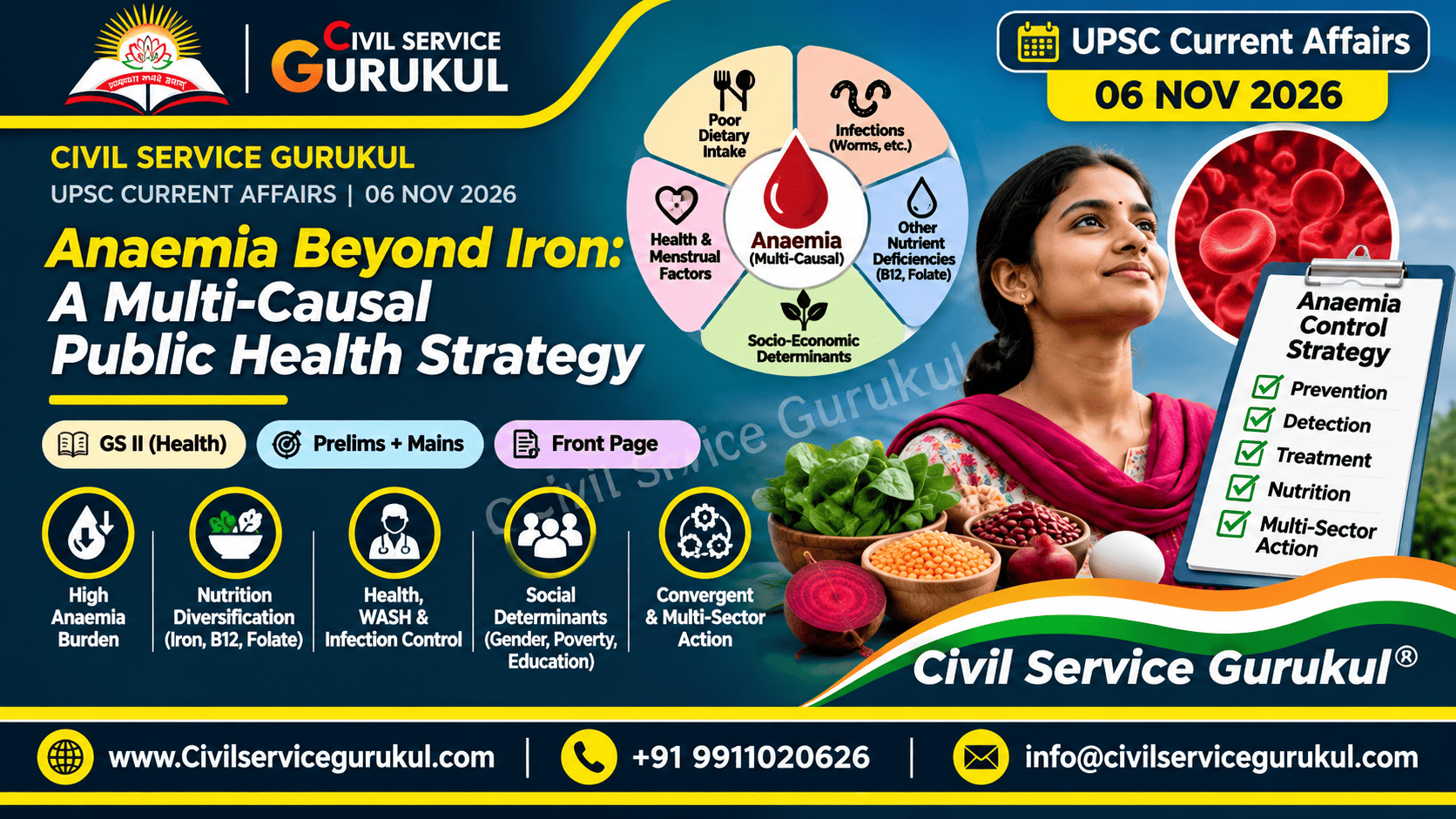
UPSC CURRENT AFFAIRS | PUBLIC HEALTH | NUTRITION | SOCIAL DEVELOPMENT
Anaemia in India: Why Iron Supplements Alone Cannot Solve the Public Health Crisis
A comprehensive UPSC analysis of nutritional deficiencies, infections, maternal health, inherited disorders, diagnostic challenges and integrated public health solutions.
UPSC Current Affairs | November 2026 | Civil Service Gurukul
UPSC Syllabus Relevance
| Paper | Relevant Topics |
|---|---|
| GS I | Women, children, social development and vulnerable populations. |
| GS II | Health services, social-sector governance, nutrition and public policy. |
| GS III | Human development, nutrition security and science-based interventions. |
| Prelims | Haemoglobin, micronutrients, infections, anaemia causes and public health programmes. |
Quick Revision: Important Concepts
1. Why Is Anaemia Beyond Iron in the News?
A current-affairs editorial dated 5 November 2026 emphasizes that iron supplementation alone cannot solve the wider problem of anaemia.
The issue is important because anaemia has multiple nutritional and non-nutritional causes.
According to the World Health Organization's 2025 overview discussed in the source, anaemia can be associated with dietary deficiencies, infections, inflammation, chronic disease, blood loss and inherited disorders.
Why It Matters for UPSC
- It connects nutrition with public health governance.
- It highlights vulnerabilities of women, children and adolescents.
- It raises questions about screening and diagnostic capacity.
- It shows why a single intervention cannot address every cause.
- It is relevant to social justice and human development.
2. What Is Anaemia?
Anaemia is a condition in which haemoglobin concentration or red blood cell capacity is insufficient to meet the body's physiological oxygen requirements.
Haemoglobin is the oxygen-carrying protein present in red blood cells.
Possible Effects
- Fatigue and weakness.
- Reduced physical capacity.
- Difficulty concentrating.
- Breathlessness in some cases.
- Greater health risks in vulnerable populations.
The severity and clinical consequences depend on the cause, degree of anaemia and individual health circumstances.
3. Why Iron Deficiency Is Not the Only Cause
Iron deficiency is an important cause of anaemia, but it is not the only one.
Some individuals may have anaemia due to nutritional deficiencies other than iron, infections, inflammation, blood loss or inherited conditions.
Major Categories
- Iron deficiency.
- Vitamin B12 deficiency.
- Folate deficiency.
- Infections and parasitic diseases.
- Inflammation and chronic illnesses.
- Menstrual or pregnancy-related blood loss.
- Inherited haemoglobin disorders.
4. Nutritional Causes of Anaemia
Iron Deficiency
Iron is required for haemoglobin production. Inadequate intake, poor absorption or increased requirements may contribute to iron deficiency.
Vitamin B12 Deficiency
Vitamin B12 plays an important role in normal red blood cell formation.
Folate Deficiency
Folate is necessary for cell division and red blood cell production.
Dietary Diversity
A diverse diet can help provide essential micronutrients and support long-term nutritional health.
5. Non-Nutritional Causes of Anaemia
Malaria
Malaria can contribute to anaemia through effects on red blood cells and related disease mechanisms.
Hookworm Infection
Hookworm infection may cause chronic intestinal blood loss and contribute to iron deficiency.
Chronic Inflammation
Inflammation can alter iron regulation and red blood cell production.
Inherited Disorders
Inherited haemoglobin disorders may contribute to anaemia and require appropriate diagnosis.
Blood Loss
Heavy menstrual bleeding and other forms of blood loss can contribute to anaemia.
6. Why a One-Size-Fits-All Strategy Is Inadequate
Treating every person with anaemia as though they have iron deficiency may fail to address the underlying condition.
A population-level supplementation programme can be valuable when appropriately designed, but individual diagnosis remains important where anaemia persists or other causes are suspected.
Limitations of a Single-Intervention Approach
- It may overlook other nutritional deficiencies.
- It may delay recognition of infections.
- It may miss chronic inflammatory conditions.
- It may fail to identify inherited disorders.
- It may not address menstrual or other blood loss.
Public health policy should combine appropriate prevention with diagnosis and cause-specific treatment.
7. Why Diagnosis Matters
Haemoglobin measurement helps identify anaemia, but determining its cause may require further clinical assessment.
Depending on the individual and available services, clinicians may consider dietary history, blood loss, infection risks and relevant laboratory investigations.
Important Diagnostic Principles
- Assess haemoglobin appropriately.
- Consider clinical symptoms and medical history.
- Evaluate possible nutritional deficiencies.
- Consider infection and inflammation.
- Investigate persistent or unexplained anaemia.
- Interpret biomarkers within the clinical context.
8. Women and Maternal Health
Women may face increased anaemia risks because of menstrual blood loss, pregnancy-related nutritional requirements and other health conditions.
Maternal healthcare services provide opportunities for screening, dietary counselling, appropriate supplementation and clinical follow-up.
Priority Measures
- Accessible antenatal care.
- Appropriate anaemia screening.
- Nutritional counselling.
- Management of identified causes.
- Timely referral for complicated cases.
- Continuity of maternal healthcare.
9. Children and Adolescents
Childhood and adolescence are important periods for growth, learning and development.
School and adolescent health platforms can provide opportunities for nutrition education, preventive services and referral where needed.
Important Interventions
- Nutrition education.
- Dietary diversity.
- Age-appropriate preventive services.
- Screening according to applicable guidance.
- Infection prevention.
- Referral and follow-up.
10. Role of Infection Control and Sanitation
Some infections and parasitic diseases can contribute to anaemia.
Therefore, effective anaemia prevention may require measures beyond nutritional supplementation.
Relevant Public Health Measures
- Safe drinking water.
- Improved sanitation.
- Hygiene education.
- Vector-borne disease control.
- Deworming where indicated.
- Accessible diagnosis and treatment of infections.
The appropriate combination of measures depends on local disease patterns and population needs.
11. Nutrition Diversity and Dietary Counselling
Dietary diversity can help improve the intake of essential nutrients.
Nutrition counselling should account for local food availability, affordability, dietary patterns and the needs of different age groups.
Important Considerations
- Availability of nutrient-rich foods.
- Access to balanced meals.
- Appropriate dietary guidance.
- Maternal and adolescent nutrition.
- Local food habits.
- Affordability and food security.
Dietary measures should complement, not replace, medically indicated treatment.
12. Public Health Delivery Challenges
Diagnostic Gaps
Limited access to appropriate testing may make cause-specific management difficult.
Supply-Chain Reliability
Health programmes require reliable availability of essential supplies and services.
Community Follow-Up
Continuity of care can be difficult where individuals face financial, geographic or social barriers.
Local Disease Variation
The relative importance of different anaemia causes may vary across regions and populations.
Data Interpretation
Programme evaluation requires careful interpretation of haemoglobin measurements and other relevant indicators.
13. Why Local Disease Patterns Matter
Different communities may face different combinations of nutritional, infectious and inherited causes of anaemia.
Public health programmes should therefore use local evidence rather than assume that all populations face identical risks.
Benefits of Localized Planning
- Better targeting of services.
- Appropriate diagnostic pathways.
- More efficient resource allocation.
- Improved community participation.
- Stronger monitoring of outcomes.
14. Monitoring and Evaluation
Effective public health programmes require measurable indicators and reliable follow-up.
Potential Monitoring Indicators
- Screening coverage.
- Appropriate diagnostic follow-up.
- Availability of essential supplies.
- Continuity of care.
- Haemoglobin outcomes.
- Referral completion.
- Community participation.
Evaluation should distinguish programme coverage from actual improvements in health outcomes.
15. Integrated Strategy for Anaemia Control
↓
↓
↓
↓
The integrated approach combines prevention, diagnosis, treatment and public health system strengthening.
16. Way Forward for India
- Improve dietary diversity: Promote access to essential nutrients.
- Strengthen screening: Identify anaemia in vulnerable populations.
- Expand diagnostic capacity: Support cause-specific assessment.
- Improve maternal healthcare: Integrate screening and follow-up into routine services.
- Control infections: Address malaria, parasitic infections and relevant local risks.
- Strengthen sanitation: Reduce preventable infection-related risks.
- Ensure reliable supplies: Improve programme implementation.
- Monitor outcomes: Track health improvements rather than only distribution figures.
- Improve community engagement: Encourage follow-up and health awareness.
17. UPSC Prelims Practice MCQs
Question 1
Anaemia can be caused by:
- Multiple nutritional and non-nutritional factors
- Iron deficiency alone
- Only inherited conditions
- Only malaria
Correct Answer: A
Explanation: Anaemia may result from nutritional deficiencies, infections, blood loss, chronic disease and inherited disorders.
Question 2
Which nutrient is important for normal red blood cell formation?
- Vitamin B12
- Vitamin K alone
- Sodium alone
- Fluoride alone
Correct Answer: A
Explanation: Vitamin B12 is important for normal red blood cell formation.
Question 3
Consider the following statements:
- Iron deficiency is the only cause of anaemia.
- Hookworm infection can contribute to anaemia.
- Inflammation may affect interpretation of iron-status biomarkers.
Which statements are correct?
- 1 only
- 2 and 3 only
- 1 and 2 only
- 1, 2 and 3
Correct Answer: B
Explanation: Statements 2 and 3 are correct. Anaemia has multiple possible causes.
Question 4
Which of the following is part of an integrated anaemia-control strategy?
- Dietary diversity
- Appropriate screening
- Infection control
- All of the above
Correct Answer: D
Explanation: Anaemia prevention and control require multiple complementary interventions.
Question 5
Why is cause-specific diagnosis important in anaemia management?
- All cases require identical treatment.
- Different causes may require different interventions.
- Haemoglobin testing has no relevance.
- Infections cannot cause anaemia.
Correct Answer: B
Explanation: Identifying the underlying cause helps guide appropriate management.
18. UPSC Mains Practice Questions
Question 1 — GS Paper II | 150 Words | 10 Marks
Why does India require an integrated approach to anaemia control beyond iron supplementation?
Question 2 — GS Paper II | 250 Words | 15 Marks
Examine the role of nutrition, infection control and diagnostic capacity in strengthening anaemia prevention and management in India.
Question 3 — GS Paper I | 150 Words | 10 Marks
Discuss the significance of maternal and adolescent health interventions in reducing anaemia-related vulnerabilities.
19. UPSC Mains Model Answer
Question: Why does India require an integrated approach to anaemia control beyond iron supplementation? (150 words)
Introduction
Anaemia is a public health condition characterized by insufficient haemoglobin or red blood cell capacity. Although iron deficiency is an important cause, anaemia has multiple nutritional and non-nutritional determinants.
Need for an Integrated Approach
- Nutritional diversity: Vitamin B12 and folate deficiencies may contribute to anaemia.
- Infection control: Malaria and hookworm can increase anaemia risk.
- Maternal health: Pregnancy-related requirements and blood loss need appropriate care.
- Diagnosis: Persistent anaemia may require cause-specific investigation.
- Public health delivery: Reliable supplies, sanitation and follow-up improve programme effectiveness.
Conclusion
India needs a life-course, evidence-based strategy integrating nutrition, appropriate screening, diagnosis, infection prevention and accessible healthcare. Iron supplementation remains valuable where indicated, but sustainable progress requires addressing the full range of underlying causes.
20. UPSC Answer-Writing Strategy
- Introduction: Define anaemia.
- Classification: Distinguish nutritional and non-nutritional causes.
- Vulnerable Groups: Discuss women, children and adolescents.
- Public Health Challenges: Explain diagnostic gaps and service delivery issues.
- Integrated Response: Include nutrition, screening, infection control and sanitation.
- Governance: Discuss monitoring and community follow-up.
- Conclusion: Emphasize evidence-based and cause-specific strategies.
21. Key Takeaways for UPSC Revision
- Anaemia has multiple nutritional and non-nutritional causes.
- Iron deficiency is important but not universal.
- Vitamin B12 and folate deficiencies can contribute to anaemia.
- Malaria and hookworm are relevant infectious causes.
- Inflammation can affect iron-status biomarkers.
- Women and adolescents require focused preventive attention.
- Appropriate diagnosis supports cause-specific management.
- Nutrition diversity is an important long-term strategy.
- Infection control and sanitation complement nutritional interventions.
- Monitoring should assess health outcomes, not merely programme coverage.
22. Frequently Asked Questions
What is anaemia?
Anaemia is a condition in which haemoglobin concentration or red blood cell capacity is insufficient for normal physiological needs.
Is anaemia always caused by iron deficiency?
No. Anaemia may result from nutritional deficiencies, infections, inflammation, chronic disease, blood loss and inherited disorders.
Can vitamin B12 deficiency cause anaemia?
Yes. Vitamin B12 deficiency can interfere with normal red blood cell formation.
Can malaria contribute to anaemia?
Yes. Malaria can contribute to anaemia through effects on red blood cells and related disease mechanisms.
Why is hookworm relevant to anaemia?
Hookworm infection can cause intestinal blood loss and contribute to iron deficiency.
Why is diagnosis important?
Different causes of anaemia may require different clinical interventions.
What is an integrated anaemia-control strategy?
It combines nutritional measures, appropriate screening, cause-specific diagnosis and treatment, infection control, maternal care, sanitation and follow-up.
Why is anaemia important for UPSC?
It connects public health, nutrition security, women and child development, social justice and health governance.
23. Important Keywords for UPSC Revision
Anaemia in India, Anaemia Beyond Iron, Haemoglobin, Iron Deficiency, Vitamin B12, Folate, Maternal Health, Adolescent Nutrition, Malaria, Hookworm, Inflammation, Inherited Haemoglobin Disorders, Nutrition Security, Public Health Governance, Integrated Anaemia Control, UPSC Current Affairs 2026.
Prepare UPSC Current Affairs with Civil Service Gurukul
Civil Service Gurukul provides UPSC current affairs, public health analysis, Indian polity and economy notes, Prelims MCQs, Mains answer-writing guidance and comprehensive civil services preparation resources.
Visit Civil Service GurukulWebsite: www.civilservicegurukul.com
Mobile: +91 9911020626
Email: info@civilservicegurukul.com
Prepare with Mentors Who Cleared the Exam
Get personalized study plans, evaluated answer models, and test series access.